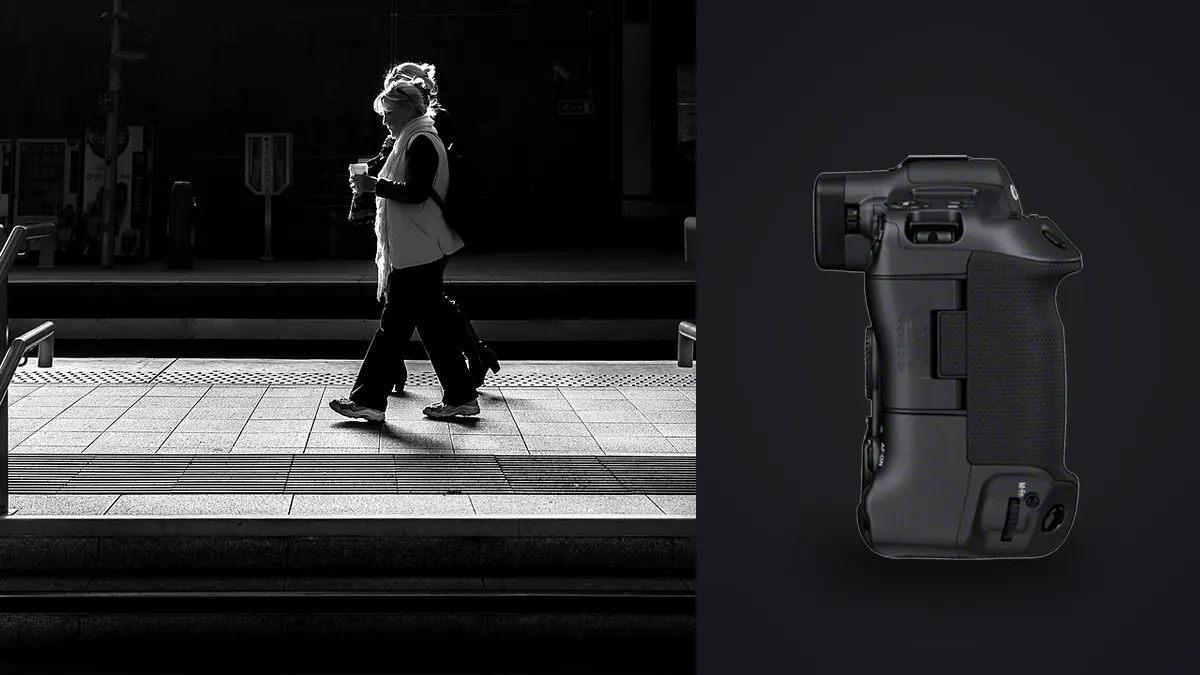
Ask five street photographers what camera belongs around their neck and none of them will say a 1,015 gram mirrorless body with a built in vertical grip. The Canon EOS R3 was designed for sidelines, ice rinks, and the pit lane at a Grand Prix, not sidewalks. And yet over the past year I've watched more documentary shooters pick one up anyway, not for the classic grab-shot style of street photography but for the slower, more sustained kind of work: a full day following a subject through a market town, building trust before the camera comes up, coming home with four thousand frames and a deadline the next morning.
That's a different job than most street photography gear advice is written for, and the R3 is built for a different job too. This is about whether it earns its keep on that kind of assignment, where it genuinely helps, and where it gets in your way.
Size and handling when you're trying not to be noticed
The integrated grip that makes the R3 so comfortable for a wildlife photographer tracking birds for six hours is the same grip that makes it impossible to slip into a jacket pocket or hide against your hip the way a Fujifilm X100V or a Ricoh GR does. On a crowded street, people notice a black bodied camera with a lens hood the size of a coffee mug well before you notice them. That changes the kind of pictures you can take. Grab shots of strangers get harder. But documentary work usually isn't about grab shots. If you've already spent an hour with a vendor at their stall, or you're working alongside a fixer who's introduced you to a family, the camera being visible stops mattering much, because the subject already knows exactly why you're there.
Where the size actually pays for itself is across the shoot day itself. Ten or twelve hours of handheld shooting punishes a small body more than people expect, wrists and necks give out long before batteries do. The R3's grip, deep and rubberized, distributes that weight into your palm rather than your fingers, and I could get through a full market day without the hand cramp that a smaller mirrorless body gives me by hour six. The silent electronic shutter mode is also genuinely silent, not the muted clack that passed for "silent" on earlier Canon bodies, so shooting inside a mosque, a quiet courtroom hallway, or a home during an interview doesn't announce every frame you take.
Eye Control AF, love it or fight it
Eye Control AF is the feature everyone asks about first, and the honest answer is that it's polarizing for a reason. Canon resurrected the tech from the EOS-1V film camera, and it works by tracking where your eye is looking inside the viewfinder and nudging the autofocus point there. On paper it sounds ideal for documentary street work: you look at the kid weaving through the crowd instead of fumbling a joystick, and the camera follows your attention.
In practice it needs calibrating per shooter, and it drifts. Switch from open sun to a covered stall and the tracking accuracy noticeably degrades until you recalibrate, which on an active market street can mean four or five recalibration stops in a single afternoon. It also doesn't play well with prescription glasses or sunglasses, both common on a bright shooting day, and dimming of the EVF in low light throws it off further. When it's dialed in, on an overcast day with consistent light, it's the fastest way I've found to move focus onto a specific face in a group without touching a dial. When it's not dialed in, it's slower than just using the joystick, because now you're fighting the system instead of ignoring it. My habit now: calibrate once at the start of a shoot in the dominant light I expect, and if the light shifts hard, switch it off rather than chase a fresh recalibration mid scene.
The stacked sensor's real advantage: no rubber-band motion
Where the R3 stops feeling like a compromise is the stacked sensor. Full electronic shutter at 30fps with essentially no rolling shutter skew means panning a motorbike weaving through a market alley, or a cyclist cutting across a crosswalk, doesn't come out looking warped the way it can on cameras with slower sensor readout. That's a real, specific advantage for street and documentary work involving any kind of vehicle traffic, which is most street work once you leave the pedestrian-only core of a city.
The catch is buffer and card choice. The R3 has two card slots, CFexpress Type B and SD UHS-II, and if you leave the SD card as your primary or only card, you won't sustain 30fps for more than a couple of seconds before the buffer chokes and the frame rate drops off a cliff. Shoot CFexpress as primary and you get several seconds of sustained 30fps, which for documentary purposes usually means one entire gesture, someone turning to laugh, a hand reaching out, captured in full rather than guessed at with three frames a second.
The flicker detection is also worth taking seriously rather than ignoring in the menu. Indoor markets and night markets are usually lit by a mix of sodium vapor and fluorescent tube lighting that bands under fast shutter speeds, and the R3's flicker detection actually times the shutter to the light's frequency instead of just warning you about it. On a three day indoor market shoot, it was the difference between half my frames having visible banding and almost none.
The burst problem nobody warns you about
Here's the part left out of most R3 reviews: 30fps for even a few seconds is 100 to 150 frames of essentially one moment, and a full documentary day of shooting like that can leave you with fifteen or twenty thousand images by dinner. Culling that by eye, at eleven at night, with a deadline in the morning, becomes its own project. This is where I stopped trying to do the first pass manually and started running the day's card through imagic before opening Lightroom at all. It scores sharpness and focus locally on the frame itself rather than relying on the camera's own AF confidence metadata, which matters with a body like the R3 because eye AF confidence and actual pixel level sharpness don't always agree, especially with a subject moving fast through mixed light. It also clusters burst runs and near duplicates into groups automatically, so instead of scrolling through 140 nearly identical frames of someone turning their head, you're looking at the four or five that are actually different and picking the sharpest.
The other detail that matters more for documentary work than for, say, a wedding or a product shoot: none of this touches a cloud service. A lot of material from projects like this hasn't been published yet, sometimes involves people who asked not to be identified until a story runs, and uploading a card's worth of unpublished, occasionally sensitive images to someone else's server isn't a risk worth taking for a faster edit. imagic runs entirely on the machine, so the cull happens on a hotel laptop with no signal and nothing leaves the drive until you decide it does. If you want the mechanics of how that kind of local scoring actually works, this breakdown of AI photo culling covers it in more depth than I have room for here.
ISO and shooting after the light drops
Native ISO tops out at 102400 with an extended range beyond that, but the number that actually matters for street and documentary work is where files still hold enough detail to print or run in a story, which in my experience is somewhere around ISO 12800 to 20000 depending on how much you lean on noise reduction afterward. Above that the files stay usable but go soft, fine for a web gallery, thin for anything printed larger. The in-body stabilization, rated around 8 stops with certain RF lenses, extends your working range more than the ISO ceiling does, because it lets you hold a slower shutter speed and keep ISO down in dim interiors, doorways, covered stalls, the inside of a bus, without a tripod you obviously can't carry on this kind of assignment anyway.
Building a lens kit around it
For a documentary kit built around the R3, I'd lean toward fewer, faster lenses rather than a wide range. The RF 28-70mm f/2 is extraordinary optically, but it's heavy enough that pairing it with an already large body starts to feel like carrying a medium format kit by hour four. The RF 35mm f/1.8 IS Macro STM is the one I reach for most: small relative to the body, sharp, and close-focusing enough to grab a detail shot, a hand, a tool, a receipt, without swapping glass. The RF 50mm f/1.2 earns its place during the quieter parts of a shoot, interviews and sit-down moments, where shallow depth of field actually serves the story instead of just looking nice. I'd leave the long glass at home unless the scene specifically needs reach, because on a body this size, adding a 70-200mm turns "conspicuous" into "obviously a professional shoot," which changes how people behave in front of you.
How it stacks up against other cameras documentary photographers actually carry
None of these numbers are marketing spec-sheet figures, they're the practical ceilings I've hit shooting each body in the field.
| Camera | Body weight (w/ battery) | Max burst, electronic shutter | Practical high-ISO ceiling | Typical price, late 2026 | How noticeable on the street |
|---|---|---|---|---|---|
| Canon EOS R3 | 1,015g | 30 fps | ~ISO 16,000 | $3,200-3,800 (used) | High, hard to miss |
| Sony A9 II | 678g | 20 fps | ~ISO 12,800 | $2,000-2,400 (used) | Medium |
| Fujifilm X-T5 | 557g | 20 fps (1.29x crop) | ~ISO 6,400 | ~$1,600 (new) | Medium-low |
| Leica Q2 | 718g | 10 fps | ~ISO 6,400 | ~$4,200 (new) | Low, reads as a tourist camera |
The R3 loses on discretion and, honestly, on value compared to the Fuji if all you need is 20fps and a smaller footprint. It wins when the assignment needs buffer depth and AF reliability more than it needs to disappear in your hands.
Battery, cards, and holding up across a multi-day shoot
Battery life on paper is modest, CIPA rates the LP-E19 around 860 shots per charge, but that figure assumes a lot of chimping and menu browsing that documentary shooting doesn't really involve. On actual multi-day shoots I've gotten well past a thousand frames per charge, and the body takes a USB-C top-up during a lunch break without needing to pull the battery out. Dual card slots matter more here than in most genres: set the camera to write raw to both cards simultaneously, and a corrupted card, a dropped bag, or a card that fails on day two of a five day shoot doesn't cost you the work already done. For documentary projects, where you often can't go back and reshoot a moment that's already passed, that redundancy is worth more than almost any other spec on this list. The weather sealing held up through a dust storm on a rural market circuit and a genuinely unpleasant downpour at a religious festival, with only a lens cloth and some common sense keeping water out of the mount.
Editing on the road without losing the day's work
The other place the R3's volume changes your workflow is in keeping a multi-day project looking like one project. Shooting across five days in wildly different light, harsh midday sun on day one, an overcast morning on day three, a lantern-lit evening market on day five, produces raw files that don't match at all straight out of camera, and manually grading two thousand keepers into a consistent look before a deadline isn't realistic. I built a preset inside imagic from a handful of edits I was already happy with early in the project, using apply_my_style to learn my own tonal choices rather than lean on someone else's preset pack, then ran the rest of the week's selects through it. It's not a substitute for actually looking at each frame, but it gets you most of the way to consistent color and contrast before you touch anything by hand, which on a tight turnaround is the difference between sleeping and not. If the review-to-delivery process is your actual bottleneck rather than the camera, these workflow tips are a reasonable place to tighten the rest of it.
None of this makes the R3 a street camera in the traditional sense. It's hard to miss even when the shutter is silent, it's heavy enough to change how long you can hold it up through a shift, and Eye Control AF is a feature you have to manage rather than one that simply works out of the box. But for documentary projects where speed, weather sealing, and a buffer deep enough to catch a full gesture rather than guess at one all matter more than staying invisible, it earns the weight. I wouldn't take it to shoot a quiet afternoon of candid strangers on a corner. I would take it on a five day assignment where reliability matters more than blending in.
Frequently Asked Questions
Is the Canon EOS R3 too big and conspicuous for street photography?
For classic candid street photography where staying unnoticed matters, yes, it's larger and more visible than a Fujifilm X100V, Ricoh GR, or Leica Q2. For documentary work where subjects already know you're photographing them, the size matters much less, and the tradeoff buys you a deeper buffer, better weather sealing, and a grip that holds up over a long shoot day.
Does Eye Control AF actually work for tracking people in a crowd?
It works well once it's calibrated to the current light and whatever you're wearing on your face, and it's genuinely fast at snapping focus onto a specific person without touching a joystick. It degrades noticeably when light changes, moving from sun into shade for example, or with sunglasses on, and needs recalibrating more often on an active street shoot than Canon's marketing suggests.
What card setup do I need to actually hit 30fps bursts?
CFexpress Type B needs to be your primary slot. Relying on the SD UHS-II slot for high speed bursts throttles the buffer within a couple of seconds, which defeats the point of the stacked sensor on fast moving street or documentary scenes.
Is the R3 still worth buying now that the EOS R1 is Canon's flagship?
For documentary and street work specifically, yes. The R1 pushes speed and AF further but at a price premium the R3 no longer has to justify, now that used and refurbished R3 pricing has come down. For a photographer whose priority is buffer depth, weather sealing, and eye tracking AF rather than the absolute top end of sports performance, the R3 remains a sensible, less expensive way into the same core toolkit.