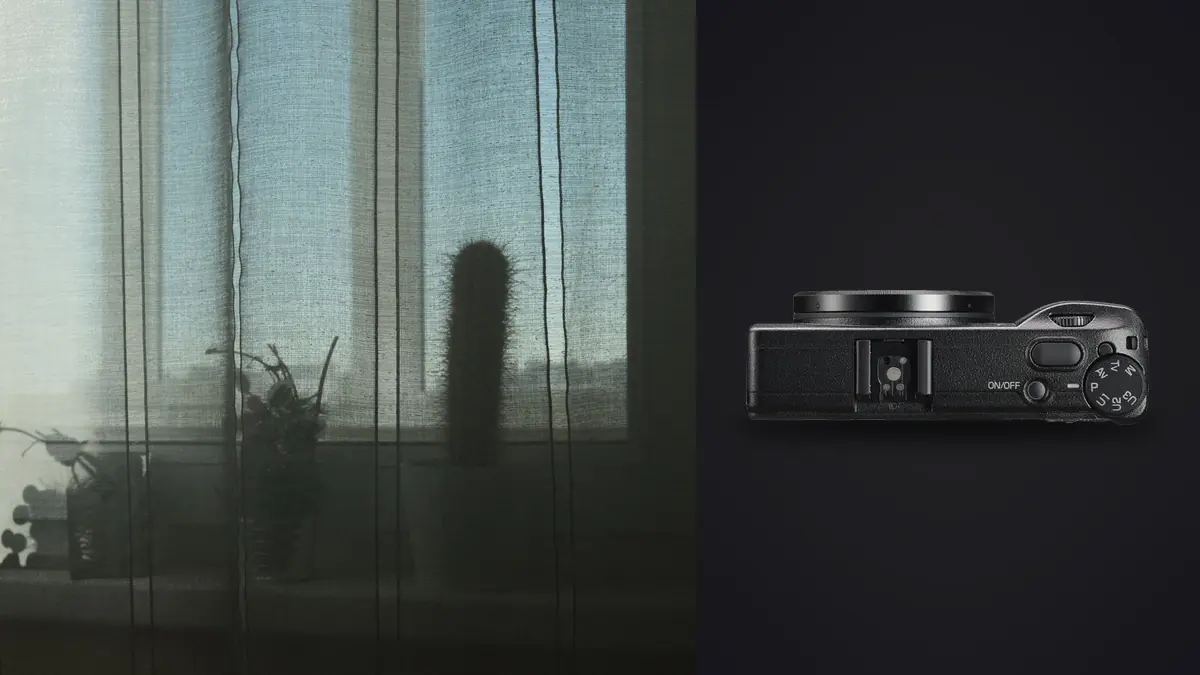
A Ricoh GR IIIx bought for street work can end up a better fit for boudoir sessions than a main mirrorless body. That's rarely the plan. It happens because a subject who sees it sitting on the dresser next to a bigger camera visibly relaxes, which is worth paying attention to. This piece is about what that little 26.1mm APS-C compact actually does well in an intimate portrait setting, where it gets in its own way, and how to build a workflow around it that doesn't fall apart under a folder of five hundred nearly identical frames.
The size does psychological work before the lens does anything
Boudoir is the one genre where the camera itself is part of the client experience, not just a tool pointed at them. A DSLR with a battery grip and a 70-200mm hanging off it reads as equipment. It puts a barrier in the room. The GR IIIx is smaller than most people's phones with a case on, and when I hold it up it doesn't look like "professional photography happening," it looks like someone taking a picture. That distinction matters enormously with clients who are already nervous about being photographed in lingerie or less, often for the first time.
Subjects often forget you are shooting for stretches of the session, something that rarely happens with a camera that has a mirror slap and a grip the size of a fist. Part of that is the leaf shutter, which is genuinely quiet, almost inaudible under a bit of music. Part of it is that the camera disappears into my hand between shots instead of hanging off a strap at chest height, staring at them.
Living with a fixed 40mm equivalent in real bedrooms
The GR IIIx's 26.1mm lens gives a 40mm full-frame equivalent, and that number matters more here than it does in most genres because boudoir happens in small rooms. Bedrooms, hotel rooms, walk-in closets used as changing areas. A 24mm-class wide angle (the original GR III's territory) will bend a body at close range in ways that flatter almost nobody, and a lot of boudoir photographers know this the hard way from early portfolio work. The 40mm equivalent sits close enough to a natural perspective that you can work at arm's length without the subject's nearest limb ballooning toward the lens.
The tradeoff is that you're doing all your framing changes with your feet, and in a 3.5-meter hotel room with a queen bed against one wall, feet run out of room fast. I've shot sessions where my back was against the closet door for a three-quarter shot and I still couldn't back up further. This is the single biggest adjustment coming from a zoom or even a small prime kit: you plan the room before the session, not during it, because there's no reaching for a wider lens mid-shoot.
The crop modes buy you a little flexibility
The GR IIIx has in-camera crop modes that step the field of view in toward roughly 50mm and 71mm equivalents by cropping the 24-megapixel sensor. I use the 50mm crop constantly for closer, more compressed portrait framing, face and shoulders, hands resting on a collarbone, that kind of thing, without physically closing the distance in a room where closing the distance isn't possible. It costs resolution, obviously, since you're cropping a 24MP sensor down, but the files still hold up fine for web delivery and reasonably sized prints. I wouldn't lean on the 71mm crop for anything I intend to print large.
No hot shoe changes how you have to light this genre
Something that trips people up who've only read the spec sheet: the GR series has never had a hot shoe. There's no way to trigger an off-camera flash from the camera body itself, optically or otherwise, through the camera's own hardware. For most photography that's a dealbreaker. For boudoir, it's less of one than it sounds, because a huge amount of intimate portrait work is already lit with continuous light, window light, or a single warm LED panel rather than strobes, precisely because continuous light lets both photographer and client see the mood building in real time instead of guessing at a flash pop.
So I lean into what the camera is actually built for: available light and continuous sources, ISO pushed up rather than flash brought in. The sensor handles ISO 3200 to 6400 acceptably for this kind of moody, warm-toned work where a bit of grain reads as filmic rather than as a flaw. If your boudoir style depends on gridded strobes and off-camera flash triggers, the GR IIIx simply isn't going to be your primary body, and I wouldn't try to force it.
How it actually stacks up against what else people carry into these sessions
I get asked a lot whether it's "better" than shooting boudoir on a full-frame mirrorless with a fast prime, or on a phone, or on something like an X100-series fixed lens compact. There's no single winner here, it depends what you're optimizing for in the room. This is roughly how I'd lay it out based on sessions I've actually run with each setup.
| Setup | Effective focal length | How it reads in the room | Low-light AF confidence | Realistic shots per battery in a session |
|---|---|---|---|---|
| Ricoh GR IIIx | 40mm | Barely reads as a camera, almost pocketable | Reliable in good window light, hunts under dim warm LEDs | 350-450 with single-shot pacing (CIPA rates it far lower) |
| Full-frame mirrorless + 50mm f/1.2 | 50mm | Reads as "a professional shoot is happening" | Excellent even in near-dark, eye AF locks fast | 500-700 depending on body |
| Fixed-lens APS-C compact (X100-style, 23mm f/2) | ~35mm | Small but still visibly "a camera," optical finder draws attention | Good, occasional hunt in very low light | 400-500 |
| Flagship phone, main lens | ~24-26mm | Invisible as "work," but clients read it as casual/snapshot | Very good via computational boost, but flattens skin oddly | Full day, but battery shared with everything else |
The honest read: the GR IIIx wins on discretion and loses on autofocus certainty and battery life against a proper mirrorless. I still reach for it constantly because discretion is the scarcer resource in this genre. A locked-on eye AF system doesn't help you if the client tensed up the moment they saw a big camera come out.
Snap focus becomes a real technique, not a gimmick
The GR IIIx's autofocus is a hybrid contrast and phase-detection system that's fine in daylight and gets noticeably slower to commit once you're working in the kind of warm, dim, deliberately underlit setup a lot of boudoir sessions favor. Rather than fight it shot to shot, I use the snap focus function, which lets you preset a focus distance (I usually run it around 1.5 to 2 meters for closer work, further out for full-length) and have the shutter fire instantly at that distance with a half-press, bypassing the hunt entirely.
This turns into a real shooting rhythm once you've done it a few times: you set your distance for the pose, you and the client both move within that plane rather than the camera chasing focus while she shifts, and you fire continuously through a sequence of small movements, a hand moving through hair, weight shifting from one hip to the other, fabric falling. It's closer to how a rangefinder shooter thinks than how most portrait photographers using autofocus zoom lenses think, and it took me a solid two sessions to stop reflexively half-pressing and waiting for a focus box to confirm.
The real cost: hundreds of near-identical frames per pose
Shooting that way, continuous small bursts through a flowing sequence rather than composed single frames, produces a lot of very similar images. A single ninety-minute session run this way can leave me with 900 to 1,200 frames, and a meaningful chunk of any given ten-shot burst differs from its neighbors by nothing more than a blink, a slightly softer hand position, or half a stop of focus drift since the plane I preset with snap focus isn't infinitely precise.
This is where I stopped trying to cull by eye at 100% zoom in Lightroom and moved that first pass into imagic. I run the take through its sharpness scoring before I look at anything, and it flags which frame in each burst actually landed critical focus rather than looking sharp at thumbnail size and falling apart at 100%, which happens constantly with snap-focus sequences shot at f/2.8. The duplicate and burst clustering groups those runs of ten near-identical frames together automatically instead of me scrolling past the same pose eleven times, so the first real editing decision I make is between three or four genuinely distinct options per burst instead of picking through the whole set cold.
If you haven't sat down and actually worked out where AI-assisted culling saves time versus where it's just marketing noise, this breakdown of how AI photo culling actually works is a fair place to start before you take my word for it.
Macro mode earns its keep on the details
Every boudoir gallery needs texture shots to break up the run of full poses: lace against skin, a ring, hands, the curve of a strap. The GR IIIx's macro mode focuses down close enough that these become genuinely easy grabs rather than a separate lens change, which matters when you're trying to keep a session's momentum without stopping to swap gear. You can often shoot two or three macro details in the gap while a subject repositions or adjusts wardrobe between setups, which is dead time otherwise.
Editing for consistency when the light keeps drifting
A single boudoir session usually moves through several lighting setups: window light in one room, a warm lamp in another, maybe a string of fairy lights for a final low-key sequence. Each of those needs a slightly different white balance and exposure starting point, but the final gallery still has to feel like one coherent set, not four different photographers' work stitched together.
What's worked for me is training imagic's apply_my_style feature on a batch of my own previously finished boudoir edits, warm shadows, slightly lifted blacks, skin tones pulled a touch toward gold rather than the cooler cast a lot of cameras default to. Running new sessions through that preset gets every lighting setup from a shoot to a matched starting point before I touch anything manually, which cuts what used to be ninety minutes of grading down to something closer to twenty for a full gallery, with the manual pass reserved for the handful of hero images that need real attention.
The local-processing part actually matters here more than most genres
I'll say this plainly because it's specific to this kind of work: boudoir files are about as sensitive as photography gets. Clients are trusting you with images of their bodies that they would not want surfacing anywhere they didn't explicitly approve. A cloud-based culling or editing tool that uploads a working set to someone else's server is a real point of exposure I'm not willing to accept for this category of work, regardless of how good the tool's marketing copy sounds about security.
That's the actual reason I moved this workflow onto imagic rather than a browser-based competitor: everything runs locally on the machine, nothing in the working set leaves the laptop during culling or the style pass. For street photography I might not think twice about a cloud tool. For a shoot where the subject's explicit condition was "these never touch the internet before I approve them," it's not a negotiable feature, it's the baseline requirement.
Where the camera actually falls short for this work
I don't want to oversell it. Battery life is genuinely rough; the official rating is around 200 frames, and even shooting the way I do, single presses rather than machine-gunning, I carry three spare batteries to a session and have run all three down on a long one. There's no hot shoe, which I've already covered, but it's worth repeating as a real limitation if your style leans on flash. Weather sealing is minimal on the standard body without the optional protection kit, though that matters less indoors. And the fixed 40mm equivalent means there is no wide environmental shot of the room, the getting-ready sequence, or a group setup without physically backing into a wall or stepping out into a hallway. I keep a second body with a wider lens in the bag specifically for those handful of frames per session that the GR IIIx just can't reach.
Would I book a full session on it alone?
Not entirely, no. Bring a second camera to any shoot you can't repeat, as insurance against the battery and autofocus limits described above. But the GR IIIx has become the camera I actually have in my hand for most of the session, because the trust it buys in the room translates directly into more relaxed, more genuine poses than a bigger rig gets me. For this specific genre, that trade is worth the workarounds.
Frequently Asked Questions
Is the Ricoh GR IIIx too limited for a paid boudoir business, given it only has one focal length?
On its own, yes, for most working photographers. I treat it as the primary "in the moment" camera for close, intimate framing and pair it with a second body carrying a wider lens for room-establishing shots, group setups, or anything that needs more working distance than a small bedroom allows. Running it as your only camera works better for photographers whose style is already tightly cropped and close.
Does the lack of image stabilization on a fixed f/2.8 lens cause problems in dim rooms?
The GR IIIx does have three-axis in-body shake reduction, so handheld shots down to slower shutter speeds than you'd expect are usable more often than not. The bigger limiting factor in dim boudoir lighting isn't camera shake, it's subject movement during the kind of slow, flowing poses this genre favors, which is where bumping ISO rather than dropping shutter speed further tends to save more frames.
How do you handle client privacy concerns around where the photos are processed and stored?
Tell clients upfront that culling and initial editing happen entirely on your own machine with no cloud upload involved, using imagic for that local pass, and that nothing leaves the laptop until you've selected and approved a gallery for their private review link. For a genre built on trust, being able to say that honestly and specifically, not just as a vague privacy promise, can win more trust than any piece of gear talk.
Is the 40mm equivalent focal length actually better than the 28mm on the standard GR III for this kind of portrait work?
For close portrait and intimate work specifically, yes, in my experience. The 28mm on the standard GR III is built for street and environmental work where you want more context in frame; used close on a person, it introduces the kind of edge distortion that reads as unflattering. The GR IIIx's 40mm equivalent sits close enough to natural human perspective that portraits shot at conversational distance don't need correction afterward.