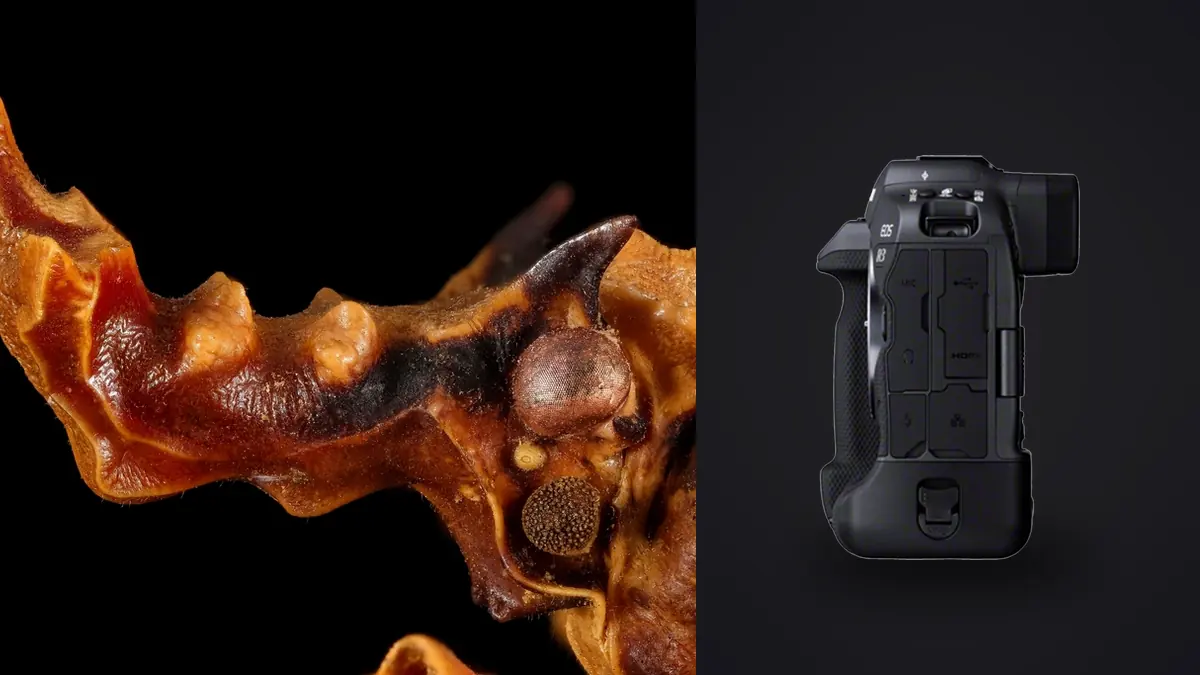
My first real morning with the Canon EOS R3 pointed at something smaller than a fingernail was chasing a robber fly on a chain-link fence at 6 a.m., and I remember thinking the whole time that this camera was not built for this. It was built for sideline football and hockey rinks, for tracking a puck at 30 frames a second with a stacked sensor that barely blinks. And yet an hour later I had eleven usable frames of a fly cleaning its front legs, sharp across the compound eyes, and I understood why a few macro shooters I know have quietly switched over despite the R3 making zero sense on paper for close-up work.
Why a Sports Body Ends Up in a Macro Bag at All
The R3 was announced as Canon's flagship for people chasing fast, unpredictable subjects, and insects are exactly that, just at a scale of centimeters instead of meters. A dragonfly launching off a reed does the same thing a wide receiver does: it commits to a direction with almost no warning. The stacked, back-illuminated 24.1MP sensor reads out fast enough that rolling shutter distortion on wingbeats is basically a non-issue, even in full electronic silent mode, which matters a lot when your subject startles at the sound of a mechanical shutter slapping six inches from its face.
Dual Pixel CMOS AF II with roughly 1,053 selectable zones is the other half of the argument. At 2x or 3x magnification your depth of field can be under a millimeter, and Canon's phase-detect coverage lets you place a genuinely tiny AF point on a jumping spider's anterior median eyes and have it stick, rather than hunting across the whole frame like older contrast-detect systems used to on cheaper bodies. I still miss plenty of shots. But the miss rate dropped noticeably compared to the R6 I used for two seasons before this.
Eye Control AF Doesn't Do What People Assume
I get asked about this constantly, so it's worth clearing up: Eye Control AF on the R3 tracks where the photographer's eye is pointed inside the viewfinder and moves the AF point there. It has nothing to do with detecting the insect's eyes. Canon's subject-detection AI covers people, dogs, cats, birds, and a handful of vehicle categories. Insects aren't in that list, and I don't expect them to be added.
What Eye Control AF actually buys you in macro work is speed of point placement when you're working handheld and the subject keeps drifting in the frame. Calibrate it properly (do the calibration in the exact lighting and with the exact glasses you'll actually be shooting in, not indoors under fluorescents), and you can flick your attention to a beetle's head and have the AF point already there before your finger reaches the shutter. Skip the calibration or wear different glasses that day and it's worse than useless, it actively fights you. I keep it on for handheld work and switch to a fixed single point the moment I mount anything on a focusing rail.
The Lens Matters More Than the Body
None of the autofocus speed in the world helps if the optics aren't right, and this is where I'd push back on anyone buying an R3 specifically for macro. At 24.1MP you have noticeably less room to crop than shooters running a 45MP R5, so you need to get physically closer or choose glass with higher native magnification rather than planning to crop your way there in post. That changes lens selection more than most people expect.
The RF 100mm F2.8L Macro IS USM is what lives on my R3 most mornings. Real 1.4x magnification without teleconverters, a working distance long enough that you're not casting a shadow over a skittish subject, and the spherical aberration control ring lets you dial in a softer or harder rendering on out-of-focus highlights, which matters more than people think when your background is a mess of leaf litter. The RF 85mm F2 Macro IS STM is the one I hand to assistants or bring on long hikes where 200 extra grams actually registers, but it tops out at 0.5x, so you're leaning on cropping again, which fights against the R3's lower resolution.
For genuinely extreme work, above 2x, I still adapt the old EF-mount MP-E 65mm through the RF adapter. It's manual focus only and has no image stabilization, which sounds miserable paired with a body famous for tracking hockey pucks, but at 5x magnification autofocus systems generally aren't fast enough to be useful anyway. You're moving the whole camera back and forth to find focus, not turning a ring.
| Lens | Max Magnification | Min. Focus Distance | Stabilization | Best For on the R3 | Street Price (approx.) |
|---|---|---|---|---|---|
| RF 100mm F2.8L Macro IS USM | 1.4x | 26 cm | Hybrid IS, up to 8 stops combined | General insect macro, walking subjects like dragonflies and beetles | $1,399 |
| RF 85mm F2 Macro IS STM | 0.5x | 35 cm | 5 stops | Lightweight days, environmental macro, portraits doubling as macro | $599 |
| RF 24mm F1.8 Macro IS STM | 0.5x | 14 cm | 5 stops | Wide "habitat" shots showing the insect in its environment | $599 |
| MP-E 65mm f/2.8 1-5x (EF, adapted) | 5x | fixed, ~10 cm working distance | None | Extreme close-ups of ants, mites, jumping spider faces | ~$1,050 |
Settings I Actually Land On, Not the Textbook Ones
Aperture-priority gets abandoned fast once you're at 1x or beyond, because depth of field collapses to almost nothing and you need direct control. I typically sit at f/11 to f/16 on the 100mm macro, which is already deep into diffraction softening territory on a 24MP sensor, but the trade-off is worth it for having an insect's whole head in focus rather than one eye. Below f/11 the depth of field on a jumping spider's face is often thinner than the spider itself.
Shutter speed depends entirely on whether I'm using flash. Handheld, natural light, chasing something moving, I want 1/1000 or faster and I'm pushing ISO up to compensate, sometimes to 6400 on overcast mornings, and the R3's sensor holds detail there better than the resolution number suggests it should. With flash (a diffused twin-flash setup off the front of the lens hood), I drop to the mechanical shutter and sync around 1/200, ISO 100, and let the flash duration freeze the motion instead of the shutter. Electronic shutter and flash sync don't play nicely together on this body for the way I shoot, even though the specs sheet claims high sync speeds are possible in certain modes.
Subject detection I leave off entirely for insects. It's tuned for animals and people, and I've watched it try to lock onto a leaf shadow that vaguely resembled an eye shape rather than the actual mantis three inches to the left. A single small AF point, placed manually or via Eye Control AF, has been more reliable every time I've tested it side by side.
Where the Real Bottleneck Shows Up: After the Shoot
Here's the part nobody warns you about before you buy a 30fps body for bugs. A single decent dragonfly-in-flight sequence, three or four seconds of bursts as it takes off and lands again, can leave you with 90 to 120 nearly identical frames. Multiply that across a four-hour morning at a pond and you're looking at several thousand RAW files by lunch, the vast majority of which differ from their neighbors by a fraction of a wingbeat.
This is where I actually lean on imagic rather than scrolling through Lightroom's grid view squinting at thumbnails. Its local sharpness scoring runs against the actual pixel data rather than an EXIF guess, so it catches the one frame in a burst of forty where the compound eyes are genuinely crisp instead of just "in the general area of focus," which matters enormously at macro magnifications where the difference between sharp and almost-sharp is a fraction of a millimeter of subject movement. The duplicate and burst clustering groups those 90-frame dragonfly sequences together automatically instead of leaving me to manually compare near-identical shots one by one, and because everything runs locally on my laptop instead of uploading to a cloud service, I can do this culling pass at a picnic table by the pond with no signal, before I've even packed up the tripod.
I've also trained imagic's apply_my_style feature on a batch of macro edits I was happy with earlier this year, mostly gentle shadow lifts and a slightly cooler background to make green eyes and metallic thoraxes pop without looking oversaturated. Running new sessions through that preset gets me most of the way to a finished look before I touch a single slider by hand, which on a morning where I've shot 2,000 frames of the same three dragonfly species is the difference between editing for two hours and editing for twenty minutes. If you're trying to get faster at this stage generally, the workflow tips in 10 tips for a faster photo workflow cover a lot of the same ground I ended up rediscovering the hard way.
Carrying It Around Is a Real Cost
I'll be blunt about the part reviews tend to gloss over: the R3 with the 100mm macro attached is heavy. Body alone is 1,015 grams, add the lens and you're comfortably past 1.7kg before batteries and a flash bracket. On a six-hour macro walk crouching over leaf litter, that weight adds up in your wrists and neck in a way it doesn't on a two-hour sports assignment where you're mostly standing with the camera up. The built-in vertical grip actually helps here more than I expected, since the added bulk gives you a more stable two-hand hold when you're trying to keep a floating focus plane steady on something the size of a grain of rice.
Battery life has never been the limiting factor, the LP-E19 comfortably clears a full morning of bursts and flash without a swap. The articulating screen matters more than I anticipated too, since a lot of interesting insect behavior happens low, in grass or under leaves, and I'm shooting from ground level with the screen flipped out more often than I'm using the viewfinder.
Would I Recommend Buying One Just for This?
No, honestly. If macro insect work is the only thing you shoot, an R7 or R6 II gets you similar autofocus performance in a lighter, cheaper body, and the R6 II's 24MP sensor is functionally the same resolution ceiling anyway. The R3 earns its keep on my shoulder because I also shoot motorsport and wildlife with the same body, and the macro work rides along on a system I already own. If you're deciding between camera bodies from scratch purely for bugs and flowers, I'd steer that budget toward glass and a proper focusing rail before I'd steer it toward this particular body. For a broader look at how autofocus systems across brands actually behave on erratic subjects, how AI photo culling actually works is worth a read too, since a lot of the sharpness-detection logic that saves you time after the shoot overlaps with how the camera's own AF is trying to solve the same problem in real time.
Frequently Asked Questions
Is 24 megapixels really enough for cropping into small insects?
It's workable but tight. You have less room to crop than a 45MP body gives you, which means getting closer with the right magnification lens matters more than it would on an R5. For anything smaller than a housefly, I'd rather add a teleconverter-free macro lens with higher native magnification than count on cropping a wide shot down after the fact.
Does the R3's high burst rate actually help with insects, or is it just more files to sort?
Both, honestly. The 30fps electronic mode catches wing positions a slower body would miss entirely, but it does mean a single dragonfly launch can produce over a hundred frames. That's manageable if you've got a culling workflow built for it (I run everything through imagic's burst clustering before I open Lightroom), but if you're still sorting manually, the file count will bury you fast.
Can I use my old EF macro lenses on the R3 instead of buying RF glass?
Yes, and for extreme magnification work like the MP-E 65mm, that's actually what most people still do since there's no RF equivalent. Canon's EF-to-RF adapter passes autofocus and stabilization through without any real penalty for standard AF lenses. Manual focus lenses like the MP-E 65mm work identically to how they did on EF bodies, since you're not relying on autofocus for that kind of magnification anyway.
What's a realistic ISO ceiling for handheld macro without flash on this body?
I stay comfortable up to about ISO 6400 for web and social use, and I'll push to 12800 if I know the shot is a rare species I won't get another chance at. Past that, noise starts eating into the fine detail on things like wing venation and antenna hairs that make macro insect shots worth taking in the first place, so I'd rather add flash than push ISO further.