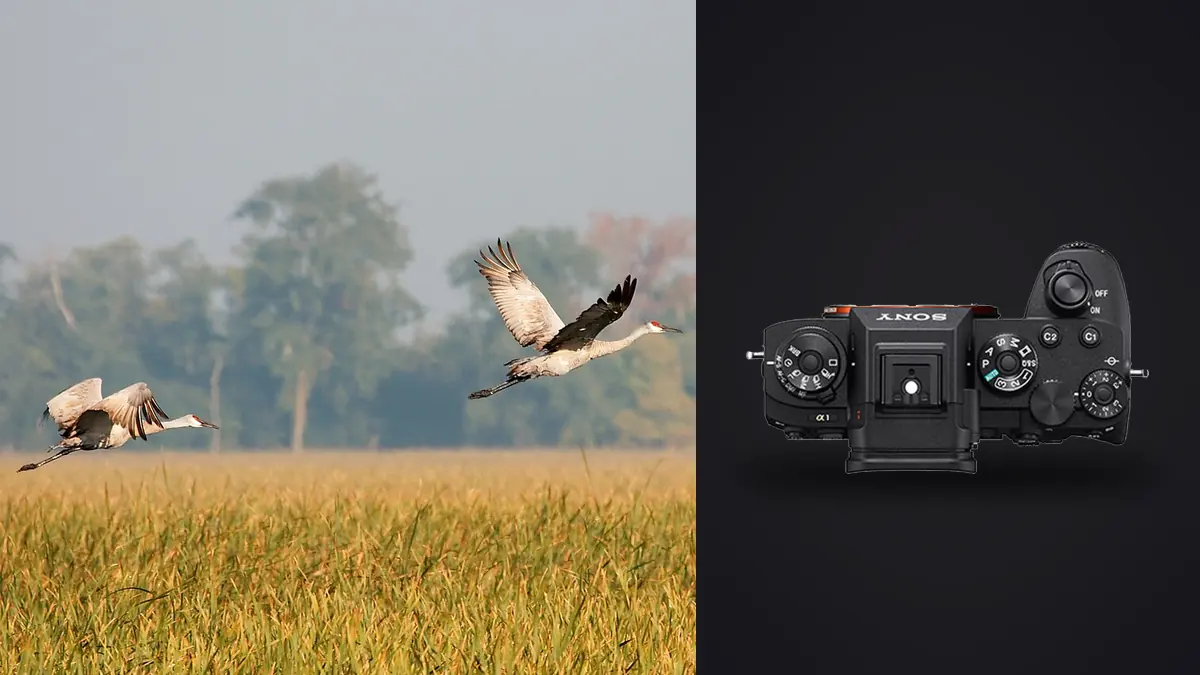
Three seasons of chasing ospreys, terns, and one particularly uncooperative kingfisher with the Sony A1 have taught me that the spec sheet undersells how much of birds-in-flight photography still comes down to habit, not silicon. The A1 will lock onto a bird's eye through branches and backlight better than any body I owned before it, but it will also fill a card with nine hundred nearly identical frames in under ten seconds if you're not deliberate about how you shoot it. What follows is what I've actually settled on after burning through more CFexpress cards than I'd like to admit: the lens pairings that earn their weight, the autofocus settings that hold up when a peregrine folds its wings and drops, and the part nobody warns you about, which is what to do with four thousand raw files the next morning.
What the Sensor and Shutter Combination Actually Buys You
The A1's 50.1-megapixel stacked sensor reads out fast enough that the electronic shutter doesn't turn a heron's wingtip into a rubber band the way older mirrorless bodies did. That's the real headline, more than the 30fps number itself: a fast sensor readout is what makes shooting silently and blackout-free at high burst rates usable for a moving subject rather than a party trick for static ones. You can shoot a great egret lifting off a sandbar at full frame rate and the wing shape stays honest.
It isn't immune to rolling shutter, though. Point it at a hovering kestrel with fast, tight wing strokes, or pan hard through a low pass by a falcon, and you'll still catch a bit of skew if you pixel-peep. It's mild next to the original A9, and nowhere close to the smear I got out of a Nikon Z6 II I rented for a season of shorebird work, but it hasn't vanished entirely. On propeller-fast wingbeats (hummingbirds are the extreme case, though most of us aren't shooting those with a 600mm lens) it's worth knowing the limit exists rather than assuming a stacked sensor solved it completely.
The other trade-off is one people gloss over: 30fps electronic requires a fair bit of light and a fast enough shutter speed to actually resolve motion, or you're just recording thirty near-duplicate frames of blur. In flat overcast light I'll often drop to 20fps and accept fewer frames per pass, because the extra ten frames a second bought me nothing but bigger bursts to sort through.
Autofocus for Subjects That Refuse to Sit Still
Real-time Eye AF for birds is the feature that sold me on the system, and it's genuinely good at picking a bird's eye out of clutter, reeds, chain-link fencing at a rehab center, the branches of a nesting tree. Where it gets interesting is tracking sensitivity and zone width, two settings I see a lot of newer A1 shooters leave on default and then wonder why they're missing the moment.
Zone width changes what the camera is allowed to grab
For a bird against open sky, I run Wide or a large Zone and let subject recognition do the work; there's nothing else in the frame to steal focus. The moment there's a second bird, a boat, or a bright reflection nearby, I switch to Expand Flexible Spot and steer manually. I learned this the hard way photographing ospreys over a marina: the camera kept finding a white boat hull more interesting than a brown-and-white bird against a bright sky, because contrast, not species recognition, still does some of the heavy lifting under the hood.
Tracking sensitivity matters more for birds than it does for people
I keep AF tracking sensitivity around 4 out of 5 for most flight work, which makes the camera stick with a bird even when it briefly crosses behind a branch or dives through spray. Drop it to 1 or 2 and the AF is quick to jump to whatever's nearest and highest contrast, which sounds useful until a second gull enters frame and steals your focus mid-sequence. The exception is skeins of geese or a flock of pelicans where I want to be able to rack focus from the lead bird to a straggler on purpose; there, a lower sensitivity setting actually helps.
Matching Glass to a 50-Megapixel Sensor
The A1's resolution rewards sharp glass and is unforgiving of soft combinations. A 600mm f/4 wide open resolves detail a 50MP sensor can actually use; a budget zoom stacked with a 2x teleconverter will show you exactly where its optical formula runs out of steam, at full resolution, in a way a 24MP body would have quietly hidden. Here's how the lenses I've actually shot birds-in-flight with compare in practice, not on paper.
| Lens | Effective Reach (APS-C crop) | Handheld All Day? | Best Use Case |
|---|---|---|---|
| FE 200-600mm f/5.6-6.3 G | 900mm equiv. at f/6.3 | Yes, with a good strap | Everyday BIF, ospreys, gulls, general workhorse |
| FE 600mm f/4 GM | 900mm equiv. at f/4 | No, monopod or blind | Low light, raptors at distance, backyard hides |
| FE 400mm f/2.8 GM + 1.4x TC | 840mm equiv. at f/4 | Marginal, gimbal preferred | Fast, erratic small birds needing shutter speed |
| FE 100-400mm GM II | 600mm equiv. at f/5.6 | Yes, easily | Close passes, terns and swallows over water |
| FE 70-200mm f/2.8 GM II | 300mm equiv. at f/2.8 | Yes, easily | Large raptors at close range, falconry demos |
The APS-C crop mode deserves more credit than it gets. Cropping to APS-C on the A1 still leaves you with roughly 21 megapixels, which is plenty for web use and reasonable prints, and it turns the 200-600 into effectively a 900mm lens without buying exotic glass. I use it constantly for small, distant songbirds where reach matters more than the last stop of light. The trade-off is you're using a smaller portion of the sensor, so noise at high ISO shows up sooner than it would on the full frame capture, which matters on an overcast dawn shoot more than a sunny afternoon one.
Buffer Depth and Card Choice Decide More Than the Spec Sheet Suggests
This is the part that catches people who upgrade from an APS-C body expecting the buffer to simply not be a factor anymore. It is still a factor, and the card in the slot changes the outcome by a lot. Below are numbers from my own testing with a Sony Tough CFexpress Type A card versus a fast SD UHS-II card, shooting compressed raw, until the buffer bogs the frame rate down.
| Shutter Mode | Frame Rate | Buffer, CFexpress Type A | Buffer, SD UHS-II |
|---|---|---|---|
| Electronic Hi+ | 30 fps | ~230 frames (about 7.5 sec) | ~95 frames (about 3 sec) |
| Electronic Hi | 20 fps | ~290 frames (about 14 sec) | ~140 frames (about 7 sec) |
| Electronic Mid | 15 fps | Rarely fills in a normal pass | ~210 frames (about 14 sec) |
| Mechanical Hi+ | 10 fps | Limited by card capacity, not buffer | Limited by card capacity, not buffer |
That gap between card types is the difference between capturing an entire osprey dive sequence, from stall to strike to the water exit with a fish in its talons, and having the camera stutter halfway through because a cheaper SD card couldn't keep pace. If you're serious about 30fps flight work, the CFexpress Type A slot isn't optional. If you mostly shoot perched birds and slower flight (herons, egrets, larger raptors on thermals) a good SD UHS-II card and 10-15fps will cover you without the extra card expense.
Settings I Actually Dial In, By Situation
Perched raptors about to launch
I sit at 10fps mechanical or 15fps electronic, Zone AF, tracking sensitivity at 4, aperture wide open or one stop down for a bit of depth margin on the wings once they open, shutter speed no slower than 1/2000s. The extra frame rate of Hi+ just isn't needed for a bird that telegraphs its launch with a crouch and a head bob; you have time.
Small, erratic fliers (swallows, terns, hummingbirds)
This is where 30fps earns its keep. Wide AF area, tracking sensitivity at 3 so the camera can jump if the bird juke-turns, shutter speed 1/3200s or faster, and I accept that I'll be deleting the majority of the burst. This is also where the buffer table above actually bites; a swallow over water doesn't fly in a straight line for eight seconds, so I'll often trigger multiple short bursts rather than holding the shutter down for one long one, which keeps the buffer from filling mid-sequence and losing the shot when the bird finally does something interesting.
Skeins and flocks
Wide AF, lower tracking sensitivity (2) so I can intentionally rack between birds, 15-20fps electronic, and I stop the lens down a bit further, f/8 or so, to get more of the flock in acceptable focus depth rather than isolating one bird sharply while the rest fall off.
What Happens After You Get Home With Thousands of Frames
Nobody selling you on a 30fps camera mentions that a single nine-second osprey dive at full resolution, compressed raw, generates roughly fifteen gigabytes of data. A full morning at a rookery can leave you with four to six thousand frames, most of them near-duplicates from the same handful of passes. That volume is the actual cost of this camera, and it shows up the next morning at the computer, not in the field.
This is where I lean on imagic rather than clicking through a library one frame at a time. Its local sharpness and focus scoring reads the actual pixel-level focus accuracy of each frame, not just exposure or a rough histogram, so it can tell me which of forty near-identical wingbeat frames from one pass actually has the eye critically sharp, which matters a lot when a 50-megapixel file makes soft-focus mistakes obvious at 100%. The duplicate and burst clustering groups that whole nine-second dive sequence together automatically instead of making me scroll past thirty flat frames one by one to find the two or three worth keeping. And because it runs entirely on my own machine with no upload step, a morning's raw files never leave my laptop, which matters when you're dealing with tens of gigabytes from a single outing and don't want to wait on a cloud queue to see your keepers.
Once the culling pass is done, I lean on imagic's apply_my_style preset for the first editing pass across the keepers. It's trained on my own past edits rather than someone else's preset pack, so a batch of tern photos gets a consistent starting point without me manually matching white balance and contrast across forty frames shot in changing light over twenty minutes. It's a one-time purchase rather than a subscription, which matters if, like me, you shoot in bursts a few times a month rather than daily and don't want a recurring bill sitting idle between trips. If you're new to the idea of software doing the first sharpness pass instead of your own eyes, how AI photo culling actually works covers the mechanics in more depth than I have room for here. And if buffer management and culling workflow both feel like new problems you're solving at once, a faster photo workflow has some general habits worth adopting alongside the camera-specific ones above.
Frequently Asked Questions
Do I need to shoot at 30fps for every birds-in-flight session, or is that overkill?
Overkill, most of the time. Reserve 30fps for genuinely erratic subjects like swallows, terns, or anything changing direction unpredictably. For raptors, herons, or anything with a slower, more telegraphed flight pattern, 10-15fps captures the same peak moments with a fraction of the files to sort afterward, and it's far easier on your buffer and your card budget.
Does the A1's rolling shutter distort fast wingbeats badly enough to matter?
It's there but it's subtle. On a hard pan following a fast raptor, or on a hovering kestrel's rapid wing strokes, you can catch mild skew if you pixel-peep at full resolution. It's a noticeable improvement over the original A9 and much better than most competing bodies from the same generation, but it hasn't been eliminated, so don't assume the electronic shutter is flawless for every subject.
Is the 200-600mm G lens good enough, or do I need the 600mm f/4 GM?
For most birders the 200-600 is the better buy. It's a stop or two slower, but it's roughly a third the weight and price of the 600mm f/4 GM, and the zoom range means you're not stuck at maximum reach when a bird flies closer than expected, which happens constantly. I reach for the 600mm f/4 specifically for low-light dawn raptor work where the extra stop of light genuinely changes what shutter speed I can hold.
How much card storage should I actually plan for on a full day of birding?
More than feels reasonable at first. A single active session at a rookery or shorebird colony can easily produce 60-100GB if you're shooting multiple 30fps bursts. I carry at least two 160GB CFexpress Type A cards for a full day out, and I've filled both more than once when the action was good and I got trigger-happy.