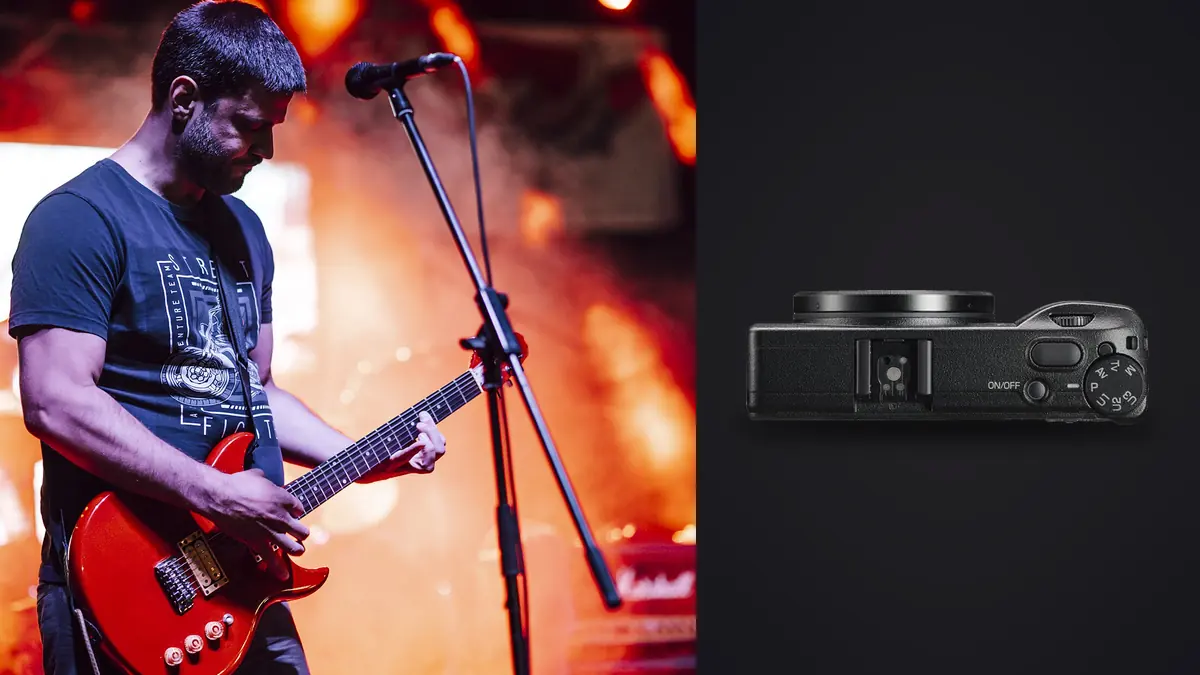
Nobody hands you a Ricoh GR IIIx and says "go shoot the pit." It's a fixed-lens compact built for street work, small enough to disappear into a jacket pocket, and the last thing most photo editors picture when they think about covering a band. And yet I've brought mine to more shows in the last year than any of my interchangeable-lens bodies, mostly because the venues I actually shoot don't hand out photo passes and don't want to see a 70-200mm anywhere near the stage. This is what I've learned running it through basement shows, mid-size theaters, and a couple of festival side stages where it was the only camera I was allowed to carry in.
Why a Fixed 40mm Compact Even Belongs at a Show
The honest answer is access. A lot of small and mid-size venues have gone from "no cameras" to "no cameras with removable lenses" as phones got good enough that door staff stopped caring about point-and-shoots. The GR IIIx reads as a point-and-shoot even though it's carrying an APS-C sensor, the same size class you'd find in a mid-range mirrorless body, just with a lens that can't come off. I've walked into general admission with it clipped to a wrist strap under my sleeve more times than I can count, on nights where a friend with a Sony and a 24-70 got stopped at the door and told to check it or leave.
That trade only works because the sensor isn't a compromise. It's the same 24-megapixel APS-C chip Ricoh has used across the GR III line, not the smaller 1-inch sensor you get in most true pocket cameras. So you're not sacrificing image quality for size, you're sacrificing lens flexibility for size. Whether that trade makes sense depends entirely on how close you can physically get to the stage, which is the next problem.
Working the 40mm Angle, From the Rail to the Back of the Room
The GR IIIx's lens is a 26.1mm optic that renders as roughly 40mm equivalent, which is longer than the 28mm on the standard GR III but still short of anything you'd call a portrait lens. At the barrier of a small room, 40mm gets you a solid two-thirds or full-body shot of a performer. From mid-floor at a 1,500-cap venue, you're basically shooting a wide establishing frame of the whole stage whether you want to or not.
Ricoh's answer is in-camera crop modes that punch in without leaving the native focal length, and they're genuinely useful rather than a marketing checkbox, because they're real sensor crops, not upscaled digital zoom. Here's how I actually use the three options during a set:
| Mode | Effective focal length | Rough output size | Where I use it during a set |
|---|---|---|---|
| Full sensor (native) | ~40mm | ~24MP | Wide stage shots, full band lineups, crowd-and-stage frames from the first few rows |
| Crop 1 | ~50mm | ~15MP | Tighter single-performer frames from the rail, without physically moving |
| Crop 2 | ~71mm | ~8MP | Reaching a vocalist or soloist when I'm stuck mid-floor and can't push forward |
The catch is that cropping to 71mm on a 24MP sensor leaves you with a file that won't survive much more cropping in post, and it won't hold up on a big print. I treat the 71mm mode as a last resort for web-sized live shots, not something I'd reach for if the goal is a gallery print of the night. It's also worth saying plainly: if you're shooting from a photo pit with a real barrier and three-song access, or from a balcony fifty feet back, this lens is the wrong tool. It's built for rooms where you can move.
What the Sensor and Shutter Actually Give You in the Dark
Stage lighting is unpredictable in a way daylight never is. A moving-head fixture can swing a performer from lit to silhouette in half a second, and most small venues run far dimmer than people expect once you're not staring at the stage with your own light-adapted eyes. The GR IIIx tops out with a native ISO range that Ricoh extends well past 100,000, but that number is marketing, not a usable ceiling. In practice I stop trusting the files past ISO 6400. Between 3200 and 6400 the noise is fine-grained and manageable, especially in RAW where you have room to work; push to 12800 and skin tones start breaking up in a way that no amount of noise reduction fixes cleanly.
Shutter speed is the bigger constraint, honestly, more than ISO. To freeze a singer moving on a downbeat you want something like 1/250 to 1/500, and getting there at ISO 6400 under a dim wash of stage light still means shooting wide open at f/2.8 most of the night. The lens doesn't stop down much before you're fighting exposure again, so f/2.8 becomes the default rather than a choice. The in-body shake reduction system helps with your own hand movement at slower shutter speeds, which matters when you drop to 1/60 or 1/30 for atmospheric shots between songs, but it does nothing for a drummer's arm mid-swing. That blur is yours to manage with shutter speed alone.
Autofocus, Snap Focus, and Where I Stopped Trusting Face Detection
Face and eye detection work reasonably well when a performer is standing still under a spotlight facing you. They fall apart the moment a singer turns their head, a guitarist leans into the crowd, or a strobe hits and the sensor loses the face for half a second. I've missed more usable frames to hunting autofocus during a chorus than I'd like to admit, especially on rooms lit mostly by colored gels where contrast for the AF system to grab onto is genuinely poor.
What actually works most nights is snap focus, set to somewhere between 2 and 3 meters depending on how close I'm standing to the stage. It locks the focus distance and lets me shoot the instant I see the moment, rather than waiting on the camera to confirm. It's a street photography feature that happens to translate almost perfectly to a crowded floor where you don't have time to half-press and wait. I'll switch back to autofocus for slower moments between songs, when there's time to let the system hunt, but for anything happening on the beat, snap focus is what I trust.
The Buffer Problem Nobody Puts in the Spec Sheet
This is the limitation that surprises people who've only shot the GR IIIx on a quiet street corner. Continuous shooting maxes out around 4 frames per second, and the RAW buffer clears out after roughly four frames before the camera slows down to write to the card. On a street shoot that's a non-issue. In a mosh pit during a chorus, it means you get one short burst of a jump before the camera stalls, and you either wait it out or switch to single shots and time it by feel.
What that shallow buffer does produce, even in short bursts, is a pile of near-identical frames: the same guitar strum captured three times half a beat apart, the same jump caught mid-air and just after landing. Sorting through those manually at the end of a two-hour set, across two or three bands, gets tedious fast when half your frames look interchangeable at a glance. This is where I actually lean on imagic once I'm home. Its duplicate and burst clustering groups those near-identical takes together automatically, and the local sharpness scoring flags which frame in each cluster is actually in focus rather than motion-blurred, which matters more at a show than in daylight because slower shutter speeds under stage lighting mean a higher percentage of any burst comes out soft. I'm not scrubbing through forty almost-identical frames at 100% zoom trying to find the one sharp one by eye anymore. For a longer look at how that kind of automated sorting actually works under the hood, I wrote more about it in how AI photo culling works.
How It Stacks Up Against the Alternatives
I get asked fairly often whether the GR IIIx is "enough" camera for a show, usually by someone deciding between it and a mirrorless kit with a fast zoom. There's no single right answer, it depends on what door policy you're dealing with and how close you can get. Here's the comparison as I've actually experienced it across the same rooms:
| Setup | Realistic usable ISO ceiling | Burst before it stalls | Focal reach | Getting it past the door |
|---|---|---|---|---|
| Ricoh GR IIIx | ISO 3200-6400 | ~4 RAW frames | Fixed 40mm plus two in-camera crops to ~50mm and ~71mm | Rarely questioned, reads as a point-and-shoot |
| Mirrorless + f/2.8 zoom | ISO 6400-12800 | 20+ RAW frames | True optical zoom, range depends on the lens | Usually needs a photo pass at anything above a dive bar |
| Phone main camera | Noisy and smeared past roughly ISO 1600 equivalent | Effectively unlimited, storage-limited only | Digital zoom only, degrades fast past 2x | Allowed everywhere, no pass needed |
The GR IIIx sits in an odd middle spot: better image quality than a phone by a wide margin, but nowhere near the reach or burst depth of a proper mirrorless rig with glass built for this. What it wins on is being let in the door in the first place, which for a lot of the shows I actually shoot, decides everything else.
Getting the Files Home and Actually Through Them
Green rooms and venue backstages almost never have usable wifi, and I've stopped counting on cell signal in basements built out of concrete and old brick. That means whatever culling and editing I do the same night happens entirely offline on a laptop, which is one of the reasons I stuck with imagic instead of anything cloud-dependent, since it processes everything locally without needing to upload a single frame to look at sharpness scores or sort duplicates.
The other habit that's saved me real time is training a custom preset on my own graded edits from a room with a consistent lighting rig, using imagic's apply_my_style feature. Most small venues run the same two or three lighting looks all year, heavy magenta and teal washes being the usual suspects, so after hand-grading one full set from a room I trust the trained style to get the next set from that same venue most of the way there automatically. It's not a substitute for actually looking at every frame, but it cuts the flat, unedited RAW files down to something presentable a lot faster on a night when I'm trying to get a gallery link out before people wake up the next morning. If your culling workflow is still entirely manual, it's worth reading through some general habits in 10 tips for a faster photo workflow, most of which apply just as much to a pile of concert RAWs as anything else.
Where I'd Leave It at Home
I want to be straightforward about the cases where this camera is the wrong call, because plenty of gear write-ups skip that part. If you have an actual photo pass and barrier access at a venue that size, bring a real zoom, the reach and burst depth aren't close. If the show is seated and you're more than thirty feet back with no ability to move, 40mm plus a 71mm crop still won't get you a usable frame of a performer's face. And if you need a viewfinder to shoot reliably, know going in that the GR IIIx has none built in; you're composing on the rear screen the whole night, which is rough in the middle of a strobe-heavy set when you can barely see your own reflection in the glass, let alone the frame.
Where it earns its spot is the opposite scenario: small rooms, general admission, no pass required, and a door policy that would stop anything bigger. That's a specific niche, but for the photographers who actually live in that niche, it's a real one.
Frequently Asked Questions
Is a 40mm-equivalent lens actually usable for photo pit work, or do I need a zoom?
If you have real pit access with a barrier keeping you five to ten feet back, 40mm plus the built-in crop modes can get you usable frames, but you're working harder for them than someone with an optical zoom, and you'll lose more shots to needing to physically reposition mid-song. For anything past mid-floor distance at a larger venue, a zoom lens is doing a job this camera simply can't.
Will the GR IIIx keep up in a dark club without flash?
There's no flash to begin with, no hot shoe either, so this is moot in one sense. What matters is whether the sensor and f/2.8 lens can handle ambient stage light alone, and the answer is yes up to about ISO 6400 with acceptable noise, and shakier past that. Rooms lit mostly by warm, dim house lighting between songs are harder than rooms with active stage lighting, oddly enough, because there's simply less light hitting the sensor.
Does the shallow buffer really matter for a two-hour set?
It matters most in the specific moments you'd expect: a jump, a big chorus, anything where you'd normally hold the shutter down for a second or two. You get about four RAW frames before the camera slows to write, so the fix is timing single shots rather than relying on bursts to catch the moment for you. Outside those peak moments, shooting single frames deliberately, the buffer never comes up.
Is the GR IIIx quiet enough for a seated acoustic show?
Yes, and this is genuinely one of its strongest cards. Switch to the electronic shutter and it's silent, no mechanical clack between songs in a room where you can hear a pin drop. I've used it at stripped-down acoustic sets where a DSLR's shutter slap would have drawn dirty looks from the front row, and nobody in the room noticed I was shooting at all.