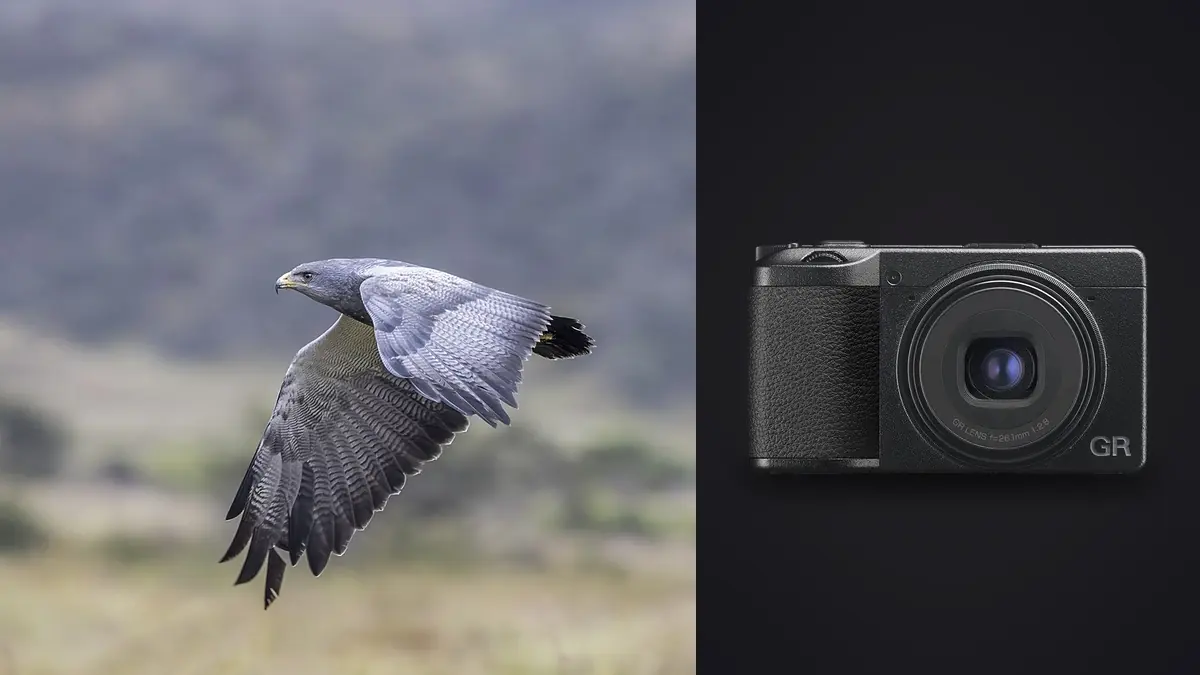
I need to say this up front because it will save some of you a wasted afternoon: the Ricoh GR IIIx is not a birding camera, and Ricoh never pretended it was one. It is a 40mm-equivalent, fixed-lens street compact with a leaf shutter and contrast-detect-leaning autofocus that was built for candid framing and pocketability, not for tracking a swift cutting across a hedge line at 30mph. I own one. I have tried, more than once, to make it do birds in flight because I wanted an excuse to carry less gear on a hike. This piece is the honest account of what happened, where it sort of worked, and where it flatly did not.
Why anyone would even try this
The appeal isn't performance, it's weight and discretion. A GR IIIx in a jacket pocket means you're carrying a camera on walks where you'd never bring a 600mm supertele and a monopod. If you already own one for street or travel work and you spot a heron lifting off a riverbank, the question isn't "should I buy a longer lens," it's "can the camera in my pocket right now get anything usable." That's a fair question, and the answer is more nuanced than a flat no.
I've had a handful of days where the GR IIIx surprised me: gulls wheeling over a car park, a heron doing a slow lazy flap along a canal, a buzzard riding a thermal at a distance where its wingbeat was almost stationary relative to the frame. Slow, large, predictable subjects at a known distance are within reach. A blue tit darting off a feeder three feet away is not. The physics of the lens and the focus system draw that line pretty clearly once you've hit it a few times.
The core problem: 40mm and single-point AF are working against you
Two things stack against you here, and neither is fixable in firmware. First, the 40mm-equivalent lens means anything smaller than a heron or a goose is going to be a speck in the frame unless it's genuinely close, which for most wild birds means it's also spooked and leaving. Second, the GR IIIx's autofocus, while genuinely quick for a compact when it comes to single-shot street snaps, was never built with a tracking algorithm that expects erratic motion toward and across the camera. There's no dedicated animal-eye AF mode, no high-speed continuous tracking servo tuned for unpredictable flight paths. You get single AF, snap focus (a fixed distance you set manually, which is actually the most useful trick for this use case), and a continuous mode that hunts more than it locks when the subject is moving fast and getting larger in frame. Snap focus is the one workaround worth knowing. If you pre-set the focus distance to, say, 5 meters and set the aperture around f/5.6 to f/8, you get a slab of usable depth of field and the shutter fires the instant you press it with zero AF hunt. That's how the handful of my keepers happened: not by tracking, but by anticipating a flight path and firing into a zone where I already knew focus would be acceptable.
What actually worked in practice
Large waterbirds taking off from a fixed point, like a heron pushing off a post or a swan running across water to get airborne, gave me the highest hit rate. The takeoff itself is slower than you'd think, there's a beat or two where the bird is essentially stationary relative to your framing before it accelerates away. That beat is your window. I'd pre-focus with snap focus at the estimated takeoff distance, set a burst, and fire through the launch. Birds gliding at altitude, gulls riding wind off a cliff edge, raptors circling a thermal, were the second category that worked. Distance does the heavy lifting for you there: at 40 or 60 meters a bird's apparent angular speed across the frame is slow even if it's actually moving quickly, so focus tolerance is more forgiving and the leaf shutter's rolling characteristics (it has none, being a leaf shutter, so no jello distortion on fast subjects) aren't an issue anyway.
What didn't work, at all
Small passerines near the camera. Anything under about 15cm body length closer than 10 meters was essentially unphotographable in flight with this setup. The AF couldn't acquire fast enough, the frame couldn't contain the erratic path, and by the time I'd half-pressed the shutter the bird had already changed direction twice. I stopped trying after the third outing dedicated to garden birds came back with zero keepers out of roughly 400 frames.
How this compares to what you'd actually want for the job
It's worth being blunt about where the GR IIIx sits relative to gear that's actually built for this, if only so nobody buys one expecting miracles.
| Setup | Effective reach | AF tracking for erratic flight | Realistic BIF keeper rate* | Carry weight |
|---|---|---|---|---|
| Ricoh GR IIIx (40mm equiv, snap focus) | None (fixed 40mm) | Not built for it; workaround only | 2-5% on favorable large/slow subjects | ~262g, pocketable |
| Superzoom bridge camera (e.g. 600mm equiv reach, small sensor) | Strong optical reach | Basic continuous AF, moderate hit rate | 15-25% | ~1.3kg, shoulder bag |
| APS-C mirrorless + 100-400mm | Good reach, cropable | Dedicated bird/animal-eye AF on recent bodies | 40-55% | ~1.8kg with lens |
| Full-frame mirrorless + 500-600mm prime or zoom | Excellent reach | Fast, precise eye/subject tracking | 55-70%+ | 3kg+, dedicated bag |
*Keeper rate defined loosely as sharp-enough, well-framed shots per hundred attempted frames on genuinely flying (not perched) subjects, based on my own outings and comparable numbers reported by birders I've talked shop with. Treat these as ballpark, not lab figures; your mileage depends heavily on subject species and light.
The gap between row one and row three isn't subtle. If birds in flight are a real, recurring goal rather than an occasional bonus shot on a camera you already carry for other reasons, the GR IIIx is the wrong tool and no amount of technique closes that gap. But if you're weighing "do I bring a second camera today" against "I already have this in my pocket," the calculus changes.
Settings that actually helped
A few adjustments made a measurable difference to my hit rate, even if the ceiling stayed low.
- Shutter priority, 1/2000s minimum. Even at 40mm-equivalent, wingtip blur shows up fast at anything under 1/1600s. I defaulted to 1/2000s and let ISO float, accepting some grain in exchange for frozen wings.
- Continuous high burst, not the slower rate. The buffer fills quickly on this camera in RAW, so I shot JPEG+small RAW or JPEG only during flight sequences specifically to buy more frames before the buffer choked.
- Snap focus over autofocus for anticipated flight paths. Covered above, but worth repeating: this is the single biggest lever. Autofocus hunting cost me more shots than anything else.
- Auto ISO capped around 6400. Past that the small sensor's noise made even a technically sharp frame look mushy after any real crop, and cropping is mandatory here because 40mm leaves birds tiny in the frame.
The culling problem this creates
Here's the part nobody mentions when they talk about compacts for wildlife: because your hit rate is so low, you end up shooting far more frames per usable image than you would with proper reach, which means far more junk to sort through afterward. A single takeoff sequence at high burst can leave you with 60-80 frames of which maybe two are sharp and well-framed. Doing that by eye, at 100% zoom, after a full day out, is genuinely tedious and it's where I started leaning on imagic to get through the pile. It runs the sharpness scoring locally on the machine, so I'm not uploading a folder of mediocre bird shots anywhere, and it groups the burst sequences together so I'm comparing frame 34 against frame 35 rather than scrolling past forty near-duplicates to find them. For a camera whose whole workflow here is "spray and pray, then find the two good ones," that clustering step saves a genuinely annoying amount of time. It won't make the GR IIIx focus faster, nothing will, but it does make peeling the two keepers out of eighty burst frames fast instead of miserable.
If you're new to the idea of software doing that first sharpness pass instead of your own eyes at 3am, this walkthrough of how AI photo culling actually works covers the mechanics in more depth than I want to get into here.
A realistic session plan if you're going to try this
Assuming you already own a GR IIIx and want to give bird flight a fair shot rather than a token attempt, here's roughly how I'd structure a session now that I've done it wrong a few times first.
- Scout a location with a predictable launch point: a heronry, a gull roost near a car park, a lake edge where waterfowl take off repeatedly. Random walks looking for opportunistic flight shots waste far more time than they're worth with this camera.
- Pre-set snap focus to your estimated takeoff distance and lock exposure to shutter priority at 1/2000s or faster.
- Position yourself where the bird's flight path crosses roughly perpendicular to you rather than straight at you. Perpendicular motion is more forgiving of focus error than a bird flying directly toward the lens, where distance (and thus correct focus) is changing every frame.
- Fire in bursts starting a half-second before you expect takeoff, not after you see it start. Reaction time alone will cost you the first quarter-second of motion otherwise.
- Accept a low hit rate and don't chase every bird that lifts off nearby. Pick your moments.
Frequently Asked Questions
Can the Ricoh GR IIIx track a bird across the frame reliably?
No. It lacks a dedicated tracking AF mode built for erratic subject motion, and the 40mm-equivalent focal length means most birds are small in frame unless close, which is exactly when tracking failure is most visible. Snap focus with a pre-set distance outperforms relying on autofocus for anything moving unpredictably.
Is the GR IIIx better or worse than the standard GR III for this?
Marginally worse for flight work specifically, because the GR IIIx's 40mm-equivalent lens is narrower than the standard GR III's 28mm-equivalent, which sounds backward until you remember that a wider lens means more forgiving framing for a fast-moving subject, even though the bird itself will appear smaller. Neither camera has AF built for this task, so the difference is minor in absolute terms.
What's a realistic subject to expect success with?
Large, slow-moving birds at a known launch point: herons, swans, geese, and gulls riding wind at a distance. Small, fast passerines close to the camera are effectively off the table regardless of technique.
Should I just buy a longer lens setup instead?
If birds in flight are a genuine, recurring interest rather than an occasional opportunistic shot, yes. An APS-C body with a 100-400mm range and dedicated subject tracking will outperform any technique on the GR IIIx by a wide margin, as the comparison table above shows. The GR IIIx is worth trying only because you already own one for other work and the marginal cost of attempting it is zero.