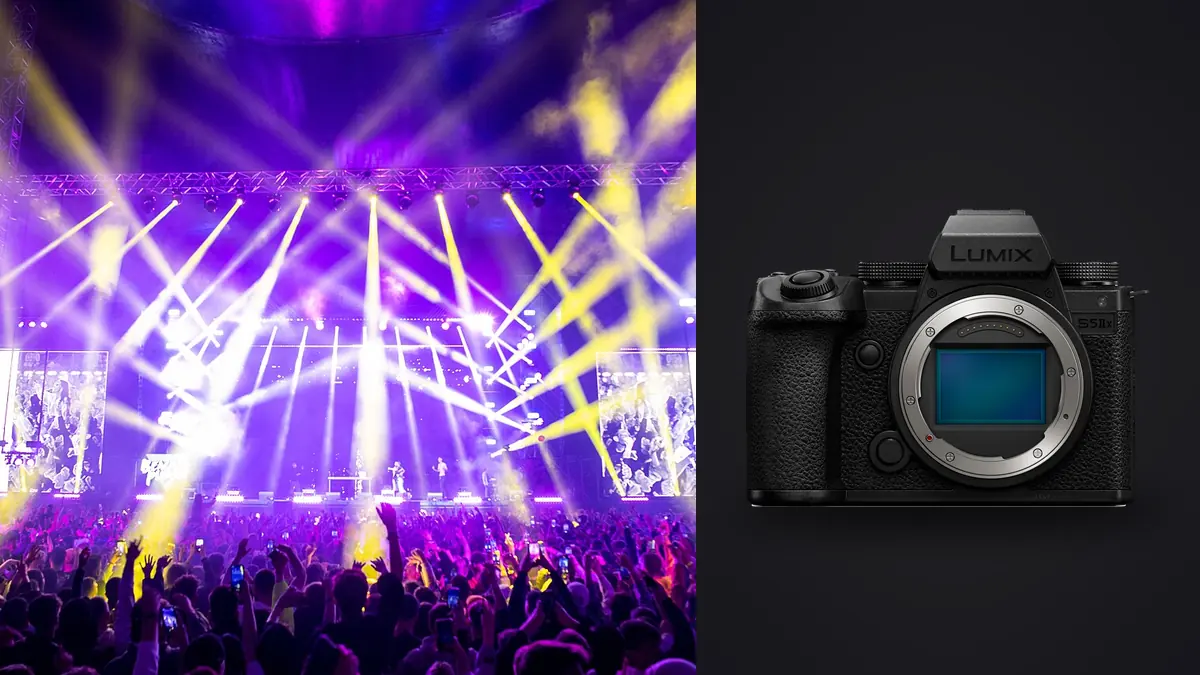
Why the S5IIx Keeps Turning Up in Photo Pits
Panasonic built the Lumix S5IIx for video people. The all-black finish, the ProRes-over-USB-SSD recording, the waveform monitor buried in the menus, none of that has anything to do with photographing a band. And yet walk into the pit at almost any mid-size venue show right now and you will find at least one shooter running an S5IIx with a 70-200mm hanging off the front, usually because they also shoot behind-the-scenes video for the same artist and didn't want to carry two systems. That crossover use case turned out to matter a lot, because the camera Panasonic built to please video editors happens to have an autofocus system, a shutter, and a stabilization unit that hold up surprisingly well when the lights drop and the singer starts moving.
This isn't a spec-sheet rundown. It's what actually changes when you take this specific body into a dark room full of unpredictable light and a performer who has zero interest in standing still for you.
What Actually Matters in a Three-Song, No-Flash Set
Most photo pit access follows the same rule: first three songs, no flash, then you're escorted out. That constraint does more to shape gear choice than any spec sheet does. You get roughly ten minutes, the lighting will change six or seven times without warning, and you cannot fire a strobe to bail yourself out of underexposure. Whatever ISO ceiling, autofocus speed, and shutter behavior your camera has, that's what you're stuck with for the entire set.
Against that backdrop, three things on the S5IIx matter more than anything else on the spec sheet: how fast and reliably it locks focus on a face that's half in shadow, how clean the files look once you've pushed ISO past 6400, and whether the shutter itself causes problems under the specific kind of lighting rigs touring productions use. Everything else, the video features Panasonic actually built this camera around, is close to irrelevant for stills work.
Autofocus: the Phase-Hybrid Upgrade That Actually Matters
The original S5 used Panasonic's old Depth From Defocus system, contrast-based autofocus that hunted visibly whenever a subject moved fast or the light got low. It was the single biggest reason serious stills shooters skipped the first-generation S5 for anything with unpredictable motion. The S5II and S5IIx replaced that with a proper phase-hybrid system, Panasonic's first phase-detect implementation on a full-frame body, and it's a genuinely different camera to shoot with as a result.
In practice: a vocalist backlit by a single spotlight, hair flying, hand partially covering their own face on the mic, is exactly the scenario that used to make the old DFD system pump focus back and forth uselessly. The phase-hybrid system holds on far more consistently. It's not flawless, if a guitarist spins away from you mid-solo and the AF point drifts onto the amp behind them, you'll lose a frame or two getting it back, but that's a normal mirrorless limitation, not a Panasonic-specific one anymore. Human detection tracks eyes reasonably well until a performer turns three-quarter away and drops below about a quarter of the frame, at which point it reverts to general subject tracking rather than face priority. Keep your AF area set to a mid-size zone rather than pinpoint for anything involving a full band on stage; single-point AF loses subjects the instant anyone steps sideways of your original focus position.
ISO Ceiling and What "Usable" Actually Looks Like on Stage
The S5IIx runs a native ISO range of 100-51200, expandable further, on a 24.2MP sensor. For concert work, the honest usable ceiling depends entirely on what you're shooting for. Web-sized band promo shots and social content hold up fine at ISO 12800, with noise that cleans up well in modern denoise tools without turning skin into plastic. Push to 25600 for a genuinely dark club and you'll see chroma noise creep into shadow areas, still printable at small sizes but not something you'd want blown up for a merch table poster.
What surprised me moving from an older APS-C body to the S5IIx was how much headroom the full-frame sensor gives you specifically in mixed-color stage lighting. Concert rigs throw wildly inconsistent color temperature, warm tungsten wash on one side, a cool blue wash on the other, a magenta gel somewhere in the middle, and a full-frame sensor at moderate ISO handles that color separation more gracefully than a smaller sensor pushed harder to compensate for a narrower aperture lens. The dual native ISO circuitry Panasonic built into this body is a video-only feature; it doesn't apply to stills capture, so don't expect it to change your noise floor for photographs.
Electronic Shutter, Rolling Shutter, and the LED Flicker Problem
This is the part most camera reviews skip entirely because it barely matters outside live event photography: touring LED lighting rigs, particularly moving-head fixtures and LED PAR cans, often pulse at refresh rates that don't play well with electronic shutter readout. The S5IIx tops out at 9fps on the mechanical shutter and up to 30fps electronic with AF/AE tracking, but that electronic shutter reads the sensor line by line rather than all at once, so under a fast-strobing rig you can get visible banding across the frame, dark bands cutting through a performer's face at the exact moment the LED cycle and the sensor readout fall out of sync.
Panasonic includes a flicker-detection scan in the menu that samples the ambient lighting frequency and adjusts shutter timing to avoid the worst of it, and it genuinely helps, but it isn't foolproof under the fastest strobe effects a lighting designer might throw during a chorus hit. My working rule: mechanical shutter for anything under heavy strobe or fast-cycling LED washes, electronic shutter reserved for quieter, steadier lighting where you want the silence (venues that explicitly ask for silent shooting, seated acoustic shows, classical and jazz sets where a mechanical shutter clack is genuinely rude). You give up a little AF tracking snappiness in mechanical mode, but you avoid coming home with a folder of unusable banded frames from the one song where the lighting designer went all-in on the strobes.
A Settings Starting Point by Venue Lighting
These are the settings I actually dial in as a starting point before adjusting off the meter, not theoretical numbers. Every venue is different, but this is close enough to save you the first thirty seconds of guessing when the house lights drop.
| Scenario | Starting ISO | Shutter Speed | AF Mode | Shutter Type |
|---|---|---|---|---|
| Small club, warm tungsten wash | 3200 | 1/250s | Zone, Human detection on | Mechanical |
| Theater, mixed gel colors | 4000 | 1/320s | Zone | Mechanical |
| Arena, fast LED strobes / moving heads | 6400 | 1/500s | Zone, tracking priority | Mechanical (flicker-prone) |
| Festival, dusk fading to full dark | 1600 rising to 8000 | 1/500s falling to 1/250s | Zone | Electronic early, mechanical once dark |
| Backlit silhouette against a spotlight | 800 | 1/1000s | Spot, manual exposure | Either |
How It Stacks Up Against the Other Two Bodies You'll See in the Pit
Sony's a7 IV and Nikon's Z6III are the two cameras I most often end up standing next to at a barricade. All three sit in roughly the same price bracket and all three get chosen by working concert shooters for overlapping but distinct reasons, so a direct comparison on the things that actually matter for this genre is more useful than a generic spec dump.
| Criteria | Panasonic Lumix S5IIx | Sony a7 IV | Nikon Z6III |
|---|---|---|---|
| Sensor | 24.2MP full-frame, phase-hybrid AF | 33MP full-frame, hybrid PDAF | 24.5MP partially-stacked full-frame |
| Rolling shutter under flicker | Noticeable, mitigated by flicker scan | Noticeable, has anti-flicker shutter | Much better controlled (partial stacking) |
| Mechanical burst | 9fps | 10fps | 14fps |
| Electronic burst w/ AF tracking | Up to 30fps | 10fps | Up to 20fps RAW |
| IBIS rating | ~6.5 stops | ~5.5 stops | ~8 stops |
| Body weight (approx) | 740g | 658g | 760g |
| Approx body-only price | $2,199 | $2,499 | $2,499 |
Nikon's partial sensor stacking gives the Z6III a real edge if you shoot mostly arena and festival gigs with heavy LED strobing, that's the single biggest practical difference in this table for concert work specifically. Sony's a7 IV still has the deepest third-party lens catalog and the most mature eye-AF tuning, which matters if you're chasing a drummer's face through cymbals. The S5IIx wins on price relative to the other two and on that 30fps electronic burst ceiling for capturing the exact peak of a jump or a guitar swing, provided the lighting cooperates. None of the three is objectively "the" concert camera. They trade off in different directions.
Lens Choices for the L-Mount Photo Pit
The L-Mount Alliance is the quiet advantage here. Because Panasonic, Leica, and Sigma all share the mount, you get Sigma's Art and I-series lenses natively, no adapter, no autofocus penalty, at prices well under Leica's own optics. For pit work specifically, the two lenses that live on my S5IIx most often are the Sigma 24-70mm f/2.8 DG DN Art for wide stage shots and crowd context, and the Lumix S 70-200mm f/2.8 for tight performer portraits from the barricade. The Panasonic 24-105mm f/4 that ships as a kit option is genuinely good glass for daylight festival work, but f/4 gives up a full stop you'll want the moment you're indoors under a dim club rig, so I'd steer a dedicated concert shooter toward the 2.8 zooms even at the extra weight and cost.
If budget is the constraint, Sigma's 28-70mm f/2.8 DG DN is meaningfully cheaper than either Panasonic or Sony equivalents and focuses fast enough on this body that I haven't noticed a practical difference from the pricier glass in actual pit conditions. That price gap is one of the more underrated reasons to be on L-mount at all right now.
Stabilization Buys You Shutter Speed, Not Frozen Performers
Dual I.S. 2 on the S5IIx is rated to roughly 6.5 stops with a compatible stabilized lens, and that number is real for static or slow-panning handheld shots, a wide establishing shot of the stage, a crowd shot with the lights up, a still moment between songs. What it will not do is freeze a drummer's stick mid-hit or a singer's head whip at 1/60s, because IBIS compensates for your hand shake, not for subject motion. That distinction trips up photographers coming from a camera with weaker stabilization who assume IBIS is a free pass to drop shutter speed across the board. Use the stops it buys you to shoot a stop or two lower ISO on the calmer moments of a set, and keep shutter speed up around 1/250s or faster the instant anyone on stage is moving with any energy.
Battery Life and the Two-Card Habit
Battery life sits around 370 shots per charge on the CIPA rating with the EVF active, and continuous AF-C tracking through an entire high-energy set will eat into that faster than the number suggests, especially if you're also chimping the rear screen between songs to check exposure (you should be, there's no reshoot in a three-song pit set). I carry two spare batteries for anything longer than a support-slot set and three for a headline show. The dual SD UHS-II slots matter more here than they would for most other genres: you get one pass at each song, no flash to save a blown highlight, no do-over once the band walks off, so shooting to both cards simultaneously in backup mode is not optional caution, it's the only safety net you have if a card fails mid-set.
Getting Through the Take Afterward
A ten-minute pit set at 20-30fps in short electronic bursts adds up fast, a few thousand frames is normal for three songs if you lean on burst mode to catch peak expression and gesture. That's where the actual work starts, because scrolling through near-identical burst sequences at 1am trying to spot which of eleven frames has the singer's eyes open and the guitar neck in a clean position is the part of this job nobody enjoys. I run these sets through imagic before I touch Lightroom: its duplicate and burst clustering groups each burst together automatically, and its local sharpness scoring flags which frame in a sequence actually nailed focus on the eye rather than the frame just before or after it, which is a meaningful difference at f/2.8 from ten feet away under moving light. Because imagic processes everything locally with no cloud upload, unreleased tour or festival photos that are under embargo until a label or PR team clears them never leave your laptop, which matters more in this genre than most, since a leaked pre-release shot can genuinely cause problems with an artist's team.
The other piece that's saved me real editing time on tour is imagic's apply_my_style preset, built from your own past edits rather than a generic filter pack. Concert lighting swings so wildly between venues that a single preset never survives contact with a new room, but training one off how you've actually graded your last dozen shows gets you 80% of the way to a consistent look before you touch a slider, which matters a lot when you're editing a gig at 2am for a 9am delivery deadline to a publicist. If you're building out a faster review-to-delivery pipeline generally, our piece on speeding up a photo workflow covers more of the habits that compound over a tour, and how AI photo culling actually works goes deeper into what the sharpness scoring is doing under the hood if you want the mechanics rather than just the result.
Frequently Asked Questions
Is the S5IIx overkill for a stills-only concert shooter who never touches video?
Mostly cosmetic overkill, not functional overkill. You're paying roughly $200 more than the S5II for ProRes-over-SSD recording, waveform monitoring, and live streaming features you'll never open if you only shoot stills. The autofocus, ISO performance, burst rate, and shutter behavior that matter for concert photography are identical between the two bodies, so a stills-only shooter is better served saving the difference and putting it toward the 70-200mm f/2.8 instead.
Does the electronic shutter's rolling shutter actually ruin photos at real shows, or is this overstated?
It's a real, visible problem under certain lighting, not a theoretical one. Steady continuous lighting, tungsten wash, most theater rigs, causes no issue at all. Fast-cycling LED strobes and moving-head fixtures at festivals and arenas are where you'll actually see banding, and it's frequent enough that I default to the mechanical shutter the moment I see that kind of rig rather than gambling on the flicker scan catching every cycle.
What's a realistic minimum shutter speed for a dark, slow-paced acoustic set?
For a seated performer with minimal movement, 1/160s is usually safe given the IBIS rating on this body, and I've gotten sharp results down to 1/125s on a truly still moment. The instant a performer leans into the mic, gestures, or the set picks up energy, that number needs to climb back toward 1/250s or faster regardless of how good the stabilization is, because IBIS does nothing for subject motion.
Should I bring a second body, or is one S5IIx enough for a full headline set?
If you're shooting the standard three-song pit access, one body is genuinely enough, you don't have time to swap systems in ten minutes anyway. For photographers covering a full set from a fixed vantage point or working a multi-act festival day where lens changes cost you moments, a second body saves real shots, but that's a workflow decision driven by access level rather than anything the S5IIx itself lacks.