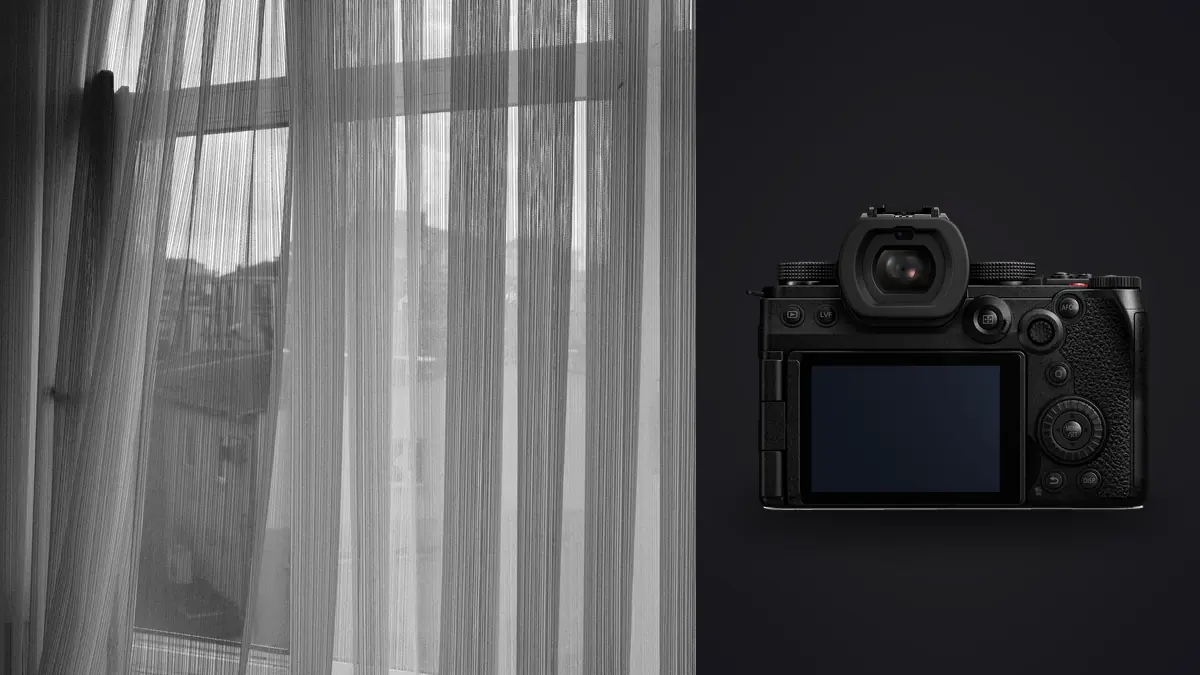
I picked up a Panasonic Lumix S5IIx eighteen months into shooting boudoir, mostly because I was tired of my previous body hunting for focus every time a subject shifted her weight on the bed. It wasn't a genre-specific purchase. Panasonic markets the IIx squarely at hybrid video shooters, with the internal ProRes recording, waveform monitor, and active cooling fan to prove it. None of that is why it ended up being the right camera for this work. What sold me was quieter: the autofocus finally trusted skin and fabric the way it used to only trust eyes in bright daylight, and the in-body stabilization let me leave the tripod in the car for entire sessions.
This isn't a spec-sheet rundown. It's what actually changes when you point this camera at a client on a hotel bed with one window and no assistant.
The Sensor Matters Less Than the Stabilization Does
The S5IIx carries the same 24.2-megapixel full-frame sensor as the standard S5II, with the same dual native ISO setup that switches its base sensitivity around ISO 640 in most picture profiles. On paper that's a mid-range spec next to the 33MP and 61MP bodies other photographers in this genre sometimes reach for. In practice, 24 megapixels is plenty for boudoir. Clients buy an 11x14 print, a phone wallpaper, or a small album. Nobody is cropping a boudoir frame down to a postage stamp and blowing it up on a billboard, so the resolution argument that matters for landscape or product work mostly doesn't apply here.
What does matter is the 5-axis in-body stabilization, rated by Panasonic at up to 8 stops when paired with a Dual I.S. 2 lens like the Lumix S 24-105mm f/4. I shoot boudoir almost entirely without flash now, working window light or a single continuous LED, and that means shutter speeds regularly drop into the 1/60 to 1/30 range indoors. Handheld, with a body that size, that used to mean a real hit rate penalty from camera shake on anything softer than 85mm. With the S5IIx I can hold 1/30 at 50mm and get a sharp frame more often than not, as long as the subject herself isn't moving. That's the trade this camera makes for you: it can't stop a person from shifting mid-exposure, but it removes your own hands as a variable, which in a genre built on slow, quiet direction is most of the battle.
Autofocus in a Genre Where Half the Frame Is Deliberately Soft
Boudoir autofocus is a strange problem. You're usually shooting wide open, f/1.4 to f/2, with a plane of focus that might be four inches deep at portrait distances. The eye needs to be tack sharp. Everything six inches behind it, including the far side of the face, can fall off completely and nobody minds. That means the autofocus system needs to lock onto an eye through hair, through a raised arm, through sheer fabric, and hold it there while a client moves through a pose rather than holding still for it.
The S5IIx's phase-hybrid AF system, inherited from the S5II, is a real generational jump over the original S5's contrast-detect-only implementation. Eye and face detection track through partial occlusion far better than I expected, including through lace and through hair falling across the face, which used to be a guaranteed hunt-and-miss situation on my old body. It's not flawless. In dim, warm lamp light, the system occasionally locks onto a shoulder or a pillow edge instead of an eye, especially with low-contrast skin tones against light bedding. My workaround is to switch to a single small AF area and place it manually rather than trusting full-frame tracking in low, mixed light. It costs a second per shot but it's a second I'd rather spend than review 200 frames later and find the focus landed on a collarbone.
The Electronic Shutter Changes the Room, Not Just the Image
This is the feature nobody puts in a review but that changes a shoot the most. Boudoir clients are, almost without exception, nervous for the first fifteen minutes. A mechanical shutter clacking away next to someone who's already self-conscious keeps reminding them a camera is documenting the moment. Switch the S5IIx to its fully silent electronic shutter and that sound disappears. The room gets quieter, the client stops flinching at the click, and direction starts to feel more like a conversation and less like a photo shoot.
There's a real limitation to know about before you rely on it: the electronic shutter caps flash sync well below what a mechanical shutter allows, and rolling shutter can show up as skew on fast movement, like hair being flipped or fabric snapping. For anything with a strobe or with quick motion I still switch back to the mechanical shutter. But for the 80 percent of a boudoir session that's slow posing under window or continuous light, silent shooting is the single biggest quality-of-life upgrade this camera gave me, ahead of resolution, ahead of dynamic range, ahead of anything on the spec sheet.
Working Light Without a Studio
Almost every boudoir session I shoot happens in a bedroom, a hotel suite, or an Airbnb, not a studio with modifiers on stands. Here's roughly where I start the S5IIx in the light situations that come up most, before adjusting to taste:
| Light Source | Aperture | Shutter | ISO | Why |
|---|---|---|---|---|
| North-facing window, overcast day | f/2 | 1/160 | 400 | Soft, even light lets you shoot wide for skin softness without losing shutter speed |
| Bedside lamp only, evening | f/1.4 | 1/60 | 4000 | Dual native ISO keeps noise manageable this high; IBIS covers the slow shutter |
| Sheer curtain, backlit midday sun | f/2.8 | 1/500 | 200 | Faster shutter needed to avoid overexposing the direct highlight through the fabric |
| Single strobe, shoot-through umbrella | f/4 | 1/160 (sync) | 100 | Mechanical shutter required here; electronic shutter won't sync reliably at this speed |
| Dimmable LED panel, warm gel | f/1.8 | 1/125 | 1600 | Continuous light means what you see in the EVF is close to the final exposure |
The dual native ISO is the quiet hero of the lamp-only row. Above roughly ISO 3200 on most full-frame bodies I've used, boudoir skin starts to look waxy as noise reduction kicks in during in-camera processing, or grainy if you shoot RAW and leave it alone. The S5IIx's second native ISO point keeps noise more film-like than digital-blotchy up to around ISO 6400, which in a genre this dependent on skin texture reading naturally is a genuine difference, not a marketing bullet.
Lenses Worth Actually Owning for This Kind of Work
The L-mount lineup is smaller than Sony's E-mount or Canon's RF, but the lenses that exist for it are unusually well suited to close, intimate portrait work.
| Lens | Focal Length | Max Aperture | Best For | Watch Out For |
|---|---|---|---|---|
| Lumix S 85mm f/1.8 | 85mm | f/1.8 | Tight detail crops, flattering compression on close-up poses | Needs 8+ feet of working distance, tough in small hotel rooms |
| Sigma 65mm f/2 DG DN | 65mm | f/2 | Full-body poses and environmental frames in an average bedroom | Focus ring feel takes some adjustment coming from Panasonic glass |
| Lumix S 50mm f/1.8 | 50mm | f/1.8 | Budget-friendly, works the whole room without stepping back | Visible softness in the corners wide open |
| Lumix S 24-105mm f/4 | 24-105mm | f/4 | Scouting a new location, behind-the-scenes footage | f/4 rarely gets the separation clients actually want as the hero shot |
If I had to keep exactly one lens on this body for a boudoir day, it's the 65mm. It's wide enough to work a cramped hotel room without backing into a wall, tight enough to still compress the background nicely, and the close focus distance is short enough to get detail shots of jewelry or lace without swapping glass mid-session.
Where It Falls Short for This Specific Job
None of this is a paid endorsement, so it's worth being honest about the parts of the S5IIx that don't earn their keep in a boudoir context. Panasonic stripped the top status LCD that the standard S5II has, in favor of the video-oriented features, and the active cooling fan adds both weight and a small amount of bulk you'll feel by hour three of a handheld session. You're also paying a real price premium for ProRes recording, waveform monitoring, and unlimited 4K60 recording, none of which a stills-only boudoir photographer will likely ever touch unless you're building out behind-the-scenes reels to sell alongside the stills. If you never plan to record video with this body, the standard S5II gets you the same sensor, the same autofocus, and the same stabilization for meaningfully less money.
Battery life is also worth planning around. A full boudoir session with wardrobe changes, review breaks, and continuous EVF use runs three to four hours easily, and it can go through a battery and a half in that window with the fan and stabilization both drawing power. I carry two spares now; I didn't used to need that with a smaller mirrorless body.
What Happens After the Shutter: Culling a Session You Can't Show Everyone
Boudoir produces a specific kind of editing problem that other genres mostly don't. A typical session gives 400 to 600 frames across a dozen poses, and because the images are personal and often only ever seen by the subject and her partner, there's no team of assistants or a public portfolio review to help narrow it down. It's me, alone, going through hundreds of very similar frames of the same pose trying to find the one where the expression, the hand position, and the focus all land together.
This is where I stopped trying to do the first pass by eye. I run the export through imagic before I ever open Lightroom, using its local sharpness and focus scoring to flag which frames in each burst are actually critical-sharp on the eye rather than close-but-not-quite, and its duplicate and burst clustering to group the eight or nine near-identical frames from a single pose into one stack instead of scrolling past them individually. It cuts the first review pass from a couple of hours down to something closer to twenty minutes, which matters when you're doing this after a full shoot day. If you're still hand-scrolling every frame at 100 percent to judge focus, this is the same idea behind a lot of the general workflow advice in our faster photo workflow piece, just applied to a genre where the volume per session is unusually high.
The other piece that's specific to this genre is privacy. Boudoir files are about as sensitive as photography gets, and clients ask, reasonably, where their images go during editing. Because imagic processes everything locally on the machine rather than uploading to a cloud service, you can tell a subject honestly that their files never leave your laptop during culling and editing. It's also a one-time purchase rather than a subscription, so it's not a recurring line item to justify in a genre where margins per session already get squeezed by wardrobe, location fees, and album production.
For the actual edit pass, I lean on imagic's apply_my_style feature, which trains a preset from my own previously edited files rather than a generic filter pack. Boudoir color grading has a narrow acceptable range: skin needs to stay warm and true without sliding into orange, and shadows need to hold detail in dark lingerie and dark bedding without crushing. Because the preset is trained on my own past edits rather than someone else's LUT pack, it gets close enough on the first pass that most images only need small local adjustments rather than a full grade from scratch.
Frequently Asked Questions
Is the S5IIx overkill if I only shoot stills and never touch video?
Mostly, yes. You're paying for ProRes recording, waveform and vectorscope monitoring, and active cooling that a stills-only boudoir workflow won't use. The standard S5II shares the same sensor, autofocus system, and in-body stabilization for less money. The IIx makes sense if you're also selling behind-the-scenes video content or building reels alongside the stills, otherwise it's money better spent on lenses or lighting.
Can I really skip a tripod for an entire session with this body?
For most of a session, yes, as long as the client is holding a pose rather than moving through it. The stabilization compensates for your hand shake, not for subject motion, so at very slow shutter speeds a pose that involves any movement, like hair being tossed or fabric shifting, will still soften. I keep a small tabletop tripod in the bag for the handful of setups where I want a slower shutter and a completely still subject, but it stays in the bag more often than it comes out.
What ISO would you actually push to before skin texture starts to suffer?
Around ISO 6400 is where I start being more careful, and past 12800 I'm usually switching to a faster lens or adding a small amount of continuous light rather than pushing further. Below 6400, the dual native ISO design keeps grain looking closer to film texture than digital noise, which actually helps skin read naturally. Past that point noise reduction in post starts smoothing texture in a way that reads as artificial in a genre where skin detail is the whole point.
Does the flip-out screen actually help in a small bedroom or hotel room?
More than I expected before I owned the camera. Boudoir often means shooting from low angles near the foot of a bed or from an awkward corner where a room doesn't give you space to stand behind the camera normally. Being able to angle the screen out and down lets me compose from the hip or from a low kneeling position without contorting to look through the viewfinder, which in a cramped hotel room is a real, repeated advantage rather than a one-time convenience.