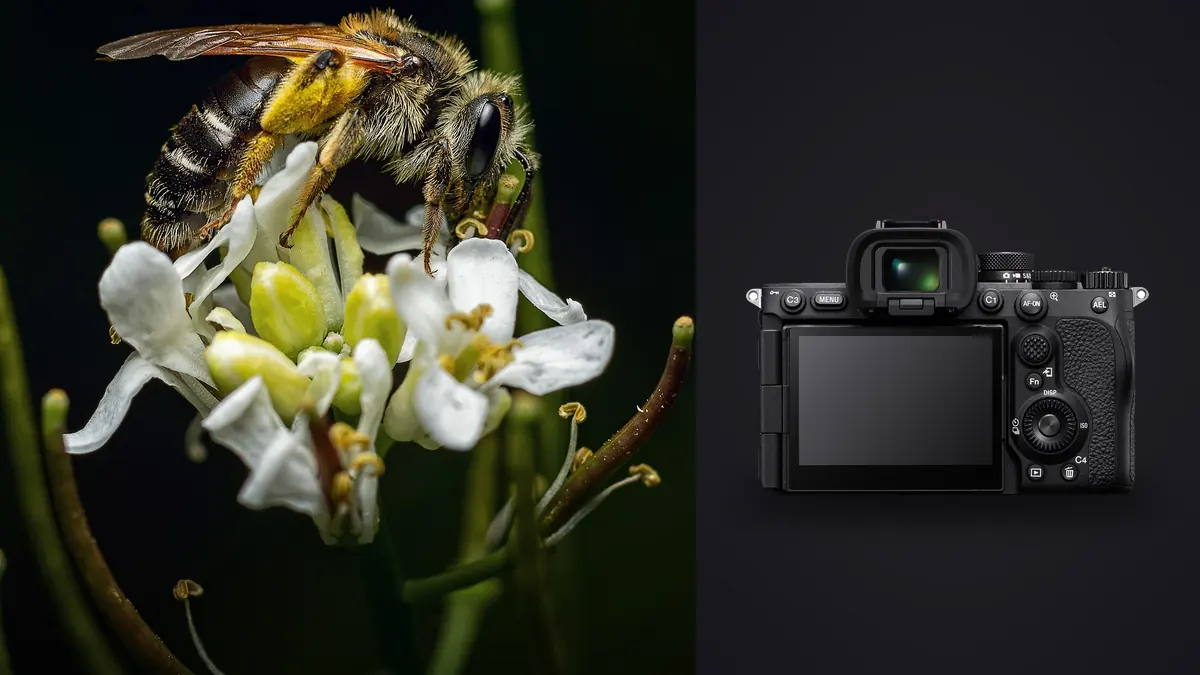
The first thing that changes when you point a Sony A7R V at a jumping spider instead of a landscape is your relationship with the shutter button. On a tripod at f/11 for a vista, you fire once and check the histogram. On a damselfly that might launch in a quarter second, you fire in bursts, you miss focus more than you'd like to admit, and you go home with a card full of near-duplicates that all look identical until you pixel-peep at 100%. This piece is about how the A7R V actually holds up for that kind of shooting, not the marketing version of it.
Why this camera even comes up for bugs
Most macro shooters land on the A7R V for one of two reasons: the 61-megapixel sensor gives room to crop into a subject that filled less of the frame than planned, or the subject-recognition autofocus system now includes an "Insect" category that Sony added through firmware rather than shipping as a launch feature. Neither reason is hype. Both come with real caveats once you're crouched in wet grass trying to get a hoverfly's compound eyes in focus before it moves.
The resolution question matters more for insects than for most other genres, because working distance is often the limiting factor, not focal length. A mantis will tolerate a lens six inches away far better than it'll tolerate you closing to three inches for more magnification. Having 61 megapixels of headroom means you can back off, shoot a little looser, and crop in post without the file falling apart. That's a genuinely different way of composing than fighting for 1:1 or 2:1 magnification in-camera every single time.
The insect-recognition AF, in practice
Sony's subject recognition was trained to detect head and eye position across categories like birds, animals, and insects, and it does track an insect's body reasonably well when the whole subject is visible against a plain background like a leaf or a flower petal. Where it struggles is exactly where macro shooting gets hard anyway: an insect half-hidden in foliage, legs and antennae breaking up the outline, or a subject small enough in the frame that the recognition engine can't confidently separate it from the clutter behind it. In those cases I've had better luck falling back to a small flexible spot and manual focus assist than trusting the AI box to lock onto, say, a stick insect that looks exactly like the twig it's standing on.
Where the recognition AF earns its keep is fast-moving, high-contrast subjects: dragonflies perched with wings up, bees working a flower head, butterflies with wings open on a sunlit stone. In good light with a clean background, the hit rate on eye-level sharp frames climbs noticeably compared to shooting the same scene on an older body without insect-specific tracking.
Lenses that actually pair well with it
The body is only half the story. A7R V bodies get paired with a fairly narrow set of macro lenses in practice, and each one changes the shooting experience in a way that's worth knowing before you buy.
| Lens | Max magnification | Working distance at 1:1 | Autofocus | Best for |
|---|---|---|---|---|
| Sony FE 90mm F2.8 Macro G OSS | 1:1 | ~130mm | Fast, native, OSS built in | Skittish insects, general macro plus portraits |
| Sigma 105mm F2.8 DG DN Macro | 1:1 | ~120mm | Fast, native mount, no OS | Budget-conscious buyers who already shoot with a gimbal or tripod |
| Sony FE 50mm F2.8 Macro | 1:1 | ~30mm | Fast, compact, no OSS | Static subjects, product-style macro, travel weight |
| Laowa 90mm F2.8 2x Macro APO | 2:1 | ~100mm | Manual focus only | Extreme magnification on cooperative or dead subjects |
| Sony FE 200-600mm + extension tube | ~0.5:1 (with tube) | 600mm+ | Fast, native | Dragonflies, wasps, anything that won't let you get close |
The 90mm G OSS is the one most people end up with, and for good reason: the built-in stabilization pairs with the A7R V's in-body 5-axis system to give a genuinely usable handheld margin, even at high magnification where camera shake gets amplified along with everything else. The 50mm is tempting because it's small and cheap, but a 30mm working distance means you're basically breathing on the subject, which spooks anything with a nervous system worth mentioning. The long-lens-plus-tube approach isn't a real macro setup in the strict sense, but for dragonflies perched over water where you can't wade closer, it's the only option that produces a usable frame at all.
Settings that hold up outdoors
Studio macro advice about f/16 and a focus rail doesn't transfer cleanly to a live subject that might fly off. In the field I've settled into a narrower set of habits:
- Aperture around f/8 to f/11. Wide enough to keep shutter speed reasonable, narrow enough to get more than a hair's width of depth of field on an insect's face. Past f/13 or so, diffraction starts eating into that 61-megapixel resolution advantage, so there's a real ceiling here.
- Shutter speed no slower than 1/500s for anything with wings, faster for damselflies which can reposition faster than you'd expect. Stabilization helps with camera shake, not subject motion.
- Auto ISO with a cap around 6400. The sensor handles noise reasonably well through 3200, and shadow detail holds up in post better than most people assume from a high-resolution sensor, but past 6400 the file starts fighting you during any real edit.
- Focus bracketing at 3-5 frames, small step width, for anything that will sit still for two seconds. The built-in bracketing function is genuinely useful for stacking a mantis or a resting butterfly, but it's useless for anything actively moving, so know which mode you're in before you commit to it.
On flash: a small diffused ring or twin-flash setup lets you shoot at f/13-f/16 without the ISO climbing into unusable territory, and it freezes wing motion far more reliably than shutter speed alone. The tradeoff is that flash-lit insect photos have a distinct look, and not every subject or background suits it. Overcast natural light with a reflector is slower to work with but produces softer, more natural color that some editors (and some clients, if this is for stock or print) prefer.
Battery and card management on longer sessions
A morning of insect macro shooting with continuous AF-C and burst shooting drains a battery faster than most other genres, mostly because you're holding focus and firing in short bursts constantly rather than composing single frames. I carry two spares minimum for a half-day session and format a fresh card rather than trusting whatever's left on the one from last week. The files are large at 61 megapixels, and a burst of twelve frames chasing a bee that never lands cleanly adds up in gigabytes faster than it feels like it should in the moment.
The part nobody mentions: what happens after the shoot
A single morning chasing dragonflies with the A7R V easily produces 800 to 1,500 frames once you count every burst, every bracket sequence, and every "just in case" shot of a subject that might fly off mid-sequence. Most of those frames are duplicates of each other by a few pixels of focus shift, and sorting them by eye on a laptop screen is genuinely one of the worst parts of macro work. I run mine through imagic afterward specifically because its local sharpness scoring can tell the difference between a frame where the compound eye is tack sharp and one that's a hair soft, which matters enormously at this kind of magnification where "close enough" usually isn't. It also clusters near-duplicate bursts automatically, so instead of scrubbing through forty frames of the same hoverfly by hand, you're reviewing four or five actual candidates.
Because it processes everything locally rather than uploading to a cloud service, it's also one of the few tools I trust to run at a campsite or a nature reserve with no signal, which is where a lot of this shooting actually happens. That offline part isn't a minor convenience for this genre; it's often the difference between culling that evening and culling a week later once you're back near wifi and the memory of which frame was actually sharp has faded.
The other piece that's saved real time is the apply_my_style preset feature, which trains on your own past edits rather than a generic filter. Macro insect files tend to need a consistent, fairly specific treatment (controlled highlights on shiny exoskeletons, careful shadow lift so legs and antennae don't disappear into black), and once that look is dialed in on a handful of reference edits, having it apply consistently across a big batch means less time nudging sliders on frame four hundred of a session. If you're new to building that kind of consistent culling and editing habit, it's worth reading through how AI photo culling actually works before assuming manual review is the only option for a burst-heavy genre like this one.
Where the camera falls short
None of this is a review that ends in unqualified praise. A few honest limitations:
- Rolling shutter on the electronic shutter can distort fast wing motion if you're shooting silent mode to avoid spooking a subject. For anything with rapidly beating wings, the mechanical shutter is still the safer choice even though it's louder.
- The insect recognition mode sometimes locks onto the wrong subject when there are two insects in frame, jumping between them rather than committing to the nearer one. A manually placed focus point avoids this but costs you reaction speed.
- Heat and humidity in the kind of environments where insects are most active (wetlands, dense undergrowth, mid-summer heat) aren't kind to any camera body over a long session, and the A7R V isn't specially sealed against either in a way that changes the calculus.
- File size adds friction everywhere downstream, from card capacity to backup time to how long a laptop takes to generate previews. The resolution that helps with cropping also taxes every other part of the workflow.
If your current workflow is already creaking under the weight of high-resolution bursts, it's worth a look at general habits for cutting review time down, independent of which camera produced the files; a faster photo workflow tends to matter more for burst-heavy macro shooters than for almost any other genre, simply because of volume.
Frequently Asked Questions
Does the Sony A7R V's insect recognition actually work better than generic animal-eye AF for bugs?
In good light against a clean background, yes, noticeably. The system was trained to look for the segmented body shape and antennae pattern rather than the more mammalian eye shape that "Animal" recognition expects, so it locks on faster and holds more reliably on genuine insects. Against cluttered foliage or on well-camouflaged subjects, the advantage shrinks and manual focus point placement often wins.
Is 61 megapixels overkill for macro insect photography?
Not overkill exactly, but it's a tradeoff rather than a pure upgrade. The extra resolution gives real cropping flexibility when you can't physically get closer to a subject, which happens constantly with insects that won't tolerate a close approach. The cost is file size, slower buffer clearing on long bursts, and a workflow that needs faster storage and more deliberate culling to stay manageable.
What's the best lens to start with if I'm new to insect macro on this body?
The Sony FE 90mm F2.8 Macro G OSS is the practical starting point for most people. It balances working distance, native autofocus speed, and built-in stabilization in a way none of the alternatives quite match, even though it costs more than the Sigma 105mm alternative.
How many shots should I expect to keep from a typical macro insect session?
Keep rates vary wildly by subject, but a realistic range for a productive session is somewhere between 3% and 8% of total frames captured as genuinely sharp, well-composed keepers, once bursts and focus brackets are accounted for. That low percentage is normal for the genre, not a sign anything went wrong, and it's exactly why culling tools matter more here than in most other kinds of photography.
None of this replaces field time. The camera and lens choices narrow the odds in your favor, but the actual skill in insect macro is still patience, knowing insect behavior well enough to predict the next two seconds, and being willing to lie in wet grass longer than feels reasonable for one sharp frame of a fly's compound eye.