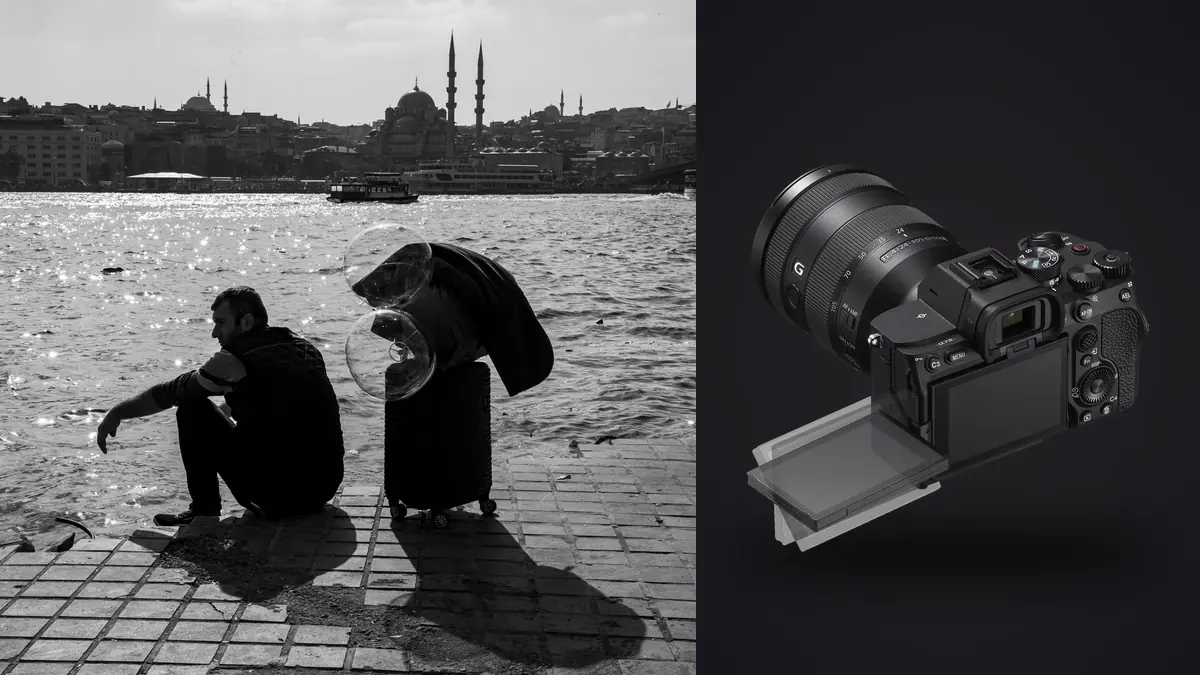
I picked up the A7 IV about eight months after it replaced the A7 III, mostly because a documentary project fell into my lap and I needed a second body that could handle both quiet observational work and the occasional fast-moving scene without me swapping settings every ten minutes. Street and documentary work are not the same discipline, even though people lump them together constantly. Street photography rewards a camera that disappears. Documentary work rewards a camera that keeps up when the moment stops being polite and starts moving. The A7 IV sits in an odd middle ground between the two, and after using it on three separate long-form projects, I have opinions about where that middle ground helps and where it gets in the way.
The Size Problem Nobody Talks About Enough
Full frame mirrorless bodies got smaller than DSLRs, but they didn't get small. The A7 IV with a battery and card in it weighs close to 660 grams for the body alone, and once you put a 35mm f/1.8 or a 24-70mm on the front, you're carrying something that reads as "photographer with a camera" to everyone around you. That matters more in street work than most gear reviews admit. A Ricoh GR III in your jacket pocket gets you shots a visible A7 IV never will, because people behave differently around a camera that looks like a camera versus one that looks like a phone.
Where the size stops being a liability is documentary assignments where you're embedded long enough that subjects stop performing for the lens. On a three-day shoot following a family-run bakery through a health inspection dispute, nobody cared what I was holding by hour four. The grip on the A7 IV is genuinely good for extended handheld carrying, better than the A7 III's grip, and that matters when you're holding a camera up to your eye for six or seven hours across a day with breaks that never come when you want them.
Autofocus in a Crowd Is a Different Test Than Autofocus in a Studio
Sony's real-time tracking gets talked about constantly, and most of that talk is generated in controlled conditions: one subject, decent light, minimal occlusion. Street and documentary work throws none of that at you. You get partial faces behind other people's shoulders, subjects walking through pools of shade and sun in the same three steps, and reflections in shop windows that the AF system sometimes locks onto instead of the person you actually want.
What I've found reliable: eye AF holds on to a face reasonably well even at 70-80% occlusion, as long as the visible portion includes part of an eye or eyebrow. What I've found unreliable: subject tracking initiated on a moving person in a dense crowd tends to jump to the nearest high-contrast edge if your initial touch point wasn't precise, and in a market or transit station that edge is frequently someone's shoulder, not their face. My workaround is to shoot in wide-area tracking with a small centered zone rather than full-frame tracking when the scene is chaotic, and switch to flexible spot only when I have time to compose deliberately, which on the street is maybe one frame in five.
Where the Sensor Actually Earns Its Keep
The 33-megapixel sensor is not a spec I cared about going in. I cared about it a lot by the end. Street and documentary shooting both involve cropping after the fact more than people admit, because you don't always have time to walk closer, and pulling a subject out of a wider frame at 33 megapixels leaves you with a usable file in a way that a 24-megapixel crop often doesn't. On a protest coverage assignment last spring, half my usable frames were crops of wider shots where getting physically closer wasn't safe or practical.
The tradeoff is file size. A day of documentary shooting at 800-1200 frames in compressed RAW eats storage fast, and the buffer on the A7 IV, while decent, is not built for sustained 10fps bursts at full resolution. You get roughly 1000 shots in compressed RAW before the buffer chokes, which sounds like plenty until you realize a chaotic five-second burst during a confrontation or a parade float passing can eat 40-60 frames on its own, several times in a day.
Low Light Without a Flash
Documentary work indoors, at dusk, in venues with terrible mixed lighting, is where the A7 IV's sensor generation shows its age a little compared to the newer A7R V or A9 III, but it's still genuinely usable up through ISO 6400 with acceptable noise for editorial or documentary delivery, and I've pushed to 12800 on black-and-white conversions where noise reads as grain rather than a flaw. What helped more than raw ISO ceiling was the in-body stabilization, rated around 5.5 stops, which let me shoot handheld at 1/15s with a 35mm lens in a dim community hall and get sharp frames on maybe two out of three attempts. That's not a number I'd bet an assignment on for a single decisive frame, but across a burst of six or eight, one comes out clean often enough.
How It Stacks Up Against What Street Shooters Actually Compare It To
Nobody buying an A7 IV for street work is cross-shopping it against a sports body. The real comparison set is smaller, quieter cameras and the A7C II, which shares the sensor but drops the size. Here's how they actually compare on the things that matter for this genre specifically, not the full spec sheet.
| Camera | Body weight | Viewfinder | Max shutter (silent) | RAW buffer (approx.) | Discretion on the street |
|---|---|---|---|---|---|
| Sony A7 IV | ~659g | 3.68M-dot EVF, 0.78x | 1/8000s | ~1000 compressed | Low. Reads as a serious camera immediately. |
| Sony A7C II | ~514g | 2.36M-dot EVF, 0.7x | 1/8000s | ~1000 compressed | Moderate. Rangefinder shape helps, EVF is cramped for long sessions. |
| Fujifilm X100V | ~478g | Hybrid optical/EVF | 1/4000s (mech), 1/8000 electronic (crop) | ~15-17 frames buffered | High. Fixed lens body reads as a hobbyist's camera to most bystanders. |
| Ricoh GR III | ~257g | None (optional add-on) | 1/4000s | ~10 frames buffered | Very high. Fits in a jacket pocket, near-invisible in use. |
The A7 IV wins on file quality, buffer depth for documentary bursts, and autofocus sophistication. It loses on every axis that matters for pure street discretion. If your work is 80% street candids and 20% documentary, I'd actually steer you toward the X100V or a used A7C for the primary body and keep something like the A7 IV as a second camera for the days you know will need reach and tracking. If it's reversed, closer to 80% documentary work where you're embedded and visible anyway, the A7 IV's advantages stop being theoretical.
Lens Choices That Actually Get Used
I own four lenses that see regular use on this body for this kind of work, and I'll be specific about what each one is actually for rather than repeating spec sheet language.
- Sony 40mm f/2.5 G: my default. Close enough to how the eye sees a scene that compositions feel natural without thinking, small and light enough that the body doesn't feel front-heavy, and sharp wide open, which matters because I shoot it wide open most of the time.
- Sony 35mm f/1.8: the low-light option when the 40mm's f/2.5 isn't enough. Slightly wider than I'd choose by default but the extra stop and a third matters more some nights than the focal length preference.
- Sigma 24mm f/3.5 DG DN: for tight interiors and documentary scenes where I need environmental context, a cramped kitchen, a small apartment, a crowded backroom. Not a lens I reach for outdoors.
- Sony 70-200mm f/4 G: the odd one out, used maybe one shoot in five, for documentary situations where getting physically close would change the behavior of the subjects, courtroom-adjacent coverage, or events with a hard perimeter.
What I don't own and don't recommend for this genre specifically is the 24-70mm f/2.8 GM. It's an excellent lens and a terrible street lens. It's heavy enough that a full day of handheld carrying wears on your shoulder in a way that changes how many frames you're willing to lift the camera for, and that's the opposite of what you want when the job is staying alert for six or eight hours straight.
The Part After the Shoot That Nobody Budgets Time For
A documentary day at 900-1200 frames turns into a real problem the moment you get home and open the folder. Culling that volume by eye, zooming into every frame to check focus on a face that was moving through a crowd, takes longer than the shoot itself if you do it carefully, and doing it carelessly means missing the one frame in a burst of eleven where the expression actually landed. This is the part of the workflow that quietly burns more hours over a year than any camera setting decision does.
I run everything through imagic before I touch Lightroom now. It scores sharpness and focus locally on the machine, no cloud upload, which matters to me on projects where the subjects haven't necessarily consented to their images leaving my hard drive before I've made editorial decisions about what gets used. On a burst of fifteen frames from a fast-moving street scene, it flags the two or three that are actually sharp on the subject rather than the background, and it clusters the near-duplicate frames from a burst so I'm not scrolling through eleven visually identical shots deciding which one is a hair sharper. That alone cut a four-hour cull session down to something closer to ninety minutes on the bakery project I mentioned earlier. If you want more detail on how that scoring approach actually works under the hood, I wrote about it separately in how AI photo culling works.
The other thing I've leaned on is the apply_my_style preset training. I shoot black and white for most documentary work and a warmer, slightly desaturated color treatment for street frames, and instead of rebuilding presets from scratch or hunting through old edits, I trained it on a batch of my own finished edits and it applies a first pass that's close enough that I'm adjusting rather than starting over. It's not magic and it doesn't replace judgment on a per-image basis, but as a starting point across a big batch it saves real time, especially on deadline days when a paper wants selects within hours of an event ending.
Custom Button Layout for Fast, Quiet Shooting
A few settings changes made a bigger difference to actual usability than anything in the menu system's default state:
| Control | My assignment | Why |
|---|---|---|
| AF-ON button | Eye AF with hold | Keeps focus and shutter release decoupled, critical when a subject's face reappears from behind an obstruction |
| C1 (front) | Silent shutter toggle | One-press switch between mechanical and fully silent electronic shutter for sensitive documentary moments |
| C2 (top) | APS-C crop toggle | Instant 1.5x reach without a lens change, useful when a scene tightens up faster than I can reposition |
| Rear dial | ISO | Fastest way to compensate for a subject moving from shade to direct sun mid-sequence |
The silent shutter mode deserves its own note. It's genuinely silent, no rolling shutter warble that you'd notice in most street subject motion, and it changed how I shoot indoor documentary scenes, funerals, courtrooms, small religious gatherings, where a mechanical shutter clack draws heads. The tradeoff is that silent mode caps your flash sync and can introduce banding under certain flickering artificial lights, so I switch back to mechanical the moment I'm under fluorescent tube lighting at a slow shutter speed.
Frequently Asked Questions
Is the Sony A7 IV too big and loud to shoot candid street photography?
It's not too loud, the electronic silent shutter mode handles that completely, but it is visually bigger than a rangefinder-style body, and that changes how strangers react to you before you've even raised the camera. If pure candid discretion is your top priority, a smaller body will get you closer, more unguarded moments. If you're doing documentary work where you're already a visible presence, the size stops mattering as much.
What ISO can I realistically push to on the A7 IV for evening documentary work without a flash?
I treat ISO 6400 as the practical ceiling for anything I plan to share, with 12800 usable specifically for black-and-white conversions where the noise pattern reads as grain instead of a defect. Past that the color shifts and detail loss start showing even in web-sized exports.
Does the buffer actually hold up during a fast-moving documentary scene, like a confrontation or a march?
For most real bursts, yes. You're looking at roughly 1000 frames in compressed RAW before it slows, which covers almost any single burst you'd shoot in the field. Where it gets tight is a day with several long bursts back to back with no pause to let the buffer clear, which happens more often in protest or breaking-news coverage than in planned documentary sessions.
Is the 33-megapixel file size worth the storage and culling overhead for street work specifically?
For pure street photography where you're rarely cropping aggressively, honestly, not always. It's most valuable when you know you'll be cropping in post or delivering large prints. If storage and cull time are real constraints, shooting compressed RAW and leaning on a tool that clusters bursts and flags sharp frames automatically (I use imagic for this) keeps the overhead from compounding into hours of manual sorting after every shoot.
Does in-body stabilization actually replace a faster lens for low light street work?
No, and I'd be careful trusting it to. It helps you hold a slower shutter speed steady, which is useful for static or slow-moving subjects, but it does nothing for subject motion blur. A person walking toward you at 1/15s will blur regardless of how steady your hands are, so it's a tool for stationary or slow scenes, not a substitute for a wider aperture when your subjects are moving.