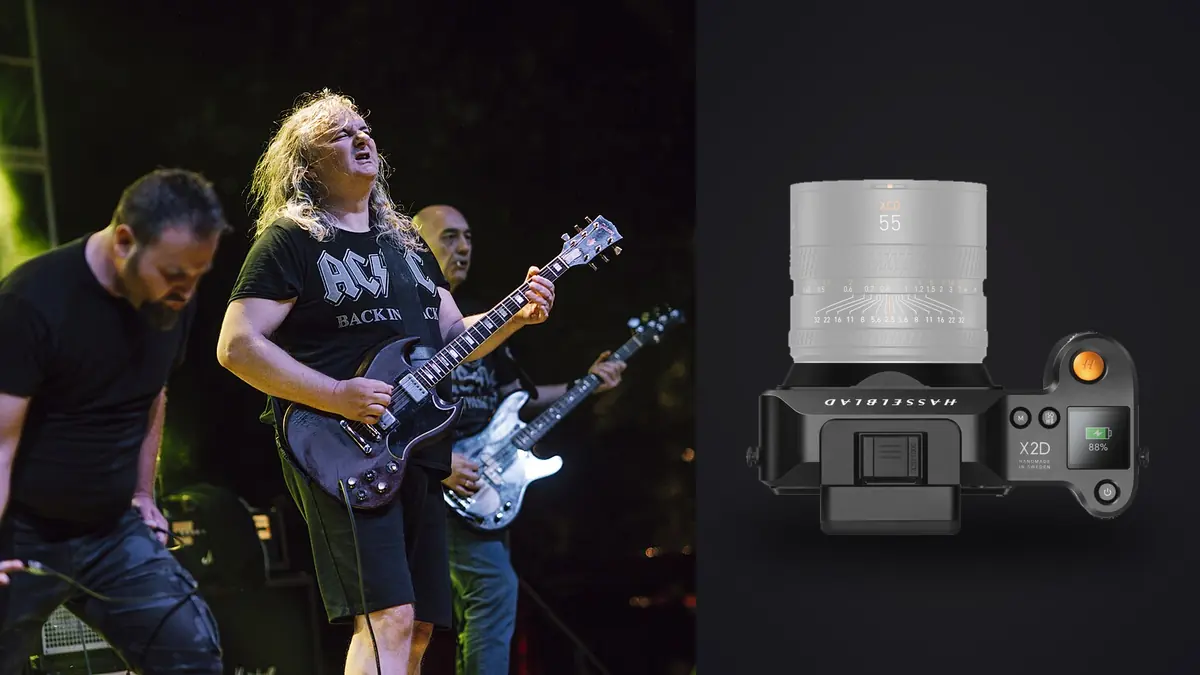
A tour photographer I know carries two bodies into every pit: something fast for the first three songs, and something slower for the acoustic encore when the house lights come down and nobody is jumping off a monitor wedge. When I told her I wanted to test a Hasselblad X2D 100C at a show, she laughed and asked if I was planning to shoot from the balcony. That reaction is basically the whole story of medium format at a live gig. It is not the camera anyone reaches for by default, and it is not useless either. Whether it belongs in your bag depends entirely on which part of the night you are shooting, and how honest you are willing to be about its limits.
This is not a spec sheet regurgitation. It is what actually happens when you point a 100-megapixel medium format body at a stage full of moving humans and shifting RGB washes, and what you give up compared to the full-frame bodies that dominate photo pits for good reason.
The pit clock does not slow down for a slow camera
Most touring venues still run the unwritten "first three songs, no flash" rule for accredited photographers. Security counts songs off a setlist taped to the barrier, and when the third one ends, you are walking out whether you got the shot or not. That math does not care what camera you brought. It rewards a photographer who can predict where a singer's hand will be in half a second, not one who is still waiting for a focus box to lock onto a face lit by a strobing follow spot.
Bring a body that hunts, and you lose frames you cannot get back. That is the blunt version of the argument against the X2D 100C in a pit, and it is worth sitting with before getting into where the camera actually redeems itself, because the redemption only applies to a narrower slice of live music work than the marketing photos of it slung around someone's neck at a festival would suggest.
Where the sensor genuinely helps under stage lighting
Concert lighting is brutal on dynamic range. You get a singer lit by a hard key light against a black backdrop one second, then a wash of blown-out magenta and cyan gels the next, sometimes both in the same frame when a follow spot crosses a colored wash. The 44 x 33mm sensor in the X2D 100C, shooting 16-bit color with Hasselblad's own color science, holds detail in those transitions in a way that is genuinely different from a 24 or 45-megapixel full-frame file. Pull the highlights back on an overexposed spotlight hit and you still have texture in a performer's shirt instead of a flat white blob. Push the shadows on a guitarist standing at the dark edge of the stage and the noise pattern stays fine-grained rather than clumping into the blotchy color noise you get from smaller sensors pushed the same distance.
Skin tones are the other place it shows. Concert lighting rigs throw saturated, often unflattering color at faces, and a lot of full-frame bodies need real work in post to pull believable skin back out from under a green or purple wash. The Hasselblad Natural Colour Solution does not fix this by magic, but it starts from a more forgiving place, and I noticed I was doing less selective color correction on faces than I expected to.
Contrast-detection autofocus is the real problem
Here is the part that matters most and gets glossed over in most gear roundups: the X2D 100C uses contrast-detection autofocus only. There is no phase-detection pixel array on the sensor, no subject tracking that understands a human body moving unpredictably across a stage, no eye tracking that locks onto a singer's face the instant they turn toward the crowd. For static or slow-moving subjects, contrast detection is accurate and quiet. For a drummer's head snapping through a fill, or a frontperson leaping off a drum riser mid-song, it is not built for that job and it shows.
In practice this means you shoot differently. Single-point AF, recomposed on a moment you can anticipate (the held note, the guitar solo where someone plants their feet and stays still for four bars) works fine. Trying to track a bassist pacing the stage under alternating strobe and haze gave me a real miss rate, hunting visibly in the viewfinder before it caught on, by which point the moment was gone. If your live music work is mostly seated jazz sets or acoustic performers who do not move much, this is a non-issue. If it is hardcore, punk, or anything with stage-diving, it will cost you frames every single song.
Living with roughly three frames a second
The X2D 100C shoots continuous bursts at around 3.3 frames per second, a figure driven partly by the sheer size of each 100-megapixel file and partly by the camera's medium format heritage, where burst speed was never the design priority. Compare that to the 15 to 20 frames per second you get from current full-frame mirrorless bodies built for sports and events, and the gap is not subtle.
What this does to your shooting is worth describing rather than just quoting a number. You stop spraying three-second bursts through a chorus hoping one frame lands clean, because you only get nine or ten frames in that window instead of forty. You start shooting the way photographers did with motor-drive film cameras: watch the pattern, anticipate the peak of the gesture, and fire single frames or short two-or-three-frame bursts timed to the beat rather than the movement. It is a more deliberate, more tiring way to shoot a two-hour set, and it will produce a lower keeper rate on genuinely chaotic stage moments no matter how good your timing is.
The lens lineup was not built with a mosh pit in mind
XCD glass is optically excellent and mechanically slow to work with compared to what a full-frame shooter is used to. The core prime lineup sits around f/2.5 to f/3.5 (the 38V, 55V, and 90V), which is not disastrously slow for a sensor this size given the exposure equivalence at play, but it does mean less latitude than a native f/1.4 or f/1.8 full-frame prime when you are fighting a dim support-act set with the house lights barely up. The XCD 80mm f/1.9 is the closest thing to a fast option and it is a beautiful lens, but at 80mm on this sensor you are working a tighter field of view than most pit photographers default to for a three-quarter shot from the barrier.
Reach is the bigger gap. There is no native XCD equivalent of the 70-200mm or 100-400mm zooms that photo pit regulars live on for isolating a performer from twenty feet back through a security barrier. You are working primes, changing lenses mid-set inside a cramped, jostling pit, which is a genuinely bad time. If your venue lets you shoot from a soundboard riser or a fixed elevated position rather than the barrier scrum, this matters much less.
No memory card slot changes how you think about backup
This one surprises people who have not handled the camera: the X2D 100C has no memory card slot at all. Everything writes to a built-in 1TB SSD, with tethering to an external SSD over USB-C as the alternative. There is no swapping a full card for an empty one at the barrier, no splitting a night's shooting across two cards as insurance against one failing. If the internal drive fills or something goes wrong mid-show, your options are limited in a way that would end most concert photographers' night. For a controlled studio or portrait session this is a non-issue. In a photo pit with three songs and one chance, it is a real point of failure worth thinking through before you rely on this as your only body for the night.
How it stacks up against a typical pit camera
Numbers help more than adjectives here, so here is how the X2D 100C compares against a Sony A9 II, a camera that is close to the default choice for working photo pit shooters right now.
| Spec | Hasselblad X2D 100C | Sony A9 II |
|---|---|---|
| Sensor | 44 x 33mm medium format, 100MP | 35.6 x 23.8mm full frame, 24.2MP |
| Native ISO range | 64-25600 | 100-51200 |
| Continuous burst | ~3.3 fps | up to 20 fps (electronic) |
| Autofocus | Contrast-detection only | 693-point phase-detection, real-time tracking |
| Body weight | ~895g | ~678g |
| Storage | 1TB internal SSD, no card slot | dual CFexpress/SD slots |
| Typical RAW file size | 100-200MB (3FR) | 25-50MB (ARW, compressed) |
The 100-megapixel file size tax back at the laptop
Shoot even a modest two-hour set on the X2D 100C and you can come home with hundreds of gigabytes of raw files from a single night. A 3FR file at full resolution routinely lands well over 100MB, and unlike a lot of full-frame cameras there is no compressed raw option to shrink that down without losing bit depth. That has real consequences for how you cull and edit, especially if you are shooting for a band or label with a same-day or next-day turnaround expectation.
This is where a local culling pass actually earns its keep rather than being a nice-to-have. I run these sets through imagic before opening anything in a full editor, since its sharpness and focus scoring flags which frames actually landed given how much the contrast-detection AF misses, and its duplicate and burst clustering groups the handful of near-identical frames from a slower burst rate so you are not opening the same guitar-solo moment nine times to pick one. All of that runs locally on the machine, which matters more than usual here: a lot of tour and label contracts specify that unreleased setlist photos or new stage design cannot leave your device before clearance, and nothing in this workflow touches a cloud upload. If you have not seen how the scoring logic actually works, this breakdown of how AI photo culling works covers it in more detail.
Shows and situations where I would actually bring it
Not a stadium tour, and not a pit with a barrier crush. Where the X2D 100C earns its place is smaller, calmer rooms: a seated acoustic set, a jazz trio in a listening room, a classical crossover performance where the leaf-shutter lenses stay near-silent and nobody is diving off anything. Backstage and soundcheck portraits are another strong fit, since you get the color and dynamic range benefits without needing fast tracking autofocus or a high burst rate. I also like it for festival coverage work that is really environmental portraiture between sets rather than pit shooting during them.
For that kind of work, consistency across a long shoot day matters as much as any single frame, and this is the other place imagic gets used on this camera's files: training a custom look with apply_my_style on a set of edits I am happy with, then applying it across a full night's backstage portraits so the color treatment stays consistent from the first act's soundcheck to the headliner's after-show. Doing that by hand across two hundred 100-megapixel files is a genuinely miserable afternoon. If your workflow is more about volume and speed than a single body's file size, these workflow tips are a better starting point than anything camera-specific.
What I would pack alongside it
If you are set on bringing the X2D into any kind of pit environment, do not bring it as your only body. Pair it with something fast for the opening songs and chaotic moments, and switch to the Hasselblad once the crowd settles or you move to a position where you are not fighting for space. Bring more storage than you think you need given there is no card-swap safety net, and budget real time afterward for culling, because nobody wants to hand-sort four hundred 100-megapixel files at 1am after a show. A monopod is worth it too. XCD lenses are not heavy individually, but a few hours of handheld shooting with a body this size adds up by the end of a long night.
Frequently Asked Questions
Is the Hasselblad X2D 100C fast enough to shoot a full concert?
It can, but expect a different rhythm than a full-frame body built for sports and events. The roughly 3.3 fps burst and contrast-detection autofocus work well for deliberate, anticipated moments and struggle with fast, unpredictable movement, so plan on a lower keeper rate for high-energy sets.
Why does the X2D 100C not have a memory card slot?
Hasselblad built it around a built-in 1TB SSD instead, with USB-C tethering to an external drive as the backup option. It simplifies the internal design but removes the card-swap workflow most event photographers rely on for real-time backup during a show.
Are XCD lenses fast enough for dim venue lighting?
Most of the core primes sit between f/2.5 and f/3.5, with the XCD 80mm f/1.9 as the fastest current option. That is workable for a lit main stage but tighter than what full-frame shooters typically carry for underlit support-act sets.
What is the biggest workflow change compared to a full-frame concert setup?
File size. A single night can produce hundreds of gigabytes of 100-200MB raw files, which makes fast, accurate culling far more important than it is with smaller full-frame files, and pushes storage and backup planning higher up your pre-show checklist.