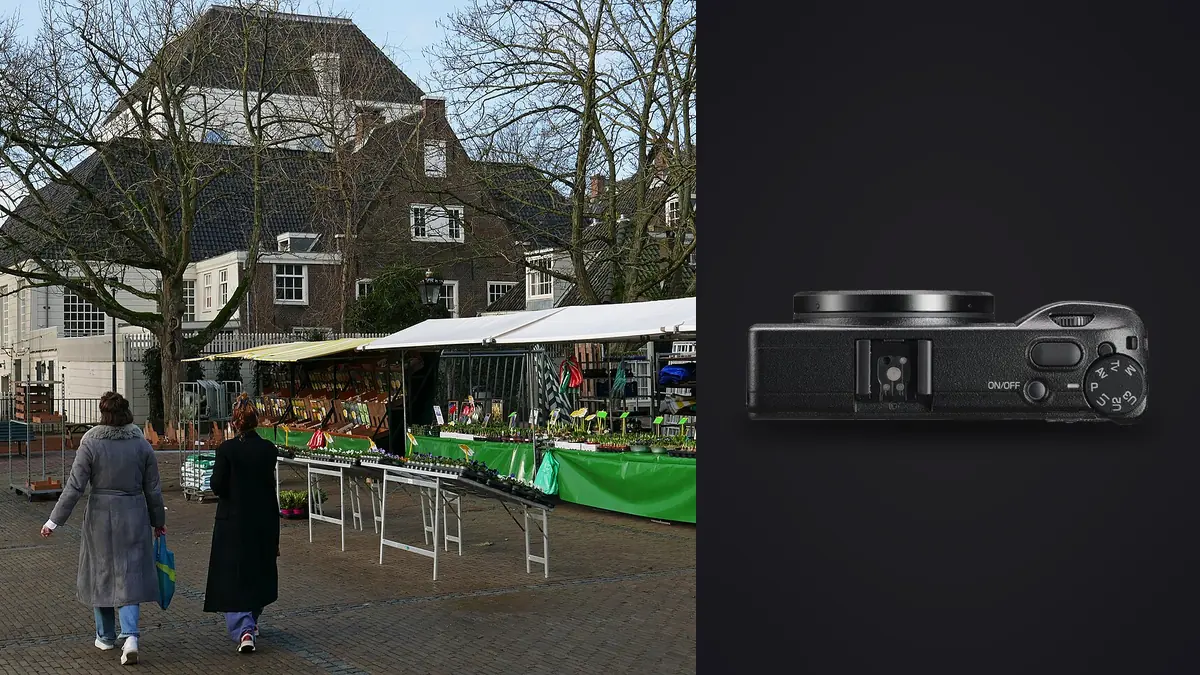
The Ricoh GR IIIx has been my carry-everywhere camera for documentary and street work for a while now, and it took me longer than I expected to trust it. Not because the image quality is lacking (it isn't) but because everything about the camera asks you to change how you shoot. If you come to it expecting a smaller GR III with a different lens bolted on, you'll be frustrated for the first few weeks. Once the 40mm equivalent framing clicks, though, it becomes one of the more honest tools I own for photographing real situations without getting in their way.
This isn't a spec-sheet review. Ricoh's own marketing already covers the megapixel count and the sensor generation. What I want to get into is what actually happens when you're working a market, a protest, a wedding's quieter margins, or a three-week documentary trip and this is the only camera in your jacket pocket.
Why 40mm Changes the Way You Work the Street
The GR series built its reputation on 28mm, and there's a whole generation of street photographers who consider that focal length non-negotiable. The IIIx breaks from that on purpose. Ricoh took the same body, the same sensor, the same control layout, and dropped in a 26.1mm lens that renders as roughly 40mm equivalent. That's a meaningfully different tool, not a minor variant.
At 28mm you're shooting environments. You include the street, the storefronts, the crowd around your subject, and you get close enough that the wide angle stops feeling exaggerated. At 40mm you're shooting people and moments inside those environments. It's closer to how your eye actually frames a scene when you're paying attention to one thing, which is exactly why Cartier-Bresson-adjacent documentary shooters have always gravitated toward 35mm and 50mm. The IIIx sits almost precisely between those two, and after a year of using it I think that's the smartest single decision Ricoh made with this variant. It forces a bit more intent into every frame. You can't rely on the wide angle to save a loose composition, so you end up walking closer, waiting longer, and cropping less afterward.
The tradeoff is real, though. In tight interiors, market stalls, narrow alleys, the kind of documentary settings where you physically cannot back up any further, 40mm runs out of room fast. I've missed frames at the IIIx's minimum working distance that a 28mm body would have handled without a second thought. If your documentary work leans heavily on cramped interiors or crowd immersion shots, the standard GR III is the more forgiving tool. If your work is about individual gestures and faces within a scene, the IIIx earns its keep.
Size, Weight, and the Body Language of Not Looking Like a Photographer
At around 262 grams with battery and card, the IIIx disappears into a jacket pocket in a way no interchangeable-lens camera manages, including the smaller mirrorless bodies people call "compact." That matters more for documentary work than most gear reviews give it credit for. A camera you can palm and pocket in two seconds changes how subjects react to you. People stop performing for the lens because half the time they don't register there's a lens.
The leaf shutter helps here too. There's no mechanical curtain slap, just a soft click that's genuinely hard to hear past a couple of feet in any environment with ambient noise. I've shot inside quiet places, small chapels, hushed waiting rooms, where an SLR shutter would have turned heads, and the GR IIIx didn't register at all. For candid documentary work that's not a nice-to-have, it's close to the whole point of the camera.
The flip side is ergonomics. This is a small, dense, angular body with no viewfinder built in (Ricoh sells an optical accessory finder separately, and it's worth having if you shoot in bright sun where the rear screen washes out). Grip fatigue is real on long days, and the control wheel and buttons are small enough that gloves are basically out of the question. I've fumbled the ISO/exposure compensation toggle more than once trying to make a quick adjustment one-handed while holding a bag, a coffee, whatever else documentary work has you juggling.
Snap Focus Is the Feature That Actually Earns Its Reputation
Every GR review mentions Snap Focus, and every one of them undersells how much it changes your shooting rhythm. Set the camera to a fixed distance (I run mine at 2 meters for most street work, closer to 1.5 meters in tight market or festival settings) and a full press of the shutter fires instantly at that distance with no autofocus hunting at all. There's a small, genuinely useful depth-of-field scale that shows up on screen so you know your effective near/far range at your current aperture.
Combined with a mid-range aperture like f/5.6 or f/8, snap focus at 2 meters gives you a working zone from roughly 1.3 meters to infinity that's acceptably sharp without you touching focus at all. That's the entire trick that makes zone-focusing street photography possible on a modern autofocus camera, and Ricoh implemented it better than anyone else currently selling a compact. You pre-focus once, then every frame after that fires the instant you press the shutter. For documentary timing, where the gap between deciding to shoot and the moment being gone can be under a second, this matters more than any autofocus benchmark.
I'll be honest about the cost: shooting wide open at f/2.8 with snap focus is a gamble. Your depth of field at 40mm and f/2.8 shrinks fast, and a half-meter misjudgment on distance will soften a face noticeably. I keep snap focus for f/5.6 and narrower and switch to single-point autofocus or manual focus with the touchscreen when I want the shallow look.
Autofocus Away From the Snap Setting
The GR III generation added hybrid phase-detection points that the GR II never had, and it's a real improvement, but I'd stop short of calling it fast in the way a modern mirrorless body with dedicated subject tracking is fast. In good light, single-point AF locks quickly enough for walking-pace street subjects. In dim interiors, at dusk, or against low-contrast backgrounds like a plain wall or overcast sky, it hunts, and it hunts in a way that costs you the shot.
There's no continuous autofocus tracking worth relying on for erratic subjects, no eye detection, nothing close to what you'd get from a current APS-C mirrorless system built around video and sports. That's fine for documentary work, which is rarely about fast unpredictable motion, but it means you plan around the limitation rather than trusting the camera to bail you out. My workaround on anything with unpredictable movement, kids running through a scene, a dog cutting across a frame, is to fall back to snap focus rather than fight the AF system in real time.
Files, the JPEG Engine, and Working Fast
The 24.2-megapixel APS-C sensor with no anti-aliasing filter produces files with real bite straight out of camera, and Ricoh's in-camera Image Control profiles (Positive Film in particular, along with the high-contrast black and white preset) are good enough that a lot of working street photographers deliver JPEGs straight from the card for quick-turnaround editorial work. I still shoot RAW plus JPEG for anything that matters, because the DNG files hold up well to recovery in shadows and highlights, but the JPEG engine earns its reputation. It's one of the few compact cameras where you could hand a client SOOC files without apologizing for them.
Where this bites you is volume. A full day of documentary shooting on a camera this easy to fire produces an enormous number of near-duplicate frames, three or four snap-focus shots of the same passing moment, a dozen variations on one scene while you wait for a gesture to land. Culling that by eye at the end of a long shoot is genuinely tedious, and it's where I lean on automated culling rather than clicking through hundreds of near-identical RAW files manually. I run the day's card through imagic, which scores focus sharpness locally on the machine and groups burst sequences and near-duplicates together, so instead of eyeballing forty frames of the same street corner I'm comparing four or five that the software has already flagged as the sharpest of each cluster. Given how much snap focus at wide apertures produces soft misses, having something check actual pixel-level sharpness rather than trusting my judgment on a small rear screen at the end of a twelve-hour day has saved more shots than I expected.
The other piece that's turned out useful is building a preset from my own edited history rather than a generic film-emulation LUT. imagic's apply_my_style feature trains on photos I've already graded, so a batch of new GR IIIx files pushed through it lands close to my usual contrast and color decisions without me manually matching every frame, which matters when you're trying to turn around a documentary set quickly. Because none of this requires uploading files anywhere, it also fits how I'd want to handle images of people photographed in the street without their knowledge in the first place, the processing stays on the laptop, not on someone else's server.
Where the Camera Falls Short for Documentary Work
Three things bother me enough to mention every time someone asks if the GR IIIx is a good documentary camera.
First, there's no weather sealing at all, and Ricoh actually removed the modest sealing the GR II had when they redesigned the III generation. I got caught in light rain on an outdoor market shoot and spent the rest of the afternoon babysitting the camera under a jacket flap instead of shooting. If your documentary work takes you outdoors in unpredictable weather regularly, this is a real limitation, not a theoretical one.
Second, battery life is thin. The DB-110 battery is CIPA-rated around 200 shots, and in practice, especially with the screen on reviewing shots between sequences, I get closer to 250 to 300 real-world frames before I need a swap. On a full documentary shooting day that means carrying at least one spare, ideally two, and USB-C charging on the body helps but doesn't fully solve it if you're away from power for extended stretches.
Third, no built-in viewfinder means composing in direct sun is a genuine problem. The rear LCD, even with brightness boosted, washes out badly outdoors at midday. The optional external optical viewfinder helps but it's an extra accessory, an extra thing to lose, and it doesn't show exposure information, just a bright-line frame.
How It Actually Compares
| Feature | Ricoh GR IIIx | Ricoh GR III | Fujifilm X100VI |
|---|---|---|---|
| Equivalent focal length | 40mm | 28mm | 35mm |
| Sensor / resolution | 24.2MP APS-C, no AA filter | 24.2MP APS-C, no AA filter | 40.2MP APS-C X-Trans |
| Viewfinder | None built in (optional optical) | None built in (optional optical) | Hybrid optical/electronic |
| In-body stabilization | 3-axis shake reduction | 3-axis shake reduction | In-body IBIS |
| Weather sealing | None | None | Optional, requires adapter ring + filter |
| Approx. weight (body, ready) | 262g | 257g | 521g |
| Snap/zone focus mode | Yes, dedicated | Yes, dedicated | No dedicated equivalent |
| Approx. launch price (USD) | $999 | $899 | $1,599 |
The comparison that matters most for documentary buyers is really about tradeoffs, not a clear winner. The GR IIIx wins on pure carry-ability and on how invisible it is in a crowd. The X100VI wins on viewfinder shooting, weather resistance with the accessory ring, and higher resolution files, but it's twice the size and weight and it's a camera people notice, which changes the dynamic with subjects. If discretion is the priority, the GR IIIx is still hard to beat. If you need one camera to survive a rainstorm and shoot through a viewfinder, look at the Fujifilm instead.
Who Should Actually Buy This Camera
I'd point a documentary shooter toward the GR IIIx specifically if their work is portrait-adjacent within a scene, individual subjects, gestures, faces, moments that sit a few paces away rather than immersive wide environments. I'd steer someone toward the standard GR III instead if their documentary style leans on crowded, immersive, environmental framing where 28mm is doing real compositional work. And I'd tell anyone shooting regularly in bad weather or who needs a viewfinder for bright outdoor work to look elsewhere entirely, because this camera was never designed to solve those problems.
What I keep coming back to after a year with it is that the GR IIIx rewards a specific kind of discipline. One lens, one rough working distance, snap focus set and mostly left alone, and a habit of moving your feet instead of zooming. That's a real constraint, and it's not for every documentary shooter. But for the kind of quiet, close, unposed work where getting seen ruins the frame, I haven't found anything smaller that produces files this good. Building a workflow that keeps pace with how many frames a camera this easy to carry actually produces is really the other half of making it work day to day, because the bottleneck stops being the shooting and starts being the edit.
Frequently Asked Questions
Is 40mm too tight for classic street photography compared to the standard GR III's 28mm?
It depends on your style more than any objective standard. If you shoot immersive, environmental street scenes where the wide angle is part of the composition, 40mm will feel restrictive and you'll find yourself backing into walls trying to fit a scene. If your street work is closer to portraiture within a public setting, individual subjects and gestures rather than whole environments, 40mm feels natural almost immediately and produces cleaner, less distorted results than a 28mm lens does at close range.
Does the GR IIIx hold up for outdoor documentary shoots in bad weather?
Not without real caution. There's no weather sealing on this camera at all, and Ricoh dropped even the modest sealing the older GR II had. Light drizzle is manageable if you're careful and quick, but this isn't a camera to trust in sustained rain, dusty environments, or anywhere moisture is a regular concern. Plan around it rather than assuming it'll shrug off the elements.
Can the autofocus keep up with fast-moving subjects during documentary coverage?
Not reliably. The hybrid AF system is a real step up from the older GR II's contrast-only system, but there's no meaningful continuous tracking for erratic or fast subjects. For anything unpredictable, a running kid, a dog cutting through a frame, a scuffle, snap focus at a pre-set zone distance is far more dependable than trusting the autofocus to lock in time.
How many shots can I realistically get through a full day of documentary shooting on one battery?
Ricoh's CIPA rating of around 200 shots is conservative for how most documentary shooters actually work, since it assumes constant screen review. In practice, shooting mostly in bursts with the screen used sparingly, I typically land between 250 and 300 frames per charge. For a full shooting day I still carry two spare DB-110 batteries as a matter of course, since USB-C charging on the body is convenient but not fast enough to top up mid-shoot in a pinch.