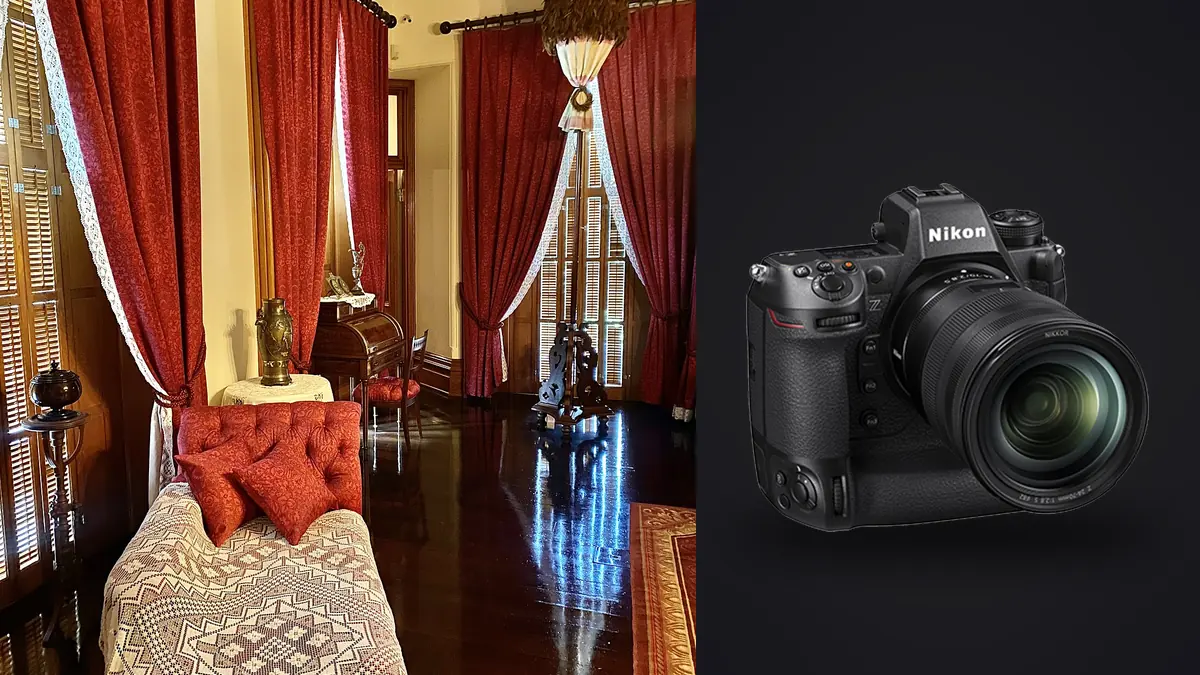
Boudoir and intimate portrait work asks a camera body to do things most gear reviews never test for. Not resolution, not dynamic range, though the Nikon Z9 has plenty of both. It asks the body to disappear into the background of a session that's already emotionally loaded for the client, and to keep locking correct focus at f/1.2 while someone shifts a shoulder three inches every few seconds. The Z9 turns out to suit boudoir and intimate portrait sessions, mostly for reasons that have nothing to do with the spec sheet everyone was arguing about online. Here's what actually changes in this kind of session, where the body earns its keep, and where you still have to work around it.
The completely silent shutter changes how the room feels
The Z9 was the first Nikon flagship built without a mechanical shutter at all. It doesn't have one to fall back on, the stacked sensor reads out fast enough that Nikon didn't bother including the extra hardware. For most photography that's a footnote. For boudoir it's the single biggest quality-of-life change I've gotten out of any camera body I've owned. A client who hasn't done this before is already managing nerves about undressing partially or fully in front of someone holding equipment. Every clack of a mirror and shutter curtain firing is a small, repeated reminder that a machine is recording them. Take that sound away and the room gets quieter in a way you can actually feel within the first ten minutes.
The entire session can run in fully silent electronic mode, with one exception: some clients actually want to hear a soft confirmation beep for the first few frames, because it gives them a concrete cue that a moment landed and helps them relax into the next pose instead of wondering if you got it. Toggle the beep on briefly at the start of a session and kill it once you're moving. The stacked sensor's fast readout also keeps rolling shutter skew low if you're panning or the client is mid-motion (a hair flip, fabric falling), which matters more here than in a static studio portrait because so much of good boudoir work happens in that half-second of movement rather than a held pose.
Autofocus in the kind of light this genre actually happens in
Boudoir rarely happens under even studio light. It's window light through sheer curtains, a single continuous LED panel bounced off a wall, or one strobe through a shoot-through umbrella in a hotel room that wasn't built for photography. 3D-tracking with subject detection on the Z9 is genuinely good when it has a face and enough contrast to grab, but it starts to hunt in three situations specific to this work: hard backlight from a window behind the subject, hair falling across the face during a reclined pose, and a body turned mostly away from camera with only a shoulder or the edge of a jaw visible. In all three, I stop trusting eye-detect and drop to single-point AF-C, usually parked on the collarbone or sternum rather than chasing the eye, because at f/1.2 to f/1.8 the plane of focus is a few millimeters deep and eye-AF will occasionally lock onto a stray hair instead of the lash line.
The in-body stabilization is doing more work in this genre than people give it credit for. A lot of boudoir clients prefer continuous light over flash because it lets them see how they're being lit in real time, which is reassuring in a way a flash pop isn't. Continuous light means slower shutter speeds, and the Z9's stabilization lets me hand-hold down to a quarter second at 85mm on a good day without ruining sharpness on the frames that matter, so I can keep the room dim and moody instead of bringing in enough continuous wattage to shoot at a "safe" shutter speed.
Lens choices for small rooms and close work
Most boudoir happens in spaces that were never meant to be studios: a spare bedroom, a hotel suite, a corner of a home with maybe eight feet of usable backdrop. Working distance matters as much as focal length here, because you often can't back up any further without hitting a wall or a piece of furniture.
| Lens | Approx. min. focus distance | Wide-open character | Where it earns its spot | Where it struggles |
|---|---|---|---|---|
| Z 85mm f/1.2 S | ~0.85m | Extremely soft falloff, almost no distortion on skin | Classic single-subject portraits with real compression | Needs 8+ feet of room to frame from the waist up |
| Z 50mm f/1.2 S | ~0.4m | Slightly more character in the transition zone, still very clean | Tight rooms, environmental frames that still isolate the subject | Perspective gets less flattering if you're forced in too close |
| Z 35mm f/1.8 S | ~0.29m | More context in frame, gentler background blur | Working a whole bed or window scene into the shot | Facial proportions distort if you get inside four feet |
| Z 105mm f/2.8 MC Micro | ~0.29m (1:1) | Clinical sharpness, true macro reproduction | Jewelry, fabric texture, lace detail, hands | Too tight and too flat-footed for full-body work |
A typical session bag is the 85mm and the 50mm, with the 105mm macro coming out only for detail shots of a garment or a ring. The 35mm stays in the bag more than I expected when I bought it, but on the sessions where the room itself is part of the story (a claw-foot tub, a bay window at golden hour) it's the lens that actually gets used.
What two hours of shooting does to your memory card
Boudoir sessions generate a specific kind of chaos in your card that other genres don't. Because so much of the work is coaching a client through small shifts (chin down an inch, weight onto the back hip, hand relaxed instead of tense) you end up shooting in short bursts at 8 to 14 frames per second to catch the exact half-second where the expression and the pose line up. A two-hour session routinely comes back with 2,500 to 4,000 raw frames, and a huge share of those are near-duplicates two or three frames apart where almost nothing changed except a blink or a fractional hand position.
Sorting that by eye at midnight after the client has gone home is where a lot of photographers burn out on this genre. I run the card through imagic before I touch anything else. It scores sharpness and eye focus locally on the raw files and groups those burst sequences together, so instead of scrolling through six nearly identical frames one at a time I'm choosing the sharpest of a cluster imagic already assembled. It's cut my initial sort time on a session down from a couple of hours to something closer to twenty minutes.
There's a second reason this matters specifically for this genre, and it's not about speed. Boudoir clients are trusting you with images they'd never want to see leaked or mishandled, and every extra place those files pass through is another point of risk. Everything imagic does happens on the machine, nothing gets uploaded to a server to be culled or scored, which fits how I'd want to handle this material even if the software were slower than it is.
Getting the skin right, not just the exposure
Mixed light is the norm rather than the exception here, window daylight through a curtain fighting a warm LED panel or a lamp left on in the corner of frame. Auto white balance on the Z9 does a reasonable job most of the time, but it drifts warm under sheer-curtained window light in a way that pushes skin toward orange if you don't catch it, so I set a manual Kelvin value for each setup rather than trusting auto once the light is locked in. I shoot Picture Control set to Flat with saturation pulled down a touch, which keeps highlight rolloff on skin gentle and gives me more room to shape the tone afterward instead of fighting an in-camera profile that's already baked in contrast.
For the edit itself, I lean on imagic's apply_my_style feature once the culling pass is done. It's trained on my own past edits rather than a generic preset, so the low-key, warm-skin look I've settled on for this kind of work gets applied consistently across a gallery of 60 to 80 final images without me hand-grading every single frame from a blank slate. If you're still figuring out your own approach to skin tone and color in post, our guide to color grading covers the fundamentals that apply here as much as anywhere else.
Settings to set before the client walks in
- RAW to slot 1 (CFexpress), a JPEG backup to slot 2 on any session I can't reshoot if a card fails.
- ISO ceiling capped around 3200 for anything going into the final gallery. It's clean on this sensor, and I'll push to 6400 for a specific dim, moody frame knowing I'll deal with a bit of noise later, but I don't let auto-ISO wander past that on its own.
- AF-C with single-point rather than wide-area tracking for anything shot wider than f/2, switching to a small dynamic-area zone once we're past f/2.8 and the focus plane has more forgiveness.
- Fully silent electronic shutter, flicker reduction enabled if there's any LED continuous light in the room, since that combination is where banding shows up if you skip it.
- Back-button focus, always, because it's the only way to hold focus on a still pose while recomposing without the shutter button re-triggering the whole autofocus hunt.
Frequently Asked Questions
Do you actually need a Z9 for this, or would a Z8 do the same job?
Honestly, for most boudoir photographers the Z8 is the more sensible buy. It shares the same sensor, the same autofocus system, and the same silent shutter, in a smaller and noticeably lighter body that's easier to hold through a two-hour session shot mostly handheld. The Z9's real advantages, dual CFexpress slots instead of one CFexpress and one SD, a bigger battery, and a burst buffer built for sports, matter less in a genre where you're not shooting 20fps for minutes at a time. I'd only point someone toward the Z9 specifically if they already own one, need the redundancy of two identical fast card slots for sessions that genuinely can't be reshot, or also shoot enough video or fast action work on the side that the extra capability pays for itself elsewhere.
Is 45.7 megapixels overkill for intimate portrait work?
It's more useful than it sounds. In a small room where you can't physically back up any further, that resolution gives you room to crop into a tighter composition after the fact without losing print quality, which happens more often in this genre than people expect. The tradeoff is storage: at those burst rates a single session can easily produce 150 to 250GB of raw files, so budget for it and don't try to run a boudoir business off a single portable drive.
How do you handle privacy for files from a shoot like this?
The short answer is minimizing every hop the files take between the card and the client's final gallery. Copy off the card to an encrypted local drive, cull and edit entirely offline (this is the other reason I like that imagic never uploads anything to process it), and only export final selects to whatever delivery gallery you and the client agreed on. Raw files never touch a general cloud backup folder that syncs automatically. It's a bit more manual than a fully cloud-based workflow, but for this genre that's the point.
What ISO can you actually push before it becomes a problem on skin?
I'm comfortable up to about ISO 3200 without thinking twice about it, and 6400 is usable with a light pass of noise reduction if the alternative is a shutter speed too slow to hand-hold. Past that, the Z9's native ceiling of 25600 technically works, but chroma noise starts to show up in shadow-heavy low-key setups specifically on skin, where it reads as blotchy rather than the fine grain that looks fine on a wall or a piece of furniture in the same frame. I'd rather bring in a bit more continuous light than lean on the expanded ISO range for anything going in a final gallery. If you're weighing camera bodies and workflow tools for this kind of work more broadly, it's also worth reading up on how AI photo culling actually works before you commit to a process for the volume this genre produces.