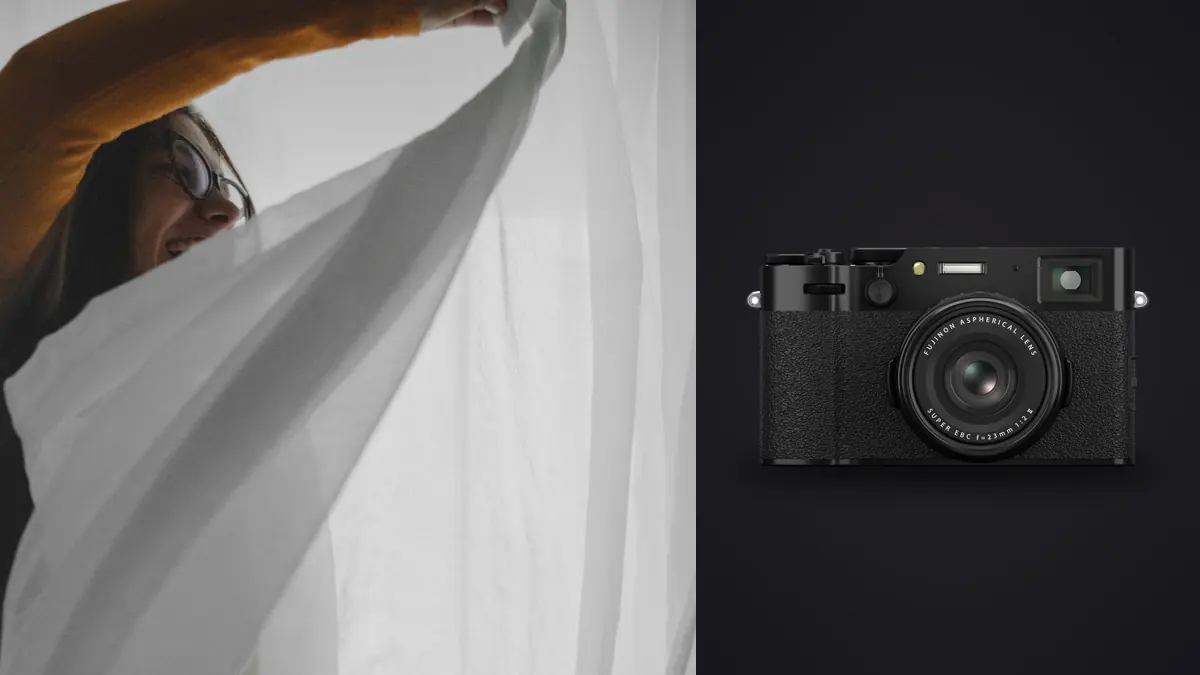
I picked up the X100VI expecting to use it as a walk-around camera, the kind of thing you bring to a friend's dinner party so you're not fumbling with a full kit. It ended up becoming the camera I reach for on a specific, narrower kind of job: boudoir and intimate portrait sessions in small rented rooms, where a big body with a zoom lens changes the mood the second you lift it. This isn't a spec sheet review. It's what actually happened across a string of sessions in hotel rooms, studio sets, and one memorably cramped Airbnb with a mirror wall that made framing a nightmare.
Why a Fixed 35mm-Equivalent Lens Works Better Than You'd Guess
The 23mm f/2 lens on the X100VI reads as 35mm equivalent once you account for the APS-C crop, and my first instinct was that this would be a problem. Boudoir work leans toward flattering compression, tighter crops on the face and shoulders, the kind of look people associate with an 85mm portrait lens. A 35mm field of view does the opposite: it includes more of the room, and if you get sloppy with your distance to the subject you get the nose-forward distortion that nobody wants in this genre.
What changed my mind was working distance in actual rooms. Most rented boudoir sets and hotel rooms aren't large. You often don't have six or eight feet of clean backdrop behind you to step back and shoot at 50mm or 85mm equivalent framing. At 35mm you can get a waist-up frame from roughly a meter and a half away, which in a lot of these spaces is the difference between shooting comfortably and shooting with your back against a wall. The 40-megapixel sensor also gives you real cropping room. A shot that reads as a loose 35mm frame in camera can be cropped down to something closer to a 50mm or 60mm look in post and still hold plenty of resolution for a large print. I treat the fixed lens less like a limitation and more like a starting point I refine afterward.
Where it genuinely struggles is close detail work. Hands resting on fabric, a ring, the texture of lace against skin. The macro mode gets you to about 10cm, but autofocus slows down noticeably and depth of field gets razor thin at f/2, so you're hunting for the plane of focus more than you'd like. If detail shots are a big part of how you deliver a boudoir gallery, you'll feel this camera's single-lens design more than in almost any other use case.
The Leaf Shutter Changes How People Behave in the Room
This is the part that surprised me most, and it's not really about image quality at all. The X100VI uses a leaf shutter built into the lens, and even in mechanical mode it's close to silent, nothing like the clack of a focal-plane shutter on a bigger mirrorless body. In an intimate session, where a client is already navigating some amount of vulnerability and self-consciousness, the sound of the camera matters more than most gear reviews ever mention.
A loud mechanical shutter announces every frame. Clients tense up right at the click, especially early in a session before trust is built. With the X100VI, subjects can genuinely forget the camera is firing for stretches at a time, which sounds like a small thing until you compare the resulting expressions to a session shot on a camera with an audible clack every frame. There's less performing for the camera and more just existing in the room. I don't think this shows up on a spec sheet anywhere, but it shows up in the outtakes.
The body itself helps too. It's rangefinder-styled, no big EVF hump, no long zoom barrel pointed at someone. It reads less like "professional equipment aimed at you" and more like something a friend might be holding. That's a real, if slightly unscientific, factor in how a first-time boudoir client relaxes into a pose.
Skin Tones in Warm, Low Light
Most of this work happens under warm practical light: bedside lamps, string lights, maybe one softbox bounced off a wall rather than a full studio setup. That's a stress test for any camera's color science, because warm ambient light pushes skin tones toward orange, and a lot of sensors either overcorrect into a sickly, flat look or leave everything looking jaundiced.
Fujifilm's film simulations give you a starting point rather than a fixed answer. I shoot RAW and ignore most of the in-camera looks, but Astia consistently reads as the gentlest on skin when I use it as a JPEG reference on the back screen during a session, softer contrast, less saturated red channel than Velvia or even Provia. That said, none of the built-in simulations are a substitute for a deliberate edit. What actually matters for consistency across a gallery of eighty or a hundred images is having one grading approach and applying it evenly, not picking a simulation and hoping it holds up frame to frame under changing light as someone moves closer to or farther from a lamp.
This is where I've leaned on imagic's apply_my_style feature more than I expected to. I built the look I want for warm-light skin tones on a handful of reference edits, and imagic trains a preset from those specific edits rather than a generic filter, then applies that same treatment across a new set. For a genre where skin tone consistency across a gallery is the whole ballgame, having that repeatable instead of re-eyeballing white balance and skin saturation on every single frame has saved real editing hours.
How It Stacks Up Against the Other Cameras People Actually Consider
Every boudoir photographer I've talked to who was deciding on the X100VI was also cross-shopping two or three other bodies. Here's how they compare on the things that actually matter for this specific kind of work, not the usual megapixel-and-ISO chart.
| Setup | Working Distance for a Waist-Up Frame | Shutter Sound Indoors | Ready-to-Shoot Weight | Approx. Price |
|---|---|---|---|---|
| Fujifilm X100VI (23mm f/2, fixed) | ~1.4m | Near-silent leaf shutter, mechanical or electronic | 521g | $1,599 |
| Fujifilm X-T5 + XF 33mm f/1.4 | ~2.0m | Audible mechanical clack; electronic option available | 927g combined | ~$2,499 combined |
| Sony a7C II + FE 35mm f/1.8 | ~1.4m | Moderate mechanical sound; silent electronic mode | 795g combined | ~$2,946 combined |
| Leica Q3 43 (43mm f/2, fixed) | ~1.7m | Near-silent leaf shutter | 743g | $6,485 |
The Sony matches the X100VI on working distance because a 35mm lens on full frame gives roughly the same field of view as 23mm on APS-C, but you're carrying nearly 300 grams more and paying almost double once you add a comparable lens. The X-T5 with the 33mm f/1.4 is a genuinely excellent portrait combination, closer to a 50mm equivalent look with faster glass, but you need more room to back into that frame and the interchangeable-lens body draws more attention when you're setting it down between shots. The Leica is the closest cousin to the X100VI in spirit, a fixed leaf-shutter lens on a compact body, but it's priced for a different client base entirely. None of these is objectively "better." They trade off differently depending on how much room you have and how much the client's comfort with the gear itself matters to the session.
In-Body Stabilization Lets You Skip the Extra Light
The X100VI is the first camera in this line to get in-body image stabilization, rated up to six stops, and it's a bigger deal for this kind of work than I expected. A lot of boudoir sessions deliberately lean on ambient and practical light rather than a full studio setup, because harsh strobe light kills the mood a session is trying to build. That means shutter speeds regularly drop into the range where handheld shots used to be a gamble.
With stabilization on, I can hold at 1/15s or even slower for a static pose and get a sharp frame more often than not, though obviously any subject movement (a hand adjusting hair, a breath) still needs a faster shutter regardless of how still the camera itself is. It doesn't replace a proper light source when you need one, but it does mean you can work by lamp light for longer stretches of a session without pushing ISO into territory where the X-Trans sensor starts to show its grain, or without stopping to set up a light stand that would interrupt the mood you just built.
The Single Card Slot Is a Real Risk on a Paid Job
This is the least glamorous part of the review and the one that matters most if you're doing this for clients rather than for yourself. The X100VI has one SD card slot. No in-camera backup, no failover if a card corrupts mid-session or gets accidentally formatted. For a personal project that's a shrug. For a paid boudoir session where the images can't be reshot (the outfit's back at the client's house, the light's gone, the moment's gone), it's a real exposure.
My workaround is boring but it works: I copy cards to a laptop at the midpoint of any session that runs more than an hour, and I never format a card in-camera until I've confirmed a successful copy on two separate drives. For higher-stakes commercial bookings, carry a second body specifically as backup rather than trusting one card slot to get through a two-hour session cleanly. It's an extra cost and an extra bag, and it's the trade-off you're accepting for the compactness and discretion that make the X100VI worth using in the first place.
What Happens After the Shoot
A single boudoir session, even a relatively short one, tends to generate two to four hundred frames once you count every small adjustment between poses, every blink, every slight shift of a hand or strap. Culling that by eye, frame by frame, is genuinely the slowest part of the job, slower than the shoot itself most weeks.
This is where I run the import through imagic before I touch anything manually. It scores sharpness and focus locally on the machine, no images ever leave the laptop, which matters more here than in almost any other genre I shoot given how sensitive the content is. It also clusters near-duplicate bursts, the four or five frames from one pose where only the eyes or the hand position differ, so I'm choosing the best of a cluster instead of scrolling past forty nearly identical thumbnails trying to spot the one with a genuine expression. If you want the mechanics of how that clustering actually decides which frames are duplicates, this breakdown of how AI photo culling works covers it in more depth than I can here. Once the set's culled down to the real selects, I run the apply_my_style pass for the skin-tone consistency I mentioned earlier, and if you want a broader grounding in how color grading choices affect skin tones specifically, this color grading guide is a solid starting point before you build your own preset.
The whole pipeline (shoot, cull, grade) is faster with the X100VI than it was with the bigger interchangeable-lens setup I used before, mostly because a smaller, quieter camera means fewer awkward, over-posed frames to sort through in the first place. Better raw material makes the editing side of the job shorter almost by accident.
Frequently Asked Questions
Is the X100VI's fixed 35mm-equivalent lens too wide for close, intimate crops?
For most framing, no. A waist-up or three-quarter frame at 35mm equivalent works fine from a reasonable working distance, and the 40-megapixel sensor gives you enough resolution to crop tighter in post without falling apart. Where it genuinely falls short is extreme close-up detail work, hands, jewelry, fabric texture, where the macro mode's slower autofocus and thin depth of field make it harder to nail focus reliably compared to a dedicated macro or short telephoto lens.
Does the leaf shutter's near-silence actually change how a client behaves?
In my experience, yes, more than any other single spec on this camera. A loud mechanical shutter announces every frame and tends to make a client tense up right at the click, particularly early in a session before rapport is built. The X100VI's leaf shutter is quiet enough that clients regularly stop noticing when frames are being taken, which shows up in more relaxed, less performed expressions across a gallery.
Should you trust a single SD card slot for a paid boudoir shoot?
Not without a backup plan. There's no in-camera redundancy, so a corrupted or lost card means losing images that usually can't be reshot. Copy cards to a laptop at natural breaks in the session rather than waiting until the end, and for higher-value commercial bookings, consider carrying a second body as insurance rather than relying on one card slot to survive a full session.
How does the color rendering handle warm, low bedroom light?
Reasonably well as a starting point, but it's not a substitute for a deliberate edit. Fujifilm's film simulations, Astia in particular, read softer and less saturated on skin than the more contrasty Velvia or Provia, which helps under warm practical light. Still, the real consistency across a gallery comes from applying one grading approach evenly across every frame rather than trusting any single in-camera look to hold up as the light shifts from shot to shot.