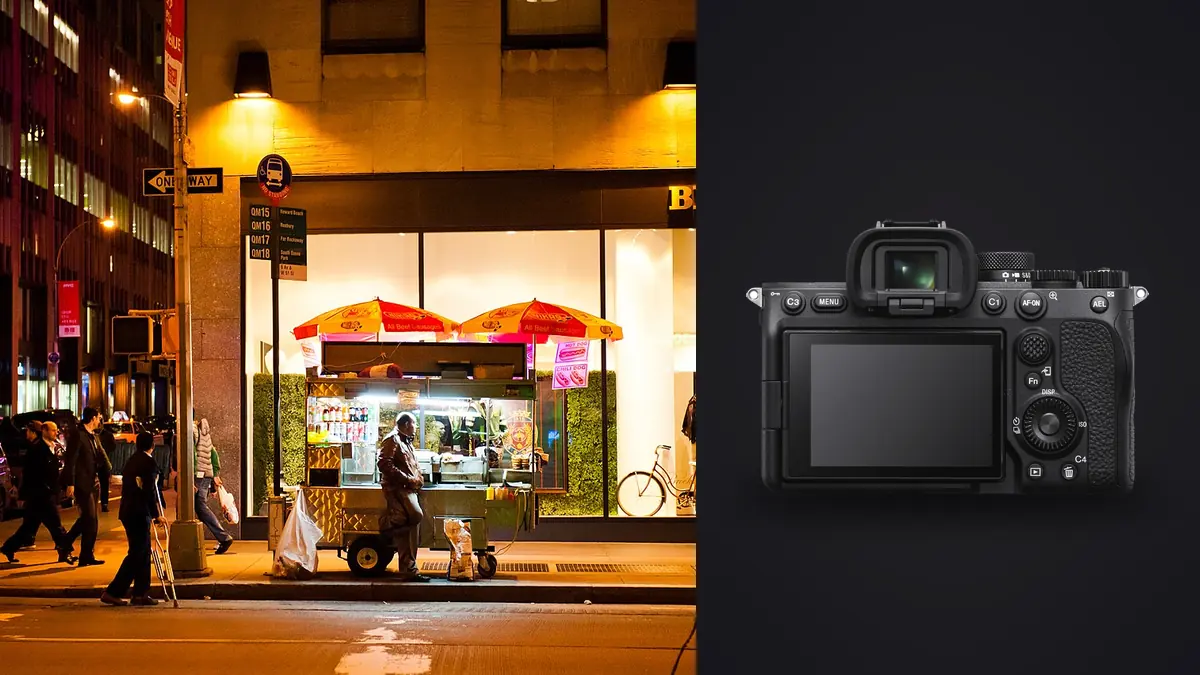
I picked up the A7 IV about eight months into a documentary project on a fishing cooperative on the west coast of Ireland, mostly because my A7 III had started throwing card errors at the worst possible moments and I needed a body I could trust for six-day trips with no backup camera. I did not buy it for street work specifically. It became my street camera almost by accident, because once you own a 33 megapixel full-frame body with that autofocus system, you stop wanting to carry anything smaller for candid work, even when smaller would genuinely serve you better half the time.
The sensor is a compromise, and it's worth naming that up front
33 megapixels is an odd number for street and documentary work. It is not the 24 megapixels that made the A7 III popular with photojournalists who wanted small files and fast card writes, and it is not the 60+ megapixels of a studio body where you crop aggressively and still print large. It sits in the middle, and in practice that middle spot works in your favor more often than not. You get enough resolution to crop a 35mm frame down to something that reads like a 50mm shot without the file falling apart, which matters a lot when you are working a market or a protest and cannot physically get closer without changing the moment you are photographing.
The tradeoff is file size. A day of documentary shooting on the A7 IV, compressed RAW, easily runs past 40GB if you are working a subject properly rather than grabbing a handful of hero shots. On a three-week assignment that adds up to a genuinely painful amount of storage and, more relevant to how you actually spend your evenings, a genuinely painful amount of time scrolling through nearly identical frames trying to find the one where the kid's hand is in the right place and the woman in the background isn't mid-blink. I did not think seriously about culling software until this camera made me start dumping a card every night and staring down 1,400 frames wondering where to even begin.
Autofocus is the actual reason to buy this camera for people photography
Everyone talks about the sensor, but the real upgrade over the A7 III for street and documentary work is the real-time tracking autofocus. Eye AF on the A7 III was good when it worked, and it lost the plot the moment someone turned their head or a hand crossed in front of their face. On the A7 IV, once you tap or half-press onto a face, the tracking holds onto that person through partial occlusion, through them turning away and back, through them walking behind a market stall and re-emerging. For street work where your subject rarely knows they are being photographed and therefore never holds still or faces you helpfully, that persistence is worth more than the resolution bump.
I run focus on the AF-ON back button, tracking set to Zone with Face/Eye priority, and I leave the joystick free to reposition the tracking point on the fly. For documentary sequences where I am following one person through a scene (a fisherman gutting the day's catch, a shopkeeper closing up), I switch to Wide tracking and just tap the subject once on the touchscreen before raising the camera. It re-acquires almost every time. The failure case is backlit scenes with strong rim light, where it occasionally locks onto the bright edge of a shoulder instead of an eye. It happens maybe once every couple hundred frames for me, which is a number I can live with.
Where the AF still lets you down
Low, harsh contre-jour light through a doorway or a bus window is the one situation where I still trust my own eye over the camera's. The system will happily lock focus on a silhouette edge rather than the eye buried in shadow, and unless you are shooting fast enough to review and correct in the moment, you will find out at your desk that half a sequence is soft on the actual subject. I have started defaulting to manual focus with focus peaking in those specific conditions, which is not a knock on the camera so much as an acknowledgment that no current AF system reads shadow detail the way a trained eye does.
Handling: bigger than it should be, but not in the ways that matter most
At 658 grams body only, the A7 IV is not a small camera, and paired with something like the FE 35mm f/1.8 it sits closer to a kilogram than the "small mirrorless" reputation the format still carries. After an eight or nine hour walking shoot, that weight is on your neck and shoulder whether you like it or not. I have gone back to a Domke strap worn bandolier-style specifically because of this camera, which I never bothered with on smaller bodies.
What surprised me is that the size stopped mattering the moment I started shooting silent electronic shutter with the shutter sound and AF beep both killed. On the A7 III I associated candid work with small cameras because small cameras felt less confrontational. On the A7 IV, the physical size becomes almost irrelevant once there is zero sound and zero blackout flicker in the viewfinder. People notice a raised camera regardless of whether it's a Fuji X100V or a full-size A7 IV. What they notice and react to is sound and obvious repeated motion, and silent shutter removes the first one entirely.
The fully articulating rear screen is the one ergonomic choice I actively dislike for this genre. It flips out sideways rather than tilting up and down, which is fantastic for vlogging and useless for the low, waist-level candid framing a lot of street photographers rely on. I mostly leave it closed and shoot through the viewfinder, or use it flipped forward-facing-away purely as a light shield rather than for its intended purpose.
Lenses that actually earn a place in a street kit
I've cycled through most of the obvious options and landed on two that stay in the bag for nearly every shoot:
- FE 40mm f/2.5 G: this is the lens I recommend to anyone asking where to start. It's small, it's genuinely sharp wide open, and 40mm on full frame sits close enough to how the eye actually sees a scene that you stop fighting the frame and start reacting to what's in front of you.
- FE 35mm f/1.8: the wider field lets you work closer in tight market alleys or crowded interiors, and f/1.8 gives you a stop of breathing room once the sun goes down without pushing ISO into territory that eats shadow detail.
I tried the 24mm f/2.8 G for a stretch of documentary work in a fish market and found it a bit too wide for my taste, it demands you get uncomfortably close to hold a subject's presence in frame, which is a valid style but not mine. Your mileage on that will vary with how you shoot.
How this camera actually compares against the alternatives street shooters debate
The A7 IV rarely gets chosen in isolation. Most people cross-shop it against the cheaper A7 III, the smaller A7C II, and at least one APS-C or fixed-lens body. Here's how they actually stack up on the things that matter for candid, fast-moving work rather than a generic spec sheet:
| Camera | Body weight | Silent-shutter usability | Real-world RAW buffer before slowdown | Rough street-relevant price | Best fit |
|---|---|---|---|---|---|
| Sony A7 IV | 658g | Excellent, near-zero rolling shutter smear at walking pace | ~25-30 compressed RAW frames on a fast SD card before the buffer clears slowly | ~$2,400 body | Hybrid shooters who need resolution headroom for cropping |
| Sony A7 III | 650g | Usable, but rolling shutter is more visible on quick pans | Deeper, thanks to smaller 24MP files | ~$1,800 body (still sold) | Budget-conscious low-light shooters who don't need to crop hard |
| Sony A7C II | 514g | Excellent, same sensor generation as the A7 IV | Comparable to the A7 IV, card-dependent | ~$2,200 body | Anyone who wants A7 IV image quality in a genuinely smaller, less conspicuous body |
| Fujifilm X-T5 | 557g | Very good, APS-C crop means faster readout and less rolling shutter | Shallower on RAW at high burst rates due to 40MP files | ~$1,700 body | Shooters who want tactile dials and don't need full-frame files |
| Leica Q2 | 734g | Good, but fixed 28mm means no reframing without walking | Moderate | ~$5,800 (fixed lens) | Shooters who've committed to one focal length and want zero lens-swap friction |
The A7C II is honestly the more interesting street camera on paper (same sensor, meaningfully lighter, rangefinder-style body that reads less like "professional camera" to strangers). I stuck with the A7 IV mainly because I already owned the lenses and the bigger grip suits how I hold a camera for a full day, but if I were starting a street kit from zero today I would test the A7C II first.
What a good day of shooting does to your evening
This is the part nobody warns you about when they talk you into a 33 megapixel body with a fast, sticky autofocus system: a good documentary day generates an enormous number of frames, and a meaningful fraction of them are near-duplicates of each other, three or four variations of the same handshake or the same glance, shot in a two-second burst because you weren't sure which fraction of a second would land. Multiply that by six or eight scenes in a day and you're looking at a card with 1,000+ frames and maybe 40 that are actually worth grading. I run those cards through imagic before I open Lightroom now, mostly because it does the two things I actually need before I've had coffee: it scores focus locally so I'm not squinting at 100% zoom on every burst trying to tell which of five nearly identical frames is actually sharp on the eyes, and it clusters the burst sequences and near-duplicates together so I'm reviewing "this moment" as a group instead of five separate unrelated thumbnails scattered across a contact sheet. Everything runs on the machine, nothing gets uploaded anywhere, which matters more than usual on documentary work where you've photographed people who did not sign a release and would not want their faces sitting on someone else's server regardless of intent.
Once I've settled on a look for a project, usually a slightly desaturated, contrast-heavy grade that suits the flat light I tend to shoot in, I train imagic's apply_my_style feature on a batch of edits I'm happy with and let it carry that look across the rest of the selects. It's not a substitute for finishing the handful of hero images by hand, but it takes the grading pass on 200 selects down from an evening to about twenty minutes, which on a multi-day trip is the difference between reviewing the day's work and just collapsing.
Battery, cards, and the parts of a documentary trip nobody photographs
The NP-FZ100 battery gets you a genuinely useful day of shooting, somewhere around 500-600 frames of real-world mixed stills and viewfinder chimping before it needs a swap, which for street work (lots of raising and lowering the camera, lots of chimping to check a frame) tends to land you comfortably through a full day on one battery plus a spare in a pocket. Where it gets tight is documentary trips with limited outlet access. I carry three batteries and a small USB-C power bank on any assignment longer than two days, because the camera charges over USB-C in a pinch and that has saved a shoot more than once in a guesthouse with one working socket.
The dual card slots matter more for documentary work than street work specifically, because on a paid or personally significant assignment you cannot afford a corrupted card wiping out three days of access you will never get back. I shoot RAW to both cards simultaneously rather than overflow, which costs some buffer depth but means a card failure is an inconvenience rather than a catastrophe.
Custom buttons I actually use, not the default layout
Out of the box the A7 IV's button layout is built for a generalist, and I remapped nearly all of it in the first week:
- C1 (top plate): toggles between mechanical and silent electronic shutter, since I switch constantly between the two depending on whether rolling shutter distortion on a moving subject is a risk.
- C2: toggles Eye AF priority between human and off, since animal/bird priority is useless to me and I don't want the camera hunting for it in a crowd.
- AEL button: reassigned to APS-C crop toggle, giving me an effective 50mm-ish reach on the 35mm without swapping lenses when I need to get tighter on a subject I can't physically approach.
None of this is groundbreaking, but the combination of silent shutter, sticky tracking AF, and a one-button crop toggle covers probably 90% of the situational adjustments I need to make mid-scene without taking the camera away from my eye.
Frequently Asked Questions
Is the Sony A7 IV too big and obvious for candid street photography?
It's larger than an X100V or a rangefinder-style body, but in my experience size matters far less than sound and motion. With silent electronic shutter and the AF beep disabled, most people never clock that a photo was taken at all, regardless of body size. If minimizing visual footprint matters more to you than resolution or lens flexibility, the A7C II carries the same sensor in a noticeably smaller shell.
Should I shoot mechanical or electronic shutter for documentary work?
I default to silent electronic shutter for anything static or slow-moving (portraits, interiors, market stalls) and switch to mechanical the moment a subject is moving quickly across the frame, cyclists, running kids, anything with fast lateral motion, because the rolling shutter on the electronic mode will skew verticals and warp spokes and limbs at speed. The C1 toggle I mentioned above exists entirely to make that switch instant.
What's the single best lens to start with on the A7 IV for street work?
The FE 40mm f/2.5 G. It's compact enough that the whole kit stops feeling like a "camera outing" and starts feeling like something you can carry all day, and the field of view is close enough to natural vision that you spend less mental effort translating what you see into what the frame will show.
Does the 33 megapixel file size actually become a problem on longer trips?
Storage-wise, yes, budget for it. Editing-wise, the bigger issue isn't file size, it's frame count. A camera with autofocus this reliable tempts you into shooting more bursts "just in case," and the real cost shows up as review time, not disk space. That's the specific problem that pushed me toward running cards through imagic before Lightroom rather than after; sorting a thousand frames down to the real contenders before you start grading changes how the whole evening goes.
If you're weighing culling tools generally rather than just this camera, the photo culling software comparison covers how different approaches handle burst-heavy work, and how AI photo culling actually works goes into more detail on what local sharpness scoring is doing under the hood.