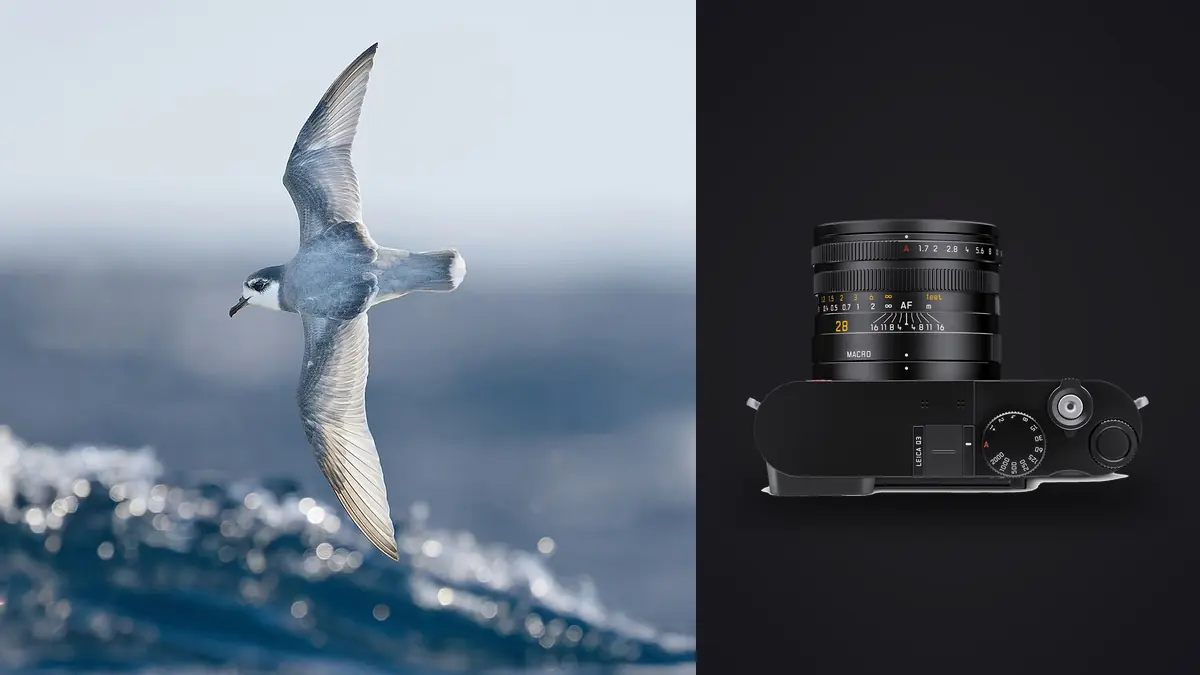
I've had a Leica Q3 in the bag for a little over a year now, and more than once I've stood at the edge of a reed bed at first light with a fixed 28mm lens between me and a marsh harrier quartering low over the water, wondering exactly what I thought I was going to do about it. This is not a birding camera. Leica never pretended it was. And yet the Q3 keeps finding its way onto wildlife mornings anyway, tucked into the same bag as a much longer lens, because there are a handful of things it does for this kind of photography that nothing else in my kit does the same way.
This piece is about that contradiction. What a fixed 28mm Summilux actually gets you when the subject is a tern folding its wings into a dive or a heron lifting off a sandbar. Where the in-camera crop modes and the hybrid autofocus genuinely help. And where you are simply out of luck, no matter how cleverly you frame the shot.
The 28mm problem nobody wants to say out loud
Start with the honest math. The Q3's Summilux is a 28mm f/1.7, full frame, no interchangeable options, no teleconverter port. A mute swan at twenty metres, which already counts as a close, cooperative subject by wetland standards, occupies a sliver of a 28mm frame. A swift over a plaza at forty metres is a dark comma against the sky. Wingbeats, feather detail, the catchlight in an eye, all of the things that separate a bird photograph from a bird-shaped smudge, need focal length the Q3 simply does not have on the front of the lens.
I want to be clear that this isn't a knock on the camera. Leica built the Q line as a documentary and street tool with a lens that biases toward context and environment, and the 28mm focal length is exactly right for that job. Wildlife photographers who reach for 400mm, 500mm, even 800mm glass are solving a completely different problem: isolating a small, distant, fast subject from its background. The Q3 was never entered in that race. Anyone buying one specifically to shoot birds in flight, expecting anything close to what a dedicated telephoto system delivers, is going to be disappointed within the first outing.
What the digital crop modes actually buy you
Leica gives you four in-camera crop options on top of the native 28mm: 35mm, 50mm, 75mm and 90mm equivalents, all made possible by the 60.3 megapixel sensor having enough resolution to spare that a heavy crop still leaves a usable file. The camera shows you crop lines in the electronic viewfinder or, if you shoot RAW plus JPEG, it will save the JPEG cropped to your chosen focal length while keeping the full 28mm frame in the DNG. That last detail matters more than people give it credit for. It means you can compose loosely at the full angle of view during a fast-moving flight sequence and decide the final crop later, at a desk, rather than betting everything on nailing the frame lines while an osprey is folding into a dive.
The catch is resolution. Every stop of digital crop trades megapixels for reach, and by the time you reach 90mm equivalent you're down to a sensor crop that produces a file closer to a 2016-era compact camera than a modern full-frame sensor. That's fine for a web gallery or a 6x4 print. It falls apart fast if you're hoping to crop again in post, which is exactly what most bird-in-flight photography demands, since even a perfectly framed shot rarely fills the frame the way you want on the first try.
| Crop mode | Approx. resolution | Realistic use for birding |
|---|---|---|
| 28mm (native, no crop) | ~60 MP | Habitat and flock shots, full-scene context, maximum room to crop later |
| 35mm | ~37 MP | Still generous enough for a second crop pass if the bird is reasonably close |
| 50mm | ~19 MP | Usable for a filled-frame water bird or raptor perched fairly near a hide |
| 75mm | ~8 MP | Getting thin; fine for social media, tight for anything printed larger than a postcard |
| 90mm | ~6 MP | Emergency reach only; treat any keeper here as a documentation shot, not a portfolio piece |
My own habit after a lot of trial and error: ignore the crop modes as a shooting tool and use them purely as a viewfinder aid. Shoot the DNG at full 28mm, let the crop lines guide composition, and make the actual crop decision afterward once I can see which frame in the sequence actually has the wing position and the eye contact I want. Deciding the crop in camera, mid-sequence, on a fast subject is a great way to throw away the one frame that was worth keeping.
Autofocus that was built for faces, not feathers
The Q3's biggest upgrade over the Q2 was moving from a contrast-only autofocus system to a hybrid setup that adds phase detection, and it's a genuinely large improvement for general use. Street candids, portraits, travel work, all of it locks faster and hunts less than the Q2 ever did. For birds in flight it's a mixed picture. The tracking is competent at holding onto a subject once it has one, using the joystick to place an AF point or touch-to-track on the rear screen, and continuous AF does keep pace with a bird crossing the frame at a moderate pace.
What it does not have is any dedicated animal or bird eye-detection layer. Modern wildlife-oriented bodies from Sony, Canon and Nikon now ship with subject-recognition models trained specifically on birds, including eye and head tracking through branches and grass. The Q3's tracking is general purpose. It will follow a bird well enough when the bird is a large, high-contrast shape against open sky, and it will struggle in exactly the situations that matter most for BIF work: a tern banking hard against a cluttered treeline, a small passerine darting between branches, anything where the AF has to make a judgment call about what the subject actually is rather than just following contrast and motion.
Practically, I run back-button focus with continuous AF engaged and the AF field set to the smallest single-point option I can reliably hold on the bird, rather than trusting a wide tracking zone to pick the right target out of a busy background. It's more work per frame, but it produces a noticeably higher keeper rate than letting the camera guess.
Burst rate, shutter, and the rolling-shutter tax
On paper the numbers look fine: up to roughly 15 frames per second using the electronic shutter, a mechanical shutter that tops out considerably slower, and an electronic shutter speed ceiling fast enough to freeze a fast wingbeat outright. In practice, the electronic shutter reads the sensor line by line rather than all at once, and a bird's wingtip moving fast enough relative to that readout will show up bent or skewed in the final file, especially at the edges of the frame during a hard bank or a wing downstroke. It's subtle at 1/2000s and up on a bird crossing the frame slowly. It gets obvious on anything erratic and close.
Buffer depth is the other practical limit. A short, controlled burst clears fine. Hold the shutter down through an entire takeoff-to-departure sequence at the top frame rate and the camera will slow down mid-sequence while it catches up writing to the card, right around the moment the bird does something interesting. I've learned to fire in short bracketed bursts, three to six frames at a time, timed to the moment rather than spraying continuously and hoping. A fast UHS-II card helps the buffer clear faster between bursts, but it doesn't change the fundamental ceiling.
| Setup | Effective longest reach | Where it actually wins |
|---|---|---|
| Leica Q3, native 28mm | 28mm | Habitat context, environmental storytelling, low light |
| Leica Q3, 90mm crop mode | 90mm (at ~6 MP) | Emergency documentation of a close, large subject |
| Leica Q3 43, native lens | 43mm | A slightly longer starting point, same crop math beyond that |
| Mirrorless body + 100-400mm zoom | 400mm (or more with crop sensor) | Genuine bird-in-flight reach with full-resolution files |
| Mirrorless body + 200-600mm zoom | 600mm+ | Small, distant, skittish species; the actual BIF tool |
Leica's own answer to part of this problem is the Q3 43, released with a fixed 43mm APO-Summicron in place of the 28mm Summilux. It nudges the starting point a bit closer to something usable and the extra reach genuinely helps for larger, closer subjects. It doesn't change the underlying math for anything airborne and distant. A 43mm lens cropped to its 90mm-equivalent mode is still nowhere near what a 400mm zoom delivers uncropped.
Where the Q3 actually earns its place in a wildlife bag
None of this means the camera is dead weight on a wildlife trip. It's just doing a different job than the telephoto rig sitting next to it. A few places it genuinely pulls its weight:
Habitat and behaviour context. A tight 500mm portrait of a heron tells you almost nothing about where it's standing or what it's doing there. A wide 28mm frame showing the bird against the full sweep of a misty estuary at dawn, or a fox threading between the roots of a fallen tree, does a kind of storytelling that a long lens physically cannot do. I shoot most of my context frames on the Q3 specifically because switching lenses mid-encounter on the main body would spook whatever I'm trying to photograph.
Larger mammals at closer range. Seals hauled out on a beach, deer in open parkland that have grown used to foot traffic, anything that lets you approach within ten or fifteen metres, sits comfortably inside what a 28-90mm equivalent range can handle. This is a very different category from a bird thirty metres up and closing fast.
Low light. The f/1.7 maximum aperture and the back-illuminated sensor make the Q3 genuinely strong at dawn and dusk, exactly when a lot of mammal activity and some crepuscular bird behaviour actually happens. A long telephoto zoom stopped down to f/6.3 at the far end of its range struggles in that same light in a way the Q3's fast prime simply doesn't.
Weather sealing and grab-and-go handling. The Q3 carries an IP52 rating and handles being carried in the rain on a marsh boardwalk far better than I expected. On mornings when I don't know what I'll find, having a fully capable, weather-resistant body around my neck that doesn't need a lens change to go from a landscape frame to a close portrait of whatever mammal wanders into range is genuinely useful, even if it never touches a bird in flight all day.
The part nobody warns you about: what happens after the shoot
Here's the thing that surprised me most about using a short lens for wildlife work. You'd think the limited reach would mean fewer frames, since you're not exactly spraying at a distant flock the way you might with a 600mm and a fast burst mode. In practice the opposite happens. Because so much of what the Q3 captures is only borderline usable, I end up shooting more variations of every scene, hedging on crop mode, hedging on framing, hoping one frame in a burst has the wing position and the light right at 28mm before I even know if the crop will hold up.
A single morning at a heron colony can leave a memory card with several hundred frames, a meaningful chunk of them near-duplicates from short bursts, and a chunk of those soft simply because the subject was too small in frame for the AF to lock onto anything but the surrounding reeds. Sorting that by eye, at a laptop, with no signal at a lodge or a car park, is exactly the kind of grind that eats an evening. This is where I actually lean on imagic rather than scrolling through a grid one frame at a time. Its local sharpness and focus scoring flags which frames in a burst are genuinely sharp on the subject rather than the background, which matters a lot more when the subject only fills a few hundred pixels of a wide frame to begin with. The duplicate and burst clustering groups those short three-to-six-frame bursts I mentioned earlier so I'm reviewing one representative thumbnail per sequence instead of every individual frame, and since imagic runs entirely offline on the machine, none of that sorting depends on having a signal out in the field.
Once the actual keepers are picked out of that pile, I lean on imagic's apply_my_style preset, trained on my own past edits, to get a consistent starting point across a set of images shot at wildly different equivalent focal lengths in the same session, rather than manually re-matching tone and colour between a 28mm habitat shot and a 90mm crop of the same bird twenty minutes later. If you want more detail on how that kind of automated sorting actually decides what's sharp versus soft, it's worth reading how AI photo culling works, and if the bottleneck in your own workflow is less about culling and more about getting through a shoot faster end to end, these workflow tips cover the rest of the pipeline.
My actual verdict after a year of dragging it to reserves
I wouldn't buy a Q3 as a first camera for birds in flight, and I'd tell anyone who asked me directly not to either. If birds in flight are the primary goal, the money is better spent on a mirrorless body with real subject-detection autofocus and a zoom that gets you to 400mm or beyond. That combination will out-produce the Q3 on keeper rate for BIF work every single time, no contest.
What I would say is that the Q3 has quietly become the camera I don't leave behind on wildlife trips, precisely because it isn't trying to be a telephoto substitute. It's the habitat shot, the low-light mammal encounter, the wide frame that gives the tight 500mm portrait somewhere to live in a finished set. Treat it as a second camera with a specific job, not a lightweight alternative to a proper telephoto rig, and it earns its spot in the bag.
Frequently Asked Questions
Can the Leica Q3 track a bird in flight at all?
It will hold focus on a bird that's large in frame and moving against a clean background, thanks to the hybrid phase-detection AF the Q3 added over the Q2. It has no dedicated animal or bird eye-detection model, so tracking gets noticeably less reliable against cluttered backgrounds or with small, erratic subjects like swallows and terns.
Is the 90mm digital crop mode actually usable for serious birding shots?
Only as a last resort. You're working with roughly 6 megapixels at that crop level, which is fine for a quick social post or a record shot proving you saw the bird, but it won't hold up to any further cropping or a large print. Treat anything captured there as documentation rather than a portfolio image.
Should I shoot RAW or use the in-camera crop modes for wildlife?
Shoot the DNG at the full 28mm frame and use the crop lines in the viewfinder purely as a composition guide. That way you keep the full resolution and can decide the final crop later, once you can actually see which frame in a fast sequence has the wing position and eye contact worth keeping.
What's a better option if I want real telephoto reach without giving up Leica glass?
Nothing in the current fixed-lens Q line solves this, including the 43mm Q3 43. If reach for birds in flight is the priority, you're looking at Leica's SL system with a longer zoom, or accepting that the Q3 plays a supporting role next to a dedicated telephoto body from another system rather than replacing it.