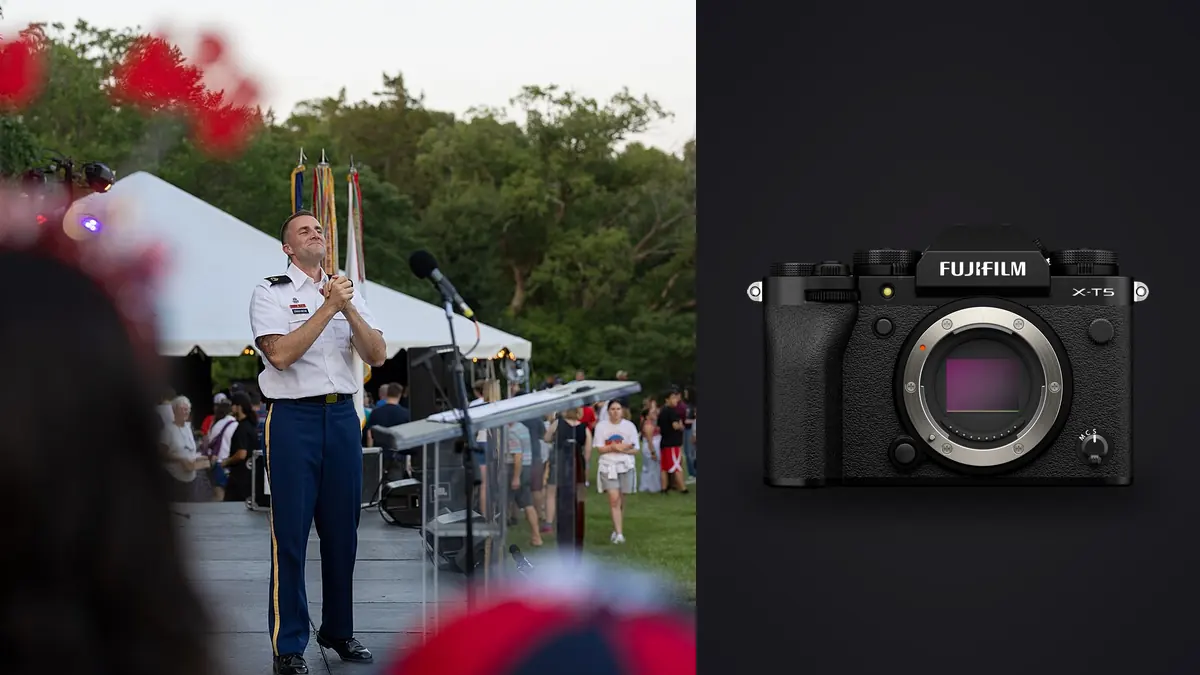
I picked up the X-T5 about eight months after it shipped, mostly because I was tired of hauling a full-frame body and three lenses into venues where the pit is the size of a parking space. I shoot maybe two to four shows a month, mostly 200 to 800 capacity rooms, occasionally a festival stage where I get three songs and then get walked out by security. None of that is glamorous, but it is a good stress test for a camera, because gig lighting is one of the least forgiving environments in photography: it changes color, direction and intensity every four seconds and it never asks your ISO if it's ready.
Why I Keep Reaching For the X-T5 at Small Venues
The short version is weight and discretion. At 557 grams body only, paired with something like the 33mm f/1.4, the whole rig is light enough that I can shoot a three-hour headline set one-handed above my shoulder without my arm giving out, which happens more often than you'd think when you're trying to clear a monitor wedge or a security barrier. It's also quieter and smaller than a full-frame DSLR, which matters in rooms where the photo pit is six feet from the front row and nobody wants a camera that looks like a weapon pointed at the stage.
What surprised me moving from an X-T4 was how much of the experience stayed familiar. Same dial-driven control layout, same general menu logic, same lens mount. The differences that matter for this specific job are the sensor, the autofocus system borrowed down from the X-H2S generation, and a few small ergonomic regressions I'll get to later.
The 40-Megapixel Sensor Is a Double-Edged Sword Here
Fujifilm jumped from the 26.1MP sensor in the X-T4 to a 40.2MP back-illuminated X-Trans sensor in the X-T5, and for landscape or studio work that's an easy win. For gig photography it's more complicated. More photosites packed into the same APS-C surface area means each individual pixel is gathering less light, and at the ISO values I actually use at a gig, that shows up as slightly more visible luminance noise per pixel than the X-T4 produced at the same setting. It's not dramatic, and Fujifilm's color science and the film simulations do a lot to disguise it, but if you pixel-peep a 12800 ISO frame from both bodies side by side, the X-T4 file looks a touch cleaner before any noise reduction.
Where the resolution pays for itself is downstream. A wide safety shot at 24mm equivalent that includes half the stage can be cropped down to a tight portrait of just the vocalist and still hold up on a festival's recap gallery or an artist's Instagram grid. I use that more than I expected to, especially at festivals where I can't always get close enough for the framing I actually want in three songs.
Practically, my ceiling for club work on the X-T5 is ISO 6400 for anything I'd sell or submit, and ISO 12800 only when the alternative is a completely unusable shutter speed. Past that the files still resolve fine on a phone screen but fall apart under any real crop or print.
Autofocus in a Room That Won't Sit Still
Stage lighting is designed to look good to the human eye, not to a contrast or phase detection system, and strobes, gobos and colored washes will absolutely make an autofocus system hunt if you let it. The X-T5 inherited the subject detection stack from the X-H2S rather than building something new, and for human faces and eyes it's noticeably stickier in low, flickering light than the X-T4's autofocus was. It doesn't nail every frame, nothing does in this environment, but the miss rate dropped enough that I stopped chimping the LCD after every song to check focus, which used to be a habit.
For settings, I run Zone AF with a fairly small area (roughly 3x3) rather than full Wide/Tracking, because Wide tends to grab a guitar headstock or a drum rim over the singer's face the moment the light dims. Of the six AF-C custom presets Fujifilm builds in, I default to Set 4 (ignore obstacles, react moderately fast to subjects that suddenly appear in frame) for most sets, and switch to Set 5 when a performer is moving fast and unpredictably across the stage, like a frontperson who won't stay in one place for more than two seconds.
One thing worth knowing before your first show on this body: back-button focus plus continuous high-speed drive with subject detection turned on will occasionally lock onto a bright shirt or a cymbal flash rather than a face when the light goes fully white during a strobe hit. Nothing fixes that except recognizing it's happening and being ready to recompose manually for those two or three seconds.
Lens Choices That Actually Earn Their Keep in the Pit
I've rotated through most of the fast Fujinon primes and a couple of the pro zooms over the years, and for this specific job, weight and maximum aperture matter more than they do for almost any other genre I shoot. Here's what I'd actually recommend, based on lenses I've used across real shows rather than a spec sheet:
| Lens | Full-frame equiv. | Max aperture | Weight | Best for |
|---|---|---|---|---|
| XF 33mm f/1.4 R LM WR | 50mm | f/1.4 | 360g | General coverage, my default walk-around for club shows |
| XF 56mm f/1.2 R WR | 84mm | f/1.2 | 445g | Tight portraits from the barrier, thin depth of field on solo shots |
| XF 16-55mm f/2.8 R LM WR | 24-84mm | f/2.8 (constant) | 655g | Festival photo pits where you can't swap lenses between songs |
| XF 50-140mm f/2.8 R LM OIS WR | 76-213mm | f/2.8 (constant) | 995g | Big stages, arena rigs, reaching a headliner from a distant pit line |
| XF 23mm f/1.4 R LM WR | 35mm | f/1.4 | 375g | Wide crowd-and-stage context shots, small rooms with no space to back up |
If I could only own one, it's the 33mm f/1.4. It covers a natural portrait-to-environmental range, it's fast enough for almost any indoor stage lighting, and it's light enough to shoot an entire festival day without shoulder pain. The 50-140mm is the one I regret not owning sooner. For any show where the pit rope is more than 15 feet from the stage, the reach genuinely changes what's possible.
Settings I Actually Dial In Before Doors Open
My baseline before a set starts: Auto ISO with a floor of 200 and a ceiling of 12800, shutter speed priority set with a minimum of 1/250s (faster, 1/500s, if there's a guitarist who headbangs or a drummer I need sharp), mechanical shutter for most of the set because I still trust it more than the electronic shutter under moving colored lights, and continuous high drive at the mechanical 15fps ceiling rather than the cropped 20fps electronic mode, since I'd rather keep the full sensor width for cropping later than gain 5fps I rarely need.
The one place I do switch to the fully electronic, fully silent shutter is acoustic sets or quieter moments between songs, where a shutter clack from six feet away is genuinely audible and rude. The tradeoff there is banding risk under LED stage lighting running at certain refresh rates, so I test a few frames the moment the room goes quiet rather than assuming it'll be clean.
Five-axis in-body stabilization rated to roughly 7 stops sounds irrelevant for a genre where you're deliberately using fast shutter speeds to freeze motion, but it earns its keep during slower, moody moments, a spotlighted acoustic breakdown at 1/60s where I want shallow depth of field without cranking ISO into the noisy range.
Buffer Depth Is Where the X-T5 Shows Its Age
This is the honest complaint. At 40 megapixels, uncompressed RAW files run around 80MB each, and even shooting compressed RAW, the buffer empties faster than I'd like during a long celebratory ending where the whole band is jumping and I want every frame. Fujifilm rates the mechanical shutter buffer around 19 frames of lossless compressed RAW before it slows down, which in real terms is a little over a second of continuous 15fps shooting. On a UHS-II card that clears reasonably fast, but during a genuinely chaotic finale I have hit the buffer wall and watched the frame rate stutter mid-burst more than once. If your subject matter tends toward long, sustained bursts (mosh pits, stage dives, pyro hits), that's worth knowing going in. I've adapted by shooting shorter, more deliberate bursts rather than holding the shutter down for four seconds at a time.
Dual UHS-II SD slots are a nice safety net, and I run mine in backup mode for anything I can't reshoot, which is every gig, obviously.
Getting Through 2,000 Frames the Next Morning
A three-band bill with a headliner set can leave me with 1,500 to 2,500 RAW files by the time the last encore ends, and at 40MP those files add up fast on disk. The actual bottleneck in this job was never the shooting, it was always the morning after, sitting down to find the 40 usable frames buried in a few thousand near-duplicates from burst sequences.
This is the part of my workflow that changed the most in the last year. I run everything through imagic before I open Lightroom now, mostly because its local sharpness and focus scoring flags the frames where a fast pan or a strobe hit cost me actual focus, which is easy to miss at a glance on a laptop screen at 1am after a show. It also clusters burst sequences and near-duplicate frames together automatically, so instead of scrolling through fifteen nearly identical shots of a guitarist mid-strum, I'm looking at one cluster with the sharpest frame already surfaced. For a genre that produces this much burst-shot volume, that alone probably saves me forty minutes a week.
The other piece I've leaned on is the apply_my_style preset feature, which trains on edits I've already made rather than a generic film-simulation-style look. Because it runs entirely on the machine, it also means unreleased tour photos or embargoed festival sets never touch a third-party server before an artist's team has cleared them, which matters more than I expected once I started shooting for bands with strict press embargoes. If you're curious how automated culling actually scores sharpness versus just guessing, our explainer on how AI photo culling works covers the mechanics in more depth than I will here, and the tips for a faster photo workflow piece has a few habits I picked up specifically from shooting high-volume events like this.
Where the X-T5 Actually Falls Short for This Job
It's not a perfect gig camera, and I'd rather say so plainly than pretend it is. The tilting screen (up, down, and out slightly for portrait orientation) is a step back from the X-T4's fully articulating screen for anyone who shoots a lot of over-head crowd shots at odd angles, since it doesn't flip out to the side the way the older model did. There's no built-in headphone jack, so if you're also running video for a promo reel you need the USB-C dongle, which I have forgotten at home more than once. And while the 40MP sensor is a genuine upgrade for daylight and studio work, I'd trade some of that resolution for cleaner high-ISO files in a heartbeat if Fujifilm offered the choice. The X-T4's 26MP sensor, frankly, was slightly better suited to this specific genre, even if it lost on almost everything else.
None of that has made me regret the switch. The autofocus improvement and the smaller, lighter body win out for how I actually shoot, but if your gigs run mostly in near-total darkness with minimal stage lighting (small basement venues, some DIY spaces), it's worth knowing the resolution tradeoff before you buy rather than after.
Frequently Asked Questions
Is 40 megapixels too much resolution for dark venue shooting?
Not too much to be usable, but it does mean slightly more visible noise per pixel at high ISO compared to lower-resolution APS-C bodies like the X-T4. The upside is heavy cropping flexibility, which matters more at festivals where you can't always get physically close to the stage.
Do I need the battery grip to get through a full show?
For a single 45 to 90 minute set, the NP-W235 battery comfortably lasts, especially if you're mostly using the EVF rather than chimping the rear screen constantly. For a full festival day covering multiple acts back to back, I carry two spare batteries rather than a grip, since the grip adds bulk I don't want in a tight pit.
Is the electronic shutter safe to use under stage lighting?
It's silent, which is genuinely useful for quiet acoustic moments, but it can produce banding under some LED lighting rigs running at certain refresh rates. I test a few frames as soon as the lighting changes rather than assuming it'll be clean, and I default back to the mechanical shutter for anything fast-moving or loud.
What's the single best lens to start with for this kind of shooting?
The XF 33mm f/1.4 R LM WR. It's fast enough for most indoor stage lighting, light enough to shoot for hours, and versatile enough to cover both wider stage shots and tighter portraits without swapping glass mid-set.