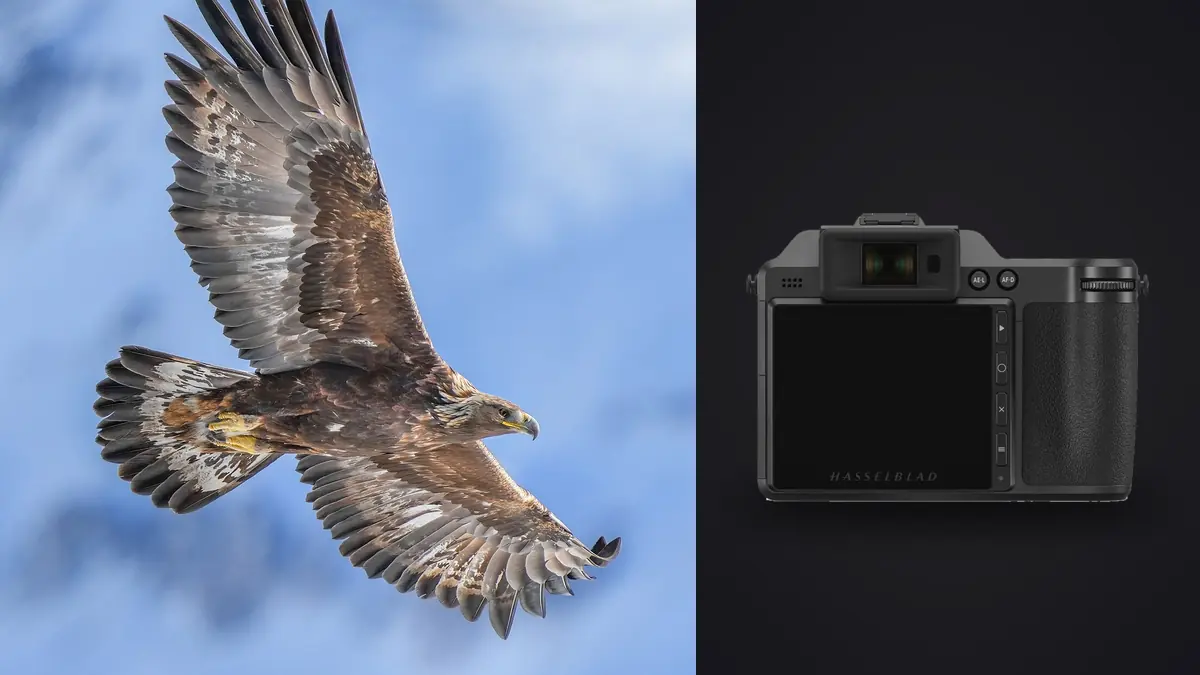
I took a Hasselblad X2D 100C to a heron rookery three mornings in a row before I admitted to myself that this camera was never built for what I was asking it to do. It is a medium format body designed for landscapes, studio portraits, and the kind of deliberate, tripod-and-cable-release work where you have thirty seconds to nail a frame, not thirty milliseconds. And yet there is a specific, slightly stubborn appeal to trying it on birds in flight anyway, and after a few hundred gigabytes of RAW files I think I understand both why people attempt it and why almost nobody sticks with it as their only rig.
This isn't a spec-sheet review. It's a field report on what actually happens when you point a 100-megapixel sensor with a contrast-detection AF heritage at a great blue heron lifting off a snag, and what you need to change about your shooting and editing habits if you want usable frames out of it.
Why anyone tries this in the first place
The pull isn't speed, obviously. It's what the file gives you afterward. The X2D 100C's sensor is 43.8 x 32.9mm, roughly 1.7x the surface area of a full-frame sensor, and the 100-megapixel files hold enough resolution that a bird occupying a modest fraction of the frame can still be cropped hard and printed large. On a 24-megapixel APS-C body, a heron that fills 15% of the frame gives you a genuinely soft, pixel-starved crop. On the X2D 100C, that same 15% crop still leaves you with 15 million pixels to work with, which is more resolution than most full-frame bodies capture natively.
Dynamic range is the other draw. Hasselblad rates the sensor around 15 stops, and in practice backlit wings against a bright sky hold detail that would blow out or crush on a lot of mirrorless bodies. Egrets and swans in direct sun, the exact subjects that make histograms ugly, are where this sensor earns its keep. If your bird photography leans toward big prints and you're willing to accept a much lower hit rate, the output quality argument is real. It's just not the whole story.
The autofocus reality, without the marketing gloss
Hasselblad built the X2D 100C's autofocus system in-house, and it's a real improvement over the X1D II's borrowed module, but it's still fundamentally a contrast-detection system tuned for careful, static composition. It hunts on low-contrast subjects, it's slower to reacquire after you lose the subject behind a branch, and it does not have the predictive tracking or animal-eye detection that Sony, Nikon, and Canon have spent the last five years building into their sports and wildlife bodies.
In practice, this means the camera is genuinely good at a heron standing still on a piling, decent at a heron taking a few slow, telegraphed steps before liftoff, and unreliable once wings are actually pumping against a cluttered background. On a clean sky, hit rate improves a lot, because the AF system has an easy, high-contrast edge to lock onto. Against reeds, water texture, or a treeline, I was regularly losing focus lock mid-sequence. A rough number from one outing: out of a 40-frame sequence tracking a gull banking against open sky, I kept six frames that were properly sharp on the eye. Against foliage, that ratio got worse, not better.
Burst rate and buffer, compared honestly
This is the part that actually disqualifies the X2D 100C from serious BIF work for most people, and it's worth putting next to the bodies photographers actually reach for when birds in flight are the primary subject.
| Camera | Sensor | Max burst rate | AF system | Approx. raw buffer | Body-only price |
|---|---|---|---|---|---|
| Hasselblad X2D 100C | 100MP medium format | ~3.3 fps | In-house contrast-based AF | ~15-25 frames | ~$8,200 |
| Fujifilm GFX100 II | 102MP medium format | ~8 fps | Phase-detect hybrid AF | ~150+ frames (raw) | ~$7,500 |
| Nikon Z9 | 45.7MP full frame | 20 fps (raw), 120 fps (crop JPEG) | Phase-detect w/ bird detection | 1,000+ frames | ~$5,500 |
| Sony A1 | 50MP full frame | 30 fps (electronic) | Phase-detect w/ bird eye AF | ~400+ compressed raw | ~$6,500 |
Look at that buffer column. At roughly 3.3 frames per second with a shallow buffer, you get maybe six or seven seconds of continuous shooting before the camera stalls to write to card, and each of those frames is a coin flip on focus for anything moving fast. A Z9 or A1 shooter can hose down twenty frames of a launch sequence and pick the two where the wing position and eye sharpness line up. On the X2D 100C you get four or five frames of that same launch, period, and you need most of them to land.
The lens problem nobody mentions upfront
What Hasselblad actually sells you
The XCD lineup was built for landscape and portrait work, and it shows the moment you think about reach. The longest native XCD prime is the 135mm f/2.8, which on the X2D's sensor gives roughly a 106mm full-frame-equivalent field of view once you apply the medium format crop factor of about 0.79. Pair it with Hasselblad's own XCD 1.7X teleconverter and you get an effective 230mm focal length, closer to 182mm full-frame equivalent, at a real-world aperture around f/4.8. That is a portrait-and-environmental-shot lens, not a "bird thirty meters up a dead tree" lens.
Adapting your way to more reach
The workaround most X2D owners use is Hasselblad's XH lens adapter, which lets you mount older H-series lenses, including the HC 300mm f/4.5, and retain autofocus and aperture control. That gets you into more usable territory for perched birds and slower flight, roughly 237mm full-frame equivalent, but it's still short of the 500-800mm range that dedicated wildlife shooters lean on, and the HC 300mm plus adapter plus X2D body is a genuinely heavy, front-loaded rig to hand-hold for hours waiting on a nest.
Where it actually pulls its weight
Perched birds, slow wader stalking, and anything with a predictable, repeatable flight path (ospreys returning to a known nest platform, gulls working a pier at the same hour every evening) are where the X2D 100C stops being a liability. You get time to pre-focus on the perch, set a focus zone, and wait. The moment the behavior becomes predictable, the camera's weaknesses matter less and its output quality starts to dominate the result. I've gotten heron portraits off this camera that no APS-C sports body could touch for tonal depth and cropping latitude, specifically because the situation let me treat it like the deliberate camera it is.
Backlit and high-contrast scenes are the other clear win. Swans against overcast skies, egrets in harsh midday sun, anything where a lot of cameras would need exposure bracketing, the 15-stop range on this sensor recovers detail in both the highlights on white feathers and the shadow side of the bird without much effort in post.
What this does to your editing workflow
A single morning of trying to catch flight sequences on this camera, even with its slow burst rate, still produces a few thousand frames once you count every attempted launch, every missed AF hunt, and every near-duplicate from re-triggering the shutter while waiting for focus to catch up. Each compressed RAW file runs 70-100MB, so a modest outing can leave you with 200+ GB to sort through, most of it either soft or redundant. That's a brutal culling job to do by eye at full resolution on files this large.
This is the part of the process where I stopped doing things manually. I run the take through imagic before I touch Lightroom: its local sharpness scoring flags which frame in a burst actually landed focus on the eye rather than the wing or the branch behind it, which matters enormously here because the contrast-AF hunting produces exactly the kind of near-miss frames that look sharp at a glance and are soft at 100%. The burst and duplicate clustering also groups the handful of frames from each launch attempt together automatically, so I'm reviewing "launch sequence 1, launch sequence 2" instead of scrolling through a flat grid of a thousand thumbnails. Because it runs entirely on-device, none of that culling depends on uploading gigabyte-scale RAW files anywhere, which matters more than I expected once I was doing this from a rookery with no real signal.
Once the keepers are isolated, I lean on imagic's apply_my_style preset to get a consistent starting grade across a session that mixes backlit flight attempts with shaded perch portraits, since the light was rarely consistent across three hours at the water. It's built from my own past edits rather than a generic wildlife preset, so it doesn't try to push saturation the way a lot of canned bird-photography presets do. If you're weighing tools for a similar high-volume, low-hit-rate workflow, it's worth reading up on how AI photo culling actually works before assuming you need to do this by hand, and if you shoot a lot of static-subject work between wildlife outings, the color grading workflow guide covers the studio side of the same principle.
Reach and drive settings that helped
A few adjustments made a real difference once I accepted the camera's limits rather than fighting them. Switching to the electronic shutter's continuous AF mode instead of single-shot cut down on some of the worst hunting, since the camera at least had a focus starting point from the previous frame instead of resetting cold each time. Pre-focusing on a fixed distance zone (the branch, the water's edge, the nest rim) and waiting for the bird to cross that plane worked far better than trying to track a bird already airborne, which is really just accepting that this is a zone-focus camera for this purpose, not a tracking camera. And shooting in the 65 x 24mm crop mode helped a couple of times when I wanted a longer effective reach out of the 135mm and was willing to give up some of the 100-megapixel advantage that was the whole reason to bring this camera in the first place, which tells you something about how often the tradeoffs cancel each other out.
Frequently Asked Questions
Can the Hasselblad X2D 100C actually track a bird in flight?
It can hold focus on a bird flying a slow, predictable path against a clean sky reasonably well. It struggles against cluttered backgrounds, fast direction changes, or anything closer to the erratic flight patterns of smaller songbirds. Treat it as a camera for deliberate, anticipated flight, not reactive tracking.
What's the longest reach you can realistically get for birds on this system?
Native XCD glass tops out around 230mm effective focal length using the 135mm f/2.8 with the 1.7X teleconverter. Adapting an HC 300mm f/4.5 through Hasselblad's XH adapter gets you further, into the low 300s of effective reach, while keeping autofocus, but it's still short of the 500mm-plus glass most dedicated bird photographers use.
Is the crop sensor mode worth using for bird photography?
It buys you extra apparent reach from a shorter lens, which is genuinely useful given the XCD lineup's limits, but it throws away a meaningful chunk of the resolution advantage that's the main reason to shoot medium format for wildlife in the first place. I'd use it as a situational tool, not a default setting.
Should someone buy an X2D 100C specifically to shoot birds in flight?
No, not as a first or only body for that purpose. If flight photography is your primary interest, a body with a fast hybrid AF system and a deep buffer will get you a dramatically higher hit rate for a lower price. The X2D 100C makes more sense if you already own one for other work and want to see what it can do on perched birds, slow waders, and predictable flight paths where its dynamic range and resolution actually get to matter.
The honest summary after three mornings and a full memory card rotation: this camera rewards patience and punishes improvisation. If you're willing to shoot fewer frames, wait for repeatable behavior, and do your culling with tools built for sorting large volumes of near-miss RAW files rather than eyeballing a Lightroom grid, you can come home with heron and osprey portraits that have a tonal quality a faster body won't match. If you need to reliably freeze an erratic warbler mid-dive, this isn't your camera, and no amount of technique compensates for a 3.3fps burst rate and a contrast-detection AF system built for something else entirely.