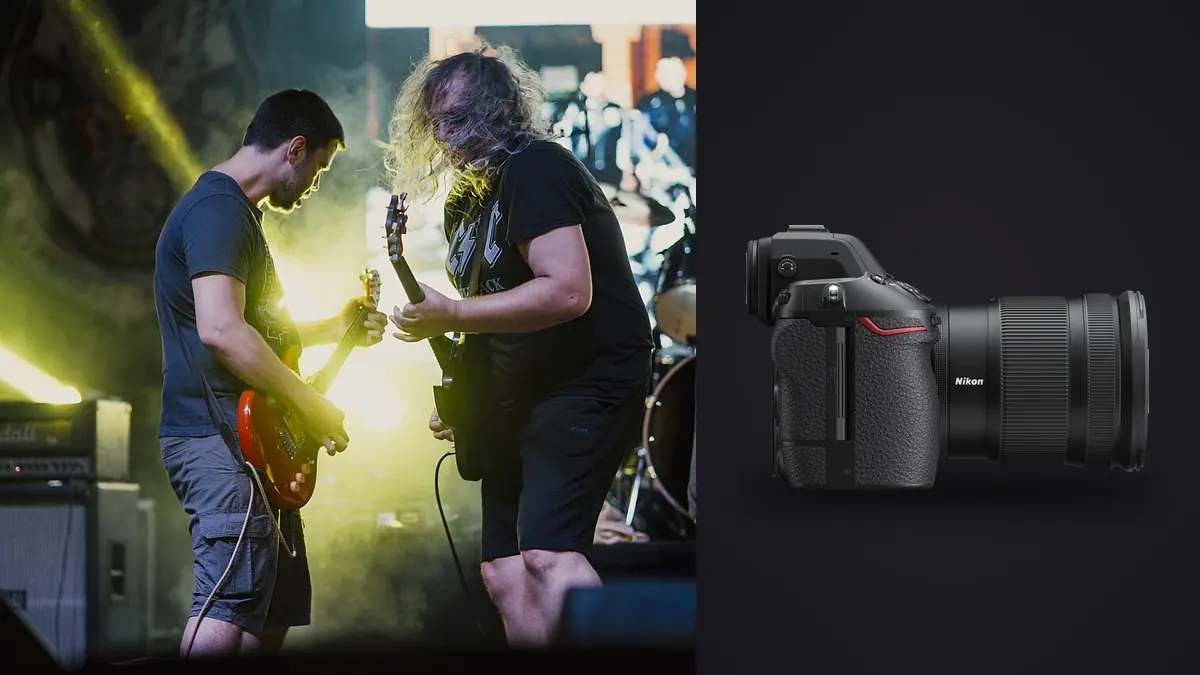
The first time I brought a Nikon Z8 into a photo pit, I spent most of the opening song watching the viewfinder instead of shooting, because I couldn't quite believe it wasn't blacking out between frames. That sounds like a small thing until you've spent years shooting gigs on a mirror-slap DSLR, trying to time a jump or a drumstick throw through a viewfinder that goes dark exactly when you need to see the peak of the action. The Z8 doesn't do that, and it changes how you shoot a set.
This isn't a spec sheet rundown. It's what actually matters when you're three feet from a stage monitor, the follow spot is swinging across a singer's face, and you've got three songs before security walks you out. Shutter behavior, autofocus in bad light, exposure under mixed colored wash, lens choices that survive a full tour bus, and what to do with the couple thousand frames you come home with.
Shutter Mode Is the First Decision You Make
The Z8 has no mechanical shutter at all. Everything runs through the stacked sensor's electronic readout, which is fast enough that rolling shutter distortion, the classic argument against electronic-only shooting, mostly stays out of the way for typical stage movement. You'll still see it occasionally: a mic stand thrown sideways hard, a fast pan following a guitarist sprinting across the stage, or a strobe hit that catches the sensor mid-readout and skews a vertical line that should be straight. It's rare enough that I stopped worrying about it, but I know it's there.
What you get in exchange is a blackout-free electronic viewfinder at full burst speed. You can hold a singer's eyes in frame through an entire chorus without the finder cutting out between shots, which sounds minor until you're trying to nail the exact instant a hand hits a cymbal. It's also silent, which matters more than people expect. Acoustic sets, seated theater shows, awards-style performances with quiet passages between songs. A mechanical shutter clattering through a 10-frame burst during a quiet bridge gets you noticed by the wrong people. The Z8 doesn't make a sound.
Autofocus When the Only Light Source Is a Follow Spot
Subject detection with eye tracking works well when a performer is lit against a dark background, which describes maybe half of what actually happens on stage. The other half is backlighting, haze cutting the follow spot into a visible beam, or a singer stepping fully into silhouette against a wall of white LED for effect. In those conditions the camera will happily lock onto whatever has contrast, which is often the wrong thing.
My working habit is to start in 3D-tracking rather than the broader auto-area people detection, and place the focus point on the face manually before the song starts rather than trusting the camera to find it in a crowd of moving bodies and instruments. Back-button focus is non-negotiable here, because you want to be able to release the AF trigger the instant a spotlight sweeps across and recompose or refocus without the shutter button doing it for you. When a performer goes fully backlit, I'll often switch briefly to single-point and focus on an edge, a shoulder or a guitar headstock, rather than fight the eye detection for a face the camera can't actually see well enough to track.
Exposure and Color Under Mixed Wash Lighting
Stage lighting swings by four or five stops between songs, sometimes between phrases of the same song. I shoot manual exposure almost exclusively at gigs now, because auto modes chase the brightest LED wash on stage and leave the performer's face underexposed by a stop or two right when you need it correctly lit. Spot metering on skin, adjusted by eye through the EVF's live exposure preview, gets me closer faster than trusting any metering mode to guess what matters in a frame full of colored light and black background.
White balance is its own fight. A stage might run warm amber key light on the singer while a cyan wash hits the drum riser and a magenta backlight rims the guitarist, all at once. Auto white balance hunts frame to frame trying to average that out, which gives you an inconsistent color cast across a burst that should look like one moment. I set a fixed Kelvin value, usually somewhere around 4000K as a starting point, and leave it there for the set. Since you're shooting RAW anyway, the exact number matters less than consistency: fix it in camera, adjust it properly later. If the venue is running LED fixtures with visible flicker or banding on faster shutter speeds, the Z8's flicker reduction option is worth switching on before doors open rather than discovering banded frames afterward.
Matching Settings to the Room
What actually changes between a 200-capacity club and a festival main stage isn't the camera, it's how much light you're given and how far away you're forced to stand. Here's roughly how I set up for each.
| Venue type | Typical ISO range | AF area mode | Lens of choice | Main hazard |
|---|---|---|---|---|
| Small club or bar (under 300 cap) | 3200 to 8000 | Single-point or 3D-tracking, manual placement | 35mm f/1.4 or 50mm f/1.2 S | Single overhead wash, almost no separation from background |
| Mid-size theater or club stage | 1600 to 6400 | 3D-tracking with eye detect | 24-70mm f/2.8 S | Fast-moving follow spots crossing faces mid-song |
| Arena or festival main stage | 800 to 4000 | Auto-area people detection | 70-200mm f/2.8 S | LED video wall shifting color and brightness behind the subject |
The pattern that surprises people new to this: the biggest shows are often the easiest to expose correctly, because production budgets buy consistent, well-aimed lighting. It's the small room with one bar-clamp par can hanging over the stage that pushes you into the ugliest ISO territory.
Lenses I Actually Bring
The 24-70mm f/2.8 S does the majority of the work in a photo pit. You're usually confined to the space between the barrier and the stage lip, and a zoom lets you go from a wide crowd-and-stage shot to a tight face without stepping anywhere, which matters when you've got three songs and a photographer standing on each side of you doing the same thing. The 70-200mm f/2.8 S comes out for anything where the pit is roped off further back, or for a headliner slot where the tour's own security keeps photographers at distance regardless of venue size.
For small rooms I'll drop a 50mm f/1.2 S or a 35mm f/1.4 in the bag instead of relying purely on the zoom's f/2.8. An extra stop and a bit of change matters when you're at ISO 6400 already and the singer steps back from the one light source that was working for you. The tradeoff is you lose reach exactly when a song calls for a wider shot, so carry a prime as a second body option, never as your only lens for a show you haven't shot before.
Cards, Batteries, and the Buffer Math
Run CFexpress Type B in the primary slot if you're shooting anywhere near full burst speed for more than a couple of seconds at a time. The SD UHS-II slot clears noticeably slower, and if you're relying on it as your main card during a long chorus-line burst you will feel the buffer catch up with you, usually at the exact moment the drummer throws a stick in the air. I use the SD slot as overflow rather than a mirror, since RAW files at 45.7 megapixels eat card space fast enough that doubling up on every frame gets expensive over a tour.
Battery life is the one place the Z8 shows its size. Running the EVF constantly through three-song sets with heavy bursts drains an EN-EL15c faster than the CIPA rating suggests. I carry at least two spares for any bill with more than one support act, and I've learned to swap at setlist breaks rather than waiting for the low battery warning to show up mid-song.
Getting Through the Files the Next Morning
A three-band bill with a full pit pass routinely leaves me with somewhere between 1,800 and 2,600 RAW frames by the time the headliner's set ends. A meaningful chunk of that is repeated bursts of the same jump, the same guitar solo, the same crowd shot from slightly different angles, because you don't get a second take at a live show and you shoot through the moment rather than betting on one frame.
That's the part of the job nobody warns you about when they hand you a camera bag. I run the night's folder through imagic before I touch anything in an editor. Its local sharpness and focus scoring flags which frame in a 20-frame jump burst actually has the eyes in focus, which used to be twenty minutes of squinting at thumbnails and is now closed out before I've finished a coffee. The duplicate and burst clustering groups those repeated sequences automatically instead of leaving me to scroll past the same guitarist windmill nine times looking for the sharpest one, and because it runs entirely on the laptop with no upload step, nothing leaves my machine before anyone else has seen it, which matters more than people think when a shoot comes with an exclusivity clause.
Once the culling pass is done, apply_my_style carries the color treatment I've built up from my own previously delivered edits across the new batch, so a Tuesday club show and a Friday festival slot land in the same visual world without me rebuilding a preset from scratch every time the lighting rig changes. It's a one-time purchase rather than another subscription stacked on top of a laptop, a couple of lenses, and a growing card collection, which after enough tours starts to matter on its own. If you're trying to tighten the whole post-show routine rather than just the culling step, our guide to a faster photo workflow covers the rest of the pipeline, and how AI photo culling actually works goes into more detail on what the sharpness scoring is doing under the hood.
Frequently Asked Questions
Is the Nikon Z8 actually quiet enough for a seated acoustic show?
Yes, and it's one of the strongest arguments for using it over an older DSLR at that kind of booking. With the electronic shutter there's no mechanical noise at all, which means you can shoot through quiet, stripped-down passages without the audience or the performer hearing a thing. The only sound you'll produce is whatever your lens's autofocus motor makes, which on the S-line lenses is close to silent anyway.
Should I shoot at the full 45.7 megapixels for gig work, or use a crop mode?
I shoot full frame and crop later rather than committing to an in-camera DX crop, mostly because you rarely know until you're editing whether a shot needs to be a tight face or a wider stage composition. The resolution gives enough room to reframe a photo pit shot into a magazine-style crop after the fact, which is useful given how little control you actually have over your position during three songs at the barrier.
What ISO ceiling is realistic before noise becomes a real problem at a gig?
In practice I stay comfortable up to about ISO 6400 for anything I plan to share, and I'll push to 12800 for a small room with genuinely bad lighting when the alternative is missing the shot entirely. Past that the file still holds together with some noise reduction in post, but I'd rather widen the aperture or accept a slightly slower shutter speed than lean on the top end of the ISO range as a first option.
Do I need to record to both card slots for a paid concert booking?
For a one-off club show, no, I run CFexpress as primary and SD as overflow once the first card fills. For a show I can't reshoot, like a one-off festival set or a tour's only date in a city, I'll switch to backup recording across both slots. It costs some buffer speed and card space, but a corrupted card on a night you can't get back is a worse problem than either of those.