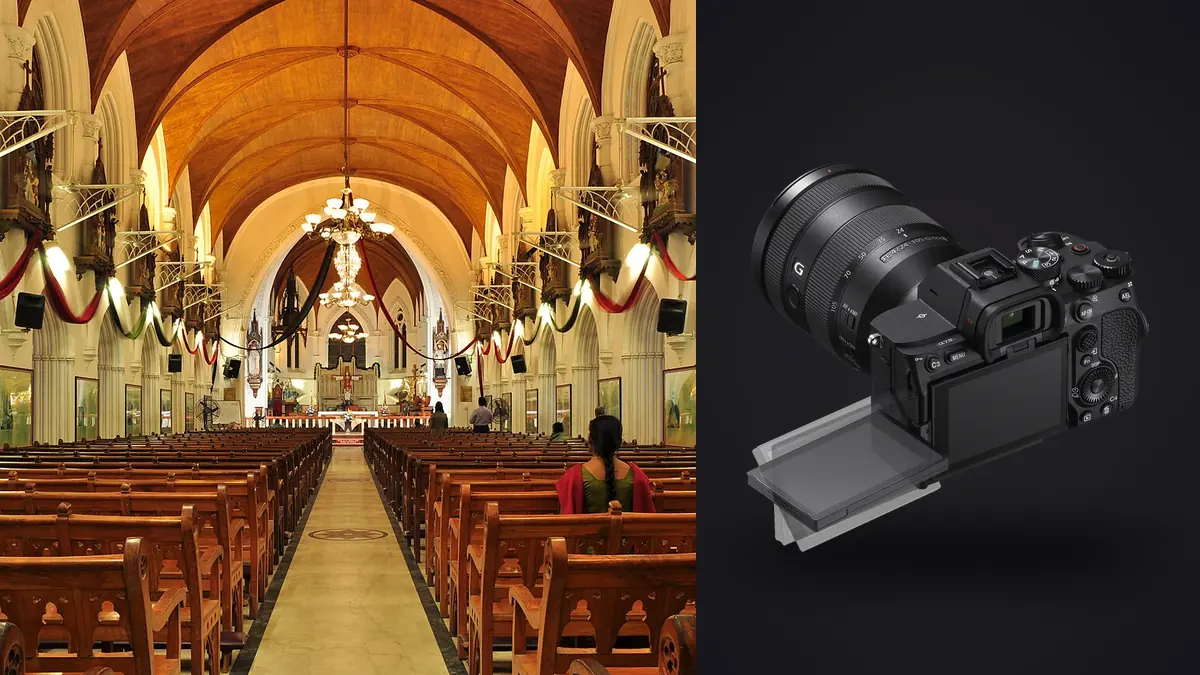
The Sony A7 IV is a capable general-purpose full-frame camera that can also handle serious architectural and interior photography. Its 33-megapixel sensor provides useful detail without the heaviest files in Sony's range, the E-mount offers many wide-angle choices, and the articulating screen helps when the camera sits near a wall or floor. Those strengths make it attractive to photographers who divide their work among property, people, events, and video.
It is not automatically the best architecture purchase. The system has no Sony-branded native tilt-shift lens, very high-resolution alternatives provide more crop room, and demanding interiors still require disciplined lighting, support, and perspective control. A buying decision should start with delivery needs and lens access, not a feature list.
Start with the job the camera must complete
Residential listings, editorial interiors, hospitality campaigns, and architectural documentation have different thresholds. A listing may prioritize a consistent set delivered quickly. A design publication may need careful color and fine material detail. A large commercial installation may demand more resolution, controlled lighting, and perspective correction than a mixed-use body is expected to provide.
Write down final dimensions, typical viewing distance, crop flexibility, turnaround, and how often images are printed large. The A7 IV's resolution is generous for web, editorial, and many print uses when composition is accurate. It is less forgiving when the photographer routinely crops away large areas after correcting converging lines. In that case, a shift lens or a higher-resolution body may be the more efficient purchase.
Also list the non-architecture work that pays for the camera. Autofocus and flexible video features add value to a hybrid business, but they do not improve a static room photograph made from a tripod. If almost every assignment is still architecture, direct the budget toward lens quality, a geared head, lighting, and reliable color tools before paying for unrelated speed.
Understand where 33 megapixels are enough
Resolution is a system result. Accurate focus, a stable camera, a strong lens, suitable aperture, low vibration, and careful processing all influence visible detail. A well-made 33-megapixel file can outperform a poorly supported higher-resolution file. For property websites, brochures, portfolios, and moderate prints, it leaves useful room for straightening and small crops.
The limit appears when perspective correction stretches corners or when a loose composition is cropped into several deliverables. Every correction discards or interpolates some information. Frame with the final verticals and aspect ratio in mind, level the camera, and move position before relying on software. This preserves more of the sensor you already own.
Clients sometimes request a resolution figure without explaining use. Ask for pixel dimensions or physical size and viewing conditions. A stitched panorama or composite process may solve some demands, but it adds capture and post-production risk and is not a feature of imagic. If the assignment regularly depends on such methods, test the complete specialist workflow before selecting the body.
Price the lens path, not just the body
For interiors, the core lens often matters more than a small difference between camera bodies. A rectilinear wide zoom offers speed when room sizes change, while a carefully chosen prime can provide lower distortion and strong corners. Look beyond the widest focal length. Evaluate how much of the frame remains useful after distortion correction and whether filters, hoods, or flare behavior suit the locations.
Perspective is not the same as lens distortion. Keeping the sensor vertical preserves vertical lines, but it may include too much floor and too little upper structure. A tilt-shift or shift lens moves the framing without tilting the camera. E-mount users can consider third-party options or adapted lenses, but adaptation should be tested for corner quality, mechanical clearance, and a secure fit. Manual focus is normal for this work.
Budget for the focal lengths that match actual rooms. An extremely wide lens can make spaces look stretched and furniture relationships unnatural. A slightly longer view from a better position often feels more credible. For exteriors, a normal or short telephoto can compress distracting foreground and isolate facade geometry. One ultra-wide zoom is not a complete architectural kit.
Consider handling on location
The A7 IV's articulating screen helps with low tripod positions, vertical frames, and cameras placed close to obstacles. Some photographers prefer a simple tilt screen for speed, but the side hinge can be useful when the tripod stands against a wall. Try the movement with the intended cable release, L-bracket, and tripod plate because accessories can obstruct the screen.
Set a custom mode for interiors: RAW capture, manual exposure, base or low ISO when practical, a short self-timer or remote release, fixed white balance as a starting point, and exposure aids visible. Another mode can hold an exterior configuration. Saved modes reduce accidental carryover from portraits or video.
Dual card slots can support an immediate second copy, but card redundancy is not a complete backup. Confirm how the camera handles mixed card types and file routing. Architecture sessions may look slow, yet a full day across many rooms creates a meaningful asset set. A clear card and folder policy protects it.
Know the sensor and shutter limits
Electronic shutter can be quiet in an occupied property, but readout behavior can interact with flickering LEDs and may distort moving objects. Curtains, people, fans, and screens can reveal problems that a static wall does not. Mechanical shutter is often the safer baseline under uncertain artificial light. Test silent capture before trusting it across a whole property.
Interior dynamic range can exceed one exposure when windows are bright and the room is dim. First control what can be controlled: choose the time of day, switch fixtures consistently, add or subtract light, and decide whether the window view is part of the brief. Bracketing records alternatives, but combining them requires a separate editing process and careful handling of moving leaves, curtains, or people.
In-body stabilization is useful when a tripod is forbidden, but architecture rewards a stable support whenever access allows. A tripod preserves composition across lighting changes and lets the photographer inspect edges. Verify stabilization behavior on the chosen support through actual files. Do not assume that either leaving it on or turning it off is universally correct for every lens and exposure.
Account for color and workflow
Mixed daylight, warm lamps, green LEDs, and colored walls make interior color difficult. RAW files provide adjustment latitude, but they cannot make conflicting sources identical. Capture a neutral reference in the key area, turn off unwanted fixtures when permitted, and note rooms where practical lights must remain for atmosphere. Consistency begins on site.
File size affects storage, preview generation, culling, and archive cost over the life of the body. The A7 IV occupies a useful middle ground: enough detail for careful work without the largest files in the system. That is a real buying advantage for high-volume property work. A high-resolution body only earns its overhead when clients use the extra information.
A local desktop app such as imagic can score sharpness, exposure, closed eyes, and composition while grouping duplicates on Windows or macOS. For static rooms, automatic scoring is a technical aid, not a composition judge. The photographer must still compare window states, light placement, reflections, and whether objects moved between frames.
Who should buy it, and who should look elsewhere
The A7 IV fits a hybrid photographer who needs one reliable body for interiors, portraits, events, and occasional motion. It also suits property work where moderate file size, broad lens choice, and flexible screen handling matter more than maximum resolution. Existing E-mount lenses and batteries strengthen the case because system switching carries hidden cost.
Look at a higher-resolution body if large commercial output and heavy perspective correction are routine. Consider a system with a clearer native shift-lens path if rise, fall, and precise geometry define most assignments. Choose a smaller or less expensive body if final files are modest and the savings can buy a better wide lens, tripod head, or lighting kit.
Before buying, rent or borrow the body with the exact wide lens and support you plan to use. Photograph a real room with bright windows, detailed corners, reflective surfaces, and mixed light. Process and export it at client size. That single end-to-end trial answers more than comparing isolated specifications. More system context is available in the camera hardware guides.
Budget for calibration, support, and a backup path
The body does not arrive as a complete architectural system. Include a stable tripod, head, release method, spare battery, dependable cards, neutral reference, calibrated display, working storage, backup storage, and protection for occupied locations. If a shift lens or adapter is required, include its plate and transport case. These items affect delivery more directly than another autofocus feature.
Check the camera's electronic level against an independent level and real vertical references. Confirm the monitor used for final color is profiled on a sensible schedule. Inspect the chosen wide lens for decentering and keep a record of its reliable apertures. Calibration here means verifying the system through photographs, not chasing perfect numbers without a visible problem.
A paid property assignment also needs a failure path. A second body does not need identical specifications, but it should accept a useful lens and produce the required output. Carry a spare plate tool, release option, card reader, and basic light trigger where relevant. The backup plan should be rehearsed before access time begins.
Add the full support cost to each candidate camera, then compare systems again. A less expensive body with a stronger lens, accurate head, and verified backup may produce a more dependable service than an A7 IV purchased without the tools that let it work precisely.
Include access time in that calculation. A body that is quick to level, easy to operate near a wall, and familiar under mixed light can reduce time inside an occupied property. That practical handling advantage may matter more than a small laboratory difference, so the rental test should include setup and pack-down as well as image quality.
Photograph one vertical frame during that trial as well, because screen movement, bracket clearance, and tripod balance can change when the camera rotates.
Frequently asked questions
Is 33 megapixels enough for professional interiors?
Yes for many web, editorial, brochure, and moderate print uses when framing and focus are accurate. Jobs requiring heavy crops or very large output may benefit from more resolution or a shift-lens workflow.
Does the Sony A7 IV have a native Sony tilt-shift lens?
No Sony-branded native E-mount tilt-shift lens is the standard path. Third-party and adapted options exist, but they should be tested for corner quality, handling, and mechanical fit.
Is silent shutter ideal inside occupied properties?
It is quiet, but some artificial lights can create banding and moving subjects can show readout distortion. Make a test under the actual fixtures and use mechanical shutter when it is more reliable.