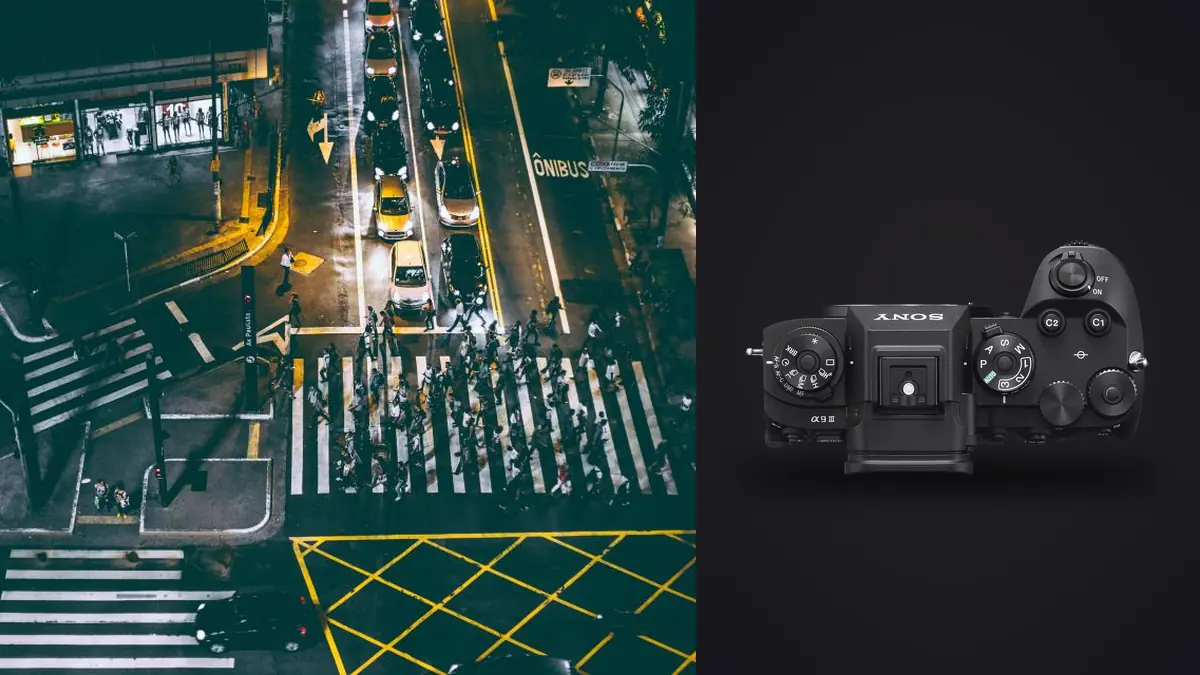
I picked up the A9 III about four months after launch, mostly out of curiosity about the global shutter, and it has stayed in my bag for every street and documentary job since. Not because it's the sharpest lens system or the biggest sensor (it isn't, at 24.6 megapixels it's the smallest file size Sony sells in this class), but because it removes an entire category of problem I used to just work around. If you've ever panned with a cyclist under sodium streetlights and watched your frame turn into a wobbly parallelogram, you already know the problem I mean.
This isn't a spec sheet regurgitation. It's what changed in my actual workflow moving from an A9 II, and briefly an A1, into a body built around a stacked global shutter sensor, and where I think that trade genuinely pays off for street and documentary work versus where it's just a novelty.
The shutter is the whole story, not a footnote
Every CMOS sensor before this one reads out line by line. Fast subjects moving through the frame during that readout get skewed, whip pans turn straight verticals into diagonals, and anything under a flickering light source (LED signage, most stadium lighting, a lot of interior fluorescent) can band or shift color across a single frame. The A9 III reads the entire sensor at once. There is no rolling shutter artifact because there's no rolling readout to begin with.
For documentary work in markets, protests, transit stations, anywhere with fast unpredictable motion crossing the frame, this stopped being an abstraction for me within the first week. I shoot a lot of scooters and delivery cyclists weaving through pedestrian crowds in the older parts of town, and on the A9 II those frames were a coin flip past 1/2000s if I was panning. On the A9 III they just aren't a problem anymore. Same with shooting toward illuminated shopfronts and neon signage at night: no banding, no color tearing across the frame.
The other practical win is flash sync. Because there's no rolling curtain, you get full flash sync at any shutter speed, up to 1/80,000s if you want it. For documentary interiors where I'm balancing a speedlight against blown-out window light, or for the rare street portrait where I want to underexpose ambient and pop a flash on the subject, this removes the usual dance with high-speed sync power loss entirely.
None of that is free. Stacked global shutter sensors have historically traded some dynamic range and base ISO noise performance for that readout speed, and the A9 III is no exception. Base ISO dynamic range sits close to a stop behind the A7 IV's 33-megapixel BSI sensor in raw shadow recoverability. If you shoot flat, evenly lit documentary interviews and push shadows hard in the grade, you'll notice it. For street work where you're exposing for highlights and accepting some crushed shadow anyway, I haven't found it to matter much in practice.
Shooting through a scene without ever losing the viewfinder
The blackout-free EVF, running at up to 120fps refresh during continuous shooting, matters more for documentary timing than the burst rate number does. On older bodies, every frame in a burst blacks out the finder for a beat, which means you're tracking a moving subject through a strobing view and guessing at timing on the frames that matter. On the A9 III you watch the scene continuously while the shutter fires. I can follow a subject's eyeline or a gesture developing in real time and fire exactly on the beat instead of a frame after it.
120fps full-resolution raw burst with continuous AE/AF exists on this body, and I'll be honest, I use it rarely. For street and documentary work that speed is more useful as an option than a default. What I use constantly is 20-30fps for sequences where a scene is unfolding (a street performer, a moment of conflict de-escalating, kids playing near traffic) and I want several candidate frames of the peak action without the shutter sound of a mechanical body giving away my position.
Card capacity becomes the real constraint at higher burst rates. A single 10-second burst at 120fps on lossless compressed raw is well over a thousand frames, and one afternoon of loose, exploratory street shooting at 20-30fps easily produces 3,000 to 5,000 frames. That volume is where the shooting stops being the bottleneck and the editing desk becomes the actual job.
| Camera | Sensor readout | Max flash sync | Full AE/AF burst | Rolling shutter risk | Body weight |
|---|---|---|---|---|---|
| Sony A9 III | Global (simultaneous) | 1/80,000s | 120fps | None | 702g |
| Sony A7 IV | Rolling (BSI CMOS) | 1/250s (mech.) | 10fps | Moderate on fast pans | 658g |
| Fujifilm X-T5 | Rolling (stacked-lite) | 1/180s (mech.) | 15fps | Noticeable; cropped mode helps | 557g |
| Leica M11 | Rolling, no AF tracking | 1/180s (mech.) | 4.5fps, manual focus | Low (slow shooting pace) | 640g |
Lenses that actually suit this kind of work
I'd steer most people away from pairing this body with the heaviest GM glass unless they genuinely need f/1.2. My daily combination is the 40mm f/2.5 G, which is small enough that the whole rig doesn't scream "camera" the way a body-plus-70-200 combo does, and light enough to carry on a wrist strap for a twelve-hour documentary day without shoulder fatigue. The 35mm f/1.4 GM is my second lens for interiors and low light where I want the extra stop, but it roughly doubles the front-of-camera weight and changes how the whole kit balances in hand.
For genuine zone-focus street shooting, the 24mm f/1.4 GM at f/8 gives enough depth of field that autofocus speed barely matters, which is somewhat beside the point on this body since the AF system is fast enough that zone focusing is more a stylistic choice than a technical necessity now. I know shooters who've moved fully to relying on the AF for street work because the eye and subject detection is reliably faster than their own zone-focus guess, and I don't disagree with them. I just still like the mechanical feel of manual zone work for reasons that are more about process than performance.
The 50mm f/1.2 GM is gorgeous glass and I own it, but it's not a street lens for me. It's heavy enough to change the camera's balance point, and f/1.2 is rarely a useful aperture on a crowded sidewalk where you want more than a sliver of your subject in focus.
Handling, discretion, and the parts nobody photographs for a review
At 702 grams body-only, this is not a small camera. It's built on the same chassis as the A9 II and A1, with a deep grip that's genuinely comfortable across a long shooting day but does not disappear into a jacket pocket the way an X100-series body does. If discretion by way of small size is your priority, this isn't that camera. Discretion here comes from a different feature: because the shutter is fully electronic and always available without the exposure penalties that plague rolling shutter electronic modes on other bodies, you can shoot completely silently, all day, at full resolution, without ever triggering a mechanical shutter. No clack, no shutter sound at all. In a courtroom, a quiet gallery opening, a funeral, or a tense moment where a shutter click changes the room, that matters more than almost any other spec on this camera.
Battery life on the NP-FZ100 is solid. I get somewhere around 500 to 600 real-world frames plus a fair bit of chimping and menu diving before I'm reaching for a spare, though burst-heavy documentary days with a lot of continuous AF tracking eat into that faster than the CIPA rating suggests. Dual CFexpress Type A slots (also accepting UHS-II SD, which is what I actually run day to day since Type A cards are still expensive per gigabyte) means I never worry about running out of space mid-assignment as long as I've planned my card rotation in advance.
The honest limit: this is not a low-light or landscape camera
I want to be direct about this because a lot of coverage glosses over it. Above ISO 6400 the A9 III shows more visible noise than the A7 IV or the A1 II at matched exposure, and by ISO 12800, which I do use for night documentary work in poorly lit interiors, you're pulling detail back in post more aggressively than you would on a body with a deeper base well. If your work is primarily low-light documentary in unlit rooms, or landscape and studio work where dynamic range is the priority, this isn't the sensor to build a kit around. It's a speed and timing tool first. I bought it because the moments I miss on other cameras are moments of fast motion and unpredictable timing, not moments of insufficient light, and it fixed exactly that problem for me while adding a genuine cost in noise floor.
Turning a week of shooting into something usable
The unglamorous part of shooting this camera the way it's designed to be shot is what happens after you get home. A single documentary assignment at 20-30fps easily leaves me with four or five thousand frames, most of them near-duplicates from the same three-second burst, and picking the one sharp, well-timed frame out of forty visually similar ones by eye is genuinely slow work, the kind that used to eat a whole evening before I could even start actually editing.
This is the part of my workflow where imagic actually earns its place. It runs entirely on my machine (nothing about a day's raw files leaves my laptop, which matters to me on assignments where I'm handling sensitive subject material), and it clusters burst sequences automatically so I'm reviewing groups of near-identical frames instead of scrolling past all of them individually. The sharpness scoring inside those clusters catches the one or two frames where focus actually landed and the subject wasn't mid-blink, which on a 120fps burst is not something I trust my own tired eyes to catch reliably at frame 40 of the day. If you haven't looked into how that kind of automated culling actually scores frames under the hood, this breakdown of how AI photo culling works covers the mechanics better than I can here.
The other piece that's saved real hours is the apply_my_style preset feature, which trains on edits I've already made rather than shipping some generic look. After I finished grading a documentary project I was happy with, I let it learn from those files, and now a fresh batch of street frames gets a first-pass edit that's already close to my usual color and contrast decisions before I touch a slider. It's not a substitute for actually looking at every keeper, but it collapses the baseline work from scratch to adjustment, which on a culled set of two or three hundred frames is the difference between an evening job and a weekend one. For anyone drowning in a similar volume problem, these workflow tips pair well with that kind of automated first pass.
Frequently Asked Questions
Is the A9 III's global shutter actually noticeable in everyday street shooting, or is it a spec that only matters for sports?
It's noticeable the moment you pan with anything moving fast near the frame edges, which happens constantly in street work even if you're not chasing action shots. Traffic crossing behind a subject, a cyclist entering frame during a burst, a dog running past mid-sequence: all of these used to introduce subtle skew on my A9 II that I'd only catch later at full zoom. On the A9 III those frames are just clean. It's a quieter benefit than the sports-shooter framing usually suggests.
How does the A9 III actually compare to the A9 II for documentary assignments, beyond the shutter?
The autofocus subject recognition is meaningfully better, particularly at holding focus on a specific person's eye in a crowd rather than jumping to whoever's closest, which matters a lot when you're working a scene with multiple people moving through frame. Buffer depth is also effectively a non-issue now, where the A9 II would occasionally choke on a long burst to a slower card. The resolution is the same 24.6 megapixels on both, so if you're not shooting fast unpredictable motion regularly, the upgrade is a harder case to make.
Can I really shoot this camera completely silently, or is that marketing?
It's real. Because there's no rolling shutter penalty to work around, the electronic shutter is the only shutter option you ever need, and it's silent at any shutter speed, including full mechanical-equivalent flash sync speeds. You can shoot an entire indoor event, including moments a few feet from someone speaking, without a single person turning toward the camera sound, because there isn't one.
Is 24.6 megapixels enough for documentary work that might get cropped or printed large?
For most editorial and documentary use, yes. It's enough resolution for a full magazine spread or a reasonably sized print without upsampling, and it keeps file sizes manageable across the multi-thousand-frame days this camera encourages. Where I'd push back is aggressive cropping: if you regularly punch in 50% or more to reframe after the fact, a higher-resolution body like the A7R V gives you more room, at the cost of everything this sensor is actually built for.