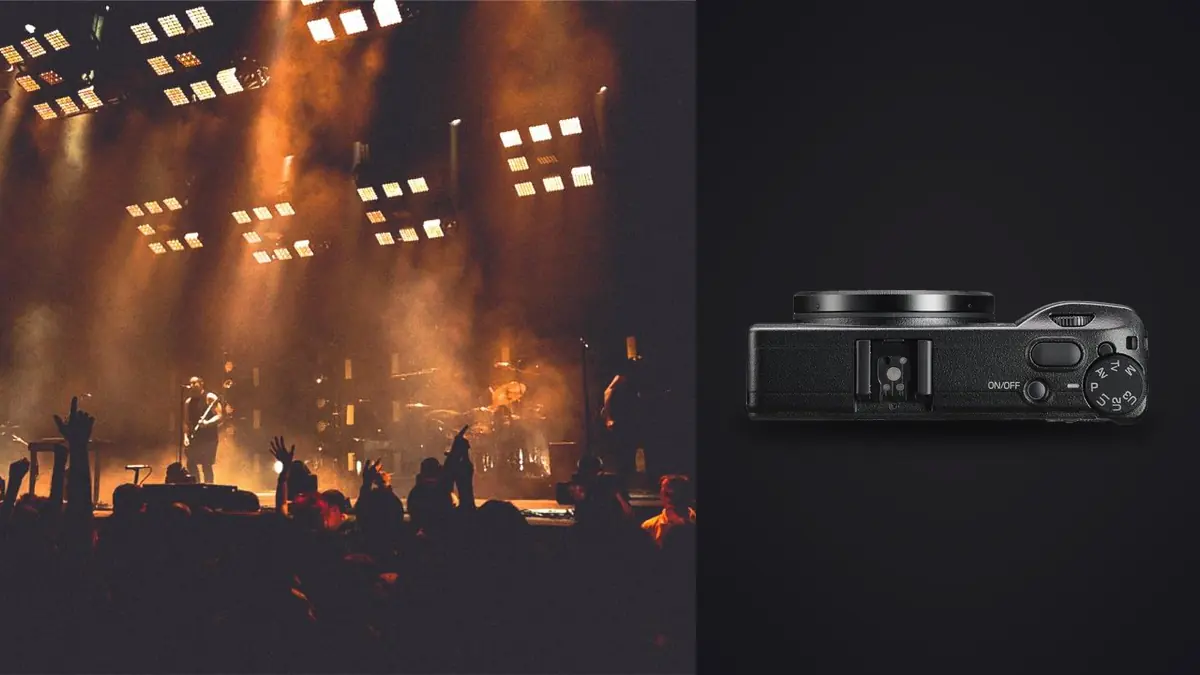
My main body went in for a shutter repair the week before three shows I'd already committed to, and the only thing left in the bag that wasn't a lens for something else was a Ricoh GR IIIx. I brought it out of necessity, not curiosity. Two of those shows were 200-capacity rooms with a photo pit you could cross in four strides, and the third was a seated theater show where cameras technically weren't allowed past the aisle. The GR IIIx got me usable frames from all three, and it's stayed in the bag ever since, sitting next to the zoom rather than replacing it.
This isn't a spec sheet review. It's what actually happens when you point a fixed 40mm-equivalent, contrast-detect-only compact at a stage full of moving people under bad light, and what you have to change about how you shoot to get something worth keeping.
The fixed 40mm changes how you have to work the room, not just what's in frame
Ricoh markets the GR IIIx as the "portrait" GR, a 40mm equivalent field of view against the standard GR III's 28mm. On paper that reads as a small difference. In a venue, it's the difference between a lens that flatters a single performer and one that's nearly useless for capturing an entire band unless you're standing a fair distance back, which most photo pits don't give you. At a small club, 40mm from the front rail gets you a tight, natural-looking headshot of the vocalist and maybe the guitarist standing next to them, nothing more. Fit the whole four-piece in frame and you need to be roughly 15 to 18 feet back, which in a lot of rooms means shooting through the crowd or standing at the sound desk instead of the pit. From a 1,200-capacity room's photo pit, a singer at center stage becomes a small, distant figure. There's no zoom to compensate. You either walk closer (if the pit and security allow it) or you accept a wider, more environmental frame than you wanted. What this lens is genuinely good at is close, personal framing in small rooms: a drummer mid-hit from eight feet away, hands on a keyboard, the particular sweat-and-stage-light look of someone singing directly into a mic three feet from your lens. If most of your live work is small venues and you like tight, intimate frames, 40mm is a feature. If you're regularly shooting arena stages or wide ensemble shots of a full band, you'll spend the whole set wishing for the GR III's wider 28mm, or honestly for an interchangeable-lens body with something longer.
Autofocus in a dark room is the actual limiting factor
The GR IIIx uses contrast-detect autofocus with no phase-detect assist, and it shows the moment stage lighting drops below what the camera considers comfortable. Under a bright, even wash it locks fast enough to keep up with normal movement. Drop into a moody blue-lit ballad or a room lit mostly by a single follow spot, and the lens starts hunting, racking back and forth before it commits, sometimes not committing at all before the moment passes. The workaround most people who shoot this camera at gigs land on eventually is snap focus. You set a fixed distance (2 meters is a common starting point for pit shooting, closer for tight club stages) and the shutter fires instantly at that distance with no AF search at all. It's a manual guess dressed up as a setting, and it means checking your rough distance to the performer between songs rather than trusting the camera to find focus mid-song. At f/2.8 and a moderate ISO, depth of field at 2 meters gives you maybe 20 to 30 centimeters of margin, which is forgiving enough for a singer who sways but not for someone actively moving toward or away from you. Stopping down to f/4 or f/5.6 when the light allows widens that margin considerably and is worth doing any time the venue gives you the ISO headroom to spare the aperture. It's a trade most working photographers make instinctively with faster glass; with a fixed f/2.8 lens on a small sensor-adjacent AF system, it matters more than usual.
What ISO is actually usable on stage
The APS-C sensor goes up to a native 102,400, which is a number nobody should take seriously for concert work. In practice, ISO 3200 is clean enough that I don't think twice about it, and 6400 is where I start being selective about which frames make the cut, since noise starts eating into shadow detail under cooler lighting. Warm tungsten washes hold up noticeably better at a given ISO than cold blue or magenta LED washes, which tend to show blotchy chroma noise in the same range. Past 12800, files are usable for web-sized crops or black-and-white conversions where grain reads as intentional, but I wouldn't print them large. Given the fixed f/2.8 and the reality that most venues you're shooting from the crowd rather than with photographer access to the lighting desk, ISO 3200 to 6400 with a shutter speed around 1/250 to 1/320 to freeze normal stage movement is the practical working range. Faster movement (a drummer's sticks, a jumping bassist) pushes you toward 1/500 or higher, which eats into your ISO headroom fast on a sensor this size.
Comparing the GR IIIx against what else you'd actually bring to a show
Here's how it stacks up against the cameras people most often cross-shop it against for live music work, based on what actually matters in a dark room rather than spec-sheet numbers.
| Camera | Equiv. focal length | Max aperture | AF in a dim club | Shutter noise | Weight | Approx. price |
|---|---|---|---|---|---|---|
| Ricoh GR IIIx | 40mm | f/2.8 | Hunts below roughly 100 lux; snap focus is the fix | Near-silent leaf shutter | 262g | $1,049 new |
| Ricoh GR III | 28mm | f/2.8 | Same AF module, same hunting behavior | Near-silent leaf shutter | 257g | $999 new |
| Fujifilm X100V | 35mm | f/2 | Hybrid PDAF, holds focus noticeably better in low light | Quiet but audible leaf-shutter click | 478g | ~$1,800 used (discontinued, marked up) |
| Sony a7C II + 40mm f/2.5 G | 40mm | f/2.5 | Fast hybrid AF with subject-eye tracking, reliable in near-dark | Silent electronic shutter option | ~680g combined | ~$2,470 combined |
The honest read: the GR IIIx wins on size and discretion by a wide margin, loses on autofocus confidence to anything with phase detection, and sits in an odd middle spot on price where you're one used-market X100V or a full generation of Sony bodies away from meaningfully better low-light AF. If autofocus reliability under bad light is your top priority, the GR IIIx is not the tool. If getting an unintimidating, pocketable camera into a pit or a crowd without drawing security's attention is the priority, nothing on this list beats it.
Being small and quiet is the actual selling point
The leaf shutter is close to silent, which matters more than it sounds like it should. At an acoustic set or a seated theater show, a DSLR's mirror slap or even a loud electronic shutter beep stands out between songs in a way that gets you dirty looks from the row behind you. The GR IIIx doesn't. I've shot quiet folk sets from a second-row seat without a single person around me noticing I was firing off frames. The size does real work too. Security at smaller venues tends to wave off anything that looks like a "real camera," meaning a body with a lens hanging off the front, but a compact that fits in a jacket pocket rarely gets a second look. That's gotten me into a couple of pits where a DSLR would have been stopped at the door. It's not a universal pass (bigger venues with formal photo passes don't care what body you're using) but for the scrappy, no-photo-pass, general-admission shows that make up most working photographers' actual calendar, it's a genuine advantage.
Sorting through the files afterward
A single 45-minute set with this camera, shot the way I've described (bursts of 4 to 6 frames to hedge against AF misses, repeated across dozens of songs), regularly leaves me with 600 to 900 RAW files by the time the encore ends. Most of those are near-duplicates of the same three seconds of a chorus, and a meaningful chunk are soft because the snap-focus distance was slightly off when the singer stepped forward. This is where I actually lean on imagic rather than scrolling through everything by eye at 1am. Its local sharpness and focus scoring flags which frame in a burst of six actually landed critical focus, which matters a lot more with this camera than with a body that has reliable subject tracking, since the AF misses here are frequent and easy to miss on a phone-sized preview screen. The duplicate and burst clustering groups those repeated bursts together automatically instead of making me click through each frame individually, which on a 900-file night is the difference between a 20-minute cull and a two-hour one. If you haven't looked at how that scoring actually works under the hood, the how AI photo culling works breakdown covers the mechanics in more depth than I will here. The other thing that's saved real time is the apply_my_style preset feature, trained on my own past edits rather than a generic look. A single night can swing from warm amber stage wash to cold blue to a full-on strobe segment, and getting a consistent starting grade across all of that used to mean redoing white balance and contrast from scratch for every lighting change. Having a baseline grade applied automatically, matched to how I actually edit rather than someone else's preset pack, cuts that down to spot adjustments per song rather than a full regrade. For anyone still doing that manually, the color grading guide is worth a read regardless of what camera you're shooting. All of that runs locally, which matters more at a venue than it sounds like it should. Green rooms and side-stage areas have notoriously bad or nonexistent wifi, and I don't want to be waiting on a cloud upload to finish culling before I can start editing on the drive home. Everything processes on the laptop with no upload step, which given how much RAW data a night like this generates is not a small convenience.
The smaller annoyances worth knowing before you rely on this camera for a paying gig
Battery life is mediocre. The DB-110 gets you through maybe 200 to 250 frames with the screen on constantly for framing (there's no viewfinder unless you buy the separate optical clip-on), which for a three-band bill easily means carrying two spare batteries. The buffer for continuous RAW bursts fills after about 10 frames before the camera pauses to write, which rules it out for anything resembling sports-style continuous tracking. There's no weather sealing, which is worth remembering at outdoor summer festivals where spilled drinks and sudden rain are part of the job. And there's no hot shoe at all, so no on-camera flash and no shotgun mic if you're also grabbing video, though 4K on this body is a nice-to-have rather than a reason to buy it.
Frequently Asked Questions
Is the GR IIIx's 40mm lens too tight for shooting a full band?
For a four- or five-piece spread across a wide stage, yes, unless you can physically stand well back from the pit. It's much better suited to tight shots of individual performers than wide ensemble frames. If full-band coverage from a close pit is your main need, the 28mm GR III is the better fit within the same lineup.
Can the autofocus keep up with an energetic performer moving around?
Not reliably. Contrast-detect AF with no tracking assist struggles with fast lateral movement, especially under low light. Most people who use this camera for live music lean on snap focus at a fixed distance rather than trusting continuous AF to follow a moving subject.
Should I get the GR IIIx or the standard GR III for concert work?
It depends on how close you can physically get. If you're shooting from a tight pit or general admission crowd where you're within 10 to 15 feet of the stage, the GR III's 28mm covers more of the scene. If you're often further back or want tighter, more portrait-style frames of individual musicians, the IIIx's 40mm makes more sense. Autofocus, sensor, and shutter behavior are otherwise identical between the two.
Is shooting RAW necessary with this camera at shows?
Given how often stage lighting swings between warm and cold color temperatures within a single set, yes. JPEG white balance decisions baked in-camera under one lighting cue often look wrong two songs later under a completely different wash, and RAW gives you the latitude to fix that afterward rather than reshooting a moment that's already gone.