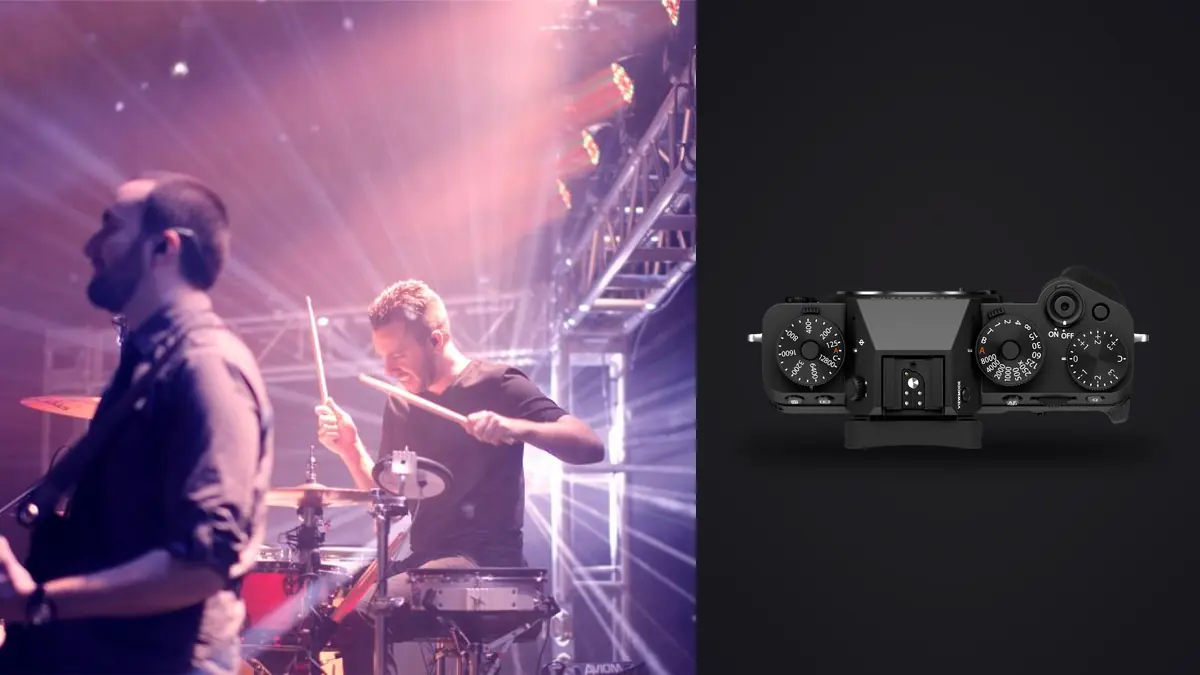
The first time I brought a Fujifilm X-T5 into a photo pit, I did it half out of curiosity and half out of laziness. My usual full-frame body and 70-200mm combo weighs enough that three hours of a festival bill leaves a bruise on your shoulder, and I wanted to know if a smaller APS-C body could actually keep up when a singer decides to sprint across the stage during the second song of a three-song set. Three tours and probably 40 shows later, I have a pretty settled opinion: the X-T5 is a genuinely capable concert camera, but it rewards you for understanding its quirks and punishes you if you just point it like a DSLR and hope.
This isn't a spec sheet regurgitation. It's what changed about how I shoot once I started using this body for live music specifically, where the light is unpredictable, you get almost no time to react, and every frame you keep has to justify the disk space a 40-megapixel RAW file eats.
The 40-megapixel sensor question nobody in the pit wants to admit worries them
Every photographer I know who picked up an X-T5 for concert work asked the same thing before buying it: is 40 megapixels going to be a liability when I'm shooting at ISO 6400 in a basement venue with one moving light and no backup plan? The honest answer is that the pixel count matters less than people think and the sensor's noise floor matters more, and those aren't the same conversation. The X-Trans CMOS 5 HR sensor in the X-T5 handles high ISO better than the resolution alone would suggest, mostly because Fujifilm's noise reduction pipeline in-camera is tuned aggressively for JPEG delivery, which matters if you're shooting a local show and need to hand a picture editor a usable frame before you've even opened a laptop. Shooting RAW and processing later gives you more room to recover shadow detail than the file size might imply, particularly below ISO 6400. Above that, in the kind of single-wash lighting you get in small clubs, grain starts showing up in a way that reads more like film grain than digital noise, which some editors actually prefer for gig photography and some hate. Know your outlet before you commit to pushing ISO past 8000. Where the resolution genuinely helps: cropping. A lot of pit access only gives you the first three songs and a barrier position you can't move from, so if the vocalist works the far side of the stage the whole set, you're not getting a clean composition without cropping in post. Forty megapixels gives you real room to reframe a shot after the fact without turning it into mush, which a 24-megapixel body simply can't offer at the same margin.
Settings that survive a stage lighting rig doing something insane
Concert lighting is the one shooting environment where "just check your exposure and adjust" doesn't really work, because the light itself is changing color temperature, direction, and intensity every few seconds on purpose. I stopped chasing perfect exposure years ago and instead set up a baseline per venue type, then ride exposure compensation on the fly. Here's roughly where I land depending on the room:
| Venue / lighting type | ISO range | Shutter speed | Aperture | What actually goes wrong if you don't adjust |
|---|---|---|---|---|
| Small club, single colored wash | 3200 to 6400 | 1/250s to 1/320s | f/1.4 to f/2 | Skin tones shift heavily toward the wash color; white balance needs correcting per song, not per set |
| Theater, hard spotlight with dark surround | 800 to 2500 | 1/320s to 1/500s | f/2 to f/2.8 | Matrix metering blows out the face and crushes everything else; spot metering on the performer is mandatory |
| Arena, moving-head fixtures and strobes | 1600 to 5000 | 1/500s minimum | f/2.8 | Strobes plus electronic shutter produce visible banding across the frame; mechanical shutter avoids it |
| Outdoor festival, daylight main stage | 100 to 400 | 1/1000s or faster | f/2.8 to f/4 | Fast performer movement blurs even at 1/500s; crowd surfers and jumps need the extra shutter speed |
| Outdoor festival, after dark with LED wall backdrop | 2000 to 8000 | 1/250s to 1/400s | f/1.8 to f/2.8 | LED walls refresh at rates that clash with electronic shutter readout, causing rolling banding across the panel |
The through-line in that table is that I'm almost never shooting wide open at ISO 100 the way you might for a portrait session. Concert light punishes you for being conservative, and the X-T5's in-body stabilization, rated around 7 stops depending on the lens attached, buys you very little when your subject is the one moving, not the camera. Stabilization stops camera shake. It does nothing for a drummer's head snapping on a downbeat.
Mechanical shutter versus electronic, and why I stopped defaulting to silent mode
The X-T5 will do 20fps in electronic shutter mode with a sensor crop, which sounds perfect for a mosh pit or a guitarist windmilling through a solo. In practice I use electronic shutter far less than I expected to when I first got the camera, because a lot of arena and festival rigs run LED video walls and moving-head fixtures with PWM dimming, and the readout speed of an electronic shutter is slow enough relative to that flicker that you get visible horizontal banding across a portion of the frame. It's subtle enough that you might not catch it on the camera's rear screen under stage light, and then you get home and half your favorite frames from the encore have a faint stripe running through the background LED wall. Mechanical shutter tops out at 15fps on the X-T5, which is still plenty for anything short of a professional sports assignment, and it sidesteps the banding problem almost entirely because the whole sensor exposes closer to simultaneously. My rule now is simple: mechanical shutter any time there's a video wall, moving-head lighting rig, or strobe element in the set, which covers most arena and festival main stage shows. Electronic shutter is fine, and genuinely useful for silence, in acoustic sets, seated venues, jazz clubs, or anywhere a camera's shutter clack would be rude or actually audible over the music. I've used silent electronic shutter at a stripped-down acoustic session where the artist was recording room audio live, and it was the right call precisely because nobody in the room could hear the camera firing at all.
Glass that's actually earned a place in my bag for this
Fuji's X-mount lens lineup has enough fast primes and zooms that you don't need to compromise much for live work, but a few specific lenses have become the ones I reach for without thinking:
- XF 50-140mm f/2.8 is the workhorse. Constant f/2.8 through the zoom range, weather sealed, and the reach (about 75-210mm full-frame equivalent) covers most pit-to-back-of-stage compositions without a lens change. It's heavy for a full night of handheld shooting, and I feel it in my wrist by the third band.
- XF 33mm f/1.4 is my "the room is too dark and too tight for a zoom" lens. A 50mm-equivalent field of view at f/1.4 handles small club shows where you're close enough to the stage that a telephoto is useless, and the extra stop over an f/2.8 zoom matters at ISO 6400.
- XF 56mm f/1.2 gives a tighter, more compressed look for isolating a single performer against a busy background, though autofocus hunts more than the 33mm in fast-changing light and I've missed a couple of critical moments trusting it too much during a strobe-heavy chorus.
- XF 16-55mm f/2.8 earns its spot for wide stage shots, crowd context, and any time I'm shooting from the soundboard rather than the barrier, where a telephoto would be too tight.
None of these are cheap, and if I had to recommend a single starting lens to someone buying an X-T5 specifically for live music, it's the 33mm f/1.4. It's the one that saves the most shots in the worst lighting, which is the scenario that actually determines whether you come home with usable work.
Autofocus when the light itself is lying to the camera
Fujifilm's subject detection autofocus has improved a lot since earlier X-series bodies, and on the X-T5 it will track a performer's face and eyes reasonably well under stable light. Concert lighting isn't stable light, though. Colored gels shift hue rapidly, strobes create total blackout frames between flashes, and backlit silhouettes against a bright screen confuse contrast-detection systems that are trying to find an edge to lock onto. I run Zone AF rather than full Wide/Tracking for most sets, because letting the camera decide the subject across the whole frame means it sometimes grabs a lighting truss or another photographer's head instead of the singer. A tighter zone that I can reposition with the joystick keeps me in control while still giving the tracking algorithm room to hold focus through a head turn. For anything genuinely fast, someone jumping off a drum riser, a guitarist lunging toward the barrier, I switch briefly to AF-C with the smallest single-point zone and a higher priority on release over focus confirmation, accepting that I'll get a few soft frames in exchange for not missing the moment entirely waiting for green-box confirmation that never comes under flickering light.
Battery, buffer, and the unglamorous stuff that actually ends your night early
The NP-W235 battery in the X-T5 is rated around 740 shots by CIPA standard, but that number assumes a mix of stills and screen review that doesn't match how a three-song pit set actually goes, which is closer to continuous high-frame-rate bursts for nine minutes straight. I've drained a full battery in a single aggressive set shooting mechanical shutter at 10-12fps bursts through an entire song. I now carry two spares as a minimum for any multi-band bill, three for a festival day. Buffer depth matters more than people expect too. Shooting compressed RAW at high burst rates, the buffer clears fast enough on a good UHS-II card that I rarely hit a wall mid-song, but I did learn the hard way that a cheap card can bottleneck the whole system during a long strobe-heavy sequence, with the buffer counter ticking down and the camera briefly locking write access right as the best frame of the night probably happened. Two UHS-II slots means I run a fast card as primary and a backup as overflow, which has saved a show or two when a card started throwing write errors mid-set.
After the last song: getting through a night's worth of bursts before the deadline
Here's the part nobody warns you about before you start shooting three-band bills regularly: a single night can leave you with 2,000 to 4,000 frames once you count every burst, and most photo editors want a filed gallery within hours, not days. Forty-megapixel files make that pile heavier on disk and slower to page through than the 24-megapixel files I was used to culling a few years ago, and doing it by eye at 1am after standing in a pit for three hours is where mistakes happen, keeping a slightly soft frame because you're tired, or deleting a sharp one by accident in a rushed swipe. I run the night's card through imagic before I touch anything else. It scores focus and sharpness locally on the machine, so the 40-megapixel files never leave my laptop while I'm sorting through them, which matters more than it sounds like when a band's management has an embargo on images until their own PR team clears them; nothing needs to touch a server I don't control before that happens. It also clusters the burst sequences from a jump or a solo into groups instead of making me scroll past eleven nearly identical frames one at a time, which is the single biggest time sink in concert culling since so much of the shooting is high-frame-rate bursts chasing one clean expression or gesture. The other thing that's changed my workflow is the apply_my_style preset feature. Because I shoot the same handful of venues repeatedly and want a consistent look across a tour rather than re-grading every show from scratch at 1am, I trained a preset on a batch of edits I was already happy with and now apply it as a starting point before fine-tuning individual frames. It's not magic, and stage lighting varies enough between venues that I still adjust white balance and exposure per show, but it cuts the flat, uncolor-corrected starting point out of the process entirely. If you're trying to speed up the between-show turnaround generally, it's worth reading through how AI photo culling actually works and a few of the broader habits in faster photo workflow tips, both of which apply directly to the volume a concert shoot generates.
Frequently Asked Questions
Is 40 megapixels overkill for shooting bands from the photo pit?
Not overkill exactly, but it's a tradeoff you should go in aware of. The extra resolution gives you real cropping room when barrier position limits your composition, which happens constantly in live music work. The cost is file size and slightly more visible noise per pixel at high ISO compared to a lower-resolution sensor of the same generation. If you mostly shoot from a fixed spot with a long zoom, you'll use the resolution. If you're often shooting wide and close, you may crop less often than you'd think.
Does the 1.5x crop sensor put me at a real disadvantage next to full-frame shooters in the pit?
Less than you'd assume for reach, since the crop factor effectively extends your telephoto's working range, useful when you can't move closer to the stage. Where full-frame still has an edge is shallow depth of field at wide apertures and marginally cleaner files above ISO 8000. For most club and theater shows, that gap is smaller than the weight and size advantage of carrying an APS-C kit through a full festival day.
Should I always shoot in silent electronic shutter mode at shows to avoid disturbing the artist?
No, and this is a common mistake for photographers new to the X-T5. Electronic shutter is genuinely useful for acoustic or seated performances, but under LED video walls, moving-head lighting, and strobes, it can introduce visible banding across the frame that mechanical shutter avoids. Reserve silent mode for quiet, simply-lit sets and default to mechanical shutter for anything with a big lighting rig.
How do I stop a night of concert bursts from taking hours to sort through?
Cull before you edit, not during. Running a night's card through local culling software that scores sharpness and groups burst sequences (which is exactly what imagic does, entirely on-device without uploading the files anywhere) cuts a multi-thousand-frame folder down to a shortlist in minutes rather than an hour of manual scrolling. From there, editing a few hundred keepers is a fundamentally different job than editing four thousand raw files.