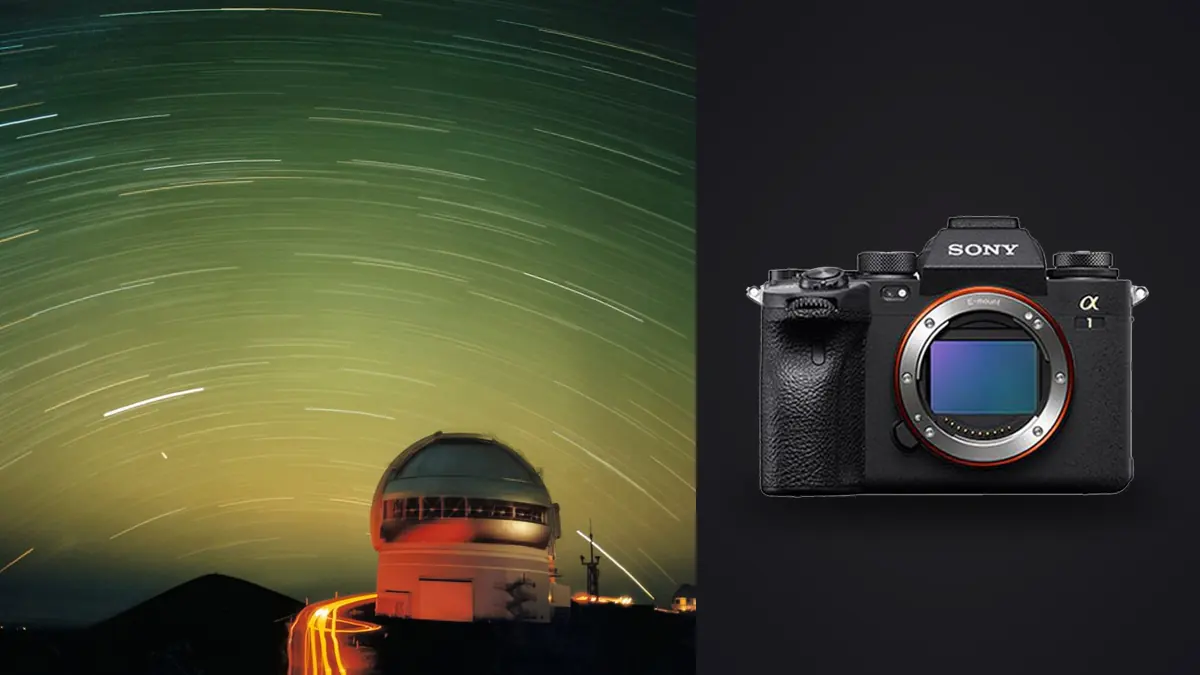
I've taken the A1 out to three different dark sky sites over the last year, and every single time someone at the trailhead has asked some version of the same question: isn't 50 megapixels a problem for night shooting? The short answer is no, not the way people think, but it does change how you shoot a stacking sequence compared to a 24MP body. This isn't a spec sheet rundown. It's what actually changed in my routine once I started stacking with this camera instead of the A7 III I used for years before it.
Why stack at all instead of one long exposure
If you've only ever shot a single 20 or 25 second frame of the Milky Way and called it done, stacking is going to feel like overkill at first. It isn't. A single frame at ISO 6400 has a certain noise floor baked in no matter how good the sensor is. Take twenty of those same frames and average them together in software, and the random noise cancels itself out while the actual signal (the stars, the airglow, the faint dust lanes) stays put and gets reinforced. You end up with something that looks like it was shot at ISO 800 with the depth of ISO 6400. That's the whole trick. It costs you more time in the field and more time at the computer, and it's worth it for anything you plan to print larger than a phone screen.
The pixel density problem, and why it's smaller than it sounds
Here's the part that actually matters with the A1 specifically. Cram 50 megapixels into a full frame sensor and your individual photosites work out to roughly 4.1 microns across, noticeably tighter than the 5.9-micron pixels on a 24MP body like the A7 III or A9. Tighter pixels resolve star trailing sooner. The old "rule of 500" (500 divided by focal length equals your safe shutter speed in seconds) was written for cameras nobody uses for serious astro work anymore. On the A1 I treat that number as roughly 40 percent too generous. With a 14mm lens the 500 rule says 35 seconds is fine. At full resolution on the A1, I start seeing soft elongation on stars near the celestial equator past about 20-22 seconds, and it gets worse the closer your subject sits to that equator versus near the poles where rotation is slower across the frame.
None of this means the sensor is bad for the job. It means each individual sub-frame needs to be shorter, which in turn means you need more of them to build up the same total signal. That's a workflow change, not a flaw. I now shoot 12-18 second subs instead of the 20-25 second subs I used on the A7 III, and I shoot roughly 40-60 of them instead of 25-30.
ISO, dual gain, and where I actually set it
Sony's stacked sensors switch to a second, cleaner gain stage above a certain ISO threshold. On the A1 that shift lands around ISO 500-640 in my own side-by-side testing (not an official published number, just what I've measured shooting the same scene at incrementing ISO values and comparing shadow noise). Below that threshold you're fighting more read noise for a given exposure; above it, the sensor's own circuitry is doing more of the work for you. For untracked star stacking I sit at ISO 3200 as a default and only push to 6400 under genuinely dark Bortle 2-3 skies where I need the extra signal and can tolerate the noise, because stacking is about to erase most of it anyway. I avoid the extended ISO range entirely (anything past native 32000) for stacking work. It buys you nothing once you're averaging dozens of frames and just adds banding risk in the shadows.
RAW format choice actually matters for a stacking run
This one surprised me the first time I ran the numbers. The A1 gives you uncompressed, lossless compressed, and compressed RAW options. For a single landscape frame I'd default to lossless compressed without a second thought. For a 50-60 frame stacking sequence, file size compounds fast: uncompressed 14-bit files run close to 100MB each, which means a single night's stacking session for one composition can eat 5-6GB before you've even started on a second composition. I switched to compressed RAW specifically for star sequences. The stacking software is averaging pixel values across dozens of frames anyway, so the small amount of precision compressed RAW sacrifices gets swallowed by the averaging process. I still shoot lossless compressed for the single blended foreground exposure, since that one frame carries more of the final image's visible detail.
Tracked versus untracked: what I actually reach for
People treat this as a binary choice and it isn't. I use both depending on what the shot needs, and the trade-offs are different enough that I made a table out of it after getting burned a few times picking the wrong one for the location.
| Approach | Typical sub length | ISO I use | Frames for a clean stack | Extra gear | Where it falls apart |
|---|---|---|---|---|---|
| Untracked, star-point stack | 12-18 sec | 3200-6400 | 40-60 | None beyond tripod | Foreground and sky can't share the same sub length if the foreground needs longer light |
| Tracked, long-sub stack | 90-180 sec | 800-1600 | 10-16 | Star tracker, polar alignment scope | Any wind at all blurs the tracked subs; foreground goes soft from the mount's motion |
| Hybrid: tracked sky, separate untracked foreground | Sky 90-180 sec / FG 15-30 sec | Sky 800-1600 / FG 1600-3200 | Sky 8-12 / FG 5-8 | Tracker + a blending pass in post | Blend line at the horizon needs manual masking, tracker leaves the foreground rotated relative to the sky |
For most nights where I've got a real foreground subject (a ridge line, a lone tree, whatever), I run the hybrid approach. It's more setup, but the A1's resolution actually earns its keep here because I can crop into the sky portion of the frame later without the composite falling apart at print size.
Calibration frames: don't skip these because it's cold
I used to skip dark frames when it was below freezing because standing around for another ten minutes with numb hands felt pointless. It isn't pointless, it's the opposite. Sensor noise gets worse as temperature drops in ways that aren't intuitive, hot pixels shift position and add fixed-pattern noise that a stacking algorithm can't tell apart from an actual star unless you feed it a dark frame to subtract. My routine now: lens cap on, same ISO, same shutter speed, same ambient temperature as the light frames, shot immediately after the sequence while the sensor is still at operating temperature. I shoot 15-20 darks per session and reuse them across multiple compositions from the same night since temperature doesn't swing that much over a couple hours outdoors. Flats I shoot separately, indoors, against a lit white surface, mostly to deal with the mild vignetting from wide primes and any dust that's crept onto the sensor since the last cleaning.
Sorting the take before it ever reaches stacking software
A single hybrid session like the one above generates somewhere between 60 and 90 frames once you count both sky and foreground exposures plus calibration frames. Not all of them are usable. Focus on a mirrorless body drifts slightly as the barrel and internal elements cool through the night, and a sub that looked sharp on the rear screen at 10pm can be measurably softer than one shot at midnight. Scrolling through 80 near-identical dark frames on a 3-inch screen to spot the two or three that drifted is exactly the kind of thing I stopped doing manually. I run the night's take through imagic's local sharpness scoring before it goes anywhere near the stacking software, since it flags the frames where focus wandered without me having to zoom into each one at 100 percent by hand. If you haven't looked at how AI-assisted culling actually scores focus under the hood, it's worth understanding before you trust it with a folder of night frames where the difference between sharp and soft is genuinely subtle. It also groups the near-duplicate subs from the same composition together, which matters when a folder has forty visually identical starfield frames sitting next to five test shots I took while nailing focus at the start of the night. All of that runs on the laptop with no signal at the site, which matters more than people expect once you're two hours from the nearest town with cell coverage.
I'd stop short of culling the actual light frames you plan to stack, though. Stacking algorithms want the full set, including the merely-okay ones, because the averaging process is what cleans them up. Where the sorting pass earns its place is catching the frames that are actually broken (focus drift, a truck's headlights sweeping across the foreground, condensation creeping onto the front element) before they get averaged into a supposedly clean result and quietly drag the whole stack down.
Picking stacking software once the frames are sorted
I run Sequator for most Windows-side untracked sequences because it handles the sky-versus-foreground masking reasonably well on its own and it's free. For anything shot with the tracker, Deep Sky Stacker gives me more control over the rejection algorithm, which matters because a bad frame in a tracked sequence (usually one hit by a gust of wind) can visibly smear the whole stack if it isn't rejected. On the Mac side Starry Landscape Stacker does a comparable job to Sequator for the untracked star-point method and handles the sky/ground separation slightly better in my experience, at the cost of being a paid tool rather than free.
After the stack: bringing the composite back into a normal edit
Once the stacking software spits out a flattened TIFF, it stops looking like an astro file and starts looking like any other landscape file that needs a real edit pass, curves, color balance, local dodging and burning around the horizon line. I keep a preset trained specifically on how I edit night skies (a punchier blue-to-magenta gradient in the upper frame, warmer and more restrained tones near the horizon) using imagic's apply_my_style feature, built from a set of my own past astro edits rather than a generic night-sky preset someone else designed. It gets me to a starting point close to my usual look in one pass instead of rebuilding the same curve adjustments from scratch every session, and I still go in and adjust individual frames from there since no two nights have the same amount of airglow or light pollution on the horizon.
Field logistics that have nothing to do with the sensor
- Battery life drops fast below freezing. I carry four NP-FZ100 packs for a full night and keep the spares in an inner jacket pocket, not the camera bag.
- A CFexpress Type A card with real sustained write speed matters more for star sequences than people expect, since you're firing dozens of frames back to back with almost no gap between them if you're using an intervalometer.
- Set the in-camera interval shooting function up before you leave the house, not at the site with cold fingers and a headlamp. I've fumbled this menu in the dark more than once.
- Since everything from sorting the take to running my edit preset happens fully offline on the laptop, none of it depends on having signal at the site, which is the normal state of affairs at any dark sky location worth driving to.
Frequently Asked Questions
Does the A1's 50-megapixel sensor actually hurt it for astro work?
Not in terms of noise performance for a given ISO, but it does mean star trailing shows up at shorter shutter speeds than on a lower-resolution body, since the pixels are smaller and resolve motion sooner. Shoot shorter subs and more of them and you end up ahead, not behind, because you also get more resolution to work with once the stack is flattened.
Is the A1 actually a good choice for astrophotography, or should I be looking at the A7S III instead?
If low light and video are your only priority, the A7S III's larger pixels and lower resolution genuinely do give it an edge in raw high-ISO cleanliness per pixel. The A1 makes more sense if you're already invested in it for other work (sports, wildlife, general stills) and don't want to own two bodies, or if you specifically want the extra resolution for large prints and cropping into a composite later. I wouldn't buy an A1 purely for astro. I'd buy it for everything else and be glad it also handles a stacking session competently.
How many light frames do I actually need for a clean stack?
It depends more on your ISO and sky darkness than on any fixed number, but as a starting point I use 40-60 untracked subs at ISO 3200-6400, or 10-16 tracked subs at ISO 800-1600. Bortle 1-2 skies need fewer frames to hit a clean result than anything with meaningful light pollution on the horizon.
Should I cull or sort my subs before running them through stacking software?
Sort out the genuinely broken frames (focus drift, wind-blurred tracked subs, a stray headlamp beam), but leave everything else for the stacking algorithm to average. That's the one place I'd draw a hard line: a quick sharpness and duplicate check before stacking saves you from averaging a handful of bad frames into an otherwise good result, but full manual culling the way you'd approach a wedding gallery isn't the goal here.