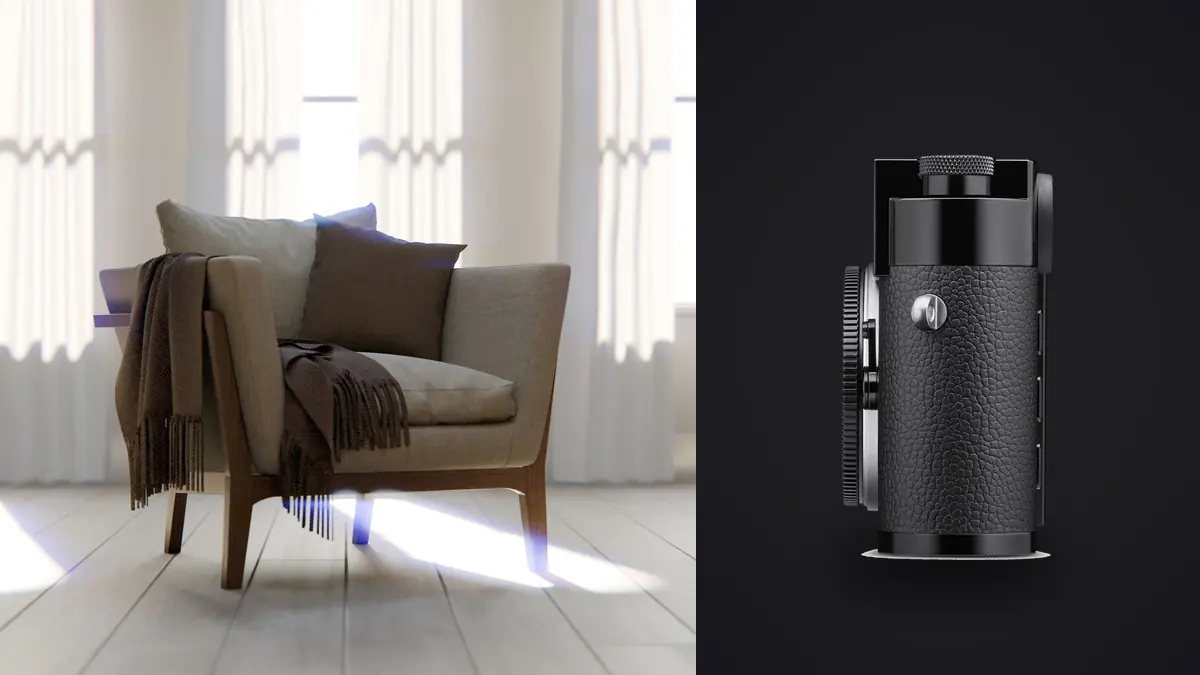
I picked up a Leica M11 as a secondary body about eighteen months ago, mostly out of curiosity, and it has since become the camera I reach for on nearly every boudoir session. Not because it is sharper than my mirrorless kit (it isn't, not meaningfully) or because it focuses faster (it doesn't focus at all, in the autofocus sense). It earns its place because of what happens in the room while I'm holding it. A rangefinder changes the physical relationship between photographer and subject in ways that matter enormously in intimate work, and almost nobody talks about that part. This is a practical account of what the M11 is actually like to shoot boudoir with, where it helps, where it genuinely gets in your way, and how I've had to adjust my post-shoot workflow to deal with the volume of near-identical frames a manual-focus body produces.
Why a Rangefinder Changes the Room
Boudoir clients are, almost without exception, nervous for the first twenty minutes. The camera is part of that nervousness, and the bigger and louder it looks, the worse it tends to be. A DSLR with a 70-200mm and a battery grip reads as equipment. An M11 with a 50mm reads as a compact rectangle that barely blocks my face. That sounds like a small thing until you've watched a client's shoulders drop the moment they realize they can still see your eyes over the top of the camera, because the M11's viewfinder is optical and offset, not a blackout box in the middle of your face like an SLR mirror slap or, honestly, most EVFs mid-burst.
The shutter matters just as much. The M11 has a mechanical shutter that tops out around 1/4000s and an electronic shutter option that goes silent, genuinely silent, no faux click, no simulated sound. In a bedroom with two people and soft directional light, that silence changes the rhythm of a session. Clients stop flinching at the sound of the frame being taken. They stop performing "the moment the shutter goes off" and start just existing in front of the lens, which is the whole goal in this genre. I don't run silent shutter for every frame (there's a rolling shutter risk with fast movement I'll get to later), but for the quiet, held poses that make up most of a boudoir set, it's a real asset, not a marketing line.
What the Sensor Actually Buys You
The M11 uses a 60-megapixel BSI sensor with no anti-aliasing filter, and Leica lets you choose your capture resolution before you shoot: full 60MP, a binned 36MP, or a further-binned 18MP DNG. For boudoir work I shoot almost everything at 36MP. Sixty is overkill for images that get delivered as 3000-4000px web and print files, and the smaller DNGs are still enormous compared to what I'd get off a Fuji or Sony body at similar settings, so cutting the resolution down saves real card space and processing time across a shoot that can run to 600-900 frames.
Base ISO is 64, which gives you a genuinely wide dynamic range for window-lit bedrooms where you've got sheer curtain highlights on one side of the frame and shadowed sheets on the other. I underexpose slightly more than I would on my mirrorless bodies to protect skin highlights, knowing I can pull shadow detail back without the noise penalty biting hard. Above ISO 3200 the files start to show their age a bit compared to newer stacked sensors, chroma noise creeps into skin tones first, so for genuinely dark hotel rooms lit only by a single lamp, I still lean on continuous LED light rather than pushing the M11 past 6400.
Lenses: Where the Real Decisions Happen
The M-mount forces a different kind of lens discipline than a modern autofocus system does, partly because rangefinder-coupled close focus tops out around 0.7 meters on most M glass (a limitation of the mechanical linkage, not the lens optics), and partly because you're choosing a look, not a zoom range. For boudoir I rotate through four lenses depending on the room and the subject's comfort level with proximity.
| Lens | Max Aperture | Rangefinder Close Focus | Why I'd Reach For It |
|---|---|---|---|
| Summilux-M 35mm f/1.4 ASPH | f/1.4 | 0.7m | Environmental frames, getting the room and the light into the shot without crowding the client |
| Summilux-M 50mm f/1.4 ASPH | f/1.4 | 0.7m | My default. Natural perspective, fast enough for lamp-lit rooms, still light on the neck after a three-hour session |
| Noctilux-M 50mm f/1.2 ASPH | f/1.2 | 1.0m | Extreme separation for a single detail shot, but heavy and the focus-by-feel margin at f/1.2 is unforgiving on a moving subject |
| APO-Summicron-M 75mm f/2 ASPH | f/2 | 0.85m | Working from further back, which some clients find more comfortable, with flattering compression on the face |
The 75mm APO-Summicron gets underrated for this kind of work. Boudoir clients are often more relaxed when the photographer isn't standing right over them, and a 75mm lets you back off two or three steps while keeping the same framing, which reads as considerate rather than distant. The Noctilux, for all its reputation, I use sparingly. At f/1.2 your plane of focus on a face from three feet away is measured in millimeters, and rangefinder patch focusing on skin, which has far less contrast than an eyelash or a jawline edge, is genuinely difficult to nail consistently while someone is breathing and shifting weight.
Manual Focus on a Subject That Won't Hold Still
This is the honest section. Autofocus exists for a reason, and boudoir subjects move constantly, small adjustments of the head, a shift in the shoulders, a breath. Focusing an M11 means aligning the rangefinder patch by eye, on a feature with skin tones, in room light that's often deliberately dim and warm. I miss more frames on the M11 than I do on any of my autofocus bodies, and I've stopped pretending otherwise to myself.
What I've done instead is change how I shoot. Where I'd take one or two frames per pose on an autofocus camera, I take four or five on the M11, making tiny refocus adjustments between each because I can't fully trust that the first one landed on the eye. That's the trade you make for the rendering and the discretion: more frames per pose, more misses to sort through, and a real dependence on reviewing focus properly afterward rather than trusting a green confirmation dot that was never there in the first place. It's also why I've stopped chimping on the rear screen during the session (it slows the pacing and breaks the mood) and instead do a proper focus pass once I'm back at the computer.
Sorting the Aftermath
A three-hour boudoir session shot this way with an M11 routinely lands me 700-900 DNGs, a large fraction of which are near-duplicate poses with only the focus point differing between them. Going through that manually at 100% zoom, frame by frame, is the part of the job nobody romanticizes, and it's also where the intimate subject matter makes a real difference: these are not files I want touched by anything that phones home or caches previews on someone else's server.
I run everything through imagic before I open a single frame in an editor. Its local sharpness scoring catches the actual focus hit within each cluster of five near-identical poses, which on an M11 set is not a minor convenience, it's the difference between a two-hour cull and a twenty-minute one. The duplicate and burst clustering groups those refocus attempts together automatically instead of leaving me to eyeball which of five almost-identical frames has the sharpest lash line. And because it processes everything on the machine with no upload step, there's no moment where a boudoir set passes through a cloud queue before I've even looked at it myself, which matters to me as much as it would matter to anyone being photographed. If you're new to how that kind of local scoring actually works under the hood, I'd point you to how AI photo culling works rather than re-explain the mechanics here.
Once the set is culled down to the 60-80 real keepers a typical delivery needs, the second problem shows up: consistency. Frames shot across three hours, in shifting window light, at slightly different ISOs as the room got darker, do not share a color baseline straight out of the M11's DNGs. I built a personal edit style in imagic from a batch of previously finished boudoir sets, warm but not orange, lifted shadows, skin kept soft without going plastic, and now apply that style as a starting point across a whole delivery in one pass. It's not a substitute for finishing each image by hand, but it gets sixty files to the same tonal starting line before I touch a single slider, which is the only way I've found to keep a delivered gallery from looking like it was shot across six different sessions. For the tonal groundwork itself, I still lean on the same principles laid out in this color grading guide, the M11's flat, low-contrast DNGs reward a deliberate grade rather than a one-click preset.
What I'd Tell Someone Considering the Switch
Don't buy an M11 for boudoir expecting it to make the technical side easier. It won't. You will miss focus more often than you're used to, you will need to shoot more frames per pose to compensate, and you will spend real money on lenses that autofocus systems give you cheaper alternatives to. What you're buying is a smaller, quieter object that doesn't sit between you and the client the way a big DSLR does, and a rendering character from the Summilux and APO-Summicron lines that a lot of boudoir photographers spend years chasing with filters and presets instead. If the relationship in the room is more important to your results than raw hit rate, which in this genre I'd argue it usually is, the trade makes sense. If you're shooting fast-moving or heavily posed commercial boudoir where you need every frame in focus on the first try, an autofocus mirrorless body will serve you better and I wouldn't talk you out of it.
Frequently Asked Questions
Is the M11's silent shutter actually usable for a full boudoir session, or just a gimmick?
It's genuinely usable for anything static or slow-moving, which is most of a boudoir set. The catch is rolling shutter distortion on fast motion, hair flips, quick turns, that sort of thing, so I switch back to the mechanical shutter for anything with real movement. For held poses and quiet moments it's the single feature I'd miss most if I went back to a DSLR.
Do I need the Noctilux, or is the Summilux 50mm enough for this kind of work?
For most sessions, the Summilux 50mm f/1.4 does the job and is far easier to focus consistently on a moving subject. I bring the Noctilux out for one or two hero frames per session where I want that extreme f/1.2 separation, not as a walk-around lens. It's heavier, slower to focus by feel, and the margin for a miss is much thinner.
How many usable frames should I expect from a typical M11 boudoir set?
Out of 700-900 frames I'd usually deliver 60-80 finished images, which is a similar final count to what I'd deliver from an autofocus body, but I get there by shooting noticeably more raw frames per pose to cover for missed focus. Budget more shooting time and more culling time than you would with a mirrorless AF system.
Should clients be concerned about where their images are processed given the subject matter?
It's a fair question and one I get asked directly more often than any other. My practice is to keep the entire pipeline local, from card to culling to final export, with nothing routed through a cloud service at any stage. That's a big part of why I settled on imagic for the culling step specifically: everything runs on the machine in front of me, and files never leave the drive until I'm ready to deliver them myself.