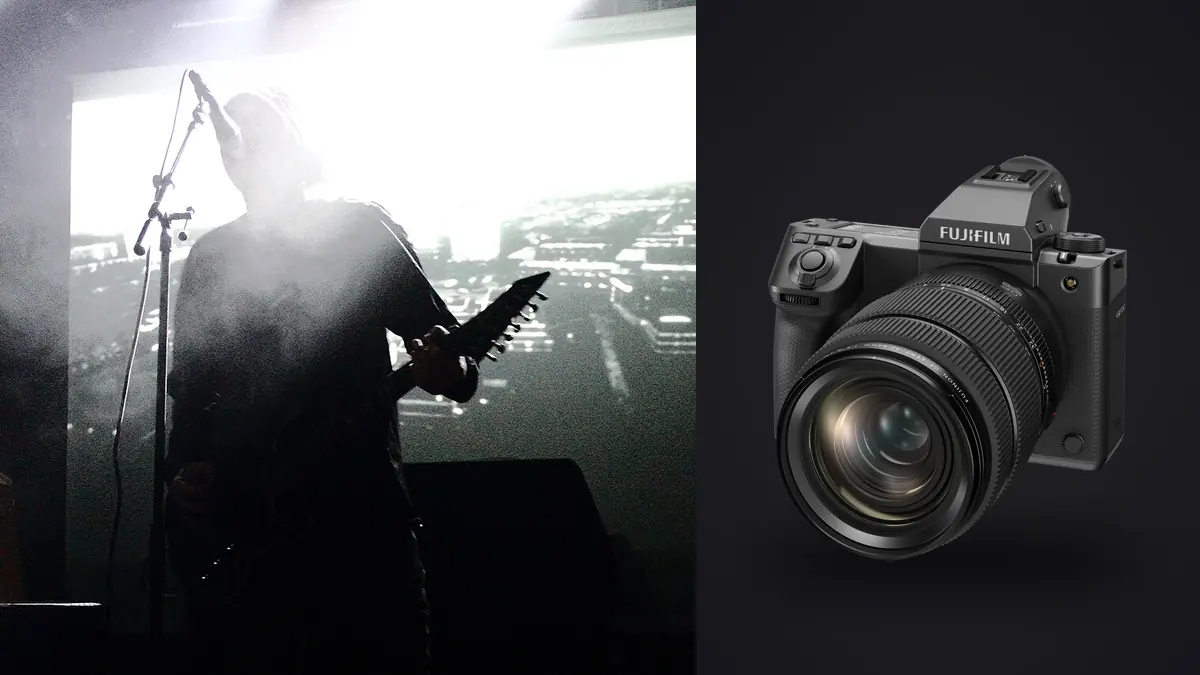
The first time I brought a Fujifilm GFX 100 II into a venue, the door guy asked if I was there to shoot the show or appraise it. Medium format at a rock club is a strange enough sight that people assume you're lost. I wasn't. I'd been shooting a run of small-venue shows for myself, and I wanted portraits pulled straight from the pit that could stand up to a full-page print without any of the usual full-frame softness at the edges. What I got back was a mixed bag: some of the best low-light detail I've captured at a show, and some genuinely frustrating gaps that a Sony or Nikon body simply doesn't have. This is what actually happened across four shows with it, not a spec-sheet fantasy.
Why bring a 102-megapixel medium format body to a gig at all
The instinct is to say don't. Concert photography rewards speed, forgiving high ISO, and lenses that reach across a stage. Medium format historically offered none of that. The GFX 100 II changes the calculus a little, not because it becomes a sports camera, but because it closes enough of the gap that for specific kinds of live work (theater-lit jazz clubs, seated acoustic shows, festival main-stage portraits shot from a fixed photo pit position where you're not chasing anyone) the resolution and tonal range pay for themselves. You are not going to track a drummer's sticks through a strobe-heavy set with it the way you would with an A9 III. You might, however, come away with a hero image of the singer that survives being printed four feet wide for a tour poster, with skin tones that don't need three passes of noise reduction first.
That distinction matters more than most gear reviews admit. Nobody buys a GFX 100 II to replace their pit camera. They buy it because one or two frames a night need to be exceptional rather than merely usable, and they're willing to trade burst depth for that.
Autofocus and burst rate where it actually gets tested
Fuji rates the GFX 100 II at 8fps with the mechanical shutter and up to 20fps in a cropped electronic mode that throws away most of that 102-megapixel advantage anyway, so in practice you're shooting mechanical for full resolution. Eight frames per second sounds fine until a guitarist jumps mid-song and you get exactly one usable frame out of a six-shot burst because the subject-detection AF hunted for a beat when the stage lights swung from cool white to deep red. The phase-detect coverage is genuinely improved over the original GFX 100, and it holds focus well on a static or slow-moving vocalist under a spotlight. It is noticeably less confident with fast, unpredictable movement under mixed or flickering LED rigs, which is most of what a support-act stage looks like on a Tuesday.
Rolling shutter is the other thing nobody tells you about until you see it. Shoot electronic shutter under LED wash lighting and you'll get banding, sometimes visible even at 1/250. Mechanical shutter avoids it but caps you around 1/4000 and that 8fps ceiling. For a photographer used to a mirrorless flagship's blackout-free 20-30fps, dropping to 8fps mechanical is the single biggest adjustment. You have to shoot more deliberately, anticipate the peak of a movement rather than spray and pray, and accept that a crowd-surf or a stage dive is going to be caught in one or two frames, not fifteen.
The lens problem nobody mentions in the marketing
This is where the GFX system shows its age for this specific use case. Fuji's GF lineup is built for studio, landscape, and portrait work, not for reaching across a festival stage from a photo pit thirty feet back. There is no native GF equivalent of a 70-200mm f/2.8. The closest long options are slower and shorter in reach than what most touring photographers carry for full-frame bodies. On a small stage with a fast prime you're fine. On a bigger stage where you need 150mm-plus equivalent reach at a wide aperture, you're stuck either cropping hard into that 102-megapixel file (which, to be fair, you can do and still deliver a usable image) or leaving the GFX at home for that set.
| GF Lens | Aperture | 35mm-equivalent field of view | Where it earns its spot at a show |
|---|---|---|---|
| GF80mm f/1.7 | f/1.7 | ~63mm | Best all-around lens for pit portraits and tight two-shots, fastest glass in the native lineup |
| GF110mm f/2 | f/2 | ~87mm | Vocalist headshots from mid-pit distance, shallow falloff for isolating against a busy backdrop |
| GF50mm f/3.5 | f/3.5 | ~40mm | Wide stage-and-crowd context shots, too slow for anything past the first two songs' lighting |
| GF35-70mm f/4.5-5.6 | f/4.5-5.6 | ~28-55mm | Practical for load-in and crowd coverage, not fast enough once house lights drop |
| GF250mm f/4 + 1.4x TC | f/4 (f/5.6 with TC) | ~198mm (~277mm) | Only real reach option for big stages, but slow enough that you're fighting ISO all night |
In practice I ended up shooting the GF80mm f/1.7 for probably 70 percent of my usable frames across those four shows. It's fast, it renders beautifully, and it's the one lens in the lineup that behaves like something you'd actually choose for people in motion. The rest of the kit stayed in the bag more than I expected.
What the sensor actually buys you under stage lighting
Here's the part that surprised me. The received wisdom is that medium format loses badly to full frame in low light because the smaller pixel pitch on such a huge sensor doesn't compensate for the effective aperture penalty of the crop factor (roughly 0.79x versus full frame, so an f/1.7 lens gathers light closer to an f/2.2 full-frame equivalent for a given depth of field comparison). That's true as far as raw high-ISO noise goes. Native ISO tops out at 12,800, and past ISO 6400 you start seeing noise that needs real work to clean up, more than I'd expect from a modern full-frame body at the same setting.
Where the GFX 100 II claws it back is dynamic range and highlight recoverability. Concert lighting is brutal on sensors: a spotlight blowing out next to a performer's face in near-total darkness a few feet away. The GFX's sensor pulls back highlight detail from stage lighting in a way that saved several frames I'd have thrown out from a smaller sensor, recovering texture in a blown-out follow-spot without the color banding I'm used to seeing. If your show has controlled, high-contrast lighting rather than strobe chaos, that dynamic range headroom is worth more to the final image than another stop of clean ISO would have been.
The 102-megapixel file problem, and why culling stops being optional
Nobody warns you how much a three-hour set changes once every frame is a 100+ megabyte compressed RAW. A night that would produce maybe 25GB on a 24-megapixel body turned into over 90GB on the GFX across four sets. Multiply that by a four-night run and you're staring down nearly 400GB of RAW files before you've even opened Lightroom, most of it burst sequences of the same guitar solo shot six frames apart with barely perceptible differences between them.
This is the point where I stopped trying to eyeball focus on a laptop screen at 1am in a green room and started running everything through imagic instead. It scores sharpness locally on the actual RAW files rather than the embedded JPEG preview, which matters a lot at this resolution because a frame can look sharp on a 13-inch screen and still be soft when you pixel-peep a 102-megapixel crop for a magazine spread (if you've never seen how that scoring actually works under the hood, it's worth reading through how AI photo culling works before you trust it with a tour's worth of files). It also clusters the burst sequences and near-duplicate frames automatically, which on a GFX shoot is the difference between spending forty minutes sorting a set versus four. Because it runs entirely on the laptop with no upload step, that matters more on tour than it would in a studio: venue wifi is unreliable at best, and I was not about to try pushing 90GB of RAW to a cloud culling service between load-out and the next city.
Once I had a look dialed in for that band's stage lighting (a slightly cooler white balance pull and a specific highlight rolloff to match how their lighting designer likes red and amber washes to read), I used apply_my_style in imagic to carry that same edit across the rest of the run without rebuilding it show by show. For a four-night stretch with a consistent lighting rig, that saved a genuinely significant amount of editing time, and the tour photos ended up looking like one coherent set rather than four separately-edited nights.
GFX 100 II against a full-frame flagship, spec for spec that matters at a show
| What matters in the pit | Fujifilm GFX 100 II | Typical full-frame flagship (e.g. Sony A1 II) |
|---|---|---|
| Mechanical burst rate | 8 fps | 10-12 fps |
| Electronic burst rate | Up to 20 fps (cropped) | Up to 30 fps (full sensor) |
| Resolution | 102MP | ~50MP |
| Native ISO ceiling | 12,800 | 32,000+ |
| Fast telephoto reach (native) | ~277mm equivalent max at f/5.6 | 400mm+ at f/2.8 readily available |
| Typical compressed RAW size | 100-130MB | 45-55MB |
| Body weight | ~1,030g | ~740-900g |
Read that table honestly and the case for the GFX at a show is narrow. It's a camera for the photographer who already owns a full-frame body for the chaos and wants a second body specifically for the handful of frames per night meant to be printed large or licensed for a poster. It is not a replacement, and anyone telling you otherwise hasn't actually tried to track a mosh pit with one.
Three things I'd tell someone before they try this
Shoot mechanical shutter only, full stop, unless the lighting rig is unusually stable. The rolling shutter banding under electronic shutter isn't subtle once you see it on a laptop screen, and it will not go away in editing.
Rent the GF80mm f/1.7 before you buy anything else. It's doing most of the work at any show where you're closer than mid-pit, and it's the one piece of glass in the system that actually feels built for people who move.
Budget real time (or a fast culling workflow) for sorting afterward. A one-hour set on this body can leave you with 1,500+ frames once you've fired off enough bursts to catch peak expression, and at 100+ megabytes each, that's not a folder you want to sort by eye. Something like imagic's local culling pass, run overnight on the tour bus or in a hotel room without needing a connection, turns that from a dread-inducing chore into something you can actually finish before the next city (a lot of the same triage habits apply here as in general faster photo workflow advice, just multiplied by the file sizes).
Frequently Asked Questions
Can the GFX 100 II keep up with a fast-moving performer under changing stage light?
It can track a single performer reasonably well once focus locks, but the combination of an 8fps mechanical cap and occasional AF hunting under rapid color-temperature swings means it will miss more peak-action frames than a sports-oriented full-frame body. It's better suited to performers who hold a pose or move predictably than to erratic, fast stage business.
Does the sensor crop factor actually make GF lenses slower for concert work?
Not in terms of light gathering (an f/1.7 lens still lets in f/1.7 amounts of light regardless of sensor size), but for a given depth of field and background separation, you're effectively working a bit closer to an f/2.2 full-frame look on the GF80mm f/1.7. It matters more for how much of a crowded stage stays in focus than for raw exposure.
Is a laptop enough to handle a night of 102-megapixel RAW files on the road?
A reasonably modern laptop handles it, but expect Lightroom or Capture One to slow down scrubbing through full-resolution previews. Culling before you ever open an editor, using something that scores focus and clusters bursts locally without needing the files uploaded anywhere, saves the most time and keeps you from importing frames you're just going to delete later.
Should I bring a full-frame backup body to a show if I'm shooting the GFX?
Yes, and not as an afterthought. Any set with unpredictable stage movement, a photo pit with a three-song limit, or lighting that flickers hard is a set where you want a faster, higher-ISO-capable body as your primary and the GFX as the camera you reach for during a held note or a quieter moment. Treating the medium format body as your only camera at a genuinely chaotic show is how you come home with fewer usable frames than you'd like.