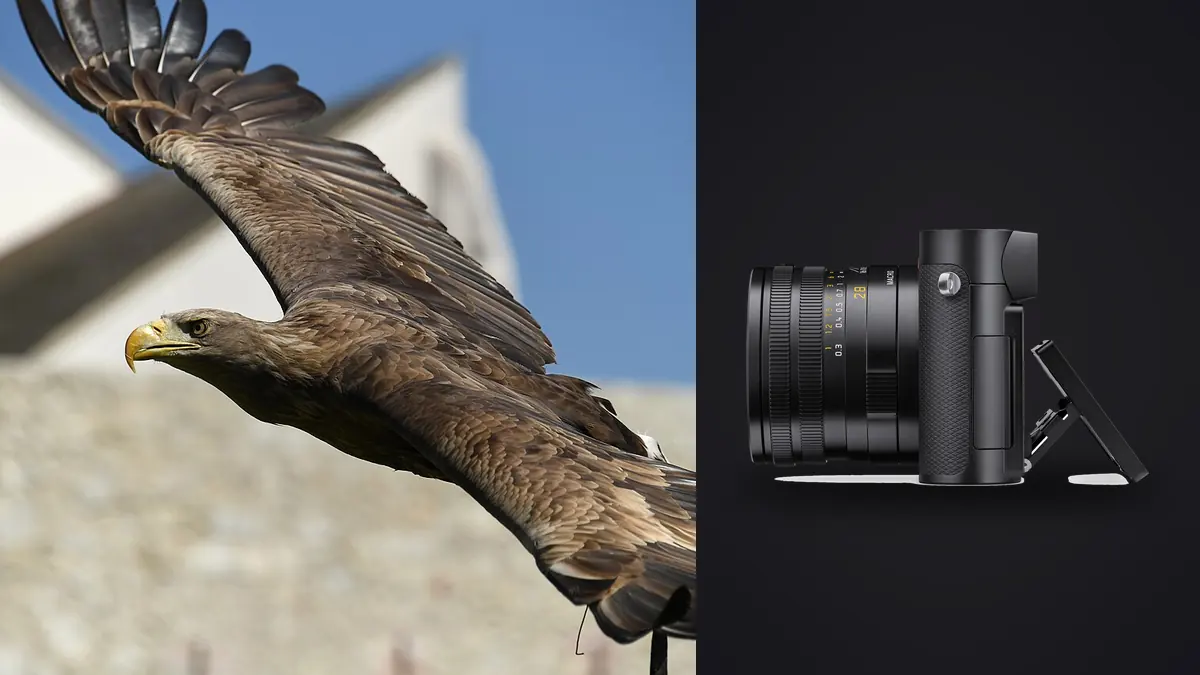
Why This Question Keeps Coming Up
I get some version of this message a couple of times a month, usually from someone who already owns a Q3 for travel and street work and is standing on a boardwalk watching gulls or terns do something photogenic overhead. "Can I use my Q3 for this, or do I need to drag out a real telephoto?" The honest answer is longer than a yes or no, because it depends entirely on what kind of bird, how far away it is, and how much you're willing to let the crop modes do the heavy lifting.
The Q3 was never designed as a wildlife camera. It's a fixed 28mm rangefinder-style body built for documentary and travel work, and Leica's own marketing has never once shown it next to a heron. But 60 megapixels is a lot of raw material to crop into, and the temptation to leave the long glass at home is real. I've spent enough mornings at the coast and enough afternoons at a local falconry display with one strapped to my shoulder to have a settled opinion on where that temptation pays off and where it just wastes a morning.
The Lens Math Nobody Mentions
Here's the part that trips people up: the Q3's "35mm / 50mm / 75mm" crop modes are not zoom positions. The lens is physically, permanently a 28mm f/1.7 Summilux. Nothing about the optical path changes when you dial up 75mm in the menu. What changes is that the camera shows you a smaller rectangle out of the same 60-megapixel sensor and records only that rectangle, at a correspondingly lower pixel count.
That matters for bird-in-flight work in a very specific way. A bird's angular size in your frame is set by its actual distance and the lens's actual focal length, which is always 28mm. Cropping after the fact doesn't bring anything closer, it just throws away the pixels around the edges and enlarges what's left. So the honest way to think about the 75mm crop mode is "the tightest 8-megapixel slice of a 28mm frame," not "a 75mm lens." A gull thirty metres out is still a gull thirty metres out. At 28mm it occupies maybe a few dozen pixels across; cropping to 75mm just makes those same few dozen pixels bigger and softer, it doesn't resolve any more detail in the bird itself.
Depth of field and background separation follow the same rule. Because the actual optic is a wide 28mm, you get wide-angle depth of field characteristics even in the cropped view, meaning backgrounds stay busier and more in focus than a real 400mm or 500mm lens would ever produce at the same aperture. If you're picturing creamy separation between a raptor and the sky, that's not what a Q3 crop delivers, even at f/1.7.
Autofocus: Fast, But Tuned for the Wrong Subject
The hybrid phase and contrast-detect system in the Q3 is genuinely quick for a fixed-lens compact, and continuous AF holds up reasonably well on predictable, moderate-speed motion. Where it starts to struggle is exactly the kind of motion birds specialize in: erratic changes of direction, a wing crossing in front of the body, a subject that's small against a bright, high-contrast sky.
Subject tracking on this camera is clearly tuned around people. Face and eye detection are strong and reliable for portraits and street work, but there's no dedicated bird- or animal-eye recognition mode the way you'd get on a modern wildlife-focused mirrorless body. Point the Q3 at a bird against open sky and it will often lock onto general contrast rather than the animal specifically, which means a stray branch or a wave crest can steal focus mid-burst. I've had far better luck ignoring the tracking modes entirely for this kind of work and using a single, small AF zone that I place manually and keep on the bird's body through the pan, or in a few cases pre-focusing a zone in the air and waiting for the bird to fly into it.
None of this means the AF is bad. It's fast to acquire, it's accurate on stationary and slow subjects, and it does fine on a heron standing in shallow water. It's specifically the erratic, small-in-frame flight case where it shows its limits, and that's worth knowing before you commit a shoot to it.
Shutter, Burst Rate, and the Rolling-Shutter Problem
Mechanical shutter tops out at 8 frames per second, which is workable but not generous for flight sequences. Switch to the electronic shutter and you get up to 15fps, but that speed comes from a sensor readout that isn't fast enough to avoid rolling shutter distortion on quick motion. Wingtips moving fast across the frame can smear or skew slightly, and panning quickly with the electronic shutter can warp straight lines in the background. For anything with rapid wingbeats close to the lens, I stick with the mechanical shutter and accept the lower frame rate rather than fight skewed geometry in every third frame.
Buffer depth is decent thanks to the Maestro processor, but a long burst of 60-megapixel DNGs on a single UHS-II SD slot will fill it faster than you'd like, and clearing that buffer takes real seconds, not fractions of one. If a bird gives you two takeoff attempts thirty seconds apart, plan for the possibility that your card is still writing out the first burst when the second one happens.
Where the Q3 Actually Delivers
Once you accept the lens math, there are scenarios where this camera genuinely works, and they all share the same trait: the bird is close, big, or moving on a predictable line.
Gulls fighting over a dropped chip on a harbor wall are a perfect example. They're large-bodied, they're used to people, and the action happens within a few metres. The 50mm or even the native 28mm framing captures the whole scuffle with room to spare, and the wide depth of field actually helps here because it keeps the whole flock of birds legible rather than isolating one against a blurred background.
Herons and egrets launching from a reed bed are another. If you can get within fifteen to twenty metres with a hide, a boat, or just patience, that initial launch is often slow and telegraphed. Watching the bird's posture for the crouch before the jump and firing a burst right on that cue works better than trying to track it airborne.
Falconry displays are the scenario I'd actually recommend the Q3 for without much caveat. The birds are released from a handler's glove a few metres from the crowd line, they fly a known route, and the light is usually good because these events are timed for it. This is close-range, predictable, repeatable action, which is precisely what this camera is built to handle.
Garden or feeder birds departing the frame can also work if you pre-focus on the perch itself, set a small AF zone right on it, and fire the moment the bird pushes off. You're not tracking flight so much as capturing the first quarter-second of it, which sidesteps most of the AF limitations above.
Where to Just Leave It Home
Swifts, swallows, terns diving for fish, anything small and fast at any real distance: don't bother. The combination of a wide native focal length, an AF system not built for tiny erratic targets, and crop modes that can't add real resolution means you'll come home with a card full of empty sky and the occasional accidental silhouette. I learned this the slow way trying to photograph swallows over a reservoir with a Q2 years ago and burned an entire evening for two usable frames, neither of which I'd print.
Distance is the other disqualifier. If a bird needs binoculars to identify, it needs a real telephoto to photograph. No amount of 60-megapixel cropping changes that math, because you're not adding detail, you're just enlarging the noise floor.
Crop Modes, Compared
The numbers below are the actual pixel counts each digital crop produces from the Q3's 60.3-megapixel sensor, along with how I'd rate each one specifically for flight work rather than for general use.
| Crop setting | Approx. resolution | Effective framing | Realistic use for birds in flight |
|---|---|---|---|
| 28mm (native) | ~60 MP | 28mm | Environmental flight shots only, bird-in-landscape context, not a tight portrait of the animal |
| 35mm crop | ~38.6 MP | 35mm | Marginally tighter than native, still too wide for anything beyond a few metres |
| 50mm crop | ~18.9 MP | 50mm | The practical minimum for large birds (gulls, herons, geese) inside about 15 metres |
| 75mm crop | ~8.4 MP | 75mm | Most reach available, but file size drops fast; fine for social use, thin for prints or heavy cropping later |
A Field Settings Starting Point
These are the settings I actually dial in before a session, adjusted from there based on light:
- Shutter speed: 1/2000s minimum for anything airborne, 1/3200s if the species has fast wingbeats like ducks or pigeons. Slower than that and you'll lose wing-tip sharpness even on a stationary-camera pan.
- Aperture: f/5.6 to f/8 rather than wide open. You don't need the shallow depth of field at 28mm anyway, and stopping down buys a little forgiveness on focus accuracy.
- ISO: Auto ISO with a sensible ceiling (3200 in good light, higher overcast) so shutter speed stays protected as the priority.
- Drive mode: Mechanical shutter, continuous high. Skip the electronic 15fps mode unless the subject is moving slowly and you specifically need the extra frames.
- Focus: Single small AF zone placed manually, continuous AF-C, back-button focus so you can pre-focus a launch point and release the shutter independently of refocusing mid-burst.
After the Shoot: Sorting a Hundred Nearly Identical Gulls
This is the part nobody mentions when they talk about crop-mode workarounds: an 8fps burst chasing a bird for even four or five seconds gives you thirty-plus frames that look almost identical at a glance, and on a screen that small it's genuinely hard to tell which ones actually nailed focus on the eye versus the wing versus nothing at all. This is where I stopped trying to eyeball it and started running the take through imagic before I touch anything else. Its local sharpness and focus scoring flags which frames in a burst are actually sharp on the subject rather than just "not obviously blurry," which matters a lot when the AF has been fighting a bright sky the whole sequence.
The duplicate and burst clustering is the other half of that. A gull-fight sequence or a falconry pass generates a pile of frames that are technically different but functionally the same shot, and having them grouped automatically instead of scrolling through a folder one thumbnail at a time saves real time on a day when you might shoot four or five separate passes. Once I've got the actual keeper picked out of each cluster, I run it through my apply_my_style preset, which I trained on my own past edits, so the handful of frames that survive get graded consistently with the rest of my catalog rather than needing individual attention. It's all local processing too, nothing leaves the laptop, which matters to me on a boat with no signal anyway. If you haven't looked at how automated culling actually decides what's sharp versus soft, the mechanics are worth a read at how AI photo culling works, and there's a broader rundown of ways to cut editing time at 10 tips for a faster photo workflow.
The Q3 43 Wrinkle
Leica's newer Q3 43 swaps the fixed 28mm Summilux for a 43mm Summicron, which shifts the whole crop ladder tighter before you even open the menu. If you're choosing between the two bodies specifically with occasional bird work in mind, the 43mm starting point closes some of the distance gap described above, though the same underlying limitation holds: it's still a fixed prime with digital crops layered on top, not a telephoto system. I wouldn't buy either variant for wildlife as a primary use case, but if you're torn between the two for travel and street work and flight shots are an occasional bonus, the 43mm start is the more forgiving one.
My Honest Verdict
If birds in flight are a real, recurring part of what you shoot, buy or rent a telephoto system built for it. There's no crop mode or processing trick that substitutes for actual focal length and an AF system designed around erratic small subjects. But if you already own a Q3 for everything else you shoot and you're standing somewhere with big, close, predictable birds (a harbor, a falconry display, a heron rookery you can get near), it's genuinely capable of coming home with keepers. Just go in knowing which category your subject falls into before you start burning frames, because the gap between "gulls on a jetty" and "swifts over a reservoir" is the difference between a good afternoon and a wasted one.
Frequently Asked Questions
Can the Leica Q3's crop modes really substitute for a telephoto lens on birds?
No, not in the way people hope. The crop modes reframe and downsample the same 28mm optical image rather than magnifying it, so a distant bird stays exactly as small and soft as it was at 28mm, just enlarged. They're genuinely useful for tightening up a composition on a bird that's already close, not for reaching out to one that isn't.
Is the Q3's autofocus fast enough to track a bird in flight?
It's fast to acquire focus and handles slow, predictable motion well, but its subject tracking is tuned for people rather than animals, so it can lose a small bird against open sky. Manual single-zone AF placed on the bird, with continuous AF-C and back-button focus, outperforms the automatic tracking modes for this specific use.
Should I buy a Leica Q3 specifically to shoot birds in flight?
No. If flight photography is a priority rather than an occasional bonus, a mirrorless body with a long telephoto will outperform the Q3 in every relevant way, from reach to tracking to burst depth. The Q3 makes sense here only if you already own one for other work and want to know what it can handle when a bird shows up.
What settings should I use on the Q3 for gulls, herons, or falconry birds?
Start around 1/2000s to 1/3200s shutter speed, f/5.6 to f/8, mechanical shutter on continuous high, and a small manually placed AF-C zone rather than automatic tracking. Reserve the 15fps electronic shutter for slower subjects, since fast wingbeats can show rolling-shutter skew at that readout speed.