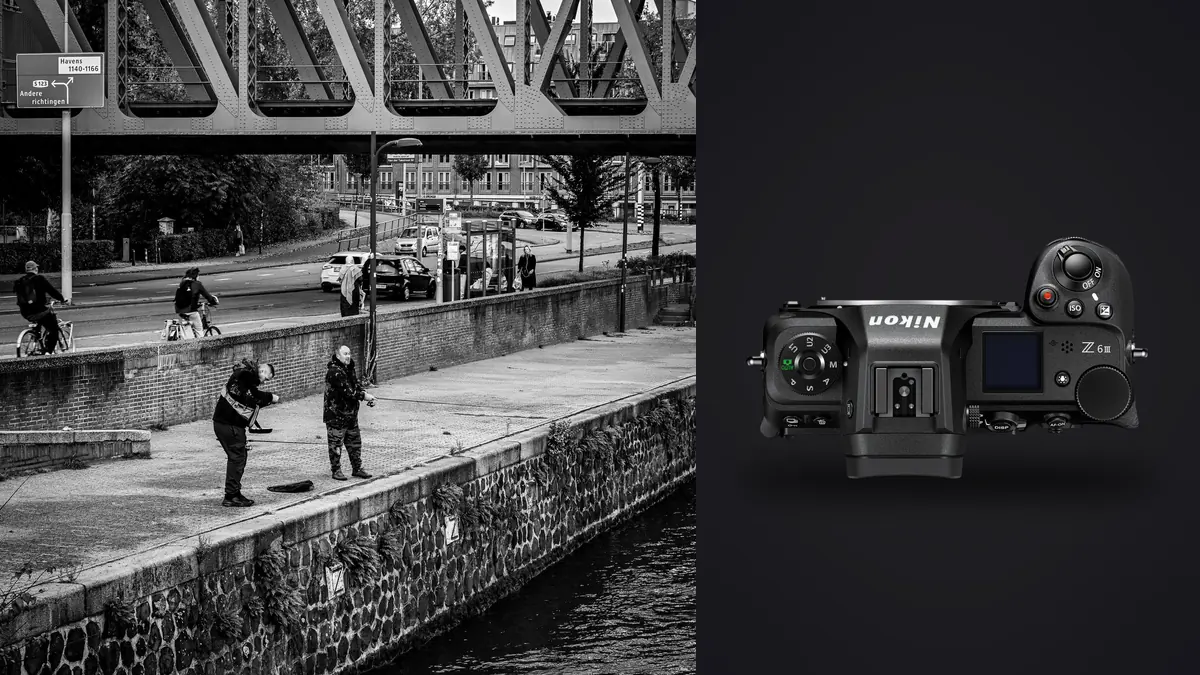
The Z6 III sits in an odd spot for documentary work. It launched with a video reel and a partially-stacked sensor that Nikon clearly built with hybrid shooters in mind, yet it quietly turned out to be one of the more capable bodies for chasing unscripted moments on foot. I've spent enough afternoons with one slung across my chest in markets, transit stations, and a couple of long-running community projects to have opinions about where it earns its price and where it doesn't.
What the sensor change actually buys you
Nikon calls the Z6 III's 24.5MP sensor "partially stacked," which is marketing shorthand for a readout that's meaningfully faster than the Z6 II's but not in the same league as the fully stacked chip in the Z8 or Z9. For street work, that distinction matters less than the practical result: rolling shutter skew on fast-moving subjects (a cyclist cutting across frame, a car turning through a crosswalk) is far better controlled than on the previous generation. It's not gone. Pan hard enough with the electronic shutter and you'll still see some lean in verticals, but it's no longer the deal-breaker it was on older Nikon bodies running full silent mode.
The other quiet win is banding under mixed artificial light. Markets, night stalls, and subway platforms are full of flickering sodium and LED sources, and older electronic shutters would chew through a session leaving half the frames with visible banding bands across the image. The Z6 III handles this noticeably better, which means you can actually trust full electronic (silent) shutter for evening documentary work instead of falling back to the mechanical shutter and its audible clack every time someone's face turns toward you.
Dynamic range at base ISO is good but not dramatically different from the Z6 II. Where the sensor does something genuinely new is in its dual base ISO handling, most relevant above ISO 800, where a second gain stage kicks in and noise behaves more like a stop or two better than the numbers alone suggest. It was built primarily for video, but stills shooters working available light after dark benefit from it too.
Handling that mostly gets out of the way
At roughly 760g with a battery and card in it, the body isn't small, and it's noticeably heavier than a Fujifilm X100VI or a Ricoh GR when you're trying to be unremarkable on a corner for two hours. But the grip is deep enough that a 24-70mm f/2.8 doesn't feel front-heavy, and the button layout hasn't changed dramatically from the Z6 II, so anyone coming from that body will feel at home within an afternoon.
The viewfinder deserves a specific mention: 3.69 million dots with a peak brightness Nikon rates at 4000 nits. That sounds like a spec-sheet number until you're trying to compose against a white stucco wall at 1pm and the finder doesn't wash out. That's a real, usable advantage for outdoor documentary work where you're framing against harsh backlight constantly.
The screen is where I have a genuine complaint. Nikon moved to a fully articulating, vari-angle screen on the Z6 III instead of the simple tilt mechanism the Z6 II used. For video that's the right call. For street shooting, where you often want to flip the screen up quickly for a waist-level, unobtrusive angle and then flip it back down, the vari-angle hinge is slower and requires swinging it out to the side first. It's a small friction, but it's the kind of small friction that adds up across a hundred candid frames in a session.
Autofocus in a crowd is a different problem than autofocus on a subject
Nikon's subject detection (people, animals, vehicles) is genuinely strong when there's one clear subject and a clean background. Point it at a portrait subject and it locks onto the near eye and holds it through movement with a confidence that older Z-series bodies didn't have. The trouble starts in a crowd. 3D-tracking and auto-area AF are both trying to guess your intent, and in a dense scene with a dozen faces the camera will sometimes snap to the wrong one, or worse, keep hunting between two candidates while you're trying to press the shutter on a fleeting expression.
What actually works for me is dialing back the cleverness. I run wide-area AF (small) or dynamic-area AF with a modest number of points, set to back-button focus, so I'm choosing the subject rather than asking the camera to guess it from a scene full of options. It's a less automated workflow than Nikon's marketing suggests you should use, but for documentary work where you need predictable behavior more than you need the smartest possible tracking, it's the more reliable choice. I keep full subject-detection tracking for isolated portraits and slower-paced sequences, and switch it off for anything happening in a crowd.
Continuous shooting speed rarely matters as much as you'd think
The Z6 III will do 20fps in full-resolution raw with the electronic shutter, and something closer to 14fps with the mechanical shutter engaged. In practice I use neither speed for most of a documentary day. Street and documentary moments are usually singular; you're waiting for one gesture, one alignment of background and subject, not spraying a burst hoping one frame lands. Where the fast electronic shutter earns its keep is short bursts around a decisive instant, three or four frames either side of the moment you actually wanted, as insurance against blink timing or a hand passing through frame. Anything longer just multiplies the number of near-duplicate frames you have to sort through later.
Lens choices that actually suit this kind of work
The Z-mount prime lineup has matured enough now that there are real options at different weight and price points, and the right pick changes how the camera behaves on the street more than any menu setting does.
| Lens | Weight | Min. focus distance | Character on the street | Approx. street price |
|---|---|---|---|---|
| Nikkor Z 28mm f/2.8 (SE) | ~155g | 0.19m | Genuinely disappears on the body; wide enough for environmental context, close focus lets you get in tight | ~$300 |
| Nikkor Z 40mm f/2 (SE) | ~170g | 0.29m | Closest thing Nikon makes to a classic 40mm street lens; slower aperture keeps it small | ~$280 |
| Nikkor Z 35mm f/1.8 S | ~370g | 0.29m | Best optical performer of the group, noticeably larger and heavier, less discreet | ~$850 |
| Nikkor Z 50mm f/1.8 S | ~415g | 0.40m | Tighter framing forces more deliberate composition, good separation for portrait-driven documentary work | ~$600 |
For pure street candids I gravitate to the 28mm SE. It's light enough that the whole rig stops feeling like "a camera" to bystanders after the first ten minutes, which changes how people behave around you. For slower documentary essays where I'm building relationships with subjects over hours or days, the 35mm f/1.8 S earns its extra weight with sharper corners and a more useful f/1.8 aperture in dim interiors.
Settings worth setting once and forgetting
A few configuration choices make a real difference across a shooting day rather than in any single frame:
- Auto ISO with a minimum shutter speed tied to focal length. Set it to "auto" (which scales with the lens) rather than a fixed number, so a 28mm and a 70mm on the same body don't share an inappropriate floor.
- A custom bank dedicated to silent, low-key shooting. Electronic shutter, no beep, no AF-assist light, reduced blackout. Being able to jump into that state with a single dial turn instead of hunting through the menu after you've already missed the moment matters.
- Back-button AF-on, separated from the shutter release. This is old advice at this point but it's especially useful with the wide-area AF approach described above, since it lets you lock focus and recompose without the camera re-triggering subject detection on the shutter half-press.
- A flatter picture control for in-camera JPEG review. If you're chimping the rear screen between sequences to check exposure and gesture, a flatter profile shows you the actual dynamic range you captured rather than a punchy default that hides clipped highlights.
The part nobody puts in the spec sheet: what happens after the shoot
A single afternoon of street shooting on the Z6 III at even a moderate pace produces somewhere between 600 and 1,200 frames once you count the insurance bursts around decisive moments. A multi-day documentary assignment can easily clear five figures. None of the camera's autofocus or sensor advantages matter much if that volume turns the edit into a week of scrubbing through near-identical frames on a laptop.
This is where I've actually changed my workflow rather than just my gear. I run the day's cards through imagic before touching Lightroom at all. It scores sharpness locally on the actual focal plane of each frame rather than relying on a rough thumbnail preview, which matters a lot for the wide-area AF approach described above, since a frame that looks sharp at a glance can have the focus point sitting slightly off the eye. It also clusters the burst sequences and near-duplicates automatically, so instead of forty frames of a single gesture you're looking at the handful that are actually candidates. Because it runs entirely on the machine with no upload step, that's also relevant on documentary work where subjects haven't necessarily consented to their faces sitting on someone else's server before you've even made an edit decision. If you haven't looked at how that kind of local sharpness scoring actually works under the hood, this breakdown of AI photo culling covers the mechanics in more detail than I can here.
The other feature that's changed how I finish a documentary set is the apply_my_style preset. I trained it on a batch of my own finished edits from an earlier project, and now a first pass across a new set of Z6 III raws lands close enough to my usual look that the remaining work is mostly small corrections rather than building tone and color from a blank slate on every single frame. For a genre where consistency across a photo essay matters more than any individual frame being technically perfect, that's saved real hours. If your current culling routine is still a manual first pass in Lightroom before any editing starts, these workflow adjustments are worth comparing against what a dedicated culling pass upfront can do instead.
Where it falls short for this kind of work
At around $2,500 body-only, the Z6 III isn't a cheap entry point, and a lot of that spend is going toward video capability a pure stills documentary shooter won't touch. If budget is the deciding factor, a used Z6 II still handles the fundamentals of street work competently and frees up money for lenses instead. The body is also still large enough that it reads as "a camera" in situations where a compact like the X100VI or a GR III would read as closer to a phone, which changes subject behavior in genuinely candid documentary settings. And the dual card slot setup, while a welcome reliability feature for paid assignment work, pairs a CFexpress Type B slot with SD UHS-II rather than dual CFexpress, so your fastest buffer clearing depends on which slot you're actually writing to.
Frequently Asked Questions
Is the Z6 III too big for candid street work?
It's larger than a fixed-lens compact, but with a small prime like the 28mm f/2.8 SE mounted, it's comparable in footprint to older DSLRs that street photographers used for decades without issue. The bigger factor is how you carry it. Worn on a strap against your body rather than held up at eye level between shots, it draws far less attention than the size alone suggests.
Do I need the 24-70mm f/2.8 kit lens for documentary work?
Not necessarily. It's a genuinely excellent lens optically, but the size and the way a zoom changes your shooting behavior (standing back and zooming instead of moving your feet) works against a lot of documentary approaches. Many working photographers get more consistent results from a single prime they know intimately than from a zoom they use as a crutch.
How loud is the Z6 III's electronic shutter in practice?
Silent in the literal sense; there's no mechanical sound at all in full electronic shutter mode. The improved rolling shutter handling means you can trust it for moving subjects far more than on the Z6 II, though very fast horizontal motion can still show mild skew if you look closely at verticals in the frame.
Does the video-oriented sensor hurt stills image quality?
Not in any way that shows up in a print or a web edit. The dual base ISO gain switching that Nikon built primarily for video also benefits stills shot above roughly ISO 800, so if anything it's a quiet advantage for available-light documentary work rather than a compromise.