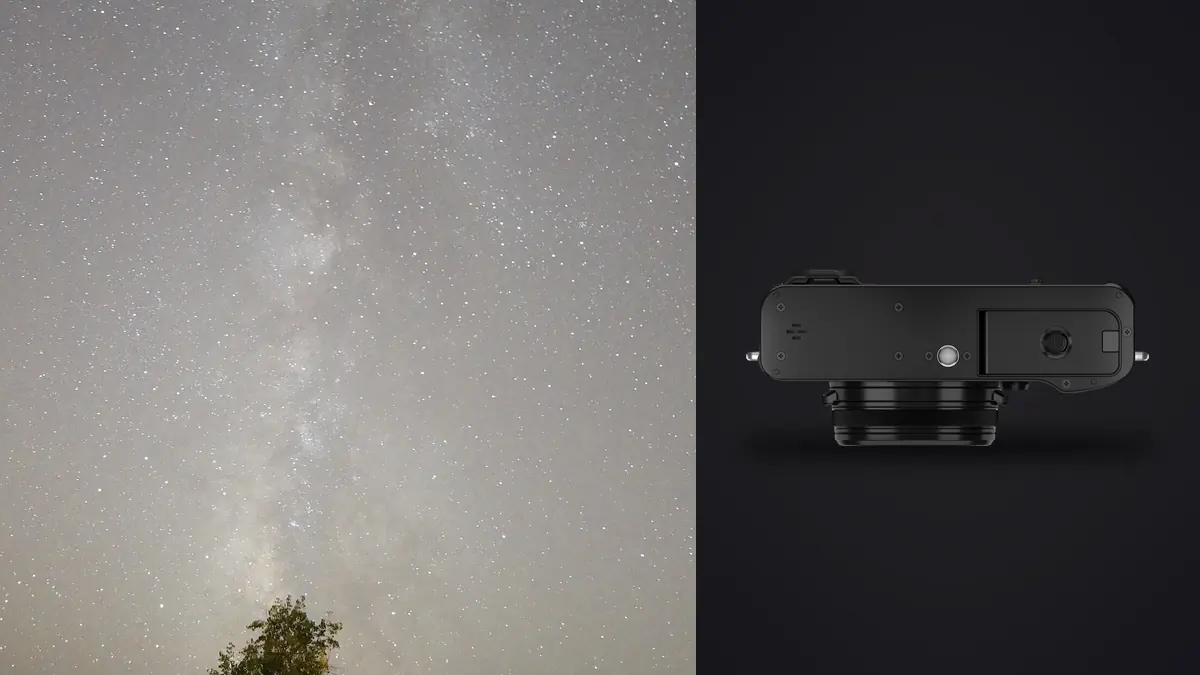
I did not buy the X100VI for astrophotography. Nobody does. It is a street and travel camera with a fixed 23mm lens, and every review of it talks about film simulations, the hybrid viewfinder, and how good it looks around your neck at a wedding. But I had one with me on a trip to a genuinely dark stretch of coastline last month, and out of curiosity I pointed it at the sky for three nights running. What follows is what actually happened when I tried to turn that footage into a clean, stacked Milky Way image, not a marketing pitch for a camera that was never designed for this.
The Fixed Lens Question
The 23mm f/2 lens on the X100VI is a 35mm-equivalent field of view once you account for the APS-C crop. That is a moderately wide angle, wide enough to fit a decent chunk of the Milky Way's core plus some foreground, but nowhere near as generous as the 14mm to 20mm primes most dedicated nightscape shooters reach for. You cannot swap it out. That single fact shapes everything else about using this camera for star work: you are locked into one composition style, and you either work with it or you don't shoot at all.
What softens that limitation somewhat is the WCL-X100 II wide converter, which Fujifilm sells specifically for this body. It knocks the effective focal length down to roughly 19mm equivalent at the cost of about a third of a stop and requires screwing on the AR-X100 adapter ring first. I used mine for two of the three nights and it genuinely helped fit more of the arch of the core into frame without having to shoot a panorama. It is not free, though, and it is one more thing to fumble with in the dark with cold hands.
f/2 is the real win here. For a fixed-lens compact, that is a fast aperture, faster than what most people get on their kit zoom, and it means you are pulling in noticeably more light per frame than a typical 24-70mm walkaround lens stopped down to f/4 for corner sharpness. I shot wide open the entire time. Corner softness at f/2 is there if you pixel-peep, but at night nobody is judging your corner sharpness against a resolution chart.
Manual Focus Is Not Optional
Autofocus will not lock onto stars reliably on this camera, and honestly I would not trust autofocus on any fixed-lens compact for this. The X100VI's lens is focus-by-wire with no hard mechanical stop at infinity, which means the position you think is infinity can drift slightly between sessions, between temperature changes, even between the moment you set it at dusk and the moment full darkness falls two hours later.
My routine: set focus mode to manual, dial in focus peaking with the highlight sensitivity turned up, and while there is still enough ambient light, focus on something genuinely distant, a hill silhouette, a lighthouse, a streetlight three kilometers off. Lock it with tape over the focus ring if you're worried about bumping it (I have knocked a ring out of position with a glove before and lost twenty minutes of shooting to soft frames I didn't catch until I got home). Once full dark hits, I do a final check using the electronic viewfinder's magnification on the brightest star I can find, usually Vega or Sirius depending on the season, and nudge until the point of light is as small and tight as it will go.
Skip this step and you will not know your images are soft until you are looking at them on a real monitor the next day, at which point the night is gone and so is the composition you liked.
How Long Before Stars Start Trailing
The old "500 rule" (500 divided by your full-frame-equivalent focal length) says you can expose for about 500/35, roughly 14 seconds, before the earth's rotation smears a star into a visible streak. That rule was written for lower-resolution sensors. The X100VI packs 40 megapixels onto an APS-C sensor, which works out to a pixel pitch around 3 microns, notably tighter than the 26-megapixel X-Trans sensors Fujifilm was shipping a few years ago. Tighter pixels show trailing sooner, because you're resolving detail the 500 rule never accounted for.
In practice, checking frames at 100 percent on my laptop, I started seeing visible elongation in individual stars past about 6 to 8 seconds, well under half of what the classic rule promised. That's the number I actually shoot to now, not the formula.
Here's what I settled on across three nights of varying sky quality, including one night that got compromised by a rising gibbous moon:
| Sky Condition | ISO | Shutter Speed | Frames to Stack | What You're Fighting |
|---|---|---|---|---|
| Bortle 1-3, true dark rural sky | 3200 | 6 sec | 20-30 | Just sensor read noise, easiest conditions to stack cleanly |
| Bortle 4-5, rural/suburban edge | 4000-5000 | 5 sec | 25-35 | Faint sky glow lifting the black point, more frames needed to average it out |
| Bortle 6-7, suburban | 6400 | 4 sec | 30-40 | Light pollution gradient across the frame, needs gradient removal after stacking |
| Moon above 50% illumination | 1600-2500 | 5-6 sec | 15-20 | Moonlight helps the foreground but washes out fainter dust lanes in the core |
Note the ISO ceiling I'm using. I did not push past 6400 on this body for star work. The X-Trans 5 sensor is solid up through the mid-ISO range but at 40 megapixels the noise starts to feel gritty rather than film-like once you cross into 8000 and above, and no amount of stacking fully rescues that texture, it just smooths it into something else that still doesn't look great printed large.
Why Stack Frames At All
A single 6-second exposure at ISO 4000 on this sensor is usable but noisy, especially in the shadows where the airglow band and faint dust structure of the Milky Way live. Stacking, meaning capturing a run of identical exposures and averaging them together in software, works because random noise cancels out across frames while the actual signal (the stars, the core) reinforces itself. Thirty frames stacked properly gets you something close to the equivalent of one very long exposure's signal-to-noise ratio, without the star trailing that a genuinely long single exposure would cause.
One thing that does not help here: in-body stabilization. The X100VI is the first X100 body with IBIS, rated for several stops, and it is genuinely useful for handheld work in low light generally. For star stacking on a tripod it does nothing, and I turn it off entirely, because stabilization systems hunting for a nonexistent handshake can occasionally introduce their own micro-blur into a long exposure. Same goes for the built-in ND filter, a nice feature for shooting wide open in bright daylight, completely irrelevant once the sun is down.
A Night in the Field
The clearest night of the trip I spent on a gravel pull-off above a bay, no artificial light for miles inland, ocean on one side keeping the horizon dark. I set up around 10pm once astronomical twilight had fully ended, dialed focus in the last usable light, then waited. The core was still low, maybe 15 degrees above the horizon, so I used the wide converter to fit both the arch of the galaxy and a line of wind-bent pine trees in the foreground.
I shot two separate sequences: 32 frames at 6 seconds, f/2, ISO 3200 for the sky, then switched to a single longer exposure (30 seconds, ISO 800) for the foreground trees, since they don't move and don't need stacking to fight noise the same way. That's a fairly standard nightscape approach, expose the sky and the ground separately, blend them later, rather than trying to get one frame to do both jobs.
What went wrong: condensation. The X100VI has no weather sealing on its own (Fujifilm sells sealing only in combination with certain filters and the adapter ring, and even then it's modest), and after about ninety minutes near the water the front element started fogging at the edges. I lost the last ten minutes of that sequence to soft, hazy frames I didn't notice until reviewing them the next morning. A dew heater strap, the kind astro photographers wrap around telescope lenses, would have solved this in about thirty seconds of prep I skipped because I wasn't treating the trip as an astro trip until I was already out there.
Turning Thirty Raw Files Into One Image
The X100VI's compressed raw files run around 40-50MB each. Multiply that by 30-plus frames per stack, across several compositions a night, and you end up with a genuinely large folder to sort through before you even open a stacking program. This is where I lean on imagic rather than scrolling through a Lightroom grid one frame at a time. Its burst clustering groups those near-identical star sequences automatically, so instead of manually comparing frame 14 against frame 15 against frame 16, I get the whole run collapsed into one cluster and can spot-check a handful rather than all thirty. It's all processed locally on the laptop, which matters more than usual on a trip like this since I was nowhere near reliable upload speed for gigabytes of raw files.
For actual stacking, Sequator (Windows, free) and Starry Landscape Stacker (Mac, paid) are the two programs built specifically for this kind of tripod-based nightscape stacking, as opposed to DeepSkyStacker, which is aimed at tracked, telescope-based deep sky imaging and expects a very different kind of input. Both Sequator and Starry Landscape Stacker align on the stars, mask out a static foreground so it doesn't get smeared by the alignment process, and output a single stacked frame you then bring into your raw editor.
Once I have that stacked file, getting it to match the color and contrast treatment I use on the rest of my night work used to mean rebuilding the same curve and white balance adjustments by hand every time. imagic's apply_my_style feature, trained on my own previous edits rather than a generic preset pack, gets a stacked file most of the way to my usual look in one pass, which I then fine-tune manually for that specific sky. It's a starting point, not a finish line, but it saves the part of the process that used to be pure repetition.
If you're weighing this against subscription-based culling tools for a workflow that's already fairly gear-light, it's worth reading how AI photo culling actually works before assuming you need cloud processing for something local software handles fine.
Where the Camera Actually Struggles
Being honest about the downsides matters more than another gear review that pretends everything works perfectly. The leaf shutter is nearly silent and vibration-free, which is genuinely nice for long exposures since there's no shutter-shock blur the way there can be with a focal-plane shutter slapping open on a lightweight tripod. But battery life drops hard in cold night air, I burned through a battery and a half across three sessions where I'd normally get a full day out of one. The single SD card slot is a minor annoyance but worth planning around if you're shooting 40-megapixel raws all night. And there is no dedicated intervalometer built in beyond a basic interval timer buried in the menus, nothing close to the flexibility of a proper astro-focused body, so if you want more exotic exposure sequences you'll be reaching for an external trigger.
The biggest structural limit is still the fixed lens. On a night with a high, well-placed core, 23mm (or 19mm with the converter) is a genuinely nice framing choice. On a night where the core is low and cramped near the horizon, you're stuck; there's no reaching for a 14mm to open the composition up. That's a real trade-off for owning one lens permanently attached to one body, and it's the thing to weigh before you drag this camera out to a dark site expecting it to behave like a dedicated wide-angle astro setup.
Frequently Asked Questions
Do I need a star tracker to get good results from the X100VI?
No, and I'd actively skip it. Trackers earn their keep on long telephoto exposures for deep sky targets, where you're fighting for minutes of exposure time on a small patch of sky. At 23mm (or the wide-converter's 19mm), your exposure window is already short before trailing shows up, so a tracker buys you very little, and it complicates the workflow since you'd still need to shoot the foreground untracked and blend two mismatched perspectives.
Does the built-in ND filter or the leaf shutter actually help at night?
The ND filter, no, it exists for shooting wide open in bright daylight and is irrelevant once it's dark. The leaf shutter helps indirectly: it's mechanically gentler than a focal-plane shutter, so there's less vibration transmitted to the tripod during exposure, which matters more than people expect when you're already fighting noise and don't want blur on top of it.
Can autofocus find stars in the dark on this camera?
Not reliably. I never got consistent autofocus lock on a star field with this lens, even in the camera's low-light AF mode. Manual focus with peaking, checked against a bright star or distant light source at magnification, is the only method I'd trust for a full night's shooting.
How many frames should I actually be stacking for a clean result?
Somewhere between 20 and 35 in my experience. Fewer than 15 and the noise reduction from stacking is barely noticeable. Past about 40, you're spending a lot more time capturing and processing for diminishing improvement, since noise reduction from averaging follows a square-root curve, not a linear one. Twenty-five frames is my usual target unless conditions are rough enough to push higher.