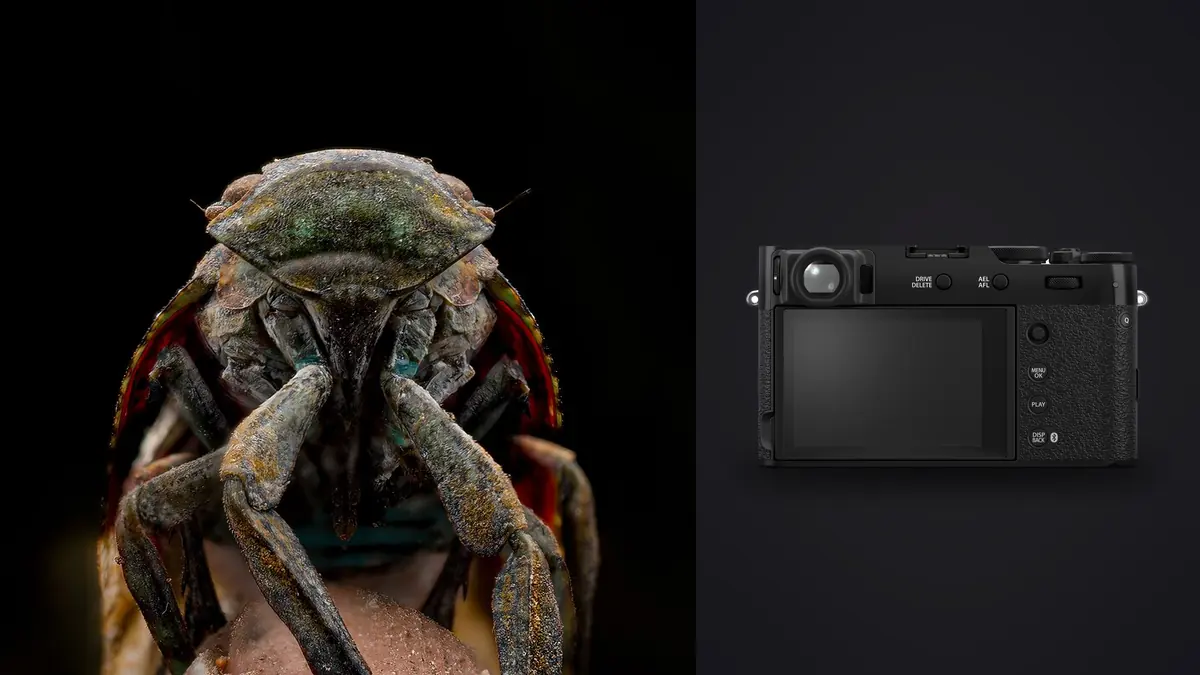
A Fujifilm X100VI is not, on paper, an insect photographer's camera. It has one lens, permanently attached: a 23mm f/2 that behaves like a 35mm on full frame. No mount to swap in a 90mm macro. No extension tube port. No focus rail compatibility that any macro shooter would recognize. And yet I have spent three field seasons carrying an X100-series body specifically for close-up bug work alongside my usual macro rig, because the limitations force a different, often better, way of finding insects, and because the files it produces at 40 megapixels leave enough room to crop hard without the shot falling apart.
This isn't a spec sheet regurgitation. It's what actually happens when you point a fixed 35mm-equivalent lens at a jumping spider on a leaf, and what you need to bolt onto the front of it, dial into the menus, and accept about your keeper rate before it starts working for you instead of against you.
Why a Wide Fixed Lens Is a Strange Starting Point for Macro
True macro photography lives and dies on two things: reproduction ratio and working distance. A dedicated 100mm macro lens gets you to 1:1 magnification while keeping the front element 15cm or more away from a dragonfly's wings, which matters because most insects fly the moment something looms over them. The X100VI's built-in macro mode gets you close, roughly 9 to 10cm from the sensor plane, which in practice means the front of the lens barrel is only about 4cm from whatever you're photographing. At 35mm equivalent, that's an uncomfortably tight working distance for anything that can see you coming. Wasps and bees at a flower head tolerate it more than you'd expect if you approach from the side and low, moving slowly rather than lunging in for the shot. Jumping spiders, oddly, are among the most cooperative subjects for this exact setup, since they seem more curious than skittish about a lens hovering nearby. Dragonflies and damselflies are a different story. Most of the frames I've kept of dragonflies with this camera were taken while the insect was already occupied mating or feeding, because a healthy, alert dragonfly simply will not let a 4cm approach happen.
What the Built-In Macro Mode Actually Gives You
Fujifilm's macro mode on the X100VI is a focus range extension, not true macro. The maximum magnification you get from the lens alone is somewhere around 0.19x, which sounds unimpressive next to a 1:1 macro lens, but the 40.2-megapixel X-Trans sensor changes the math. A cropped-in section of a 40MP file still leaves you 15 to 20 megapixels to work with, which is plenty for web use, print up to A4, and definitely plenty for the kind of insect close-ups that end up on a blog or in a portfolio gallery rather than a gallery wall at 40 inches wide. The camera's digital teleconverter modes (50mm and 70mm equivalent crops) stack on top of macro mode too. They don't add real magnification since they're just center crops applied before you press the shutter, but they do let you compose tighter in the viewfinder and judge focus more precisely than squinting at a wide frame and guessing where the subject sits. I shoot in the 50mm crop for most insect work and only drop to the full 35mm frame when I'm intentionally including habitat context, a leaf, a flower, the insect small in the scene.
Getting Real Magnification Without an Interchangeable Mount
Since there's no mount to attach extension tubes to, the only practical way to push past 0.2x magnification is a screw-on close-up lens, sometimes called a diopter or achromat, threaded onto the front filter ring via a 49mm adapter (the X100VI needs the official adapter ring or a third-party equivalent since the lens barrel doesn't have exposed threads on its own). I've run three different close-up lenses on mine over the past year and they behave differently enough that it's worth laying out the tradeoffs rather than just naming a "best" one. The two-element achromatic doublets (Raynox-style) hold corner sharpness far better than a cheap single-element screw-on diopter, which will smear detail badly toward the edges of the frame, especially wide open. Every insect shooter I know who has tried a bargain single-element close-up filter on a sharp lens like this one has regretted it within the first roll of shots.
| Accessory | Approx. working distance | Effective magnification | Corner sharpness | Field notes |
|---|---|---|---|---|
| Macro mode alone, no filter | ~4cm | ~0.19x | Excellent (native lens) | Best for cooperative subjects like resting butterflies or basking spiders |
| Macro mode + 50mm digital tele crop | ~4cm | ~0.27x equivalent framing | Excellent, file drops to ~20MP | My default combo for most sessions |
| Achromatic +4 diopter (49mm) | ~18-22cm | ~0.30x | Very good, slight softness at extreme corners | Good middle ground, keeps enough distance for bees and hoverflies |
| Achromatic +10 diopter (49mm, Raynox DCR-250 style) | ~8-10cm | ~0.55-0.60x | Good in the center, visibly softer past the outer third | Highest magnification the setup can reach, but working distance gets uncomfortably short again |
| Single-element uncoated +10 diopter (cheap) | ~9cm | ~0.55x | Poor, chromatic fringing and edge blur even stopped down | Not worth the money saved versus an achromat |
My actual working kit is the achromatic +4, left on the camera for probably 80% of a session, swapped for the stronger +10 only when I've found something stationary enough to tolerate the closer approach, a caterpillar, a resting moth, a spider guarding an egg sac. The numbers above come from my own measuring tape and test charts, not a manufacturer datasheet, so treat them as field-tested approximations rather than lab figures.
Camera Settings That Hold Up in the Field
Depth of field at these magnifications is measured in millimeters, sometimes less. I shoot between f/8 and f/11 almost exclusively for insects, which on this small a sensor still gives usably shallow separation from the background while keeping enough of the subject's face or thorax in focus that the shot reads as sharp rather than merely "in the general vicinity of focus." Wider than f/8 and you'll lose an antenna or a far eye on anything angled even slightly toward the lens. Past f/11 you start fighting diffraction softness on the X-Trans sensor, and honestly by f/16 the loss in per-pixel sharpness is more damaging to a macro shot than a slightly thin depth of field would have been. Shutter speed needs to stay high regardless of how still the subject looks, because your own hand movement at this magnification gets amplified just as much as the insect's. I don't go below 1/500 handheld, and for anything with wings that might twitch, jumping spiders especially, I'd rather be at 1/1000 or faster and push ISO than accept motion blur I can't fix later. The leaf shutter built into the X100VI is genuinely useful here in a way that doesn't show up on a spec sheet: it's close to silent up to its top mechanical speed, and I've had noticeably better luck approaching wary subjects with it than with any DSLR I've used, where the shutter slap alone was enough to send a hoverfly off its perch. In-body stabilization helps compose steadily through the viewfinder, but it does nothing for subject motion, so don't let a "stabilized" badge on the spec sheet talk you into slower shutter speeds than the subject actually needs.
Autofocus Gives Up Fast at This Range
Past about 15cm the X100VI's contrast-detect autofocus starts hunting more than it locks, and inside the true macro range it's close to useless for anything with texture as fine as insect eyes or wing veins. I shoot manual focus for essentially all of this work, with focus peaking turned up to its highest sensitivity and the display color set to something that stands out against green foliage, red works well against most plant backgrounds I encounter. The technique that actually gets keepers is rocking rather than turning the focus ring: pick your approximate magnification with the ring, then physically move the camera forward and back a few millimeters at a time, watching the peaking highlights sweep across the subject's eyes. Fire the shutter the instant they land where you want them. It sounds slow described this way, but with practice it becomes closer to a reflex, and it's far more reliable than trying to twist a focus ring with the same precision at this magnification.
Light Is Usually the Real Obstacle, Not Magnification
Stopping down to f/8-f/11 at high shutter speeds eats light fast, and insects tend to be most active in exactly the dappled, uneven light of a woodland edge or an overgrown hedge where a camera's metering struggles. I carry a small diffused flash on a bracket for anything in shade, angled from slightly above and to the side rather than straight on, which avoids the flat, waxy look that direct on-axis flash gives insect exoskeletons. The X100VI's leaf shutter syncs with flash at any shutter speed up to its mechanical maximum, which is a real advantage over a focal-plane shutter body limited to a sync speed around 1/200: it means I can freeze a fidgety fly at 1/2000 and still get full flash exposure, something a lot of interchangeable-lens bodies simply can't do without a high-speed sync mode that costs you flash power. On overcast days I mostly skip flash altogether and just accept ISO 800-1600, which the sensor handles cleanly enough that noise isn't the limiting factor, hand shake and subject movement are.
The Part Nobody Mentions: What Happens to 400 Insect Photos Afterward
A productive hour with this setup easily produces 300 to 500 frames, most of them near-duplicates of the same jumping spider from slightly different rocking positions, three or four sharp, the rest soft by a hair. Sorting that by eye on a laptop screen after a long field day is the part of macro shooting nobody romanticizes, and it's where I actually rely on imagic now instead of clicking through a filmstrip one image at a time. imagic scores sharpness locally on the machine, no upload, which matters when I'm working through a card on a laptop with no signal out past the treeline, and it groups the near-identical rocking-technique bursts together so I'm picking a winner from four frames instead of scrolling past all four separately while trying to remember which one had the sharper eye. For the color side, I built an apply_my_style preset in imagic off a batch of macro insect edits I was happy with, punchy without oversaturating greens, a slight warmth pulled into shadow detail, and now new sessions get that same look applied automatically before I do any manual tweaking, which cuts a lot of repetitive slider work out of a genre that already eats enough time at the culling stage. If you're shooting this kind of high-frame-count, low-hit-rate subject regularly, it's worth reading up on how AI photo culling actually works before assuming manual sorting is just the cost of doing macro photography, because for insects specifically it really doesn't have to be. A few of the general habits in speeding up a photo workflow apply directly to a high-volume genre like this one too, even outside the macro-specific parts.
Where This Setup Falls Short
I want to be honest about the ceiling here rather than sell the X100VI as a secret macro weapon. Past roughly 0.6x magnification with the strongest diopter stacked on, image quality degrades in a way no amount of careful technique fixes, corner softness, mild chromatic fringing, a general softening across the frame that a dedicated macro lens simply doesn't show at the same reproduction ratio. If you want true 1:1 magnification of something like a mosquito's compound eye, or you're planning serious focus-stacked studio macro work, an interchangeable-lens body with a proper macro lens and a focus rail will beat this setup every time, and it isn't close. What the X100VI earns instead is portability and spontaneity. It's the camera already around my neck on a hike, in a car, at a campsite, when a mantis shows up on the picnic table and there's no time to dig a macro rig out of a bag. For that role, close but honest limitations and all, it's earned its spot.
Frequently Asked Questions
Do I need the official Fujifilm adapter ring to attach a close-up lens?
You need some 49mm adapter ring compatible with the X100VI's lens barrel; it doesn't have to be the Fujifilm-branded AR-X100 specifically, though that one seats cleanly and doesn't vignette. Cheaper third-party rings exist and mostly work, but I've had one with a slightly loose thread that let a diopter sit at a faint cant, enough to throw off focus at these magnifications.
Is the built-in macro mode enough without buying a close-up lens?
For flowers, resting butterflies, and larger stationary insects, yes, macro mode alone plus the digital tele crop gets you a solid close-up. For anything under about 15mm long, a jumping spider, a small beetle, an ant, you'll want the added magnification from a diopter or the subject will read as small and under-detailed even after cropping in post.
Will the leaf shutter really stop wing motion on something like a hoverfly?
At its fastest mechanical speed, close, but a hoverfly's wingbeat is fast enough that you'll still see some blur unless you catch it mid-hover rather than mid-wingbeat. For genuinely frozen wings you're better served by flash duration doing the freezing rather than shutter speed alone, since flash pulses are typically far shorter than any mechanical shutter speed this camera reaches.
How does this compare to just buying a cheap dedicated macro lens for a different camera system?
If macro insect work is going to be your main genre, a body with a true macro lens will out-resolve this setup at every magnification past about 0.3x and give you far more working distance flexibility through extension tubes and focus rails. The case for the X100VI here is specifically the "camera you already have on you" scenario, not a recommendation to buy this instead of dedicated macro gear if that's your primary interest.