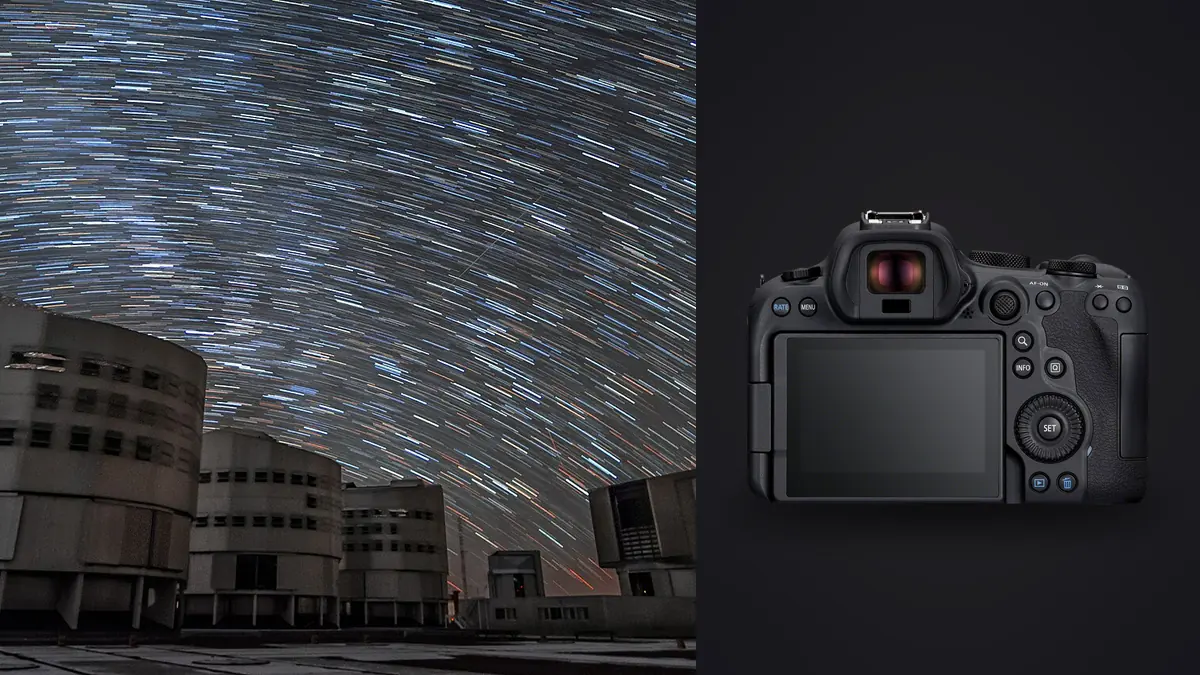
I took the R6 II to the Elan Valley in Wales three times last winter before I trusted it with a full Milky Way stacking session, and the camera that finally earned that trust wasn't the one I expected walking in. The dual pixel sensor and the in-body stabilization get all the marketing attention, but neither of those is why the R6 II works well for star stacking. It's the boring stuff: a sensible interval timer buried in the menus, dual card slots that let a long session run without a card-swap panic, and a sensor that stays clean enough at ISO 3200 that you don't need to fight noise on every single sub-frame.
The sensor you're actually stacking with
The R6 II uses a 24.2MP full-frame stacked sensor, which puts its pixel pitch at roughly 3.7 microns, smaller than the original R6's 20.1MP chip. That matters for two reasons that don't show up in spec sheets. First, smaller pixels mean star trailing shows up sooner at a given exposure length compared to the older, lower-resolution sensor, so the "500 rule" numbers people quote from a decade ago are too generous here. Second, the read noise on this sensor is genuinely low for a non-cooled, non-dedicated astro camera, which means the stacking process (averaging 40, 60, 100 frames together) has less garbage to average out in the first place.
I don't shoot single long exposures for deep sky targets on this body and I wouldn't recommend it. The whole point of a stack is trading one noisy 4-minute exposure for eighty clean 20-second ones, and the R6 II's buffer and processing speed are built for exactly that kind of rapid-fire capture. Where it falls short of a dedicated astro camera is thermal noise on warm nights above about 15°C; you'll see more hot pixels in your darks than you would on a cooled sensor, but a proper dark frame library takes care of that in stacking software regardless.
Getting focus right before you waste an hour of clear sky
Autofocus on the R6 II is rated down to -6.5 EV with an f/1.2 lens, and in practice it will lock onto Jupiter or a first-magnitude star through the viewfinder on a genuinely dark night, which is more than I can say for most bodies I've used. But I still focus manually for stacking work, because autofocus hunting between subs is the single fastest way to ruin a sequence you won't discover was ruined until you're back home reviewing thumbnails.
My routine: switch to manual focus, point at the brightest star or planet in the frame, punch in with the magnify button to 10x, and nudge the focus ring until the point is as small and tight as it'll get. Focus peaking helps a little here but it's not reliable on dim stars, so I trust the zoomed live view over the peaking overlay every time. Then I tape the focus ring down. Not because the R6 II drifts on its own, but because a stray hand or a gust of wind against the lens barrel absolutely will, three hours into an unattended sequence.
Temperature drift is the other thing nobody mentions until it bites them. If you focus at 8pm and the temperature drops six or seven degrees by midnight, glass contracts enough on some lenses that a session that started tack sharp finishes soft. On long sessions I re-check focus at the halfway point with a couple of test frames rather than assuming the tape job holds forever.
The settings that actually matter for a clean stack
Shoot RAW, not CR3+JPEG, and not compressed RAW if you can afford the card space. Turn off Long Exposure Noise Reduction entirely. That setting takes a dark frame after every light frame automatically, which doubles your time between subs and, worse, breaks the back-to-back cadence that stacking software relies on to reject satellite trails and plane lights cleanly. I shoot my own separate batch of dark frames at the end of the session instead (lens cap on, same ISO, same shutter speed, same ambient temperature) and let DeepSkyStacker or Sequator handle the subtraction.
I shoot the electronic shutter for the sequence itself. There's no mirror to slap on this body, but the mechanical shutter still introduces a faint vibration at the start of each exposure that shows up as slightly softer stars if you pixel-peep a stack closely enough. Electronic first-curtain is a reasonable middle ground if you're worried about rolling shutter artifacts from a passing car's headlights, but for star fields with no fast-moving light sources, fully electronic is what I use.
Aperture: I shoot most wide astro lenses one-third to two-thirds of a stop down from wide open. Coma at the corners on an f/1.4 or f/1.8 lens wide open turns stars into little seagull shapes near the frame edges, and stopping down even slightly cleans that up without costing you much in exposure time. ISO is where I diverge from a lot of the advice floating around: I don't chase ISO 6400 "because the sensor can handle it." On the R6 II I get a genuinely better stacked result out of ISO 3200 with a slightly longer per-frame exposure than out of ISO 6400 with a shorter one, because the extra frames needed to hit the same total exposure at higher ISO don't fully compensate for the added read noise per frame.
How long can a single frame run before stars smear
This is the NPF rule applied to this specific sensor's pixel pitch, not the old 500/600 rule that was built around film-era resolution assumptions. These numbers assume a static tripod, no tracker, and are rounded to what I actually use in the field rather than the decimal-precision the formula spits out.
| Lens focal length | Max single exposure (untracked) | What I'd actually shoot | Typical use on this sensor |
|---|---|---|---|
| 14mm | ~11 seconds | 10 sec | Wide Milky Way with foreground |
| 20mm | ~8 seconds | 8 sec | Milky Way core, arch panoramas |
| 24mm | ~7 seconds | 6 sec | Tighter core framing |
| 35mm | ~5 seconds | 4-5 sec | Star clusters, constellation detail |
| 50mm | ~3.5 seconds | 3 sec | Rarely worth it untracked; use a tracker |
Notice how fast that ceiling drops past 35mm. This is exactly why I stopped trying to do anything longer than a 35mm untracked on this body. Past that focal length the exposure times get so short that you need an enormous number of subs to build up decent signal, and the arithmetic stops making sense compared to just mounting a tracker.
Tracked versus handheld-adjacent: when IBIS is enough
Canon rates the R6 II's in-body stabilization at up to 8 stops with certain lenses, and it's genuinely excellent for handheld low light work. It is not a substitute for a star tracker, and I want to be direct about that because I've seen it marketed almost like it could be. IBIS compensates for camera shake during an exposure; it does nothing to compensate for the earth's rotation relative to a fixed tripod, which is the actual cause of star trailing. Those are two different problems.
For wide-field Milky Way shots at 14-24mm, I skip the tracker entirely and just stack more untracked frames using the exposure ceilings above. It's simpler, there's no polar alignment to fumble in the dark, and the results stack up cleanly. For anything with a longer lens where I want more resolved detail (Orion's sword, a wider nebula region past 50mm), I put the R6 II on a Star Adventurer. The body balances fine on a small tracker; it's not a heavy camera, and paired with something like a 100-400mm the counterweight setup is manageable without extra hardware.
Battery, cards, and the unglamorous logistics
A star stacking session at -2°C with the LP-E6NH eats through charge faster than the daytime numbers on the box suggest, largely because you're leaving the camera powered on and shooting continuously for an hour or two rather than the stop-start rhythm of normal shooting. I plan on two batteries for anything past a 90-minute session in cold weather and keep the spare in an inside jacket pocket, not in the camera bag, because cold batteries lose voltage fast.
Dual UHS-II card slots matter more here than they do for most other genres. I set the second slot to overflow rather than mirror, so I get the full card capacity rather than halving it, but the option to switch to backup recording on a session you can't reshoot (you're not getting that exact sky again) is there if you want the redundancy instead.
For the interval timer itself: the R6 II has a built-in interval timer shooting mode in the shooting menu, so you don't need an external intervalometer for a straightforward sequence of identical exposures. I set the interval a couple of seconds longer than my exposure time to give the buffer breathing room, set the number of shots higher than I think I need (it's cheap to stop early, expensive to restart a sequence and lose consistency), and then leave the camera alone. Touching it mid-sequence is how you end up with one frame at a slightly different framing that throws off the stack's alignment.
What actually happens after the shutter stops
A two-hour session at 8-second intervals leaves you with somewhere around 700-900 frames once you count lights, darks, and the inevitable test shots at the start where you were still dialing in focus. Sorting through that by hand is where most people's enthusiasm for astrophotography quietly dies. I run the folder through imagic before anything touches a stacking program. Its sharpness scoring catches the handful of frames where a truck's headlights swept the horizon, dew fogged the front element, or a gust nudged the tripod mid-exposure, and it does that scoring locally without uploading several gigabytes of RAW files anywhere, which matters when you're processing this on a laptop at a dark-sky site with no signal.
The duplicate and burst clustering is what actually saves time on a session like this, since a long interval-timer run is functionally one enormous burst as far as the software's concerned; it groups the near-identical frames so I'm reviewing clusters instead of scrolling through hundreds of thumbnails that all look the same at a glance. I still feed nearly all of the surviving light frames into the stacker (that's how stacking works, more frames is generally better even if a few are mediocre), but the culling pass is what stops one bad frame from throwing off alignment or contaminating the final average unnoticed. If you haven't sorted through a genuinely large RAW folder with tools built for that volume before, this breakdown of how AI photo culling actually works covers the mechanics in more depth than I have room for here.
Once I've got a clean stack out of DeepSkyStacker or Sequator, I bring the result into imagic for the final grade rather than starting color work from scratch every session. I built a preset off my own edited foreground-and-sky blends using apply_my_style, trained on a set of night shots I'd already finished manually, and it gets new sessions to roughly the right starting point (color balance between the warm foreground and cooler sky, contrast curve) before I fine-tune. It's not magic and it doesn't nail every frame, but it cuts the repetitive part of the edit down considerably, which matters when you're doing this after a string of exhausting night shoots and your patience for manual color grading is running low.
Mistakes I've made so you don't have to
Forgetting a dew heater on a humid night is the one that's cost me the most usable frames. The R6 II's front element fogs faster than I expected once humidity climbs, especially near water, and you won't notice it happening through the viewfinder in the dark. I check a rear-screen zoom on a test frame every twenty minutes or so now specifically to catch this before it ruins half a session.
Moonrise timing has bitten me twice. A quarter moon rising at 1am doesn't look like much to the naked eye, but it washes out faint Milky Way detail in a stack far more than you'd guess, and by the time you notice on the rear screen you've already burned an hour of exposure time. I check moonrise against my planned shoot window every time now, not just moon phase.
And satellite trails: with the number of Starlink satellites currently in low orbit, a two-hour sequence from most locations will catch at least a few streaks. This isn't an R6 II problem specifically, but stacking software handles rejection of these differently, and Sequator in particular is more aggressive about trail rejection than DeepSkyStacker's default settings, which is worth knowing before you pick a tool for a session with a lot of satellite traffic overhead.
Frequently Asked Questions
Is the R6 II's autofocus actually usable for astrophotography, or is manual focus mandatory?
Autofocus can lock onto bright planets or first-magnitude stars in good conditions given the -6.5 EV rating, but I still recommend manual focus with 10x live view magnification for anything you're stacking. The risk of a single autofocus hunt mid-sequence ruining an hour of frames outweighs the convenience, and manual focus locked with tape removes that risk entirely.
Do I need a star tracker with this camera, or does the in-body stabilization cover it?
IBIS and a star tracker solve different problems. Stabilization compensates for camera shake during a single exposure; a tracker compensates for the earth's rotation across many exposures at longer focal lengths. For wide-field shots under about 35mm, skip the tracker and stack more untracked frames. Past that focal length, a tracker becomes worth the extra setup time.
How many sub-exposures do I actually need for a clean Milky Way stack?
I rarely shoot fewer than 40 light frames for a wide-field Milky Way stack, and closer to 80-100 when conditions are marginal (some haze, a bit of moon glow, or light pollution nearby). More frames reduce noise through averaging in a way that's hard to fake by just shooting fewer, longer exposures, especially once you're bumping against the trailing ceiling from the exposure table above.
Should I use electronic or mechanical shutter for a stacking sequence?
Electronic shutter for the light frames themselves. There's no mirror slap on this body, but the mechanical shutter still introduces a small amount of vibration at the start of each frame, and over a long sequence that shows up as marginally softer stars once you're pixel-peeping the final stack. It also spares the mechanical shutter unit wear across a session that might rack up several hundred actuations in one night.