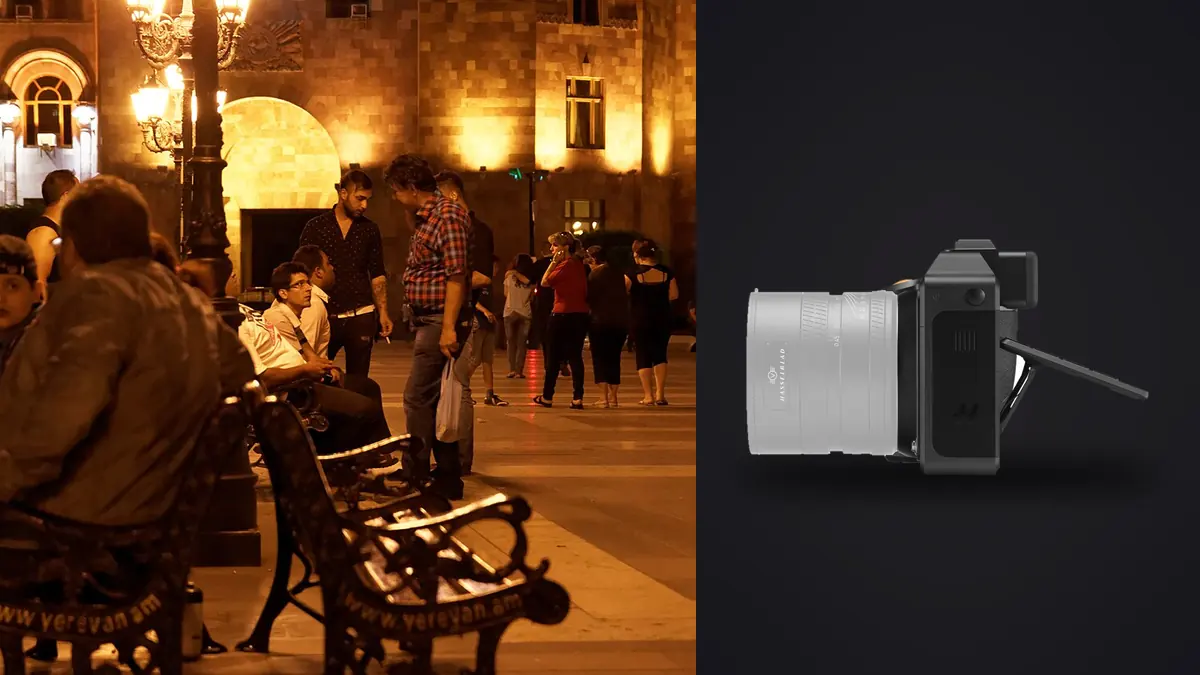
Nobody hands a new street photographer a medium format camera as their first choice. The genre rewards speed, low profile, and a body you can forget is even hanging off your shoulder. The Hasselblad X2D 100C is none of those things by reputation. It's a 100-megapixel medium format body built for studio, landscape, and architectural work, priced well north of anything most documentary shooters would call sensible. And yet I spent four months carrying one through market streets, transit stations, and a couple of long walking days in older European city centers, specifically to find out whether the reputation holds up or whether it's just inherited assumption from a camera category that used to mean tripods and view cameras.
The short answer: it's a strange, occasionally frustrating, occasionally spectacular tool for this work. It is not the camera I'd hand a beginner, and it is not the camera for anyone shooting fast-moving action. But for a specific, slower kind of documentary photography, the kind built around walking a neighborhood for hours and waiting for a scene to compose itself, it does things no APS-C or full-frame body I've used can match.
Why Bring a Medium Format Camera to the Street at All
The case against it is obvious and I'm not going to pretend otherwise. At 895 grams for the body alone, before you add an XCD lens that typically runs another 400 to 700 grams, you're carrying close to a kilogram and a half around your neck for a full day of walking. The autofocus, while genuinely usable now that Hasselblad added phase detection to this generation, still hunts in low light in a way that a modern full-frame mirrorless body simply doesn't. Burst shooting tops out around 3.3 frames per second, which rules out anything resembling a fast-action sequence.
What you get in exchange is a sensor and color engine that changes how you approach a scene. The X2D forces a slower rhythm because the gear itself is slower, and for documentary work specifically, that slowness is sometimes the point. I found myself watching a scene build for ninety seconds before pressing the shutter instead of firing off a burst and sorting it out later. That's not a workflow that suits every assignment, but for long-form neighborhood documentary projects where you're building a body of work over weeks rather than capturing a single decisive afternoon, it's a genuinely different way of working, not a worse one.
What the Sensor Actually Buys You in Harsh City Light
Street work in the middle of the day is brutal light. Deep shadow under awnings next to blown-out sidewalk, storefront glass throwing hard reflections, faces half in shade. This is where the 43.8 x 32.9mm sensor earns its keep. Shooting at base ISO 64, I was consistently able to pull three to four stops of recoverable shadow detail out of a single 16-bit RAW file without banding or obvious noise creeping into midtones. On a full-frame camera at ISO 64 you'd be lucky to get half of that cleanly.
The Hasselblad Natural Colour Solution processing also matters more on the street than I expected going in. Skin tones under mixed sodium streetlight and daylight spill (a common combination in older city centers where storefronts stay lit through the afternoon) come out of camera closer to accurate than anything I've gotten from a Bayer sensor without heavy correction. That doesn't mean the files need no work. It means the starting point for a documentary edit, where you're often trying to preserve a scene's actual mood rather than punch it up, is more honest.
The tradeoff is dynamic range headroom costs you resolution flexibility elsewhere. There's no pixel-shift mode on this body, no in-camera multi-shot composite, because none of that makes sense for a handheld street shooter anyway. What you have is one clean 100-megapixel capture per press of the shutter, and it has to be right.
Handling a 895-Gram Body in a Moving Crowd
The X2D has no mechanical shutter at all. Every exposure is electronic, which means the body itself is completely silent. That's a genuine advantage for candid documentary work, more so than on cameras that merely offer a silent shutter mode as an option. There's no half-hearted "quiet mode" compromise here. You press the shutter, the sensor reads out, and nothing moves. In a quiet interior or a hushed moment on a train platform, that matters more than people expect until they've shot next to someone with a DSLR mirror slapping away.
The size and weight are the real friction point. The body itself is compact for medium format, closer in footprint to a chunky mirrorless full-frame body than to a Fuji GFX-style brick, but paired with even a modest XCD lens it's not something you're slinging around all day without noticing. I switched to a wrist strap plus a thin sling rather than a neck strap after the second week, mostly to redistribute weight during long walking stretches. Grip comfort is good, better than the original X1D generation, and the deeper handgrip means one-handed shooting from the hip is actually viable, which matters for the kind of unposed street frame where raising a camera to your eye changes the scene.
Rolling shutter is the other handling consideration nobody talks about enough. Because there's no mechanical shutter, fast-moving subjects (a cyclist cutting across frame, someone jogging past close to the lens) can show skew and distortion at faster shutter speeds than you'd expect from a global-shutter or mechanical-shutter camera. It's not severe, but I noticed it enough on a handful of frames involving cyclists to start deliberately timing shots around subjects moving laterally at speed.
Autofocus and the Decisive Moment Problem
This is the generation of Hasselblad medium format that finally added phase-detection autofocus rather than relying purely on contrast detection, and it's a real improvement over the previous X1D line. Single-point AF in daylight is reliable and reasonably quick. Where it still lags behind a modern mirrorless body is continuous autofocus tracking on an erratic, unpredictable human subject, which is more or less the definition of street photography.
My workaround, and I'd guess most people doing serious documentary work with this body land on the same one, was to lean heavily on zone focusing with the XCD 55V stopped down to f/5.6 or f/8. Pre-focus to a distance, wait for the subject to walk into the zone, shoot. It's an old technique that predates autofocus entirely, and it happens to suit this camera's actual strengths (deliberate framing, patience, letting a scene come to you) better than trying to force it into a run-and-gun AF-C workflow it was never built for. If your documentary work depends on tracking fast unpredictable motion, this isn't your camera. If it depends on composing a frame and waiting, the AF limitations matter a lot less than the spec sheet suggests.
Picking XCD Glass for Documentary Work
Three lenses covered almost everything I shot. The XCD 38V (30mm full-frame equivalent) became the default for environmental scenes where I wanted context, market stalls, building facades, groups of people in a square. It's compact for the system and focuses close enough for a decent environmental portrait. The XCD 55V, closer to a 43mm full-frame equivalent, sat on the body more often than any other lens simply because it matches how I naturally frame a documentary scene, close enough to feel present without distorting faces at portrait distance.
The XCD 90V (roughly 71mm equivalent) came out less often but earned its place for compressed, quieter portraits of individual subjects at a respectful distance, the kind of frame where getting physically closer would change the moment you're trying to capture. All three lenses use Hasselblad's leaf shutter design, which syncs flash at up to 1/2000s, useful if your documentary work ever needs fill flash in harsh midday shadow without the usual full-frame sync speed ceiling of 1/200s or 1/250s.
How It Stacks Up Against Other Street Cameras
None of these are perfect analogues, sensor formats and price points differ enormously, but this is roughly how the X2D 100C compares against the cameras most commonly carried for this kind of work.
| Camera | Sensor | Body weight | Shutter | Burst speed | Typical RAW size | Body price (approx.) |
|---|---|---|---|---|---|---|
| Hasselblad X2D 100C | 43.8 x 32.9mm, 100MP | 895g | Fully electronic, silent | 3.3 fps | 100-150MB (3FR) | $8,199 |
| Leica Q3 43 | Full frame, 60MP | 743g | Leaf + electronic to 1/40000 | 15 fps | ~80MB (DNG) | $6,485 |
| Fujifilm X100VI | APS-C, 40MP | 521g | Leaf + electronic to 1/180000 | 11 fps | ~50-80MB | $1,599 |
| Sony A7R V | Full frame, 61MP | 723g | Mechanical + electronic to 1/8000 | 10 fps | ~60-120MB | $3,898 |
The pattern is stark once it's laid out. Every other camera on that list beats the X2D on speed, weight, and price, often by a wide margin. What it wins on is dynamic range headroom and per-file color depth, and it wins by enough that a certain kind of documentary work, the slower, print-oriented, archival kind, genuinely benefits from the tradeoff. It is not the camera for a photojournalist chasing breaking news. It's closer to the camera for someone building a book-length project over a year.
The File Management Reality Nobody Mentions
This is the part that catches people off guard, and it's worth being blunt about it. A single day of reasonably active street shooting on the X2D, somewhere between 300 and 600 frames, produces 40 to 90 gigabytes of 16-bit RAW files. A multi-week documentary trip can easily generate several thousand frames and multiple terabytes before you've opened a single one in an editor. At 100 megapixels, even scrubbing through a folder to find the sharp frame in a burst of near-identical shots becomes a real time cost, not just a mild annoyance, because every full-resolution preview render is slower than it would be on a 24-megapixel file.
This is where I ended up leaning on imagic rather than doing the first pass by eye. Its local sharpness and focus scoring runs on the actual pixel data rather than a downsampled thumbnail, which matters a lot at 100 megapixels because a frame that looks sharp in a small preview can reveal focus drift once you're at full resolution, and the reverse happens too. The burst and duplicate clustering also earns its keep specifically because of that 3.3 fps ceiling. When you're shooting a scene four or five times at that slow a frame rate hoping to catch the right expression, having the software group those near-duplicates automatically instead of hunting through them manually saves a genuinely meaningful chunk of an editing day.
Because the X2D produces such distinctive color out of camera through Hasselblad's color science, I also built out an apply_my_style preset in imagic trained on a set of my own finished street edits, which let me apply a consistent grading pass across a week's worth of culled selects without re-deriving the same curve and color balance from scratch every session. And because street and documentary photography frequently involves photographing strangers in public, having the whole culling and editing pass run locally with nothing uploaded to a server was not a minor convenience. It's a real consideration when the subjects in your files are people who never consented to appear in someone else's cloud storage. If you're weighing tools for this kind of volume, our breakdown of how AI photo culling actually works covers the scoring approach in more depth, and imagic's pricing page lays out the one-time cost against what a subscription tool would run you over a year of heavy shooting.
Settings and Field Technique That Held Up
- Base ISO 64 whenever light allows. This is where the sensor's dynamic range is at its widest, and city daylight rarely forces you off it.
- Expose to protect highlights, not shadows. The shadow recovery headroom is generous enough that underexposing slightly and pulling up in post beats blowing out a bright storefront or sky.
- Back-button focus, always. Separating focus from the shutter button matters more here than on a fast-AF body, since you often want to lock focus on a zone and then wait, sometimes for a full minute, before firing.
- Stop down for zone focusing. f/5.6 to f/8 on the 55V gives enough depth of field to forgive imperfect distance estimation while still keeping backgrounds reasonably separated.
- Use the leaf shutter sync for shadow fill. On harsh midday streets, a touch of flash at 1/1000s or faster to open up a shadowed face is something full-frame shooters with a 1/200s sync ceiling can't casually do.
Frequently Asked Questions
Is the Hasselblad X2D 100C too slow for candid street photography?
For fast, reactive candid work, yes, the autofocus and 3.3 fps burst rate will frustrate you. For a slower, more observational style where you're composing a scene and waiting for the right moment within it, the limitations matter much less, and the silent electronic shutter actually helps you stay unnoticed in the meantime.
Can you shoot handheld all day with this camera without fatigue?
Yes, but it takes adjustment. At around 895 grams for the body plus 400-700 grams per lens, it's noticeably heavier than a typical mirrorless street setup. A sling strap that distributes weight across the body rather than a thin neck strap makes a meaningful difference over an eight-hour walking day.
Do I need a new computer to handle 100-megapixel documentary files?
You don't need a top-tier workstation, but you'll feel the difference on an older laptop. 16-bit files at this resolution are large enough that culling software matters more than it would with smaller files, since scrubbing full-resolution previews by hand gets slow. Running culling locally rather than through a cloud-dependent tool also avoids upload wait times on multi-terabyte shoots.
Is the XCD 55V or the 38V the better single lens for a documentary trip?
If you can only bring one, the 55V's roughly 43mm equivalent field of view is the more versatile documentary focal length, close to how the eye naturally frames a scene. The 38V earns its place when the project leans heavily on wider environmental context, crowded markets or streetscapes where you want the setting as much as the subject.
Would I recommend the X2D 100C as a first street camera to someone starting out? No. It's an expensive, deliberate tool that punishes impatience and rewards a slower documentary approach. But for a photographer who already knows they work that way, who's building a long-term project rather than chasing single frames, it produces files with a color depth and shadow recoverability that nothing else on this list quite matches.