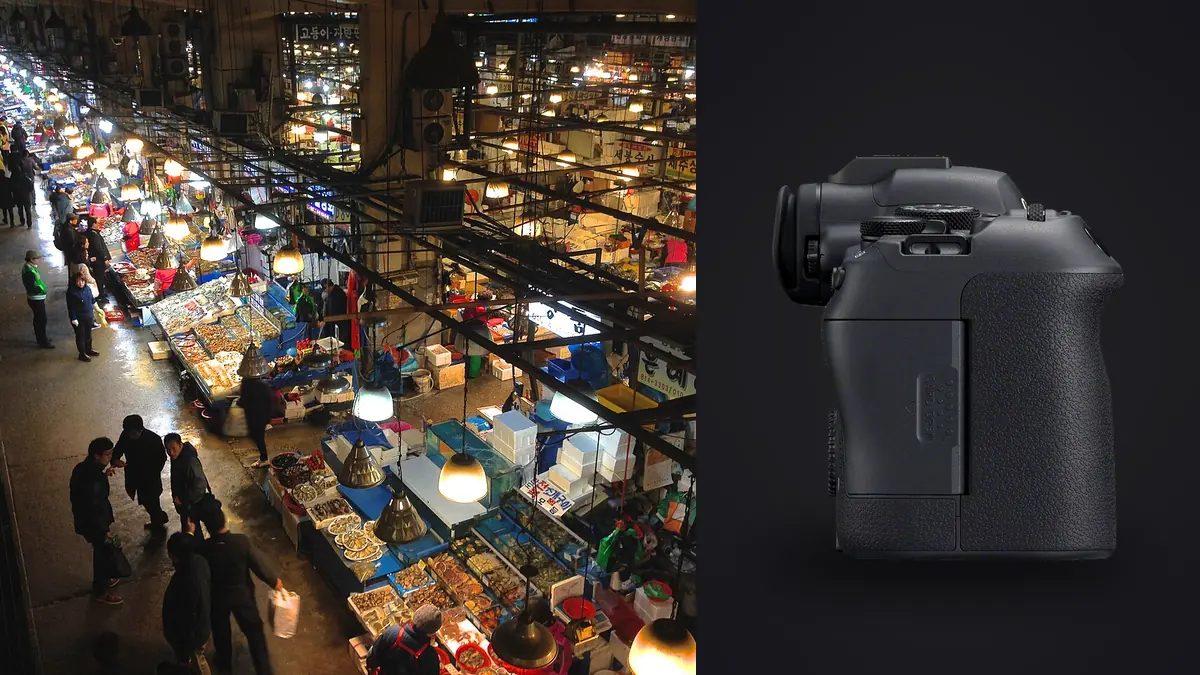
I picked up the R6 Mark II expecting a sports and events camera that would be fine for street work as a side benefit. That's backwards. After two years shooting markets, protests, and a lot of aimless neighborhood walking with it, I think Canon accidentally built one of the better full-frame bodies for this kind of shooting, and almost none of the marketing mentions why.
Handling: heavier than a rangefinder, lighter than you'd think
At roughly 670g body-only, the R6 II is not a Ricoh GR you slip into a jacket pocket. But paired with something like the RF 35mm f/1.8 or the RF 28mm f/2.8 pancake, the whole kit sits comfortably under a kilogram, which is light enough to carry all day without the neck strap becoming a conversation topic. I've shot 8-hour market days with it slung cross-body and never once thought about the weight the way I do with an R5 and a 24-70mm f/2.8.
The grip is deep enough that one-handed shooting while holding a coffee, a door, or a kid's hand actually works, which matters more for documentary work than any spec sheet number. The fully articulating screen is the one handling choice I go back and forth on. It's fantastic for low, hip-level shots in crowds where you want to see the frame without lifting the camera to your face, but flipping it out to the side to check exposure is a visibly larger gesture than a simple tilt screen, and on the street that gesture gets noticed. My workaround is to leave the screen closed against the body by default and only pop it out when I've already decided I'm doing something deliberately visible, like a posed environmental portrait rather than a candid grab.
Autofocus is the actual headline feature for this genre
Dual Pixel CMOS AF II with subject detection is the reason I switched systems for this kind of work. Eye detection on people holds through partial occlusion (a hand passing in front of a face, a market umbrella clipping the top of the frame) far better than the R5's first-generation system did, and it keeps tracking through fast, erratic movement, which is most of what street photography actually is. For a documentary sequence of a parade or a procession, I set the joystick to recenter the AF point instantly and let subject tracking do the rest rather than fiddling with a focus box.
What I didn't expect was how useful the vehicle detection mode is outside of car shows. It picks up bicycles, motorbikes, and rickshaws in dense street scenes, which is exactly the kind of unpredictable moving subject that used to eat my keeper rate on older bodies. It's not flawless. In backlit scenes with strong flare, like shooting into low afternoon sun down a narrow street, the system occasionally locks onto a bright patch of pavement instead of the person walking through it. I've learned to switch back to a single AF point in that specific lighting condition rather than fight the algorithm.
Shutter modes: the silence is real, but so is the rolling shutter
Fully electronic shutter is where this camera earns its keep for anything requiring discretion: quiet interiors, religious ceremonies, courtrooms, small apartments where a mechanical click would be rude. Completely silent, and paired with the anti-flicker setting it handles the sodium and fluorescent lighting you get in a lot of indoor market and transit shooting without banding across frames.
The tradeoff is rolling shutter distortion on anything moving fast through frame. Cyclists, cars, a kid running past close to the lens all show skew at the top of the sensor readout under electronic shutter, and it's ugly enough that I've had to reshoot moments I thought I nailed. My rule now: electronic shutter for anything static or slow (portraits, interiors, seated subjects), mechanical for anything with real lateral motion. It's an extra decision to make mid-shoot, which is annoying, but it's a decision, not a limitation, once you know the boundary.
Buffer and files: 40fps is a party trick you'll rarely use
Canon advertises 40fps with the electronic shutter and it's real, but at full resolution RAW the buffer clears out in a couple of seconds of sustained shooting before the camera slows down to write to card. For documentary work I almost never touch 40fps. A burst of a gesture or an expression rarely needs more than 8-10 frames to catch the right one, and shooting at 40fps just means an enormous pile of near-duplicate files to sort through later for a marginal gain in hit rate. I mostly shoot the 12fps mechanical mode or a slower 5fps burst for walking sequences, which keeps the card from filling in an hour and keeps the edit sane afterward.
That said, the sorting problem is real regardless of burst rate, and it's the part of this workflow nobody warns you about before they buy the camera. A single afternoon of street shooting on this body routinely produces 800 to 1,200 RAW files, most of them variations on the same three or four seconds. I run everything through imagic before I open a single frame in an editor. Its local sharpness scoring flags which frame in a burst is actually in focus (useful when eye AF nails frame 3 of 8 and drifts slightly by frame 6), and the duplicate and burst clustering groups the near-identical frames together instead of leaving me to scroll past forty almost-identical market shots one at a time. Because it runs entirely on the machine, I'm not uploading photos of strangers' faces to a server to get a first pass, which matters more in documentary work than in most other genres given the subjects didn't sign a release.
Lenses that make sense for this specific job
The kit lens, the RF 24-105mm f/4-7.1, is not what I'd recommend, the variable aperture is too slow for the low light this genre lives in. What's actually worked for me:
- RF 35mm f/1.8 STM IS Macro: my default. Close enough to a normal perspective for environmental portraits, wide enough for interiors, and the built-in stabilization pairs with the body's IBIS for handheld shots well under 1/15s.
- RF 28mm f/2.8 STM: the pancake. Genuinely small, genuinely light, and the widest lens I'd trust for close-quarters street work without obvious distortion on faces at the edge of frame.
- RF 50mm f/1.8 STM: cheap, sharp, and useful for isolating a single subject out of a crowded scene when 35mm includes too much clutter.
Third-party RF-mount primes from Sigma opened up after Canon loosened the mount licensing, and their 23mm f/1.4 is worth a look if you want wider than 28mm with a fast aperture for after-dark work, though it's noticeably heavier than any of Canon's own compacts.
How it stacks up against the cameras people actually cross-shop
Nobody buying a street/documentary camera is choosing between the R6 II and a sports body. The real comparison is against the compact fixed-lens crowd and Canon's own R8. Here's how they actually compare on the things that matter for this genre, not the full spec sheet:
| Camera | Body weight | Silent shutter | Subject-detect AF | Battery life (CIPA) | Best fit |
|---|---|---|---|---|---|
| Canon EOS R6 Mark II | ~670g | Yes, full electronic | People / animals / vehicles | ~580 shots (EVF) | Fast-moving documentary, mixed light, long shoot days |
| Fujifilm X100VI | ~521g | Yes, leaf + electronic | People / animals / vehicles | ~450 shots | Pure street, fixed 35mm-equiv, maximum discretion |
| Ricoh GR IIIx | ~262g | Yes, mostly silent by design | Basic face detect only | ~200 shots | Pocketable, snapshot-speed candid work |
| Canon EOS R8 | ~461g | Yes, full electronic | Same AF core as R6 II | ~290 shots | Budget entry to the same AF system, weaker grip and no IBIS |
The R8 is the interesting one here because it shares the R6 II's autofocus brain in a smaller, cheaper body, but it drops in-body stabilization and battery life takes a real hit for it. If money is tight and you shoot mostly in daylight, that trade might be fine. If you're doing evening processions, dim interiors, or anything where you need slow handheld shutter speeds without flash, the R6 II's IBIS is worth the extra weight and cost.
Low light and dynamic range in real conditions
Base ISO dynamic range on this sensor is generous enough that I regularly shoot into harsh midday shadow-and-highlight scenes (a street market under a corrugated roof with sun cutting through gaps) and recover shadow detail in post without the noise showing up in a print. Past ISO 6400 things get grainy in a way that's usable for documentary work (grain reads as authentic, not as a flaw, in this genre) but I wouldn't push much past 12800 if the images are going to a portfolio rather than a photo essay where texture is part of the story.
In-body stabilization rated around 6-8 stops depending on the lens has let me shoot handheld at 1/8s and occasionally slower for static interior scenes, which has meant leaving the flash at home for a lot of assignments where a flash would have killed the mood entirely. It doesn't help with subject motion blur, obviously, that's what the shutter speed and ISO combination is still for, but for holding the camera steady during a long available-light exposure of a still scene, it's genuinely changed how I shoot interiors.
Where the editing workflow actually lives
The part of this that surprised me most wasn't the camera, it was how much the back end changed once the files started stacking up. A week-long documentary trip with this body easily produces 6,000 to 8,000 RAW files. Culling that manually in a traditional editor, clicking through one at a time to flag keepers, used to eat an entire evening after every shoot day. I now run the card through imagic first: it clusters bursts, scores focus locally on my own machine (no cloud round-trip, which matters when I'm shooting in places with no reliable connection anyway), and once I've picked a handful of favorites from an early edit, its apply_my_style feature learns from those edits and applies a consistent look across the rest of the set instead of me manually matching white balance and contrast across a thousand frames from three different lighting conditions in one day. It's not doing the creative work for me, it's just removing the repetitive part so the actual editing time goes toward the twenty or thirty images that end up in the final story rather than the nine hundred that didn't make the cut. If you're weighing tools for this stage of the process rather than the camera itself, the mechanics of how automated culling actually scores focus and groups bursts are worth understanding before you trust it with a paid job; how AI photo culling works covers that in more depth. For anyone still hand-sorting thousands of files a shoot, it's also worth reading through a few practical habit changes, and these workflow tips cover more of the pre-culling side, like naming and folder structure, that a good culling pass alone won't fix.
Frequently Asked Questions
Is the R6 Mark II too big for candid street photography?
It's bigger than a fixed-lens compact, but with a small prime like the RF 28mm or 35mm it's not the camera that gives you away. What draws attention on the street is usually behavior, holding the camera up and waiting, checking the screen after every shot, rather than the body size itself. Shooting from the hip with the AF locked on continuous subject tracking gets you most of the discretion people assume you need a smaller camera for.
Should I shoot mechanical or electronic shutter for a documentary event?
Default to mechanical unless silence is the priority. Electronic shutter's rolling shutter skew shows up on anything crossing the frame at walking pace or faster, and documentary events are full of that kind of motion. Save electronic shutter for the moments where the sound of a mechanical shutter would actually disrupt the scene, like a quiet ceremony or an intimate interior conversation.
Does the R6 Mark II need a battery grip for a full day of street shooting?
No. A single LP-E6NH comfortably covers a full day of stop-start street shooting for most people, since CIPA figures are conservative compared to how street photographers actually shoot (short bursts, long gaps, screen mostly off). I carry one spare battery for full-day documentary coverage and have never come close to needing it before the day ends.
How many images should I expect to cull after a day of street shooting with this camera?
Depends heavily on burst habits, but shooting a mix of single frames and short 5fps bursts, a full day typically lands between 600 and 1,000 RAW files for me. Anyone leaning on the 40fps electronic mode regularly will see that number climb into the thousands fast, which is more a warning about burst discipline than anything specific to this camera.