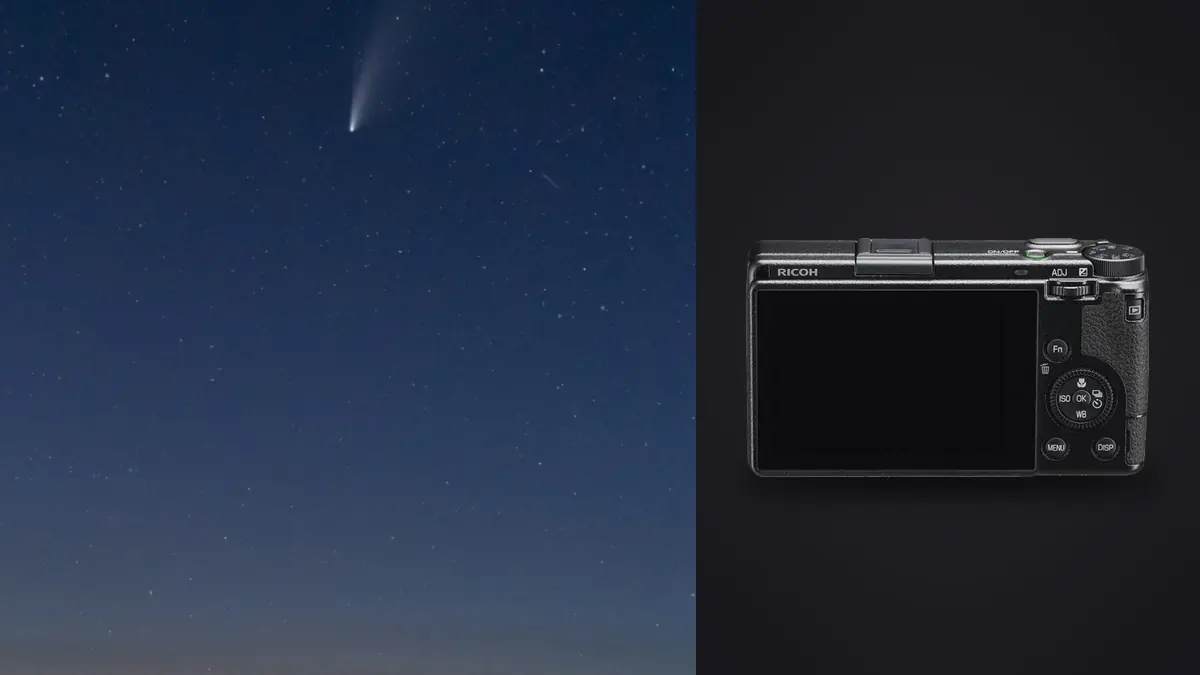
I did not buy a Ricoh GR IIIx to shoot stars. I bought it because it fits in a jacket pocket and the 40mm equivalent framing matches how I already see a scene when I'm walking around a city at dusk. It took a canceled flight and a clear night in the hills outside a small town in northern Chile, with no other camera in my bag, to find out what this thing can and cannot do once the sun goes down and stays down. The short answer: it is a genuinely odd choice for astrophotography, and it works anyway, if you stop trying to make it behave like a full-frame mirrorless body and instead lean into the one thing it does that a lot of dedicated astro setups don't bother with, shoot fast, small, silent sequences that you stack together rather than one heroic thirty-second frame.
A Compact That Was Never Built For This
Start with the spec sheet honesty: a 24.2 megapixel APS-C sensor, a fixed f/2.8 lens that's physically 26.3mm but reads as roughly 40mm equivalent field of view once you account for the crop, and a leaf-less shutter that in its normal exposure modes stops at 30 seconds. There's no interchangeable lens, so if 40mm equivalent isn't wide enough to swallow the arch of the Milky Way in one frame, that isn't a lens swap away from being fixed, it's a stitching problem you now own. There's no articulating screen, no weather sealing worth trusting on a damp night, and the small DB-110 battery loses noticeable capacity once the temperature drops below about 5°C, which is exactly the kind of night that produces the cleanest skies.
None of that reads like an astrophotography camera, because it isn't one. But three things work in its favor that don't show up on a spec sheet: it's dead silent, so there's no shutter slap introducing micro-vibration on a light tripod; it's small enough that a genuinely lightweight travel tripod can hold it steady in wind that would rock a heavier body; and Ricoh buried a pair of interval modes in the firmware that happen to be close to ideal for what star stacking actually needs.
Why the Shutter Ceiling Is Basically the Point
A 30-second ceiling with no true bulb mode sounds like a limitation, and on a single-frame basis it is. You can't get the two, three, four minute single exposures that produce long, buttery star trail arcs from Polaris out to the edge of frame in one shot. But single long exposures were never the only route to a trail image, and for APS-C pixels at higher ISO, they're arguably not even the better route. A single four-minute exposure at ISO 3200 accumulates thermal noise and hot pixels for the entire time the shutter is open, with no chance to discard a bad frame partway through. Thirty short exposures at 20 to 25 seconds each, stacked afterward, give you the same total light-gathering time with a get-out clause on every frame: a plane crosses frame twelve, you delete frame twelve and keep the other twenty-nine.
The GR III and GR IIIx both carry an "Interval Composite" mode in the shooting menu, which fires a sequence at a set interval and blends the frames in-camera using a lighten-only stack, essentially building a rough star trail image as you shoot, no laptop required. It's genuinely useful for checking composition and trail direction on site before you commit to a longer sequence. I don't rely on it for a final image, though. I use plain "Interval Shooting" instead, which fires the sequence and saves every frame individually as a DNG, and do the real stacking on a computer where I have actual control over alignment, noise handling, and whether the final image reads as trails or pinpoint stars.
The Settings I Actually Use in the Field
Focus
Autofocus hunting in near-total darkness is the fastest way to waste a clear night, so the first thing I do is switch to manual focus, set Snap Focus to infinity in the menu, then confirm it visually with the manual focus magnifier on a bright star or a distant streetlight before the sky gets fully dark. The GR IIIx doesn't have a focus ring with a hard stop; focus is driven by the up and down arrows on the rear dial against a distance scale on screen, which is slower than a lens with witness marks but repeatable once it's dialed in. I leave it alone for the rest of the session, because refocusing partway through an interval sequence is how you end up with a stack full of frames that won't align.
Exposure
My starting point on a reasonably dark site, Bortle 3 to 4, is 20 seconds at f/2.8, ISO 3200, shot in full Manual with Auto White Balance turned off in favor of a fixed 4000K, because AWB drifts slightly frame to frame under starlight, and that drift shows up as visible color banding once you stack fifty of them. Image stabilization goes off entirely, since the GR IIIx's shake reduction is tuned for handheld daylight work and can introduce its own small movements when the body is already locked to a tripod. I shoot DNG only, never JPEG, because the stacking software needs raw sensor data, not an in-camera noise-reduction pass already baked into a compressed file. Interval is set to 25 seconds against a 20-second exposure, leaving a five-second buffer for the shutter to close and the file to start writing before the next frame opens, since this camera isn't fast at flushing DNGs to an SD card.
How It Stacks Up Against Other Small Cameras for This
None of these were designed as astro bodies either, but they're the compacts people actually reach for, and the differences matter more under a dark sky than they do on a street corner.
| Camera | Sensor / equiv. focal length | Max shutter, no bulb | Built-in interval / composite mode | Body weight | Where it lands for stacking |
|---|---|---|---|---|---|
| Ricoh GR IIIx | APS-C, 24.2MP, ~40mm f/2.8 | 30 sec | Yes, both interval shooting and in-camera composite | ~262g | Narrower field forces stitching for a full Milky Way arch, but it's the smallest, most pocketable option here by a wide margin |
| Ricoh GR III | APS-C, 24.2MP, ~28mm f/2.8 | 30 sec | Yes, identical firmware modes | ~257g | Wider frame makes it the better single-shot Milky Way choice of the two GRs, same stacking ceiling either way |
| Fujifilm X100V | APS-C, 26.1MP, 35mm f/2 | Native T/Bulb modes extend well past 30 sec | No native interval composite; needs an app or cable release for sequences | ~478g | Removes the stacking requirement for a single long frame, but louder shutter and no built-in interval workflow |
| Sony RX1R II | Full-frame, 42.4MP, 35mm f/2 | Native Bulb mode | No; requires app-based intervalometer | ~507g | Full-frame sensor is the biggest single upgrade in dark-sky signal-to-noise here, at more than double the weight and roughly triple the price |
Turning Two Hundred Frames Into One Image
A single night session with a 25-second interval over ninety minutes produces somewhere around 200 to 250 DNG files, plus whatever test frames and duplicates I fired off while dialing in exposure. That volume is the actual bottleneck in this workflow, not the camera. For the alignment and stacking itself I use Sequator on Windows for straightforward star-point stacking with sky tracking, and Starry Landscape Stacker on Mac when there's a real horizon and foreground in frame that needs to stay sharp while the stars get aligned and blended around it. DeepSkyStacker is my fallback when I want more manual control over dark frame subtraction on a particularly noisy ISO 6400 sequence.
Sorting the Keepers Before Any of That
Before any stacking software opens, I need to know which frames in a 200-image sequence are actually sharp. A light breeze at a 20-second exposure introduces micro-blur on some frames and not others even with the camera locked down, and scrolling through 200 near-identical dark thumbnails to spot it by eye is how an evening turns into a wasted hour. This is the one part of the workflow where I lean on imagic rather than doing it manually: its local sharpness and focus scoring flags the frames that actually held focus and weren't nudged by wind, and its duplicate and burst clustering groups the whole interval sequence together automatically instead of leaving me to scroll through a flat folder. Everything runs on the laptop with no upload step, which matters more than it sounds like when a night's shooting is pushing several gigabytes of raw DNGs and there's no reliable signal out where I usually shoot. If you haven't looked at how that kind of automated sorting actually works under the hood, this breakdown of AI photo culling covers the mechanics in more depth than I need to here.
Getting the Grade to Match Across Every Frame
Once the stack is flattened into a single composite, it still needs a grade, and so does the separate foreground exposure I'll blend under it. Matching color and contrast by eye across two very differently lit frames, one built from thirty stacked star exposures, one a single blue-hour foreground shot, used to mean manually re-tweaking curves until they sat together convincingly. I now build that look once on a handful of finished night shots and use imagic's apply_my_style feature, trained on my own past edits, to carry the same grade across the rest of the set without redoing the work by hand each time. It's a small thing, but on a night where I've shot three or four separate star sequences at different spots, it's the difference between finishing edits before bed and still being at it the next afternoon. For the rest of the pipeline, from import to export, these workflow tips line up closely with how I actually work through a folder this size.
Blending a Foreground That Isn't an Afterthought
The 40mm equivalent framing that makes the GR IIIx an odd astro choice actually helps here. A 14mm ultra-wide swallows a huge amount of sky but tends to reduce foreground subjects to a sliver at the bottom of frame. At 40mm equivalent, a ridge line, a tent, or a person standing against the sky reads as a real subject rather than a silhouette footnote. My usual approach is a separate foreground frame shot during the last few minutes of blue hour, when there's still enough ambient light to expose it cleanly at a lower ISO without light painting, then blending that under the finished star stack in post. Trying to get both foreground and sky right in the same 20-second exposure at ISO 3200 almost never works with a lens this fast and a sensor this size; the foreground either goes muddy or the sky blows past usable.
Where It Genuinely Struggles
I'd rather list these plainly than pretend they don't matter. Cold-weather battery life is the biggest one: a fresh DB-110 that reads a comfortable 70% at the trailhead can be down near 20% ninety minutes later once the temperature drops, and I now carry two spares rather than one whenever the forecast is below 5°C. There's no wired remote port, so triggering the camera without touching it means either the self-timer or the Ricoh app over Bluetooth, and the app adds enough lag between tap and shutter that I've stopped trusting it for anything time-sensitive. Buffer clearing is the other recurring annoyance: on anything slower than a fast UHS-I card, the camera can lag behind a 25-second interval, occasionally dropping a frame from the sequence entirely, which is exactly why I pad the interval rather than trying to run the two numbers tight against each other.
Frequently Asked Questions
Does the Ricoh GR IIIx have a true bulb mode for long exposures?
No. In its standard shooting modes the shutter tops out at 30 seconds, with no bulb setting to hold it open manually. That's precisely why the interval-and-stack approach in this article exists as a workaround rather than a stylistic choice.
How many frames do I actually need for a clean star stack from this camera?
For pinpoint star images with visibly reduced noise, I start seeing real improvement around 40 to 60 stacked frames and diminishing returns past about 150. For star trail composites the count depends entirely on how long you want the trail to read, since each frame only adds roughly 20 to 25 seconds of arc.
Is the 40mm equivalent field of view too tight for Milky Way shots?
For the full galactic arch in one frame, yes, it's noticeably tighter than the 14 to 24mm range most astro photographers reach for, and you'll need to stitch two or three frames for that composition. For a single subject against a starry sky with a real foreground, the tighter framing is often an advantage rather than a limitation.
Do I need special software just for this camera's files?
No. The GR IIIx writes standard Adobe DNG, so any stacking tool that reads DNG, Sequator, DeepSkyStacker, Starry Landscape Stacker, or a general raw editor, handles the files without any camera-specific plugin.