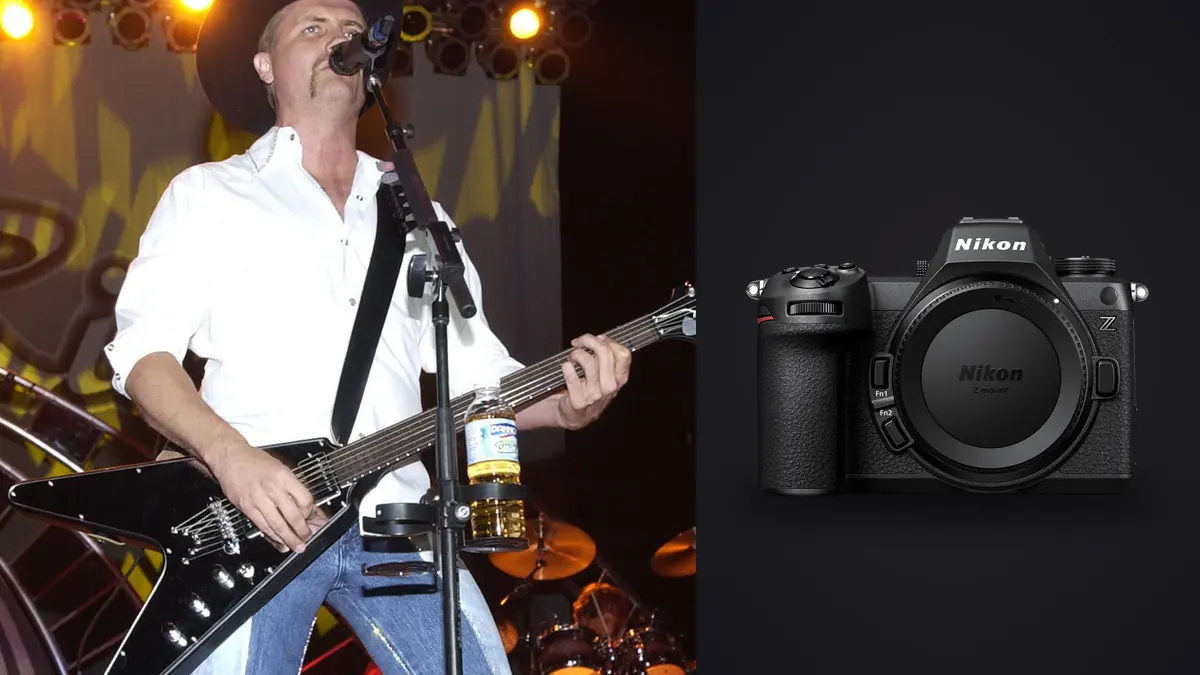
Three songs, no flash, and a photo pit barely wide enough to turn around in: that's the standard deal at most venues, and it's the environment the Nikon Z6 III actually gets tested in, not a studio with a controlled key light. I've run this body at everything from a 150-cap basement show with one moving-head fixture doing all the work, to a two-night arena run where the video wall behind the drummer was brighter than the drummer. The camera behaves differently in those two rooms, and most of what matters for concert work isn't in the marketing copy.
The sensor readout is the whole story in a pit
The Z6 III uses a partial-stacked 24.5MP sensor, and in practice that's the single spec that matters most for live music, more than resolution and arguably more than the ISO ceiling. Stage lighting rigs run LED fixtures on PWM dimming, which means the lights are pulsing on and off faster than you can see, and a slow sensor readout will catch that pulse mid-cycle and bake a dark band across part of the frame. It's the same mechanism that makes some cameras produce banded, half-lit frames of a singer under a moving head at anything other than a lucky shutter speed.
The faster readout on this sensor doesn't make banding impossible, LED banding is a light-source problem as much as a camera problem, but it narrows the window where it happens and it makes the electronic shutter genuinely usable for silent shooting during quieter songs, not just a checkbox feature. I shoot fully silent through acoustic breaks and between-song stage banter now, something I wouldn't have trusted on the Z6 II without checking every frame afterward for rolling shutter skew on someone's guitar headstock.
Settings I actually run, venue by venue
Nobody dials in the "correct" concert exposure once and reuses it all night. The light changes every four bars. But there's a baseline I start from depending on the room, and it's worth writing down because it saves the first two songs of trial and error, which is exactly when the most energetic photos of the night usually happen.
| Venue type | Typical ISO I run | Shutter speed | Aperture | What bites you here |
|---|---|---|---|---|
| Small club, single wash (100-300 cap) | 6400-12800 | 1/320s | f/1.8-2.8 | One light color for the whole set; skin tones drift green or magenta fast |
| Theater / seated venue with follow spot | 3200-6400 | 1/500s | f/2.8 | Follow spot blows highlights while the rest of the stage sits two stops under |
| Festival main stage (moving heads, strobes) | 1600-3200 | 1/800-1/1000s | f/2.8-4 | Strobes at high shutter speed can catch a completely dark frame between flashes |
| Arena with LED video wall behind the band | 2000-5000 | 1/500-1/640s | f/2.8 | Wall light shifts white balance every scene change; auto WB hunts constantly |
| Acoustic or seated show, static wash | 1600-4000 | 1/250s | f/2 | Lowest-energy light of the list, but also the least forgiving of camera shake at that shutter speed |
The native ISO ceiling on this sensor is 64000, and it's usable up there in a real emergency, a dark support-act set with nothing but a single red gel, for instance, but I try to stay under 6400 whenever the room allows it. Past that point you're trading detail for the ability to freeze motion at all, which in a mosh-heavy set is still the right trade, just not a free one.
Autofocus when the light rig won't sit still
Eye-detect autofocus on a static portrait subject is easy for almost any current camera. Eye-detect on a vocalist who's thrown their head back under a strobe that's currently mid-flash is a different problem, and it's where the Z6 III's low-light AF sensitivity actually shows up. I run wide-area AF-C with subject detection set to "person" rather than the tighter single-point pin, because in a pit you don't have time to walk a focus point across the frame between a guitarist's headstock and the singer's face. The camera loses lock occasionally in genuinely black-stage moments, a dead blackout between songs, but it reacquires fast enough that I don't feel like I'm fighting it.
Where it still struggles
Backlit silhouettes against a bright screen are the one scenario where I switch back to manual or single-point focus. Subject detection wants a face to lock onto, and against a blown-out LED wall it sometimes grabs the wall instead of the performer standing in front of it. That's not a Z6 III problem specifically, most subject-detection systems do this, but it's worth knowing before you're three songs in and wondering why half your silhouette shots are soft.
Buffer, cards, and the three-song clock
Most venues that still enforce the "first three songs, no flash" rule give you roughly ten to twelve minutes in the pit before security waves you out. That's not a lot of time to second-guess a burst length, so buffer depth matters more here than it would shooting, say, a wedding reception where you can pace yourself.
Shooting 14-bit raw at the faster electronic burst rates will fill a buffer noticeably quicker than mechanical shooting will, and the card you're using changes how fast it clears. A CFexpress Type B card in the primary slot clears a filled buffer in a few seconds; a UHS-II SD card in the same body takes visibly longer, and if you're double-writing raw to both slots for backup (which I do for anything I can't reshoot, meaning every show), you're bottlenecked by the slower of the two cards. My workaround is shorter, more deliberate bursts rather than holding the shutter down through an entire chorus. Six or eight frames on the beat drop gets you the shot without eating the whole buffer on a moment that was never going to have a keeper past frame three anyway.
Lenses that actually earn their spot in a pit bag
A 24-70mm f/2.8 covers probably 70% of what happens in a standard pit, close enough to the stage for a tight vocal shot, wide enough to catch the whole band when they line up for the last chorus. But the lens I reach for most in small clubs is a 35mm or 50mm f/1.4 prime, because clubs are dark enough that the extra stop over an f/2.8 zoom is the difference between ISO 6400 and ISO 12800, and because in a room that small you're rarely more than fifteen feet from the stage anyway.
For anything with a real pit barrier, festivals, arenas, theaters with a proper photo rail, a 70-200mm f/2.8 becomes non-negotiable. You're often shooting from twenty or thirty feet back, and a wide lens just gets you a small, distant performer in a sea of empty stage. I know photographers who bring a third body specifically to avoid changing lenses mid-set; with one Z6 III body I just accept that I'm going to miss a wide shot while I'm mounted long, and vice versa. That's a bag decision, not a camera limitation.
Getting through a night's worth of frames before the deadline
A three-song pit set at 8-10 fps in short bursts still adds up to 900-1500 raw files by the time you walk out. Multiply that by two support acts and a headliner and you're looking at a genuinely unpleasant editing session if you're doing it by eye, especially when half the venue wifi is unusable and the promoter wants a gallery link that same night.
This is where I stopped trying to cull manually and started running the take through imagic before touching Lightroom. It does the sharpness and focus scoring locally on the laptop, no upload, no waiting on a hotel or venue connection that's usually terrible anyway, and it flags which frame in a six-shot burst is actually the sharp one instead of making me pixel-peep four nearly identical frames of the same jump. The burst and duplicate clustering matters even more at a gig than it does at, say, a wedding, because live music produces far more genuinely redundant frames per second of actual usable content.
The other piece that's specific to concert work is color consistency across a set where the lighting rig itself is the thing changing the mood of every song. I trained imagic's apply_my_style preset on a batch of my own previously graded gig photos rather than starting from a generic preset, so when a set swings from a teal-lit ballad to red strobes on the closer, the grade it applies still reads as my color, not whatever the venue's LED rig happened to be doing that minute. If you're trying to build a consistent portfolio across dozens of different rooms with wildly different lighting, that's arguably a bigger deal than any single camera setting. If you haven't looked at how automated culling actually scores sharpness versus just guessing from thumbnails, it's worth reading through how AI photo culling works before trusting it with a night you can't reshoot; I was skeptical the first time too.
None of that replaces good habits during the set itself, though. I still shoot deliberately rather than holding the shutter down, and the general workflow tips in 10 tips for a faster photo workflow apply just as much to a gig as to any other kind of event shooting, the biggest one being that the fastest edit is the one you don't have to make because you didn't shoot ten redundant frames of the same beat in the first place.
Frequently Asked Questions
Does the Z6 III's rolling shutter actually solve LED banding, or just reduce it?
Reduce it, not solve it. The partial-stacked readout is faster than a standard BSI sensor, which shrinks the window where a PWM-dimmed light source gets caught mid-pulse, but banding is fundamentally about the relationship between your shutter speed and the venue's specific LED refresh rate. Different rigs flicker at different frequencies. The honest approach is still to take a couple of test frames at the start of a set and nudge shutter speed up or down slightly if you see banding, rather than assuming any camera makes the problem disappear entirely.
Is the high ISO ceiling good enough that I can leave my fast primes at home?
No, and this surprises people coming from crop-sensor bodies where the ISO gain from a full-frame upgrade feels dramatic enough to justify slower glass. The Z6 III's high-ISO files are genuinely clean up to around 6400-12800 for web and social use, but an f/1.8 or f/1.4 prime buys you a full stop or more that translates directly into either a lower ISO or a faster shutter speed to freeze motion, and in a dark club both of those matter more than squeezing another stop out of the sensor's noise floor.
How many raw frames can I realistically burst before the buffer stalls?
It depends heavily on card choice and burst mode, but as a working number: on CFexpress, you can hold a burst through most single musical phrases (roughly two to four seconds of continuous shooting) before feeling any slowdown; on SD UHS-II alone, that window is noticeably shorter, and double-writing to both slots simultaneously (which I'd still recommend for anything you can't reshoot) narrows it further. Shorter, timed bursts on specific beats consistently outperform holding the shutter down for an entire song.
Is silent electronic shutter safe to use during a quiet acoustic segment?
Mostly yes, and it's one of the more useful upgrades this body brings to live music work specifically, since older non-stacked sensors produced visible skew on anything moving quickly under electronic shutter. For a static or slow-moving acoustic performer under a steady wash, I don't hesitate to go fully silent. I still switch back to mechanical or electronic front-curtain for fast, strobe-lit segments, since very rapid subject motion combined with a strobing light source is still the one combination where a stacked-but-not-fully-stacked sensor can show artifacts.