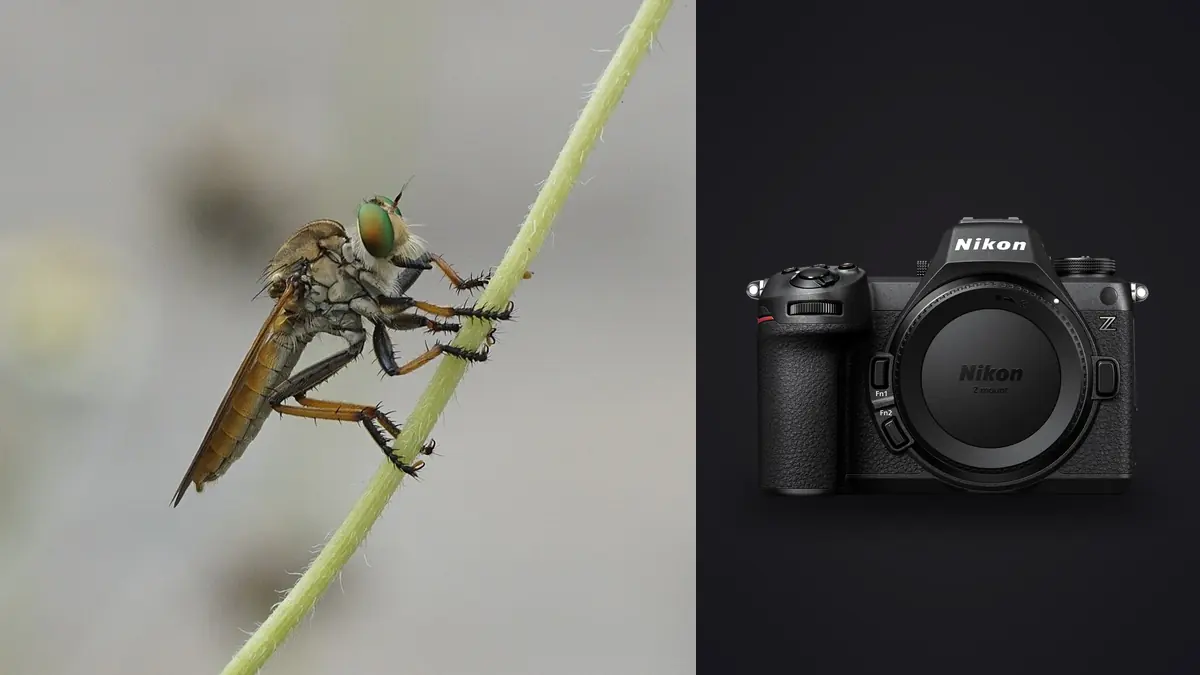
Most of what gets written about the Nikon Z6 III treats it as a hybrid stills-and-video body for weddings and events, and that's a fair read of the marketing. But spend a few damp mornings crawling through undergrowth trying to get a jumping spider's front eyes in focus before it hops off the leaf, and the camera starts to reveal a different personality. The partially stacked sensor, the redesigned viewfinder, and the focus-shift bracketing were clearly built with fast, unpredictable subjects in mind, even if Nikon's product pages talk about them in the context of sports and birds rather than beetles.
This is a field report built around actual insect macro sessions with the Z6 III, mostly paired with the Nikkor Z MC 105mm f/2.8 VR S, plus some time with a couple of alternative lenses. It's not a spec dump. It's what actually changes about how you shoot bugs when the body under your hands is this one instead of, say, a Z7 II or an older DSLR.
Why sensor readout speed matters more than megapixels here
Insect macro punishes rolling shutter in ways that landscape or portrait work never will. A dragonfly's wings can flicker through several beat cycles in the time it takes a slow-readout sensor to scan a single frame, and on older mirrorless bodies that shows up as wing tips that look bent, smeared, or oddly striped when you shoot electronic shutter at high speed. The Z6 III's partially stacked BSI sensor reads out fast enough that this problem mostly disappears, even at its faster electronic shutter speeds. That matters more for insect work than the resolution figure does. 24.5 megapixels sounds modest next to a 45MP body, and if your entire plan is to crop a full-frame shot down to make an ant look like a boulder, you'll feel the pixel shortage. But most insect macro doesn't work that way once you're actually at 1:1 or better magnification. The subject already fills a meaningful chunk of the frame, so you're not relying on brutal crops to manufacture the close-up. What you are relying on is the sensor keeping up with a subject that can go from stationary to gone in a tenth of a second, and that's a readout-speed problem, not a pixel-count problem.
Lens choice: the 105mm is the sensible pick, but it isn't the only one
The Z MC 105mm f/2.8 VR S is the obvious default and for most people it should stay the default. It hits true 1:1 magnification, the built-in VR is rated up to 4.5 stops on its own and works well in combination with the body's in-body stabilization, and the working distance at maximum magnification (a little over 14cm from the front element to the subject) is workable for most insects that will tolerate a lens getting close without bolting. The manual focus ring has real resistance and a long throw at close distances, which you'll want because autofocus on this lens starts to hunt once you're inside a few centimeters of true macro distance. Where the 105mm falls short is with genuinely tiny subjects, things like springtails, aphids, or the smaller jumping spiders, where even 1:1 doesn't get you enough magnification to show real detail. For that I've used the Laowa 90mm f/2.8 2x Macro APO on the Z mount and it's a legitimately different tool: fully manual focus, no electronics at all, but it reaches 2x magnification natively. It's slower to work with because you're doing everything by hand, including aperture, but for a motionless subject like a dew-covered beetle at first light it produces detail the 105mm simply can't match at the same distance. The Nikkor Z MC 50mm f/2.8 is worth a mention too, mostly because it's cheap and small, but the working distance at 1:1 is under 5cm, which spooks most insects that can walk or fly away. I use it almost exclusively for subjects that genuinely cannot move, like seed pods or dead specimens on a light table.
| Lens | Max magnification | Working distance at max mag | Autofocus | Best suited to |
|---|---|---|---|---|
| Nikkor Z MC 105mm f/2.8 VR S | 1:1 | ~14.5cm | Yes, hunts up close | General insect work, live and mobile subjects |
| Laowa 90mm f/2.8 2x Macro APO | 2:1 | ~10cm | Manual only | Tiny, stationary subjects needing extreme detail |
| Nikkor Z MC 50mm f/2.8 | 1:1 | ~4.5cm | Yes, hunts up close | Static subjects only, studio or captive insects |
| Venus Optics 25mm 2.5-5x Ultra Macro | 5:1 | ~4cm | Manual only | Extreme close-up, focus rail work, not handheld |
Autofocus is built for eyes, and insects don't cooperate with that assumption
This is the part that surprises people who buy the Z6 III expecting its subject detection to just handle bugs the way it handles dogs and birds. Nikon's subject detection categories on this body cover people, dogs and cats, birds, and various vehicles. There isn't a dedicated insect mode, and in practice the general "auto" subject detection will sometimes lock onto an insect's head or eye cluster, especially on larger subjects like dragonflies or big beetles, but just as often it grabs onto a leg, an antenna, or a patch of reflective wing and holds there confidently while the actual point of focus you wanted sits a few millimeters away and stays soft. What actually works better, and what I've settled into as a default, is switching out of subject detection entirely for anything smaller than a bumblebee and using single-point AF-C with the smallest available point size, recomposed by moving the camera rather than by pressing focus-and-recompose (at macro distances even a small amount of pivot changes your focus plane enough to miss). For subjects that are basically stationary, manual focus with focus peaking turned on and magnified live view is more reliable than any autofocus mode. The Z6 III's viewfinder resolution and refresh rate make manual focusing at high magnification genuinely comfortable in a way it wasn't on older EVFs, so this isn't the compromise it would have been five years ago. For fast, erratic subjects like hoverflies or small flying wasps, I'll set a focus limiter on the lens (the 105mm has a switch for this) to stop the lens from racking through its entire focus range every time it loses the subject, and pre-focus roughly to the expected distance, then let AF-C do fine adjustment from there rather than a full search.
A quick settings reference by scenario
| Scenario | AF approach | Aperture | Shutter/ISO | Flash |
|---|---|---|---|---|
| Dew-covered, cold insect at dawn (slow, stationary) | Manual focus, peaking on | f/8 to f/11 | 1/125s, ISO 200-400 | Optional fill, low power |
| Dragonfly perched, wings visible | Single-point AF-C, small point | f/11 | 1/500s, ISO 800 | Diffused flash, mid power |
| Bee or wasp working flowers (active, unpredictable) | AF-C, focus limiter set close | f/13 | 1/800s, ISO 1600 | Twin flash, high power |
| Jumping spider portrait (very small, curious, moves in bursts) | Manual focus rail, still air | f/9 | 1/200s, ISO 400 | Diffused single flash |
| Static specimen, focus-stacked composite | Manual focus, in-camera focus shift | f/5.6 | 1/60s, ISO 100 | Continuous LED, not flash |
Light: this is where most macro insect shots actually fail
None of the camera or lens choices above matter much if the light is wrong, and insect macro has a specific lighting problem that landscape and portrait work don't: your lens is so close to the subject that it blocks a lot of the ambient light that would otherwise be falling on it, and at f/11 or smaller you need enough light to keep shutter speeds fast enough to freeze wing motion or hand shake at high magnification. The two approaches that work are shooting at first light when insects are cold and slow (dew on a spider's web or a beetle's back also just looks good), or using flash. For flash I've had the best results with a diffused twin-flash setup mounted on the lens's filter thread, run at low power with a folded piece of white diffusion material rather than the plastic dome that ships with most macro flash kits, which tends to leave a hot, obvious catchlight pattern on wet or shiny insect surfaces. Full power flash on a bee's compound eyes looks harsh and clinical; dialing it back two stops and diffusing it wider makes the same shot look like it was taken in soft daylight. One thing the Z6 III's in-body stabilization genuinely helps with here: at 1:1 magnification, camera shake is magnified along with everything else, so even with flash freezing the subject, a soft or doubled background can result from body movement during the exposure. The combination of lens VR and in-body VR noticeably steadies the framing through the viewfinder while you're composing, even if the flash is doing the actual work of freezing motion in the final exposure.
Dealing with the sheer number of frames you end up with
Insect macro at 20 fps in electronic shutter mode produces an absurd number of nearly identical frames in a single session. Chase a hoverfly around a lavender bush for twenty minutes and you can easily come home with two or three thousand images, most of which are the same three or four moments repeated dozens of times with tiny variations in wing position or focus plane. Sorting that by eye is the single most tedious part of macro work, more tedious than the actual shooting. This is where I've leaned on imagic for the culling pass rather than scrubbing through everything in Lightroom's grid view. Because it runs its sharpness and focus scoring locally on the machine rather than uploading anything, and because a lot of macro subjects are shot somewhere without great signal (understory, hedgerows, damp mornings), not depending on a cloud round trip to see which of four hundred near-identical frames actually nailed focus on the eye is a real practical advantage, not just a privacy talking point. The duplicate and burst clustering groups those repeated wing-position frames together automatically instead of making you compare them one at a time, which for a 20fps burst session is the difference between a ten-minute cull and an hour of squinting at thumbnails. It's a one-time purchase too, which matters for a hobby where the shooting volume swings hard by season; I'm not paying a subscription through the winter months when the cameras stay in the bag.
Focus stacking, and when it's actually worth the setup
The Z6 III has an in-camera focus shift shooting mode that will step focus through up to 300 frames at an interval you set, which you then combine in Helicon Focus, Zerene Stacker, or Photoshop's own stacking tools. For a live insect this is close to useless; nothing holds still for 300 frames, and even 30 is optimistic for anything with legs. Where it earns its place is with dead specimens, insects found already still (a moth that's expired on a windowsill, for instance), or captive subjects in a controlled setup with continuous LED lighting rather than flash, since flash recycle time will slow the stack down and introduce exposure drift between frames. For a beetle or moth specimen at 1:1 with a stack of maybe 40-60 frames at narrow focus steps, the resulting composite has a depth of field that would be physically impossible in a single exposure without stopping down so far you'd lose all the detail to diffraction. It's a genuinely different kind of image from a single-frame macro shot, and it's one of the few times where I'd say the extra setup time (a tripod, a focus rail if you want more control than the in-camera stepping gives you, and patience with the compositing software) is worth it over just shooting handheld. If your workflow is still mostly ad-hoc, the tips in 10 tips for a faster photo workflow are a decent starting point before you add a step this fiddly to your process.
The editing side, briefly
Once you're through a stack of a few hundred keepers from a session, the color work on insect macro tends to be fairly consistent shot to shot within the same session and even across sessions if you're shooting the same habitat repeatedly. I built a preset in imagic using its apply_my_style feature, trained on a batch of edits I'd already done by hand on earlier macro sets, so it picks up the general tone I go for (slightly cooler shadows, restrained saturation on greens so foliage doesn't overwhelm the subject) and applies it as a starting point rather than a finished edit. It saves a meaningful amount of time on a big batch without flattening every shot into an identical look, since it's still adapting to each frame's own exposure and color rather than pasting one fixed preset over everything. If you're new to culling workflows generally, the breakdown at how AI photo culling actually works covers the scoring approach in more depth than I have room for here.
Frequently Asked Questions
Does the Z6 III's subject detection actually recognize insects as a category?
No, not as a dedicated mode. The camera's subject detection is built around people, dogs and cats, birds, and vehicles, and general "auto" detection will sometimes catch an insect's head on larger subjects but isn't reliable enough to trust for anything smaller than a big dragonfly or beetle. Single-point AF-C or manual focus with peaking is the more consistent approach for most insect work.
Is 24.5 megapixels really enough for insects as small as ants or springtails?
At true 1:1 magnification with the 105mm, small subjects like ants are workable but you're not cropping much further without losing detail. For genuinely tiny subjects you're better served going to a higher-magnification lens like the Laowa 90mm 2x than trying to crop your way there from a 1:1 shot, regardless of sensor resolution.
Should I get the Z MC 105mm or something with more magnification like the Laowa 90mm 2x?
Start with the 105mm if you're shooting live, mobile insects, since the autofocus and working distance make it far more usable in the field. Add the Laowa (or a similar manual high-magnification lens) once you're specifically chasing subjects too small for 1:1 to do justice, and accept that it's a manual-only, tripod-friendly tool rather than a walk-around lens.
How much does in-body stabilization actually matter at macro distances?
It helps with framing stability and handheld composition more than it directly freezes subject motion, since at high magnification even small hand movements shift the frame significantly. For freezing an insect's own movement (wingbeats, quick leg motion) you're still relying on shutter speed or flash duration, not stabilization, but a steadier viewfinder image makes manual focusing at 1:1 noticeably less frustrating.