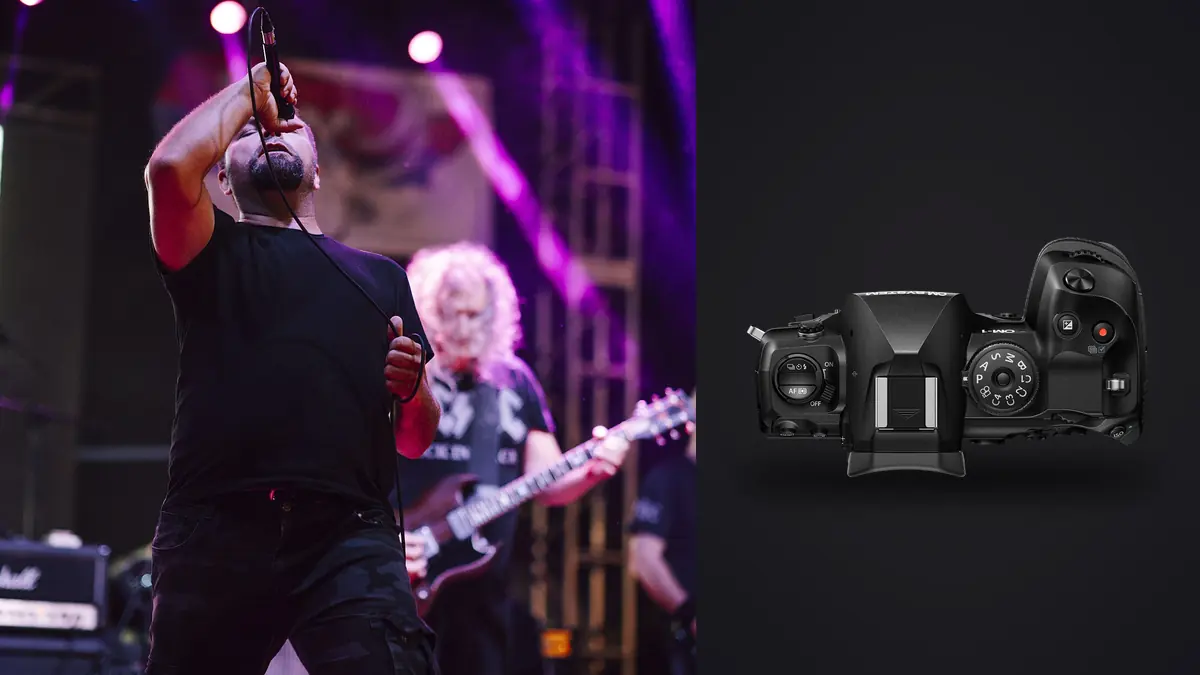
The first time I brought the OM-1 Mark II into a photo pit, it was a mid-size club show, three songs, no flash, house lights doing that thing where they swing from deep red to blinding white and back in about four seconds. I'd been shooting concerts on full-frame bodies for years and I'll admit I walked in skeptical. A Micro Four Thirds sensor at a gig with terrible lighting sounds like a bad idea on paper. It mostly wasn't, and the parts where it struggled taught me more about how this camera actually behaves than any spec sheet did.
This isn't a lab review. It's what happened across a handful of shows, from a 200-capacity room to a festival side stage, using the OM-1 Mark II as my only body for a stretch of weeks. If you shoot live music regularly, or you're deciding whether to build a kit around this camera instead of switching to full-frame, here's what actually matters.
Why Sensor Size Actually Matters in a Dark Room
Let's deal with the elephant first. Micro Four Thirds has a smaller sensor than APS-C or full-frame, and in a dim venue that means fewer photons hitting fewer, smaller photosites. I won't pretend the OM-1 Mark II beats a Sony a7S III or a Nikon Z6 III for clean high-ISO files. It doesn't, and anyone telling you otherwise hasn't pushed both cameras past ISO 6400 in the same room and pixel-peeped the result.
What the OM-1 Mark II does have going for it is genuinely excellent in-body stabilization, rated up to 8.5 stops with certain lenses. That's not marketing fluff you can ignore. For the static or slow-moving parts of a set, a ballad, a between-song moment, a quiet acoustic breakdown, you can drop your shutter speed further than you'd dare on a less stabilized body and let ISO come down instead of noise going up. It does nothing for a drummer's arms or a singer jumping off a monitor, where you still need shutter speed regardless of what sensor is behind the lens.
Where the smaller sensor actually helps
The 2x crop factor means your telephoto reach doubles for the same physical lens length and weight. A 40-150mm f2.8 PRO gives you an 80-300mm field of view while weighing under 900 grams. Try carrying a 300mm f2.8 full-frame lens through a festival photo pit for eight hours and you'll understand why that matters more than people give it credit for.
Where it genuinely doesn't
Depth of field and light gathering both track with actual aperture and sensor size together, not just the f-number on the barrel. An f2.8 lens on Micro Four Thirds behaves like roughly f5.6 for background separation purposes, which is fine for isolating a singer against a busy stage but won't melt a backdrop the way a full-frame f2.8 will. If creamy separation from a cluttered backline is your priority shot, this system asks you to get closer or use the fastest primes OM System makes.
Autofocus and the Frame Rate Question
Concert autofocus lives and dies on how well a camera holds focus on a moving face under lighting that keeps changing color and intensity. The Mark II's human detection AF is noticeably better than the original OM-1's, which struggled to lock onto a face lit from one side by a hard blue wash. I still lost the occasional frame when a singer turned fully backlit by a strobe, but that's a hard case for every camera I've used, not just this one.
Frame rate is where this body shows off. Mechanical shutter tops out around 10fps, which is plenty for most performance moments, but the electronic shutter modes go much higher, and Pro Capture is the feature I actually built habits around. It keeps buffering frames continuously while you have the shutter half-pressed, so when a performer finally hits the jump you've been waiting for, you already have the frames from just before your finger reacted, not just after. For anyone who's missed the exact peak of a stage dive by a tenth of a second, this changes how you shoot those moments.
The tradeoff is obvious the first time you check your card that night: Pro Capture at high frame rates from a two-hour set produces an enormous number of near-duplicate frames. More on sorting that mess in a minute.
Dealing With Stage Lighting Instead of Fighting It
Stage LEDs flicker at frequencies that don't always line up cleanly with your shutter, and on electronic shutter especially, that can show up as banding or uneven exposure across a burst. The Mark II includes a flicker-detection mode that scans the lighting and nudges shutter timing to avoid the worst of it. It's not magic and it doesn't catch everything, particularly with cheaper venue lighting rigs running erratic PWM dimming, but it noticeably cut down on the banded frames I was throwing away compared to shooting blind. White balance is the other recurring headache. Mixed LED washes, moving lights cycling through color, and haze in the air all conspire to make auto white balance guess wrong constantly. I stopped fighting it in-camera and started shooting everything in raw, correcting later in batches by song or by lighting cue rather than frame by frame. It's faster to fix fifteen frames under one purple wash at once than to chase white balance shot by shot.
Lens Choices by Where You're Actually Standing
Concert photography isn't one job, it's several different distances with different demands, and the right OM System glass changes depending on where you're shooting from. Here's what I actually reach for at each position, not a generic lens lineup pulled from a spec sheet.
| Shooting position | Typical distance to performer | Lens I reach for | ISO reality indoors | Frame rate I actually use |
|---|---|---|---|---|
| Photo pit, first three songs, barricade | 3-8 meters | 12-40mm f2.8 PRO II, sometimes an 8-25mm f4 for wide stage shots | ISO 3200-6400 | Mechanical 10fps, only bumping to electronic for a single jump |
| Small club, no barrier, shooting from the crowd | 2-5 meters | 17mm f1.2 or 25mm f1.2 prime | ISO 4000-8000 | Mechanical, or silent electronic when I don't want the shutter heard |
| Festival, side-of-stage riser | 15-40 meters | 40-150mm f2.8 PRO (80-300mm equivalent) | ISO 1600-3200, better rigs are usually brighter | Pro Capture SH1 for jumps and crowd interaction |
| Arena, elevated press platform | 40-80+ meters | 150-400mm f4.5 PRO with the built-in 1.25x teleconverter | ISO 1000-2500 | Electronic high burst, flicker scan on |
Notice the ISO numbers climbing as the venue gets smaller and darker rather than bigger and brighter. That surprises people who assume arenas are the hard case. In practice, arena rigs are usually lit by production companies with real budgets, while the club with the great local band has three PAR cans and a fog machine. Small rooms are where this camera, and honestly any camera, gets pushed hardest.
Sorting a Few Thousand Frames After Load-Out
This is the part nobody mentions in gear reviews and it's the part that actually eats your week. A single set shot with Pro Capture active for the big moments, plus normal bursts for the rest, easily produces two to four thousand frames from one night. Multiply that by a festival weekend or a tour leg and you have a genuine backlog problem, not a creative one.
I run everything through imagic before it ever touches a Lightroom catalog. It does its sharpness and focus scoring locally, on the machine, which matters when you're backstage on venue wifi that barely loads email, let alone a cloud upload. The bigger win for this specific camera is the duplicate and burst clustering. When Pro Capture hands you forty nearly-identical frames of a jump, imagic groups them and surfaces the sharpest one instead of making me click through all forty myself at 1am in a hotel room. I've also trained the apply_my_style preset on a batch of my own past concert edits, so the culled set of keepers already carries something close to my usual stage-lighting color treatment before I open a single raw file to fine-tune it. It's not a substitute for actually grading the hero shots, but it cuts the distance between "camera roll" and "sendable to the client" by a lot.
If you're new to building a culling workflow around a high-volume shooting style like this, it's worth reading up on how AI photo culling actually works before you commit to a process, and there's a broader rundown of speeding up the whole intake-to-delivery chain in tips for a faster photo workflow that applies whether you're shooting concerts or anything else that generates volume fast.
What I'd Tell Someone Deciding Between This and Full-Frame
If your work is mostly arena and festival photo pits where you're handed a photographer's pass, three songs, and told to keep up with five other shooters, the weight and reach advantage of this system is real and it adds up across a long tour. If most of your gigs are small clubs where ISO 6400 is a Tuesday, a full-frame body will give you cleaner shadows and more forgiving noise at the extremes, and that's worth being honest about before you commit to a system. What tipped it for me wasn't the sensor at all. It was that I stopped worrying about gear failing under moisture and spilled beer in a packed room, and I stopped dreading the physical toll of an 80-300mm equivalent lens on my shoulder by the fourth show of a weekend. Your mileage depends entirely on which rooms you actually shoot in.
Frequently Asked Questions
Is the smaller Micro Four Thirds sensor really a dealbreaker for dark venues?
Not a dealbreaker, but it's a real tradeoff you should plan around rather than ignore. Expect to run higher ISO than you would on full-frame for the same shutter speed, and lean on the stabilization for anything that isn't moving fast. For fast-moving performers under harsh light, you'll notice more noise in shadow areas than a full-frame body would produce at the same settings.
Does the electronic shutter cause banding under stage lighting?
It can, particularly with cheaper venue LED rigs on poorly regulated dimmers. The built-in flicker scan reduces how often it happens by timing the shutter to the lighting's actual frequency, but it's not foolproof. On mechanical shutter this is almost never an issue, so for anything under 10fps I default to mechanical unless I specifically need Pro Capture.
Which lens should I buy first if I only shoot small clubs?
A fast prime beats a zoom for small-room work almost every time. The 17mm f1.2 or 25mm f1.2 give you the extra stop or two of real light gathering that matters far more in a 200-capacity room than reach does, since you're rarely more than five meters from the stage anyway.
How do you deal with the three-song rule and Pro Capture's buffer at the same time?
Pro Capture only matters for the handful of peak-action moments in those three songs, a jump, a guitar swing, a crowd surf launch. I keep it off by default and switch it on for maybe ten seconds total per song when I see a moment building, then switch back. Leaving it running the whole set just multiplies your culling workload for no real benefit, since most of a set is people standing at microphones.