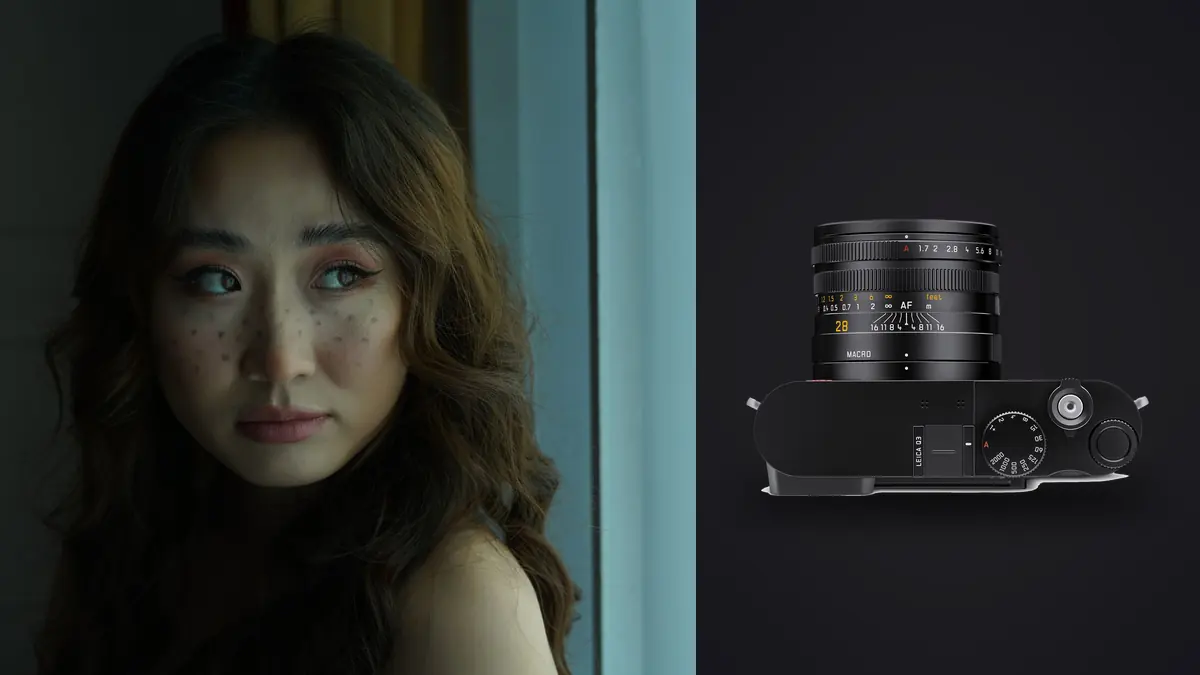
A fixed 28mm lens is not the obvious choice for boudoir work. Most photographers I know reach for something between 50mm and 85mm on a full-frame body, because that range flatters a body without distorting it and lets you work from a comfortable distance. So when a friend asked me to shoot her session on a Leica Q3 (she owned one and wanted the files to come off her own camera, with me directing), I was skeptical going in. Three sessions later I understood the appeal, and two of the reasons had nothing to do with image quality.
This isn't a spec sheet regurgitation. It's what actually changes when you shoot intimate portrait work on a camera with one lens, no interchangeable optics, and a body small enough to fit in a coat pocket.
The Space Problem Nobody Warns You About
Boudoir sessions almost never happen in a studio. They happen in bedrooms, hotel suites, and the occasional Airbnb with good window light and bad closet space. A standard bedroom runs somewhere around 3.3 by 3.7 meters once you account for the bed, a dresser, and whatever furniture the client didn't move out of frame. That's not much working room, and it gets smaller fast once you factor in where the light is coming from.
With an 85mm on a full-frame body, getting a three-quarter length shot in a room that size often means backing into a closet or shooting through a doorway. The Q3's native 28mm doesn't have that problem. At 28mm you can frame a full-length shot from six feet away, which in a cramped hotel room is the difference between getting the shot and not getting it. The tradeoff is real too: 28mm at close range distorts hands, feet, and anything near the edge of frame, so you have to be deliberate about camera height and where limbs fall relative to center.
What actually won me over was using the crop modes to get past the wide-angle problem without walking through a wall.
What the Crop Modes Are Actually For
The Q3 shoots at 28mm natively but has in-camera digital crop options that simulate 35mm, 50mm, and 75mm framing, using the center of the 60-megapixel sensor. Because the sensor resolution is so high to start with, the cropped files still hold up for print and client galleries, at least at the tighter crops. Here's how I actually use each one on a session, not how the spec sheet describes them.
| Crop Setting | Approx. File Resolution | Where I Use It in a Session | Working Distance in a Small Bedroom |
|---|---|---|---|
| 28mm (full sensor) | ~60 MP | Full-length shots, environmental frames, wide window-light setups | 1.8-2.4 m |
| 35mm crop | ~38 MP | Three-quarter length, most of the session's working shots | 2.4-3 m |
| 50mm crop | ~19 MP | Waist-up and closer portrait framing, less distortion on faces | 3-3.7 m (often tight against the far wall) |
| 75mm crop | ~8 MP | Face-only detail shots, only when the room allows the distance | Rarely usable in a bedroom under 4 m long |
In practice, the 35mm crop became my default for the bulk of a shoot. It softens the wide-angle distortion enough that faces and shoulders read naturally, and 38 megapixels is still more resolution than most clients will ever need, even for a large canvas print. The 75mm crop sounds appealing on paper but I rarely use it indoors. You need real distance to make it work, and most bedrooms don't have it.
Leaf Shutter, Silence, and Why It Matters More Than You'd Think
The Q3 uses a leaf shutter built into the lens rather than a focal-plane shutter in the body. Practically, that means the camera is close to silent in mechanical mode, and the electronic shutter option removes even that faint click. I didn't think this would matter much until I was mid-session with a first-time subject who was visibly tense every time she heard the shutter fire on a test shot with a DSLR earlier that day (she'd brought both cameras to compare). Boudoir clients are, almost without exception, more self-conscious than in any other kind of portrait session. A loud mechanical shutter slap is a constant reminder that a picture is being taken, right at the moment you want someone to stop performing for the camera and just exist in the space. Dropping the audible feedback to nearly nothing changes the energy in the room more than any amount of coaching I could offer. It's a small mechanical detail that ends up mattering as much as the lens speed.
Available Light and How Far You Can Push It
Most of my boudoir work leans on window light and maybe one continuous LED panel bounced off a wall or ceiling, rather than flash. Flash recycle noise and the pop of a strobe firing work against the same mood the leaf shutter is protecting. The Q3's f/1.7 Summilux glass and the stabilization built into the lens let me shoot handheld at shutter speeds down around 1/30s in a dim room without much hesitation, and I'll push ISO to 3200 without worrying about the files falling apart in a delivered gallery. Past 6400 I start seeing enough noise in shadow areas that I'll only use those frames for a black-and-white edit where grain reads as intentional rather than as a limitation. Late afternoon in a west-facing bedroom, with the blinds half-closed and a single lamp for fill, is close to my ideal boudoir lighting setup, and it's exactly the kind of low, uneven light that punishes a slower lens. Having f/1.7 available at every focal length (since it's one fixed lens, not a zoom that drops to f/4 at the long end) means I'm not making exposure compromises depending on which crop mode I'm framing in.
Skin Tones, and Why I Stopped Fighting the Color Profile
I'll admit I went in expecting to override the Leica color science entirely and build my own base look in post, the way I do with most other camera bodies. The out-of-camera JPEGs (and the raw files rendered through Leica's own profile) handle warm skin tones without the slightly sickly yellow-orange cast I've fought on other systems in mixed tungsten and window light. It's not perfect for every skin tone, cooler undertones in shadow areas sometimes need a touch of magenta pulled back out, but it needed noticeably less correction than I expected before I could call a frame finished. That said, consistency across a two-hour session with light changing as the sun moves is still work. I don't shoot boudoir the way I'd shoot a quick headshot session where one develop setting covers the whole shoot. I built a starting point in Lightroom from the files I liked best out of the first session, then used imagic's apply_my_style feature to carry that same tonal treatment across the following sessions automatically, since it trains on your own past edits rather than a generic filter. That saved a real amount of time on sessions two and three, where I would otherwise have been rebuilding the same warmth and contrast adjustments from scratch on every gallery.
Macro Mode for the Detail Frames
A boudoir gallery usually includes a handful of detail shots: lace texture, a ring, hands against fabric, the curve of a shoulder strap. The Q3 has a macro switch on the lens barrel that drops the minimum focus distance down to somewhere around 17cm, close enough to fill the frame with a hand or a piece of jewelry without cropping in from a wider shot and losing resolution. I use this maybe six or eight times a shoot, always near the end once the subject is relaxed and the bigger, more deliberate frames are already in the bag. It's not a macro lens in the true sense, magnification is modest, but for texture and detail work in a portrait context it's more than enough, and it means I never have to pack a second lens for those two minutes of a shoot.
The File Pile-Up Nobody Talks About
Sixty megapixels per frame adds up fast. A two-hour session with reasonable burst use lands somewhere around 25 to 40GB of raw files, and boudoir sessions tend to generate a lot of near-duplicate frames by nature. You're often shooting the same pose across three or four exposures to catch the right expression or the right fall of fabric, which means the culling pass afterward is genuinely tedious if you're doing it by eye, frame by frame, at full resolution on a 60-megapixel file. This is where I've leaned on imagic rather than clicking through Lightroom's Compare view manually. Its burst and duplicate clustering groups those near-identical takes automatically, and the local sharpness scoring flags which frame in each cluster is actually the sharpest at the eyes, which matters more here than in most genres since focus falls off fast at f/1.7. Given how personal and private this kind of work is, the fact that all of that happens on-device with nothing uploaded to a cloud service is not a minor detail for me, it's close to a requirement before I'll even open sensitive portrait files on a shared or synced machine. If you haven't looked at how AI-assisted culling actually works under the hood, it's worth reading up on before you trust it with sensitive galleries: how AI photo culling works.
What's Actually in the Bag
Part of the appeal of the Q3 for this kind of work is how little else you need to bring. My kit for a typical boudoir session on the Q3 is the body, one spare battery (real-world battery life on this camera does not match a mirrorless system body, so a spare isn't optional), a small LED panel with a diffusion sock, and a reflector I rarely end up using because window light plus the panel usually covers it. No lens bag, no bounce for flash, no light stand for a second strobe. For a genre where client comfort depends partly on the room not feeling like a film set, showing up with one camera and a soft light instead of a full lighting rig changes the tone of the first ten minutes more than people expect. If your workflow habits still assume you're hauling a full kit into every session, it's worth revisiting how much of that gear actually earns its place: a few notes on trimming a slower workflow down cover some of the same ground from the editing side.
Frequently Asked Questions
Is a fixed 28mm lens actually workable for boudoir, or is it a compromise you learn to live with?
It's a genuine tradeoff, not a hidden win. You get speed of setup, quiet operation, and enough resolution in the crop modes to cover most framing needs, but you give up the working distance and natural compression of a true 85mm portrait lens. In a spacious studio I'd still reach for a longer prime on a different body. In the tight, real-world rooms where most boudoir sessions actually happen, the 28mm's short working distance turns from a limitation into an advantage.
Do the digital crop modes actually hold up for large prints?
The 35mm and 50mm crops hold up fine for anything up to roughly a 16x20 print, since you're still working with 19 to 38 megapixels of real sensor data rather than an upscaled digital zoom. The 75mm crop, at around 8 megapixels, is fine for web galleries and smaller prints but I wouldn't push it past an 8x10 for a wall print.
How do you handle client privacy with files this size and this personal?
Everything stays local from card to delivery. Files come off the camera onto an encrypted drive, culling and editing happen entirely on-device (imagic's processing never touches a cloud server, which was part of why I adopted it for this genre specifically), and galleries go out through a password-protected delivery link rather than a shared cloud folder. Subjects tend to ask about this more in boudoir work than in any other genre, and having a straight answer matters.
Is the leaf shutter really quieter than a normal mirrorless camera in silent mode?
Most modern mirrorless bodies also offer a fully silent electronic shutter mode, so on paper they're comparable. In practice I've found subjects respond differently to a camera that looks and sounds unobtrusive by default, without needing to dig into a menu to turn a setting on. It's less about a measurable decibel difference and more about the camera not announcing itself, which matters in a genre built around a client feeling unobserved rather than photographed.