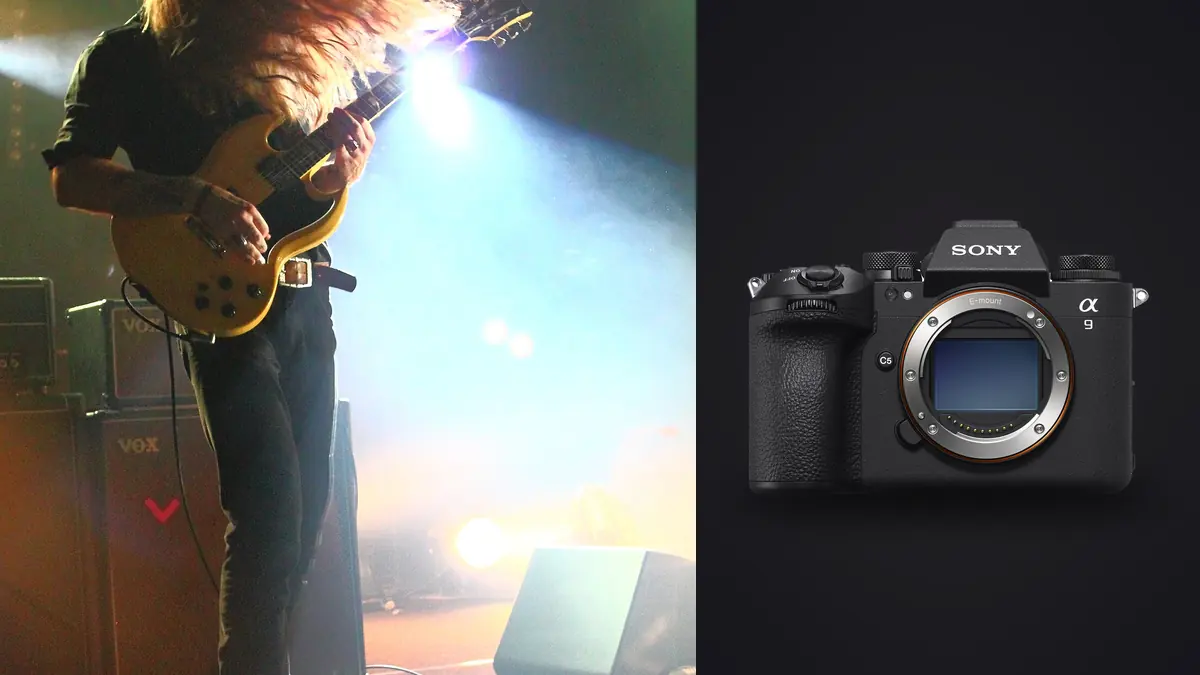
Three songs. That's the standard photo pit allowance at most touring shows, and it's the entire reason a lot of the Sony A9 III's spec sheet suddenly reads like it was designed by someone who has actually stood at a barrier with a security guard tapping their watch. I've shot with the A9 III for the better part of a year now, mostly clubs and mid-size theaters with the occasional festival main stage thrown in, and I want to talk about what actually changes in practice, not what changes on paper.
What the global shutter actually fixes under stage lighting
Every touring rig I've shot under in the last five years runs LED wash lights, LED walls, or moving-head fixtures with PWM dimming, and that dimming is where rolling shutter cameras get ugly. A conventional stacked sensor reads the frame top to bottom in a few milliseconds, and if a light source is pulsing faster than the human eye notices but not faster than the sensor's scan time, you get horizontal banding, partial exposure, or color shifts that vary row by row. Anti-flicker modes help, but they work by timing the shutter to the light's pulse, and when a lighting designer is running four different fixture brands at four different refresh rates on the same song, there's no single timing that saves you.
The A9 III reads the entire sensor at once. There is no top-to-bottom scan, so there is nothing for a strobing LED to interact with unevenly. I stopped thinking about banding entirely once I switched, which sounds like a small thing until you remember how much time I used to spend in post cloning color bands out of a singer's face because the light rig happened to flicker at the wrong frequency during the chorus. The same global readout kills the other classic rolling shutter tell: skewed verticals when a guitarist whips the neck fast, or a drummer's stick smearing into a slight diagonal. On the A9 III those elements stay geometrically correct at any shutter speed, because there's no scan direction to skew against.
120fps and what it's actually for
The A9 III can shoot at up to 120 frames per second with full autofocus and auto-exposure tracking, in a blackout-free viewfinder, using an electronic shutter with mechanical-shutter image quality. I don't run it at 120fps for a whole set, that would be an insane number of files to review, but I lean on it for maybe four or five seconds at a time around a specific moment: a jump at the end of a chorus, a drummer's stick contact, a singer's hair catching backlight mid-spin. At 20 or 30fps you can still miss the exact peak of a fast, non-repeating motion. At 120fps you don't, and that's the honest use case, not spray-and-pray across an entire song.
How fast the buffer actually clears in the pit
Sony rates the buffer at north of a thousand compressed RAW frames before it slows down, which in real photo-pit terms means you're not going to hit a wall during your three allotted songs even if you're aggressive with short 120fps bursts. Where it matters more is between songs, when you're chimping to check exposure or focus while the band retunes. With a CFexpress Type A card the buffer clears fast enough that I've never felt like I was waiting on the camera. That was not true of the older A9 II, where a heavy burst during an encore could leave you staring at a "processing" indicator while the best moment of the night happened in front of you.
Autofocus when the lighting is actively working against you
Real-time recognition AF on the A9 III is genuinely better at holding a face through backlight, haze, and colored gels than anything I used before it, including the A9 II. Concert lighting throws every AF stress test at once: a singer silhouetted against a wall of white light, then two seconds later lit from below in red, then obscured by fog with a spotlight punching through it. The system doesn't nail every single frame in that chaos, nothing does, but the hit rate holding focus on an eye through a haze machine is noticeably higher than what I got out of the A9 II, and it recovers faster after the subject is briefly occluded by another band member walking past.
Where I still see hunting is when a performer is fully backlit with no separation from the background, essentially a black silhouette against a bright void. No amount of subject recognition can find an eye that isn't rendering any detail. That's a lighting problem, not a camera problem, and I've learned to just wait a beat for the rig to change rather than fight it.
How the A9 III stacks up against the cameras concert shooters actually compare it to
Most people asking about the A9 III for live music work are weighing it against the A9 II they already own or a Nikon Z9 a shooting partner swears by. Here's how the numbers that matter for pit work actually line up.
| Spec (concert-relevant) | Sony A9 III | Sony A9 II | Nikon Z9 |
|---|---|---|---|
| Sensor readout | Global shutter, zero rolling shutter | Stacked sensor, mild rolling shutter under fast pans | Stacked sensor, very fast readout, minimal but present rolling shutter |
| Max burst w/ full AF-C | 120fps (e-shutter, mechanical-quality) | 20fps e-shutter / 10fps mechanical | 20fps full-res RAW, higher fps at reduced resolution |
| Banding risk under PWM/LED lighting | None | Occasional, needs anti-flicker mode | Low, occasional under mixed rigs |
| Max flash sync | 1/80,000s at any shutter speed | 1/250s mechanical | No mechanical shutter; e-shutter sync limited |
| Native ISO range | ISO 250-25,600 (exp. 125-51,200) | ISO 100-51,200 | ISO 64-25,600 |
| Approx. body price (2026) | ~$5,998 new | ~$3,500-4,000 (secondary market) | ~$5,499 new |
The flash sync line looks irrelevant for a pit shooter, since most venues ban flash outright for the standard three-song window. It matters a lot more for the promo and press shoots that happen around the tour, where you're syncing a strobe at 1/8000s to freeze motion and still get ambient stage color in the same frame, something the A9 II simply can't do without dropping to a fraction of that shutter speed.
The ISO tradeoff nobody mentions in the marketing copy
Here's the part I wish someone had told me before I bought the camera. Global shutter sensors currently carry a noise penalty relative to the best conventional stacked sensors at the top of their ISO range, because every pixel needs extra circuitry to hold its charge for the simultaneous readout, and that circuitry eats into the light-gathering area. In daylight or well-lit rooms you'll never see it. In a dim club running mostly ISO 6400 to 12800, I find A9 III files hold together beautifully with a light denoise pass. Push past ISO 20000 into the true darkness of a black-box venue with minimal stage wash, and the grain is coarser and less flattering than what I got out of the A1 or even the A9 II at the same ISO. My workaround has been simple: I protect my shutter speed less aggressively than I used to and lean on a wider aperture prime instead of chasing an extra stop of ISO headroom I know will cost me in noise. It's a real tradeoff, not a dealbreaker, but anyone switching from an A1 expecting a clean upgrade across the board should know the high-ISO ceiling actually moved down slightly, not up.
Lens pairing for pit work versus further-back positions
For barrier-distance pit shooting, a 24-70mm f/2.8 covers most of a set: wide enough for full-body shots when a performer leans over the crowd, long enough for a tight face shot from ten feet back. I keep a 70-200mm f/2.8 on a second body or slung over a shoulder for theaters and arenas where the stage is set back further, or for isolating a drummer who never leaves their riser. In small clubs where I'm sometimes closer than three feet to the stage, I've started reaching for a fast 35mm prime instead of a zoom, purely because f/1.4 buys back some of that ISO headroom I just complained about losing. None of this is A9 III-specific advice exactly, but the camera's autofocus is good enough now that I trust it wide open on a fast prime in ways I didn't fully trust the A9 II, which used to hunt slightly more at f/1.4 in low light.
The part that happens after the set
A three-band bill shot with any real use of that 120fps burst mode can easily produce four to six thousand frames in one night, and that's before you count the between-song safety shots at more sensible frame rates. Sorting that volume by eye, at 1am, after standing in a pit for three hours, is where most of my actual time goes now, not the shooting itself. I run everything through imagic before I touch Lightroom, because its local sharpness and focus scoring flags the genuinely soft frames out of a burst without me having to zoom into six hundred near-identical shots of the same jump, and its duplicate and burst clustering groups those bursts down to the handful of frames actually worth a second look. It runs entirely on my laptop, no upload queue, which matters at festivals where the venue wifi can't handle a photographer tent full of people trying to sync RAW files at once, and it matters just as much when a band's management wants embargo control on anything shot before a single drops.
The other piece I've come to rely on is imagic's apply_my_style preset, trained on my own past edits rather than someone else's look. A single night can swing from warm tungsten club lighting to cold LED wash to a hazy magenta encore, and having a starting point that already reflects how I personally handle skin tones under mixed color temperature saves a real chunk of the editing session, even though I still hand-tune the standout frames afterward. If you're new to thinking about culling as its own workflow step rather than something you do inside your editor, it's worth reading through how AI photo culling actually works before you're staring down a six-thousand-frame folder at 1am. I'd also point anyone shooting multiple gigs a week toward tightening the rest of the workflow around it, because the camera stopped being the bottleneck for me well before the editing did.
Frequently Asked Questions
Is the global shutter actually necessary for club shows, or is that overstated for smaller venues?
It matters less in a 200-cap club running two or three basic wash lights than it does under a full touring rig with LED walls and moving heads. Smaller venues with simpler, steadier lighting rarely trigger bad banding on a good stacked-sensor body either. If you're mostly shooting small local shows, the global shutter is a nice-to-have. If you're touring or shooting rooms with production-grade LED rigs, it removes a problem you'll otherwise fight all night.
Does the A9 III's extra noise at high ISO actually show up in real gig photos, or only on test charts?
It shows up once you're consistently past ISO 20000 in genuinely dark rooms, which happens more often than test-chart comparisons suggest for anyone shooting black-box venues or unlit basement clubs. Below that, in the ISO 3200 to 12800 range most shows actually sit in, I haven't found it to be a practical issue after a normal denoise pass.
How many usable keepers should I expect from a three-song pit set at 120fps?
From a heavy burst session across three songs I'll typically pull somewhere between 40 and 80 frames worth editing out of several hundred to a couple thousand captured, depending on how much of the set I actually shot at the top frame rate versus a more restrained 20 to 30fps for general coverage. The ratio drops fast if you leave the camera pinned at 120fps the entire time, which is why I only use it around specific peak moments.
Do I need to buy new lenses to get the most out of the A9 III's autofocus in low light?
No, existing Sony E-mount glass focuses the same way it always has. What changed is how well the body holds onto a subject through occlusion and backlight, which benefits any lens you already own. A faster aperture lens still buys you a cleaner file at lower ISO, but that's true regardless of which Sony body is driving it.