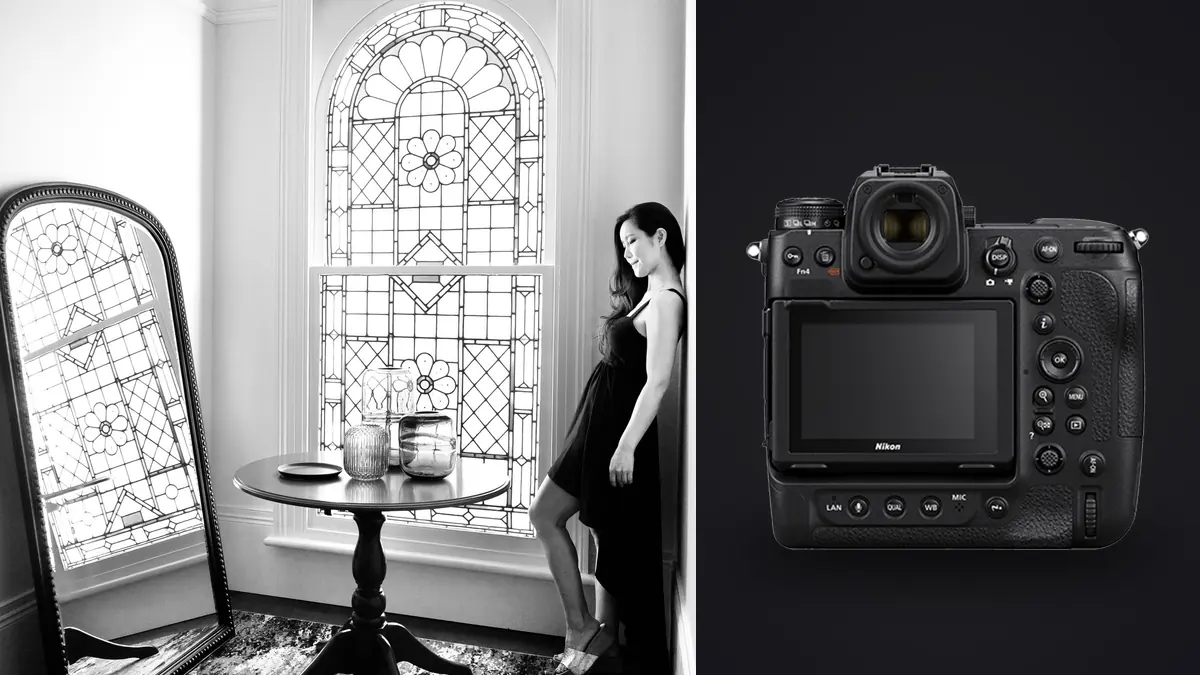
Boudoir and intimate portraiture put a camera through a different kind of test than a wedding or a corporate headshot session. You're usually working in a bedroom, a hotel suite, or a small studio set dressed to look like one, with mixed window and lamp light, a subject who is often nervous in front of a lens for the first time, and almost no room to reset if you miss the moment. The Nikon Z9 turns out to be a strong match for that particular set of problems. Not because Nikon built it with boudoir photographers in mind, but because the things it was engineered to solve, quiet operation, subject tracking in low light, and enormous buffer depth, map almost directly onto what this genre actually needs from a body.
Boudoir sessions with the Z9 mostly happen in client bedrooms and rented Airbnbs with decent window light. What follows isn't a spec sheet. It's what actually changes about how you work when this specific camera is the one in your hands, in this specific genre.
Why the Shutter Matters More Here Than in Most Genres
The Z9 has no mechanical shutter at all. It reads the stacked sensor electronically, fast enough that Nikon dropped the mechanical curtain entirely, and that single design choice changes the emotional register of a boudoir session more than any other spec on the camera. There's no clack, no mirror slap, no mechanical sound that announces "photo taken" and makes a subject freeze or self-consciously reset her expression. You can shoot continuously through a slow exhale, a shift in weight, a hand moving through hair, and the only sound in the room is the client's own breathing.
That matters clinically, not just aesthetically. A lot of the best frames in this genre happen in the half-second after you'd normally have stopped shooting, when the subject thinks the moment has passed and drops the pose she was holding for you. With a loud shutter, that drop is audibly bracketed and she knows exactly when you're "done." With the Z9 running silent, she doesn't, and you keep getting real moments instead of held ones.
The stacked sensor's fast readout also earns its keep on movement. Fabric falling off a shoulder, hair whipped mid-turn, a robe pulled open in one motion, all of these used to be where rolling shutter skew showed up on slower sensors. On the Z9 that skew is close to invisible at normal shutter speeds, so a fast hair flip doesn't come out looking like it's leaning sideways.
Lens Pairings That Actually Get Used in the Room
Boudoir rooms are small. That's the constraint that decides which Z-mount lenses earn a permanent spot in the bag versus which ones sound good in theory and never come out.
The NIKKOR Z 50mm f/1.2 S is the one to reach for most often, purely because most client bedrooms don't give you the eight or nine feet of working distance an 85mm wants for a three-quarter shot. At f/1.2 it still separates the subject from a cluttered headboard or a window with visible neighbors outside, and it focuses close enough for detail work on hands, jewelry, or fabric texture without switching lenses. The Z 85mm f/1.2 S comes out for larger primary bedrooms, hotel suites, or anywhere I can back up against a far wall, and the compression it gives on skin and background is genuinely different from the 50mm, worth the lens change when the room allows it. The Z 135mm f/1.8 S Plena rarely gets used indoors for this genre (there simply isn't room), but it's a strong choice for outdoor or studio-with-space sessions where a client wants a softer, almost painterly rendering at a longer working distance that feels less invasive.
For detail shots, an underrated addition is the Z MC 105mm f/2.8 VR S macro. Lace texture, a garter clasp, the stitching on lingerie, a ring on a hand resting against skin: these sell as much as the wider portraits do in a finished gallery, and a dedicated macro produces a level of detail the other primes simply can't match at close focus distances.
Autofocus When Half the Frame Is Fabric and Shadow
The Z9's subject-detection AF handles eyes reliably in this genre right up until the pose turns the face away, which happens constantly in boudoir work. A lot of the strongest compositions here are profile shots, over-the-shoulder glances, or shots where the eyes are closed entirely. That's where I stop relying on eye detection and switch to 3D tracking anchored on a shoulder, collarbone, or the edge of the jaw. The tracking box holds onto that reference point through fairly aggressive movement, which matters when a pose shifts three or four times in a five-second sequence.
Low light AF performance is the other place the Z9 earns its keep. A lot of boudoir work happens at window light in the early evening, or under a single practical lamp with blackout curtains half drawn for mood. Nikon rates the Z9's AF sensitivity down to around -8.5 EV with a fast lens attached, and in practice that translates to the camera still locking focus reliably in rooms where you'd genuinely struggle to read without squinting. I've had far more trouble finding a flattering angle in that kind of light than I've had getting the camera to focus in it.
Capture Mode Comparison for a Boudoir Session
Not every burst mode on this camera is worth using for this kind of work. Here's how the main ones actually play out across a typical 45 to 60 minute session:
| Mode | Frame Rate | Format / Resolution | Where It Fits a Boudoir Session | The Cost Afterward |
|---|---|---|---|---|
| Single frame | 1 fps | 45.7MP RAW | Held poses near window light, direction-and-hold shots | Normal culling load, nothing unusual |
| Continuous High | 20 fps | 45.7MP 12-bit lossless RAW | Fabric drops, hair movement, transitions between poses | 400 to 600 near-identical RAW files per 20 to 30 second sequence |
| Pre-Release Capture | buffers up to 1 second before full press | Matches active capture mode | Catching a genuine laugh or exhale before you consciously react to it | Adds a buffer's worth of extra frames every time you half-press, even on misses |
| C30 high-speed | 30 fps | 45.7MP JPEG/HEIF only, no RAW | Client preview reels or behind-the-scenes clips | Not usable as a final deliverable, still needs sorting for the reel |
| C120 high-speed | 120 fps | 11MP DX-crop JPEG | Almost never, in a controlled indoor boudoir setting | Listed here mainly to say skip it for this genre |
Getting Skin Tones Close Before You Ever Open a RAW File
I shoot boudoir on the Flat picture control almost exclusively now, not because I love the look on the back of the camera (it's deliberately washed out) but because it preserves highlight roll-off on skin that Standard tends to clip a stop or two earlier. Skin under warm lamp light blows out fast if you're metering for a moody, shadow-heavy frame, and Flat buys real room to bring that back in post without banding.
White balance is worth setting manually rather than trusting Auto in most of these rooms. Mixed window daylight and a warm bedside lamp confuses Auto WB constantly, and it tends to average toward a slightly green cast on skin that's a pain to correct consistently across a whole gallery. I set a Kelvin value by eye off the dominant light source and adjust per setup rather than per shot. Base ISO 64 on this sensor also has more shadow latitude than people expect, which matters directly here: a lot of boudoir compositions are intentionally underexposed on one side of the frame, and pulling that side up in post without introducing noise depends entirely on how much real data you captured at capture time.
The Frame Count Problem This Camera Creates
Here's the part nobody puts in the marketing copy. Between 20 fps bursts and Pre-Release Capture running through most of a session, a single boudoir shoot on the Z9 routinely produces 1,500 to 2,500 RAW frames. Multiply that by even a modest client roster and you're not looking at a creative bottleneck anymore, you're looking at hours of dead time just clicking through near-duplicate frames looking for the one where the eyes are open and the focus actually landed on the near shoulder instead of the pillow behind it.
This is the actual reason I moved my culling over to imagic rather than doing it by eye in a folder view. It scores sharpness and focus accuracy locally on the machine, which matters a lot with an f/1.2 lens where the plane of focus is thin enough that a near-identical burst can have three sharp frames and thirty soft ones that all look fine at thumbnail size. It also clusters the burst and duplicate frames from those 20 fps sequences automatically, so instead of scrolling through 500 frames of one hair flip I'm looking at the handful it flagged as actually distinct and in focus. There's a longer breakdown of how that scoring and clustering process works at how AI photo culling actually works if you want the mechanics of it.
Why Where the Files Go Matters More in This Genre
Client privacy carries more weight in boudoir work than in almost any other kind of portrait photography, and it's not an abstract concern. Clients can ask directly, before booking, what happens to their images between the camera card and the final gallery, and "they get uploaded somewhere for processing" is not an answer that lands well when the images in question are of someone's body in a vulnerable, personal context.
That's part of why the local-only processing in imagic matters here, not just as a technical preference. Culling and organizing a shoot doesn't require anything leaving the laptop for a cloud service, which is a real thing you can tell a nervous client rather than a marketing line. Once a session is culled, the apply_my_style feature carries over the same skin-tone and shadow treatment built up from past edited boudoir work, so a new client's selects come out already close to an established look instead of starting from a flat, ungraded RAW every time. And because it's a one-time purchase rather than a recurring subscription tied to image count or cloud storage tiers, the cost doesn't scale up as the Z9's file volume does, which it would with several of the subscription alternatives I looked at before switching. The pricing details are on the pricing page if that comparison matters to how you're weighing tools.
Handling a 1.3 Kilogram Body in a Small, Personal Room
The Z9 is not a small camera. Body alone runs around 1,340 grams, and paired with the 50mm f/1.2 S it's pushing close to 2.3 kilograms in hand, held for the better part of an hour with intermittent breaks. That's a real consideration in a genre where you're often crouched at an angle on a bed or a floor to get a low, flattering camera position, and wrist fatigue shows up as a very slight downward drift in framing by the end of a session if you're not conscious of it.
There's also a psychological side to the size that's worth naming honestly. A body this large, with an integrated vertical grip that makes it look even bigger, can read as intimidating in a small, personal room with a client who's already nervous about being photographed undressed or semi-undressed. I've found the way to offset that isn't to apologize for the gear, it's to lean on what the size actually buys her: the silent shutter means she's not hearing a mechanical "gotcha" every time you press the button, and the enormous EN-EL18d battery means there's no mid-session pause to swap batteries that breaks the rapport you've built. A smaller, louder camera that needs a battery change forty minutes in disrupts a session more than a big, quiet one that doesn't.
Frequently Asked Questions
Is the Z9's size actually a problem in a typical bedroom set?
It's a real factor but not a disqualifying one. The size affects handheld comfort over a long session more than it affects the images themselves. If you're shooting mostly at 50mm in a small room, you're not backing far enough away for the weight to matter much for stability, but you will feel it in your wrists and shoulders by the end of an hour if you're not taking short breaks between setups.
Do I need the fastest burst modes for this kind of work, or is that overkill?
For most boudoir sequences, 20 fps Continuous High with Pre-Release Capture enabled covers what you actually need: catching a natural transition between held poses, a hair movement, or an unguarded exhale. The 30 fps and 120 fps modes shoot JPEG only on this camera, not RAW, so they're not useful for anything beyond a quick preview clip. Running 20 fps constantly rather than selectively is more often the issue, since it inflates your frame count without adding usable variety.
What ISO range actually holds up for moody, low-light boudoir images?
Base ISO 64 gives the most shadow latitude on this sensor, which is useful given how often boudoir compositions are intentionally underexposed on part of the frame. I stay comfortable up to around ISO 3200 to 6400 for available-light work in a dim room before noise starts showing visibly in shadow recovery, though that threshold depends on how aggressively you're pulling shadows in post and how much fine detail (lace, skin texture) is in the frame.
How do you realistically manage thousands of near-identical frames from one session?
Culling software built around sharpness and duplicate detection is close to mandatory once you're shooting bursts on a camera this fast. I run everything through imagic first, which flags the sharpest frame in each burst cluster locally on the machine before I ever sit down to review, cutting a 2,000-frame session down to a couple hundred worth actually looking at. Doing that sorting by eye in a standard folder view is the single biggest time sink in this workflow if you skip a culling pass entirely.