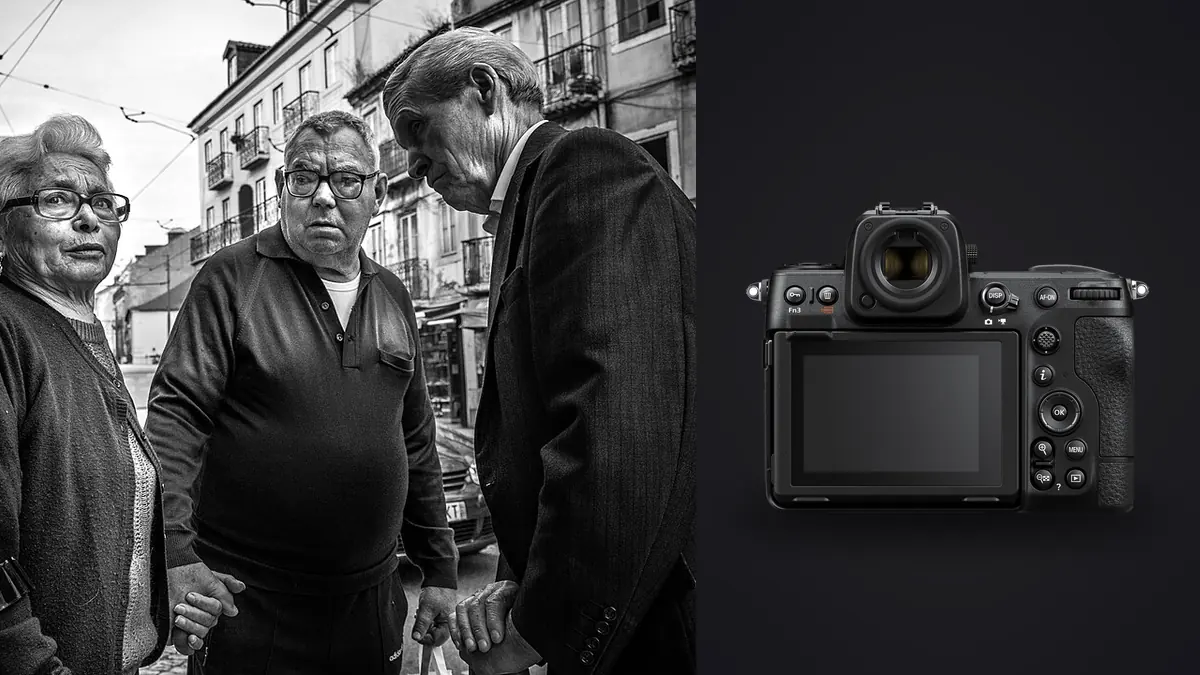
I carried a Z8 through six weeks of a documentary project last year, mostly on foot, mostly in places where a big camera makes people change how they act. It replaced a pair of Fuji bodies I'd used for the previous project, and the switch wasn't about specs on paper. It was about whether the camera disappeared in my hands fast enough to keep shooting when a moment lasted two seconds instead of twenty. This is what actually mattered, and what didn't, after using it on real assignments rather than a weekend test walk.
The size question, honestly answered
The Z8 is not a small camera. Body only, it sits around 910 grams with a battery and card in it, which is roughly 150 grams heavier than a Z6III and about 400 grams lighter than a Z9. On a neck strap after eight hours of walking, that difference is not trivial. I felt it in my shoulders by the third week, in a way I never did with a Fuji X-T body.
But weight alone isn't the whole story for street work. The Z8's grip is deep enough that a 35mm or 50mm prime balances well one-handed, which matters when you're holding a coffee, opening a door, or bracing against a subway pole with the other hand. A Z9 with the same lens is nose-heavy and awkward one-handed. A Z6III is lighter but the smaller grip means my pinky finger has nowhere to go, and I noticed my hand cramping on long days in a way the Z8 never caused. For documentary work where you're carrying the camera ready for eight or ten hours at a stretch, the Z8's size is a genuine compromise, not obviously wrong, not obviously right. It depends on your hands and your tolerance for neck strain.
Autofocus in situations you can't rehearse
Street and documentary subjects don't hold still, don't warn you, and don't repeat the moment. The Z8's subject detection (human, and it will lock onto a partial face turned away, a person in silhouette against a bright window, a kid running between market stalls) is the single feature that changed my keeper rate the most coming from an older camera. It picks up a person's eye through a crowd of other people with a consistency that older phase-detect systems just didn't have.
Where it struggles: fast lateral motion at close range, like a cyclist cutting across the frame at three meters, still trips it up occasionally, and it will sometimes latch onto the nearest face rather than the one you meant. 3D tracking with a half-press before the moment starts is more reliable than trusting auto-area detection to guess your intent in a crowd. I also lean on back-button AF-on with a dedicated AF-C mode assigned to a front function button, so I can flip between wide tracking and a single tight point without digging into a menu while someone's expression is about to change.
A firmware update also brought pre-release buffering to the Z8, meaning the camera can hold onto frames from just before your finger fully presses the shutter when you're in a high-speed continuous mode. I use it sparingly, mostly for handshakes, someone turning a corner, or a bird lifting off near a person's shoulder, because it does eat into buffer and battery faster than I'd like for an all-day shoot. It is not a substitute for anticipation, but it has saved a frame or two I would have otherwise missed by a fraction of a second.
Custom banks I actually use
The Z8 gives you three user banks (U1, U2, U3) plus a fourth slot on the mode dial, and I stopped treating them as a novelty once I set them up around real scenarios instead of generic "portrait" or "sports" presets. Here's what I run, adjusted after a season of shooting with them:
| Scenario | Shutter mode | Min shutter speed | Auto ISO ceiling | AF area mode | Frame rate |
|---|---|---|---|---|---|
| Bright market / daylight walking | Electronic, silent | 1/500s | 3200 | Wide-area AF (human) | Single or Low-speed C |
| Overcast street, general walking | Electronic, silent | 1/250s | 6400 | 3D-tracking | Low-speed C, 5 fps |
| Subway / transit interior | Electronic, silent | 1/160s | 12800 | Wide-area AF (human) | High-speed C, 10 fps |
| Evening event or interior gathering | Electronic front-curtain | 1/125s | 12800 | 3D-tracking | Low-speed C, 5 fps |
| Fast reportage (parade, protest, rally) | Electronic, silent | 1/1000s | 6400 | Auto-area AF (human) | High-speed C+, 20 fps |
The minimum shutter speeds look conservative for a stabilized body, and they are, but I'd rather hand-hold a slightly higher ISO than lose a decisive moment to a blurred hand or foot mid-stride. The subway bank in particular took some trial and error. Fluorescent and LED lighting underground flickers in ways that can band your frames at certain shutter speeds even with the flicker reduction setting on, so I settled on 1/160s as a speed that mostly sidesteps it on the systems I've shot in.
The shutter, and why it's quieter than people expect
Like the Z9, the Z8 has no mechanical shutter at all, front or rear curtain. Everything is electronic. In silent mode there is genuinely zero shutter sound, no clunk, no whir, nothing. For candid documentary work in a quiet room, a funeral, a courtroom hallway, a library, this matters more than almost any other spec on the camera. People who would flinch at a DSLR's mirror slap simply don't register that you took the photo.
The tradeoff is sensor readout speed, and rolling shutter, which on the Z8's stacked sensor is fast enough that I've stopped worrying about it for almost everything I shoot on the street. Panning past a moving train, following a cyclist, catching someone mid-stride, none of it shows the skewed, jello-like distortion I used to get from older electronic shutters on non-stacked sensors. I did see mild skew once, photographing a fast-spinning carousel at a fairground, but that's an edge case most documentary work won't hit.
One habit worth building: leave the camera in silent electronic shutter as your default, and only switch to electronic front-curtain for situations with visible flicker or very high shutter speeds where banding becomes a real risk. I keep front-curtain assigned to my evening bank above for exactly that reason.
Lens pairings that actually get used
I rotated through four lenses over the project and ended up leaning hard on two of them. The 35mm f/1.4 S is my default. It's not small, but the rendering at wide apertures and the focus speed on moving subjects made it worth the extra weight over the compact 40mm f/2 SE, which I initially wanted to prefer for exactly the reasons you'd expect (it's tiny, it balances the body beautifully, it's the closest thing Nikon makes to the pancake primes street shooters loved on older systems). In practice the 40mm's slower aperture cost me frames in doorways, arcades, and dim interiors where the 35mm f/1.4 kept working.
The 28mm f/2.8 SE earned a place in the bag for closer, more confrontational documentary framing, the kind where you're a couple of feet from someone and want environmental context around them without distorting faces the way a 24mm would. It's inexpensive by Z-mount standards and light enough that I sometimes carried it as a second body's lens rather than swapping. I tried a 50mm f/1.8 S for a week and mostly left it home. Great lens, wrong focal length for how close I like to work when the story is about a person rather than a scene.
What happens after the shoot
The unglamorous part of documentary work is what you do with the cards at the end of the day. A single afternoon of the fast reportage bank above, 20 fps electronic bursts on moving subjects, produces sequences of 40 to 60 nearly identical frames where only one or two actually nail the expression or the gesture. Multiply that across six weeks and you end up with tens of thousands of RAW files, most of them redundant.
This is the point where I stopped trying to cull manually in Lightroom's grid view and moved that first pass into imagic instead. It runs entirely on my laptop with no cloud upload, which matters to me on documentary work where some of the people I photograph haven't consented to their images sitting on someone else's server before I've even made an edit decision. It scores sharpness and eye focus locally and clusters those 40-shot bursts down to the two or three frames actually worth opening, which turns a three-hour first pass into something closer to forty minutes. For anyone curious about the mechanics behind that kind of automated pass, how AI photo culling actually works covers it in more depth than I will here.
The other piece I've come to rely on is imagic's apply_my_style feature, which learns from edits I've already made and applies that same look to new imports. Documentary work benefits from visual consistency across a project shot over weeks, in different light, on different days, and doing that manually per-image is exactly the kind of repetitive task I'd rather not spend an evening on after a full day of shooting. It's a one-time purchase rather than another subscription stacked on top of the ones I already pay for, which made it an easy decision when I was already justifying a new camera body that year.
Battery life and carrying strategy
CIPA rates the Z8 around 340 shots per charge with the EN-EL15c, which is a number I've never come close to hitting in real use because burst shooting and constant screen-on framing burn through it faster than the standard test cycle suggests. On a full documentary day I go through two batteries reliably, sometimes touching a third if I'm using the electronic viewfinder constantly rather than the rear screen. I carry three, charge two overnight, and treat the spare pouch as non-negotiable gear, same tier as a spare card.
Card slots are one CFexpress Type B and one UHS-II SD, and I shoot RAW to the CFexpress with the SD as an overflow rather than a backup, mostly because the write speed difference is significant once you're pushing 20 fps bursts. A slow SD card as your primary slot will bottleneck the buffer in ways that show up exactly when you can least afford it, mid-sequence on the one moment you were waiting all day for.
Frequently Asked Questions
Is the Nikon Z8 too heavy for a full day of street shooting compared to something like a Fuji X100VI?
It's genuinely heavier, and if all-day comfort is your top priority over autofocus performance and burst speed, a compact fixed-lens camera will be kinder to your shoulders. I still choose the Z8 for documentary assignments because the subject detection and buffer depth pay for the extra weight when the moment only happens once, but for pure street wandering on a day off, I often reach for something smaller.
Does the Z8's electronic shutter cause visible rolling shutter when panning with fast subjects?
Rarely, and only in genuinely extreme cases, like a very fast subject moving diagonally across the frame at close range. The stacked sensor's readout speed is fast enough that ordinary street subjects, walking pedestrians, cyclists, moving vehicles at a normal pace, show no visible skew in my experience.
What's the single best lens to start with for documentary work on the Z8?
The 35mm f/1.4 S, if you can afford it and don't mind the extra weight. It's fast enough for interiors and dusk, focuses quickly on moving people, and the focal length reads as neutral rather than stylized, which suits documentary storytelling better than a wider or more compressed field of view.
Do I need the fastest CFexpress card available, or will a mid-range one keep up?
For the high-speed reportage bank at 20 fps, a mid-range CFexpress Type B card will keep up for realistic burst lengths (a handful of seconds), but it will slow noticeably if you hold the shutter down for extended sequences. I've had good results without buying the absolute fastest card on the market, but I wouldn't go below a card rated for sustained video-capable write speeds.