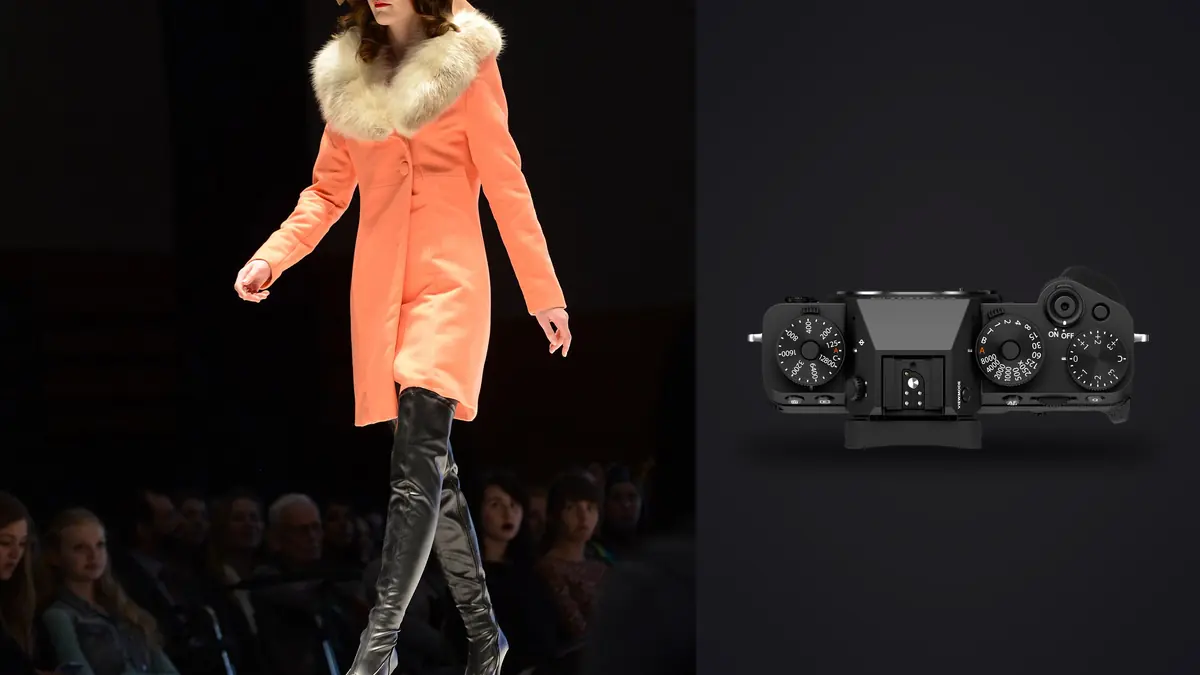
Picture a nine-piece capsule collection from a small knitwear label that needs twenty finished images turned around in five days, with no agency, no full studio crew, just you, one assistant steaming garments between looks, and a rented cyc space for a single day. That's the context for everything below. This isn't a spec sheet rewrite; it's what a day like that looks like when you point a 40-megapixel APS-C body at eight different models over nine hours and have to hand over a clean edit by Friday.
Why I picked the X-T5 for this over a full-frame body
Lookbook work isn't the same brief as an editorial spread. Clients want clean, repeatable, well-lit product-on-model shots that read consistently across a grid on a website or a PDF catalog. Resolution matters more here than in a lot of fashion photography because e-commerce teams crop hard: a full-length shot becomes a chest-up thumbnail, a detail of the stitching gets pulled from the same frame as the wide. The X-T5's 40.2-megapixel sensor gives you room to deliver both without a second lens change, which saves real time on set.
What surprised me coming from the X-T4 was how much the extra resolution changed my shooting habits. I stopped bracketing focal lengths as aggressively because I could crop a 35mm-equivalent frame down to something that reads like an 85mm portrait without visible softness at web sizes. That's not true at print sizes larger than roughly A3, so if a client tells you the lookbook is going into a large-format press kit, plan your framing tighter in camera rather than leaning on the crop.
The trade-off is buffer depth. Shooting compressed RAW at 40MP, the X-T5's buffer clears noticeably slower than the X-T4's did at 26MP, and if you're shooting mechanical shutter at 15fps to catch fabric movement on a twirl or a jump, you'll hit the buffer wall inside two seconds on a fast card and sit there waiting. I learned to shoot shorter bursts (four to six frames) and reset between attempts rather than holding the shutter down, which is a discipline change more than a gear complaint.
Lens pairings that actually earned their keep
I brought five lenses to the shoot and used three of them for 90% of the frames. Here's what did the work and what sat in the bag.
| Lens | Role on set | Aperture I shot at | Note |
|---|---|---|---|
| XF 33mm f/1.4 R LM WR | Full-length looks against the cyc | f/4 to f/5.6 | Sharp enough wide open that I didn't need to stop down for the group shots, but I did anyway for consistent depth across the line |
| XF 56mm f/1.2 R WR | Waist-up and detail crops | f/2 to f/2.8 | The rendering on skin and knit texture is the reason I still own this lens; nothing else in the kit matches it for fabric detail |
| XF 16-55mm f/2.8 R LM WR | Movement shots, wide environmental frames | f/2.8 to f/4 | Versatile but heavier on a body that's already front-loaded with a battery grip; my wrist knew it by hour six |
| XF 90mm f/2 R LM WR | Reserved for tight product close-ups (buttons, seams) | f/2.5 | Barely used; the 56mm covered most of what I thought I'd need this for |
| XF 23mm f/1.4 R | Backup wide, unused | - | Left in the bag; the 16-55 covered anything I needed wider than the 33 |
If I were packing lighter for a similar day, I'd take the 33mm, the 56mm, and skip the zoom entirely unless the brief specifically calls for environmental or lifestyle frames mixed into the lookbook, which some brands now want alongside the flat product shots.
Settings that mattered more than I expected
Shutter mode
I shot mechanical shutter for anything static and switched to electronic shutter only for burst sequences where a model was moving (walking toward camera, a hem catching air). The X-T5's rolling shutter on the electronic setting is noticeably worse than the global-shutter-adjacent performance you get on something like the X-H2S, and I saw skew on fast horizontal hand movement in maybe one frame out of every twenty bursts. Nothing that ruined a shot outright, but enough that I wouldn't trust electronic shutter for anything with genuinely fast motion, like a jump or a spin with loose fabric, without shooting extra insurance frames.
File format and card strategy
Compressed RAW, not lossless. For a lookbook that's getting retouched and delivered as JPEG or web-optimized files, the extra file size of lossless compressed RAW bought me nothing I could see in the final output, and it made the day's total take (just under 3,100 frames across nine looks) balloon past 90GB. I shot to both card slots in backup mode rather than overflow, which matters more on a same-day-turnaround job than people give it credit for. Losing a card at 4pm with a Friday deadline is not a recoverable situation.
Film simulation as a starting point, not a finish line
I'd shoot with Reala Ace baked into the RAW preview because it gives anyone watching the tethered laptop something closer to final color to look at during the shoot, which keeps approvals moving. But film simulations are a look on top of the RAW data, not a substitute for a real edit pass, and the moment you're retouching skin, correcting garment color to match the actual product (a common ask when the dye lot in person doesn't match how it photographs), and matching exposure across nine different looks shot under slightly shifting studio light, you need a consistent, repeatable edit applied across the whole set. That's the part of the day the camera itself has no opinion about.
The part nobody warns you about: the take pile
Nine looks, roughly 340 frames per look once you count wardrobe adjustments and pose variations, and by the end of the day I had just over 3,000 RAW files to get through before I could even start retouching. This is the actual bottleneck on lookbook work, more than lens choice or sensor resolution. You're not short on good frames, you're drowning in near-duplicates: the same pose shot four times because the model blinked, or the fabric wasn't sitting right, or the assistant's steam wand left a visible shine on the jacket sleeve in three out of five otherwise-identical frames.
This is where I've leaned on imagic for the last several jobs. It runs the sharpness and focus scoring locally on the machine, which matters because a lot of the misses on a lookbook shoot aren't obviously bad, they're a hair soft on the eyes at f/2 with the 56mm, and squinting at a laptop screen at 1pm on day two of editing is a bad way to catch that consistently. The duplicate and burst clustering is the bigger time saver though: it groups those four-frame bursts of the same pose together instead of making me scroll past near-identical thumbnails one at a time, which on a 3,000-frame day is the difference between a two-hour cull and a six-hour one.
The other piece that's specific to fashion work is the apply_my_style preset. Once the first two looks are graded the way the brief calls for (slightly warm, contrast pulled up a touch on the knitwear to keep texture visible), train a preset on those edits and run it across the remaining picks rather than starting each look's grade from scratch. It's trained on your own edit history, not a generic filter, so it holds onto the specific adjustments you've made rather than flattening everything toward some average look. Worth saying too: everything processes offline, no cloud upload, which matters when a collection isn't public yet and the brand is nervous about pre-release images sitting on someone else's server.
If you're new to culling workflow generally rather than just this camera, it's worth reading through how AI photo culling actually works before you're standing in front of a few thousand frames trying to figure out a system on the fly. And if speed on delivery day is the actual constraint (it usually is, on lookbook turnarounds), a faster end-to-end workflow is worth more than any single piece of gear.
What I'd do differently next time
Two things. First, I'd shoot a tighter, more deliberate frame count per pose rather than defaulting to bursts out of habit. The X-T5's buffer punishes trigger-happy shooting at 40MP, and honestly the hit rate on a deliberate three-frame sequence (breathe, shoot, check the back of the camera) was just as good as the sloppy fifteen-frame bursts I fell into by hour four when I was tired.
Second, I'd get sign-off on crop ratios before the shoot, not after. Because the sensor gives you enough resolution to crop aggressively in post, it's tempting to shoot loose and decide the framing later. That's fine until the client wants a specific 4:5 grid for their site and half your "hero" frames were composed for a wider aspect ratio. It's easy to end up recomposing six shots in the edit that would've taken thirty seconds each on set if you'd known the target crop going in.
The battery grip is worth the extra weight, for what it's worth. I went through two batteries across the day with a mix of tethered shooting and screen chimping between setups, and having the second battery hot-swap without a lens cap juggling act kept the day moving. If you're shooting untethered and checking the rear screen less, you might stretch one battery further, but I wouldn't bet a whole shoot on it.
Frequently Asked Questions
Is 40 megapixels actually necessary for a lookbook that only ends up on a website?
Not strictly, but it buys you flexibility you'll use more than you expect. Web delivery might only need 2,000 pixels on the long edge, but shooting at full resolution means you can pull tight crops for social or secondary catalog use from the same frame instead of reshooting. On this job it saved me from having to set up a separate detail-shot pass for three of the garments.
Should I shoot mechanical or electronic shutter for movement shots in a lookbook?
Mechanical for anything with real speed to it. The X-T5's electronic shutter rolling artifacts show up on fast hand or fabric movement often enough that I don't trust it for hero shots, only for burst safety nets where I'm also grabbing mechanical frames of the same pose.
How many keeper frames should I expect to walk away with per look?
Picture a shoot that delivers two to three finished frames per look out of roughly 340 raw captures, which is a fairly typical ratio for lookbook work once you account for wardrobe resets, pose testing, and lighting checks mixed into the count. The real number that matters for planning your day is shots-per-hour, and a realistic average is about 340 to 400 frames per look including all the misses, spread across roughly 50 minutes per garment change.
Does the smaller APS-C sensor limit how shallow I can get the background for a clean product-focused look?
A little, but for lookbook work that's usually an advantage rather than a limitation. Clients generally want the garment in focus edge to edge, not a shallow-depth editorial look, so the APS-C crop factor working against extreme background blur was rarely something I fought against. The 56mm f/1.2 at f/2 gave plenty of separation when a shot did call for it.