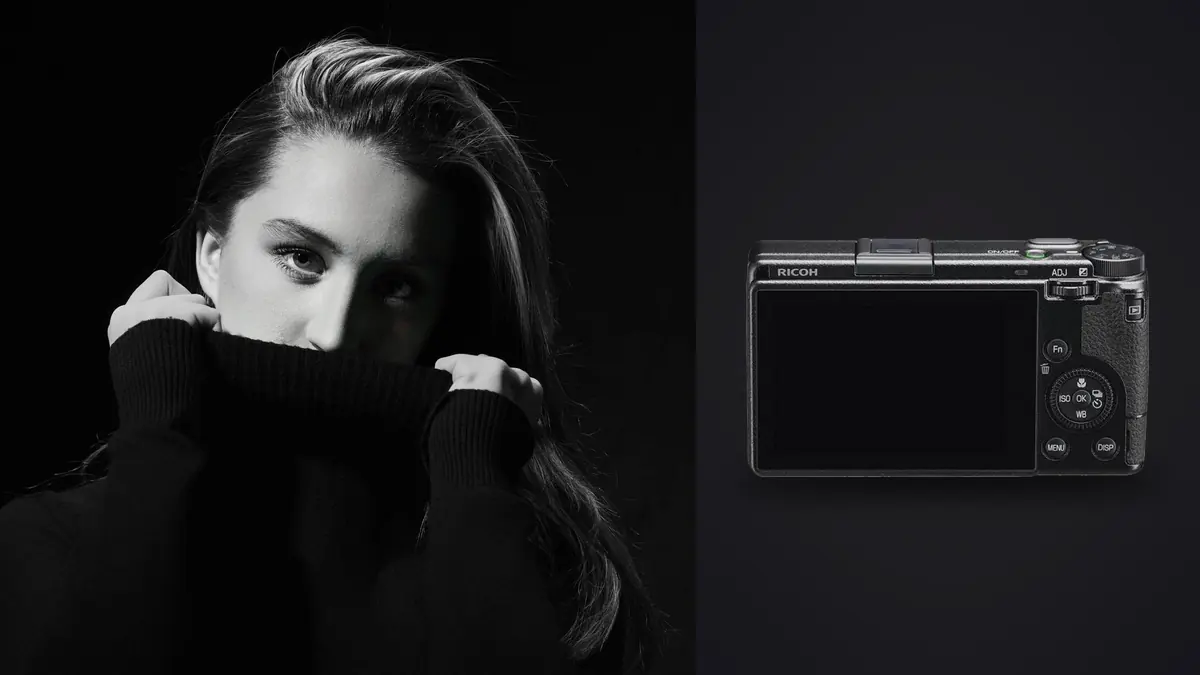
I picked up a Ricoh GR IIIx about a year into shooting boudoir portraits, mostly out of frustration. My usual kit for that work was a mirrorless body with an 85mm lens, and while the images were fine, the camera itself was a problem. It's a big black block with a long barrel pointed at someone who's already nervous about being photographed in their bedroom or a hotel room in their underwear. Swapping in something the size of a thick smartphone changed the room. That's really the whole reason this camera earned a permanent spot in my bag for this genre, and it's worth explaining in detail, because the GR IIIx is also genuinely limiting in ways that matter for this kind of work.
Why a Small, Quiet Camera Changes the Room
Boudoir and intimate portrait sessions live or die on how comfortable the subject feels, and camera size does more to that comfort level than most photographers give it credit for. A DSLR with a battery grip and a long lens reads as "professional shoot," which sounds good on paper but in practice puts people on edge. They tense their shoulders, they suck in, they start performing instead of relaxing. The GR IIIx disappears into my hand. Subjects can ask mid-session where the camera went, because it's been lowered to your side between frames and it's small enough not to register as a threat.
The leaf shutter helps too. It's not silent, but it's a soft click rather than the mechanical slap of a DSLR mirror, and in a quiet bedroom with music playing low, it barely registers. There's also a fully silent electronic shutter mode buried in the settings, which I use for the moments right after I've asked someone to just breathe and settle, when I don't want a shutter sound to snap them back into self-consciousness. None of this shows up in a spec sheet comparison, but it's the actual reason the camera works for this genre.
The 40mm Problem: Room Size Fights You
Here's the trade-off nobody mentions when they recommend the GR IIIx for portraits. The 40mm equivalent focal length (26.1mm on the APS-C sensor) is genuinely nice for headshots and half-body work because it doesn't distort features the way a 28mm wide angle does up close. But boudoir sessions happen in bedrooms, and bedrooms are small. To get a full-body composition at 40mm you need real distance from your subject, often six to eight feet minimum depending on how loose you want the frame, and a lot of the hotel rooms and apartment bedrooms I've shot in simply don't offer that much backing space before you hit a wall or a dresser.
I've solved this three ways, none of them perfect. First, I shoot a lot more from doorways and hallway thresholds than I used to, using the extra depth those spaces give me. Second, I lean on the in-camera crop modes (the GR IIIx offers 50mm and 71mm equivalent crop options) for tighter details, hands, collarbones, the line of a leg, where I'm close anyway and the crop just tightens what I'm already composing. Third, I've accepted that some rooms simply call for a different lens, and on those days I bring a second body. If you're buying a GR IIIx specifically for this work and you regularly shoot in small rooms, know that going in. The standard GR III at 28mm gives you more working room but flattens faces less flatteringly up close.
Working the Available Light You're Actually Given
Almost nobody wants a flash for boudoir. The whole point of the genre is soft, ambient, believable light, whether that's a window with sheer curtains, a bedside lamp, or string lights on a headboard. The GR IIIx has a maximum aperture of f/2.8, which is not fast by prime lens standards, and it doesn't have a huge sensor advantage to compensate. In practice this means I'm shooting at ISO 1600 to 6400 more often than I'd like, especially for evening sessions lit only by lamps.
The in-body shake reduction genuinely helps here. I can hand-hold down to around 1/15s reliably for static poses, which buys a stop or two of ISO headroom I wouldn't get on an unstabilized compact. It does nothing for subject movement, though, and boudoir involves a lot of small movement (breathing, shifting weight, hair falling) so I still end up pushing ISO higher than the shutter speed math alone would suggest, just to freeze that motion. Custom white balance matters more here than on almost any other camera I own, because warm lamp light and cool window light mixing in the same frame will wreck skin tones if you leave it on auto. I set a manual Kelvin value at the start of every session and adjust it as the light in the room shifts.
The HDF Version, and Whether It's Worth It
Ricoh released a variant of the GR IIIx called the HDF (Highlight Diffusion Filter), which has a permanently mounted optical diffusion element sitting in front of the lens. It's built specifically to soften highlights and add a gentle glow, and it was marketed with portrait and lifestyle shooters in mind, boudoir being an obvious use case. I've used both bodies extensively and my honest take is that it's a nice effect but not one I'd want baked in permanently. The diffusion can't be turned off. Every frame gets it, whether you're photographing soft window light on skin (where it looks lovely) or a detail shot where you actually want crisp texture (where it just looks soft in a way you can't undo).
My workaround has been running two bodies, a standard GR IIIx for anything needing sharp detail and the HDF for the wide, romantic, hazy shots that open or close a gallery. That's an expensive answer and not one every photographer needs. If your style leans consistently soft and filmic across an entire shoot, the HDF alone might suit you fine. If you want the option to go both ways within one session, buy the standard body and add the look in post instead, where it's reversible.
| Setup | Effective focal length | Closest working distance for full body in a small room | Best use in a boudoir session | Low light behavior |
|---|---|---|---|---|
| GR IIIx (standard) | 40mm equiv. | ~7-8 ft | Half-body, seated poses, detail crops via digital tele | Usable to ISO 3200 handheld with SR on; noise gets aggressive past that |
| GR IIIx HDF | 40mm equiv. | ~7-8 ft | Wide romantic frames, window-light silhouettes, opening gallery images | Diffusion softens shadow detail further, so push ISO more conservatively |
| GR III (28mm) | 28mm equiv. | ~4-5 ft | Tight rooms, environmental context, full body in small hotel spaces | Same sensor and SR system, slightly wider light gathering per pixel at edges |
Autofocus, Snap Focus, and the Half-Second You Get
The hybrid autofocus on the GR IIIx is a real improvement over the earlier GR III's contrast-only system, but I still wouldn't call it fast in dim rooms. When the light drops to lamp-only levels, the lens hunts, and boudoir is exactly the kind of shoot where you can't afford to miss the two seconds a subject's expression actually reads as genuine. My fix has been leaning hard on Snap Focus, which lets you lock the lens to a preset distance (I usually set mine to 1.5 or 2 meters depending on the room) and skip autofocus hunting entirely for candid or fast-moving moments. It's not precise focus, it's zone focus, but for a genre where the emotional read matters more than pixel-level sharpness on the eyelashes, it's saved me more usable frames than autofocus has.
Because I'm shooting a lot of continuous small movements rather than posed-and-hold portraits, I come home from a two-hour session with anywhere from 400 to 700 frames, a big chunk of them near-duplicates from the same three seconds of a shifting pose. Sorting that by eye used to eat a full evening. I run everything through imagic now, which scores sharpness locally on the actual focus point rather than just flagging blur, and clusters the burst sequences so I'm choosing between five grouped near-duplicates instead of scrolling past all five individually. For a genre where half your keepers come down to which frame caught the more relaxed shoulder or softer smile, that grouping view actually speeds up the creative decision, not just the technical one. If you want the mechanics behind how that kind of scoring actually works, how AI photo culling works covers it in more depth than I will here.
Getting the Files Home Without Handing Them to a Cloud
This is the part of the workflow conversation that matters most for this specific genre and gets skipped in most gear reviews. Boudoir images are private in a way that a landscape or even a standard portrait isn't, and clients ask, reasonably, where their photos are going during editing. It's worth skipping any culling tool that uploads to a server the moment you start shooting this work, because "your images went through our cloud processing pipeline" is not something you want to explain to a client who trusted you with a bedroom session. Everything I import off the GR IIIx's SD card goes through imagic entirely on my own machine, no upload step, which is a straightforward thing to tell a client and an even easier thing to actually stand behind.
On the editing side, I built out a preset in imagic's apply_my_style feature using a batch of my own previously graded boudoir edits, warm shadows, slightly lifted blacks, skin tones pulled a touch toward peach rather than the yellow the GR IIIx's JPEG engine defaults to. Running new sessions through that trained preset gets me about 80% of the way to a finished look before I touch anything by hand, which matters when you're delivering fifty to eighty final images per client and can't spend twenty minutes per photo matching a look from memory. The rest of that turnaround comes down to general workflow discipline more than any one tool, and 10 tips for a faster photo workflow covers habits that pair well with a trained preset like this one.
What I'd Tell Someone Buying One for This Work
Buy at least two spare batteries. The DB-110 is rated around 200 shots and a real session with review breaks and client conversation will drain it faster than that number suggests, especially in colder rooms. Skip the optional external viewfinder unless you shoot outdoors a lot for this genre; for indoor bedroom work the rear screen is fine and the finder just adds bulk to the thing that's supposed to stay small. Don't count on weather sealing protecting you from lotion, oil, or hairspray drift in the air during a styled shoot; the GR IIIx isn't sealed at all and I keep a microfiber cloth in my pocket for exactly this reason. And decide on the 28mm-versus-40mm question before you buy, based on the actual rooms you shoot in most often, because that's the one variable you can't fix later without buying a second body.
Frequently Asked Questions
Is the GR IIIx too wide for close-up boudoir detail shots?
Not really, since 40mm equivalent is closer to a natural viewing angle than a wide lens, and the camera's macro mode focuses close enough for hands, jewelry, or fabric texture without noticeable distortion. The bigger constraint is full-body framing in small rooms, not close detail work.
Does the HDF version make the standard GR IIIx unnecessary for this genre?
No, and I'd argue the opposite for most working photographers. The HDF's diffusion effect is permanent and can't be dialed back per shot, which is limiting when a single session calls for both soft romantic frames and crisp detail crops. The standard body plus a diffusion effect added selectively in editing gives you more control.
Can I use flash with the GR IIIx during a boudoir session?
You can, the hot shoe supports external flash and there's a built-in pop-up flash too, but most boudoir work leans on continuous ambient light specifically because flash tends to flatten the mood and read as clinical. I keep a small continuous LED panel in my bag for rooms with genuinely insufficient light rather than reaching for flash.
How many images should I expect to shoot in a typical session, and how long does culling take?
A two-hour session with wardrobe or pose changes typically produces 400 to 700 frames on this camera given how many near-identical shots you take chasing a natural expression. Culling that by hand used to take an evening; running it through imagic's local sharpness scoring and burst grouping usually gets me to a shortlist in under an hour.