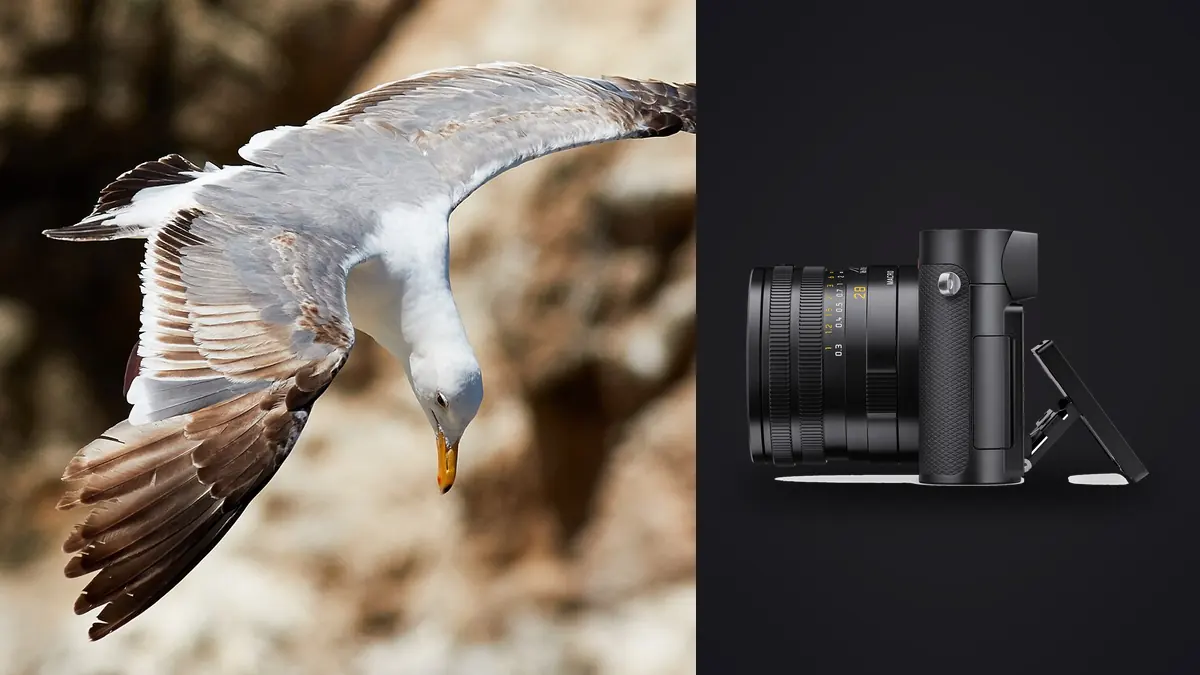
A friend sent me a photo of a common tern folding its wings mid-dive, shot on a Leica Q3, and I did a double take. Not because the shot was spectacular (it was decent, nothing a birder with a 500mm couldn't match on a slow afternoon), but because of what took it. The Q3 has one lens. No zoom ring, no mount, no swapping to something longer when a bird refuses to cooperate. Pointing a fixed 28mm at something thirty meters offshore and expecting a keeper sounds like a setup for disappointment, and for most birding-in-flight work, it is exactly that. But the camera has spent more days in my bag this year than I expected going in, and the reasons are worth laying out honestly, because most of what gets written about the Q3 and wildlife either oversells it as a stealth superzoom or writes it off completely as a street camera with no business near a bird.
The lens is the whole story, and it wasn't built for this
Everything about how the Q3 handles birds in flight traces back to one decision Leica made years before this body existed: the Summilux 28mm f/1.7 ASPH is permanently attached. There is no telephoto version of this camera. At 28mm, a gull at thirty meters occupies a sliver of the frame, maybe two or three percent of the image height. Put that same gull in front of a 500mm lens at the same distance and it fills most of the frame with room to spare for wing detail and eye contact. That gap doesn't close with better glass or a faster sensor. It's geometry, and no amount of Leica engineering changes the fact that 28mm is a wide-angle focal length built for context, not reach.
I say this up front because it's the single most important thing to understand before spending real money expecting this camera to do wildlife-lens work. If your subject is a peregrine stooping at four hundred feet, or an osprey fishing a lake from a hundred meters out, the Q3 will not get you a usable frame no matter how good the autofocus is. What it can do, and does surprisingly well, is close-range work where the bird is already near you, plus a kind of environmental bird photography that a long lens physically can't produce because it's cropping the world down to nothing but the subject.
What the digital crop modes actually buy you
Leica leans on the 60.3-megapixel sensor to offer in-camera crops at 35mm, 50mm, 75mm and 90mm equivalent framing, and it's worth being clear-eyed about what these are. They're not optical zoom. They're the same math you'd do yourself cropping a full-resolution RAW file in Lightroom after the fact, just previewed live in the viewfinder so you can compose before you shoot rather than guess and crop later.
| Framing mode | Effective resolution | Realistic use in the field |
|---|---|---|
| 28mm (native) | 60.3MP | Full habitat context, bird as one element in a wider scene |
| 35mm crop | ~39MP | Loose environmental shot, a heron on a post with the shoreline still visible |
| 50mm crop | ~19MP | A gull or gannet close enough to occupy a third of the frame |
| 75mm crop | ~8MP | Nesting-cliff birds at close range; fine for web, tight for large prints |
| 90mm crop | ~6MP | The tightest option the camera offers; usable, but you're spending resolution fast |
The honest way to read that table is that even the maximum crop only gets you to 90mm equivalent, which is still a short portrait lens by wildlife standards, and it costs you almost 90 percent of your resolution to get there. A photographer used to a 400mm or 600mm prime is going to find the Q3's "reach" laughably short by comparison. Where it earns its keep is when the bird is already close enough that 90mm is plenty, which happens more often than you'd think at seabird colonies, feeding stations, and falconry displays.
The autofocus is legitimately good. The frame rate is where it gets complicated
This is the part that actually changed my opinion of the camera. Earlier Q-series bodies relied on contrast-detection autofocus, which hunts visibly on anything moving fast against a busy background, sky included. The Q3 added phase-detection to the mix alongside depth-from-defocus processing, and Leica also built in subject recognition that covers people and animals, birds among them. In practice, when a gull is moving predictably across a clean sky, the camera locks onto it and holds focus in a way the Q2 simply couldn't.
The catch is frame rate, and it's a real one, not a footnote. Run the shutter in continuous autofocus, the mode you actually need for a bird changing direction mid-flight, and the top speed drops to around 4 frames per second. The 15fps burst that Leica advertises only applies when focus is locked ahead of time rather than tracked, and that top-speed burst also shoots 12-bit RAW instead of 14-bit, a tradeoff most people shooting birds won't notice in the field but is worth knowing about if you print big.
| Burst mode | Frame rate | Autofocus behavior | Raw bit depth | When I reach for it |
|---|---|---|---|---|
| Single AF, mechanical shutter | ~10fps | Locks before the first frame | 14-bit | A heron about to launch from a known perch distance |
| Single AF, electronic shutter | 15fps | Locked, not tracking | 12-bit | Pre-focused on a set patch of water where terns are diving |
| Continuous AF (AF-C) | ~4fps | Tracks the subject, including animal recognition | 14-bit | Anything unpredictable: a gull banking, a raptor changing line |
Four frames a second sounds slow next to the 20-30fps a dedicated wildlife body offers, and it is. But it's not nothing either. A wing-beat cycle on most gulls and terns takes roughly a third to half a second, so 4fps still gives you two or three distinct wing positions across a beat, which is often enough to land on one with the wings in a clean, readable shape. What you lose is the ability to burst through an entire unpredictable maneuver and cherry-pick afterward the way you would with a sports body. You need to time your trigger pull more deliberately, which, honestly, isn't the worst discipline to build.
Where this combination actually earns its keep
Once you accept the reach limitation, a specific set of scenarios opens up where the Q3 stops being a compromise and starts being a genuinely good tool:
- Seabird colonies where nesting cliffs put gannets or kittiwakes within ten to fifteen meters of a viewing path
- Gulls trailing a small fishing boat at close range, where a long lens is actually harder to swing and track than a compact body
- Falconry displays and raptor centers, where birds fly set routes at close, repeatable distances
- Garden or reserve feeding stations, where tits and finches make short predictable hops between perches
- Urban peregrines on buildings you can get reasonably close to, where the wide end also captures the architecture as context
- Geese or swans coming in to land on a lake close to a hide, a moment that's more about the whole scene than a tight portrait
That last point matters more than it sounds. A 600mm lens isolates a bird from everything around it by design. The Q3, even in its 90mm crop, keeps enough environment in frame that you get storytelling images: the bird, the water, the light, the other birds reacting. I've had more editors interested in a wide gannet-dive shot with the cliff and the sea spray visible than in another tight portrait of a gannet's head, if only because the wide version says something the tight crop doesn't.
Field technique that makes the difference
A few habits changed my hit rate more than any setting did. First, for anything with a predictable flight path (terns working a patch of shallow water, gulls circling a chum line), I switch to single-AF at 15fps and pre-focus on the spot where I expect the bird to cross, rather than trying to track it continuously. It's zone focusing, basically, and it works better with this camera than fighting AF-C for a faster burst that isn't actually available anyway.
Second, shutter speed does more work than anything else to freeze a wingtip. I don't go below 1/2000s for anything actively flying, and I'll push higher into good light. The lens has optical stabilization, which helps with camera shake, but it does nothing for subject motion, so don't expect it to bail you out on a slow shutter with a fast-moving bird.
Third, the IP52 weather sealing is real but limited. It shrugs off drizzle, dust, and the occasional wave of sea spray at a coastal colony, which covers most of the situations birders actually shoot in. It is not rated for a genuine downpour, and I wipe salt spray off the body and lens front after any session near the water rather than letting it sit. Fourth, bright sky backgrounds behind a flying bird will fool average metering into underexposing the bird itself, so I dial in positive exposure compensation, usually a stop to a stop and a third, and check the histogram rather than trusting the preview on a sunny day.
The cull problem this creates, and how I actually deal with it
Even at a modest 4fps, ten seconds of tracking a diving gannet is forty frames. Most of them are near duplicates of each other. A handful are soft because the AF hunted briefly as the bird crossed in front of the cliff face. Multiply that across a weekend at a colony and you're looking at thousands of frames where maybe two or three hundred are actually worth a second look, and picking those out by eye at 100% zoom, frame by frame, is where a lot of my evening used to go.
This is the part of the workflow where imagic has actually changed how I shoot, not just how I edit. It runs entirely on the laptop, no upload required, which matters at an exposed coastal site where there's often no signal anyway. It groups the near-identical frames from a dive sequence into clusters automatically, and inside each cluster it scores actual sharpness, not just exposure or composition, so I can go straight to the frame where the eye and the leading wing edge are genuinely in focus instead of the one that merely looks sharp on a small screen. Once I've settled on keepers across a few days of shooting, I lean on the apply_my_style preset, trained on my own past edits rather than a generic bird-photography look, to bring a consistent grade across the whole set without rebuilding it from scratch each trip. If you haven't looked at how that kind of automated culling actually decides what's sharp versus what isn't, the mechanics are worth a read at how AI photo culling works, and if burst-heavy shooting in general is slowing your evenings down, there's more on tightening that loop at 10 tips for a faster photo workflow.
What I'd reach for instead if birds were the whole assignment
I want to be straightforward about this rather than talk the camera up past what it is. If birds in flight are the primary subject of a trip, a dedicated wildlife body paired with a 400mm or 600mm lens will out-resolve, out-reach, and out-frame-rate the Q3 in every meaningful way. That's not a controversial statement, it's just physics and buffer depth. The Q3 was never designed to compete there and Leica has never marketed it that way either.
Where it fits is as a second body, one I carry because I'm already carrying it for everything else that trip (street work, landscapes, quick portraits) and it happens to have autofocus good enough and a sensor high-resolution enough to come home with usable bird images when the opportunity is close. Treating it as a dedicated birding tool sets you up to be disappointed. Treating it as a capable generalist that occasionally nails a bird shot you weren't specifically set up for is a much more honest way to own one.
Frequently Asked Questions
Can the Leica Q3's autofocus actually track a bird in flight?
Yes, within limits. The phase-detection system with animal subject recognition holds focus on a bird moving against clean backgrounds noticeably better than earlier Q-series contrast-only autofocus did. The constraint isn't tracking accuracy, it's frame rate: continuous AF caps out around 4fps, which is enough to catch distinct wing positions but far short of what a dedicated sports or wildlife body offers for unpredictable maneuvers.
Do the digital crop modes give you real extra reach for distant birds?
No, and this trips people up. The 35/50/75/90mm crops are the same operation as cropping a full-resolution RAW file after the shot, just previewed live. The 90mm crop, the tightest available, drops you to roughly 6 megapixels. You're trading resolution for framing convenience, not gaining actual telephoto magnification.
Is the Leica Q3 weather-sealed enough to shoot near water or in rain?
It carries an IP52 rating, which handles dust and light drizzle comfortably, including the spray you'll pick up at a coastal seabird colony. It is not built for a sustained downpour. Wiping salt spray off the body and lens front after a session near the ocean is worth the thirty seconds it takes.
What's a realistic use case for the Q3 in bird photography, if not distant flight shots?
Close-range work is where it delivers: seabird colonies with cliffside access, falconry displays, feeding stations, and urban peregrines you can approach reasonably close. It also produces a style of wide, environmental bird photograph that a long telephoto physically can't, since it keeps the habitat and context in frame rather than isolating the subject completely.