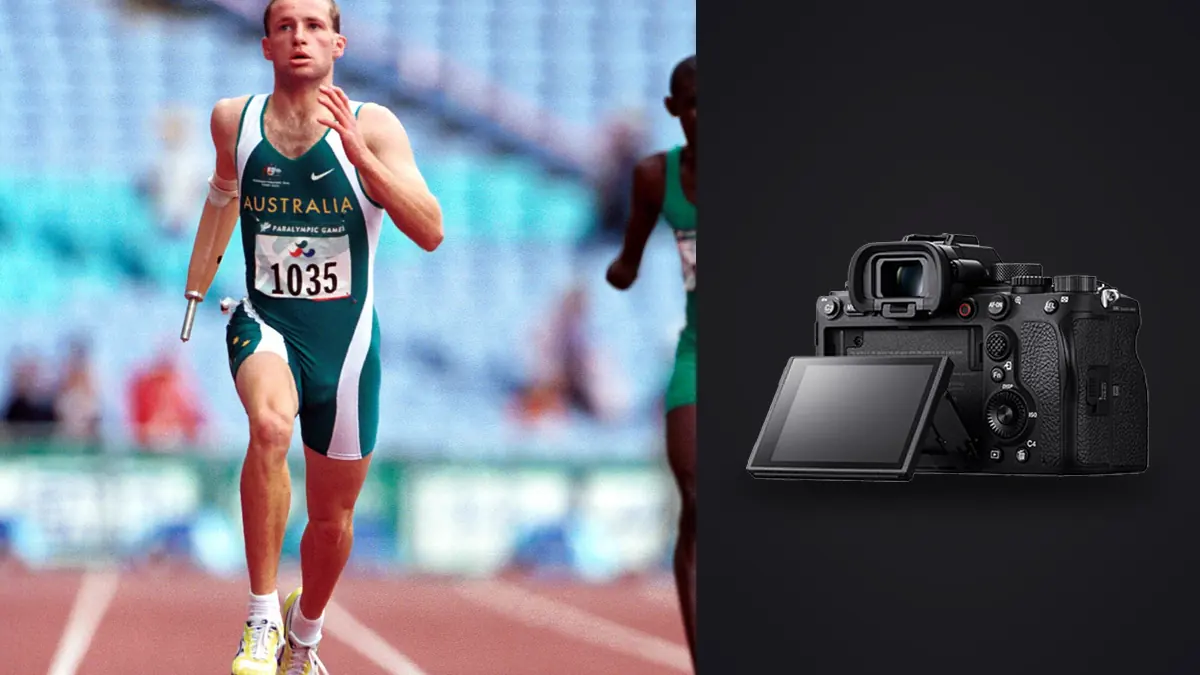
Track and field is a strange sport to shoot because it isn't one sport, it's about a dozen of them happening on the same afternoon. A 400m runner coming off the final bend has almost nothing in common, technically, with a pole vaulter at the top of an arc or a shot putter mid-spin. I've been shooting high school and club-level meets with a Sony A1 for a bit over a year now, after moving off a pair of A9 bodies, and the honest takeaway is that the camera solves the parts of this sport that used to cost you frames, but it creates a new problem that nobody warns you about: what to do with 4,000 images from a single meet.
This isn't a spec sheet regurgitation. I want to walk through how the A1 actually behaves at a track meet, which lenses earn their keep, where the buffer and card choice bite you, and what my actual AF settings look like event by event. Then I want to talk about the unglamorous back half of the job, because that's where most of the time actually goes.
Why the Sensor and Shutter Combination Matters More Than the Megapixels
Everyone talks about the A1's 50.1 megapixel count like it's the headline feature for sports, and for track it's almost beside the point. What matters is that it's a stacked sensor with a fast enough readout that rolling shutter distortion, the thing that used to bend sprinters' legs and warp discs mid-flight on earlier mirrorless bodies, is a non-issue in practice. I've shot discus and hammer throw with the fully electronic shutter at 30fps and gone back through frames specifically looking for skew on the implement. It isn't there in any way that matters for a print or a web gallery.
That electronic shutter also means silence, which sounds like a nice-to-have until you're shooting a 100m final from the infield eight feet from the lane and a mechanical shutter slapping away at 20fps would be audible on the finish line broadcast mic. Meet officials notice. I've had a starter ask me to move because my old A9 was loud enough to be a distraction during a false-start review. That conversation doesn't happen anymore.
Where the shutter speed actually costs you something is flash sync, which caps out well below what a mechanical shutter offers, but track and field is a daylight and stadium-lighting sport almost across the board, so this rarely bites unless you're doing studio-style portraits of athletes afterward.
Setting Up Differently for Sprints, Distance, and the Field
Sprints and hurdles
For the 100m and 110m hurdles I sit low, often on a bean bag or a monopod kept short, and shoot from lane level rather than a raised photo position when I can get access. Shutter speed lives at 1/2000s or faster for anything under 200m because limbs move faster than the torso and you want them frozen too, not just sharp on the body. I run continuous AF with a narrow Zone or Spot tracking box locked to the torso, not the face, because at these speeds the face is turned or blurred with motion half the time anyway and torso tracking is more forgiving when a runner's head snaps during a stride.
Distance events
800m and up, I actually drop the shutter speed intentionally on some frames, down around 1/500s to 1/800s, because at that pace a fully frozen frame reads as static and a bit dead. A touch of motion blur in the trailing leg sells pace better than a technically sharper frame does. This is one of those calls that's more art direction than camera setting, and the A1's tracking holds up fine even when you're not chasing maximum shutter speed.
Field events
Long jump and triple jump reward pre-focusing on the board and letting Zone AF pick up the athlete as they enter the frame rather than trying to track them the whole runway. Pole vault is the hardest event on the infield because the subject moves vertically fast right at the point of peak interest, and I've found Wide-area tracking with human pose priority does better here than a tight Spot box, which tends to lose the athlete against the bar or the sky right when it matters. Throws (shot, discus, javelin, hammer) are mostly about anticipating the release point and firing a short burst rather than holding the trigger the whole windup, partly to save buffer and partly because a 30fps burst through an entire hammer spin is fifteen near-identical frames you'll never use.
Lens Pairings That Actually Get Used at a Meet
I own more glass than I need, like most people do, but at a track meet the rotation narrows fast. Here's what I actually reach for and when, based on shooting from a standard infield photo position rather than a media tribune with a fixed long lens setup.
| Lens | Best for at a track meet | Typical aperture used | Honest downside |
|---|---|---|---|
| Sony 400mm f/2.8 GM | Straightaway sprints, finish line from outside the fence | f/2.8 to f/4 | Heavy for a full day handheld, needs a monopod by hour three |
| Sony 300mm f/2.8 GM | Field events, distance runners on the back straight | f/2.8 | Still pricey, and 300mm is short for a far backstretch |
| 70-200mm f/2.8 GM II | Long jump, high jump, javelin runup, anything close to the infield rail | f/2.8 to f/4 | Too short for a start line shot from the far side of the track |
| 200-600mm f/5.6-6.3 G | Any event when you're stuck in the stands, not on the infield | f/6.3 wide open | Slower glass hurts in a dim stadium under lights |
| 2x teleconverter on the 300mm | Reaching a far lane on a wide track without buying longer glass | f/5.6 effective | AF speed drops noticeably, I only use it in bright sun |
If I had to keep one lens for a whole outdoor season, it's the 300mm f/2.8. It covers most field events from the infield and reaches far enough down a straight to be useful for sprints without the bulk of the 400mm. The 70-200 comes out for anything happening close, which at a lot of smaller meets is more often than you'd think, since infield access at high school and club level is usually looser than at a sanctioned championship.
Buffer, Cards, and the 30fps Reality Check
30fps sounds great until you actually do the math on a hurdles race. A men's 110m hurdles final runs somewhere around 13 to 15 seconds at a competitive level. Hold the shutter the whole time at full burst and you've generated over 400 frames of one race. The A1's buffer with compressed RAW handles a burst like that without choking if you're on a fast CFexpress Type A card, but the moment you're on SD UHS-II in the second slot as backup, you'll feel the buffer clear noticeably slower, and if you fire another long burst before it's flushed, the frame rate throttles. I run CFexpress Type A in slot one for anything I'm actively shooting and SD in slot two purely as a simultaneous backup, accepting that slot two is the bottleneck if I lean on it too hard. The Type A cards are genuinely expensive relative to CFexpress Type B or SD, and that cost is a real factor if you're outfitting more than one body, but for a camera capable of 30fps at full resolution there isn't really a way around it if you want the buffer to keep up with what the sensor can do.
Practically, I've stopped holding the shutter for entire races. I burst in two or three second windows around the moments that actually matter (the start, the midpoint, the finish) rather than one continuous 15-second spray. It protects the buffer and, more importantly, it protects me from the culling problem I'll get to in a minute.
Autofocus Settings I Actually Use
The A1's subject recognition for humans is good enough that I leave it on for essentially the entire meet, with eye and body priority rather than eye-only, because at the distances and shutter speeds involved in track, a clean eye lock is a bonus, not something to chase at the expense of missing body tracking entirely. For events with a single, isolated athlete against clean sky or track surface (pole vault, high jump), I'll tighten to a smaller Zone box because a wide tracking area starts picking up the bar, the standards, or another athlete warming up in the background. AF-C is the only mode that makes sense here, and I keep AF sensitivity (the tracking persistence setting) toward the responsive end for sprints, since you want the system to jump to a new subject fast if a hurdler clips a barrier and stumbles into another lane's space, and toward the more locked-on end for distance events where subjects don't do anything sudden and you'd rather the camera not get pulled off by a passing runner in another lane.
The Part Nobody Mentions: What Happens After the Meet
Here's the thing about a camera that shoots 30 frames a second across an eight-hour meet with a dozen concurrent events: you come home with more images than any human wants to look at one by one. A single meet for me regularly produces somewhere between 3,000 and 6,000 frames once you count every heat, every field event flight, and every warmup shot I fired off out of habit. Most of those are three or four near-duplicate frames from the same half-second burst, differing only by which one has the sharpest eye or the cleanest limb position. This is the actual bottleneck in sports photography at this volume, and it has nothing to do with the camera anymore. I switched to imagic for this stage specifically because it runs the sharpness and focus scoring locally on my laptop rather than needing anything uploaded anywhere, which matters when you're trying to turn around a gallery for a school the same evening and don't have great upload speed at a stadium. It clusters burst sequences and near-duplicates together so I'm choosing the best frame out of a stack of twelve rather than scrolling past all twelve individually, which for a 400m final shot at 30fps is the difference between a five-minute cull and a forty-minute one.
The other piece that's saved me time is the apply_my_style preset feature, since it's trained on my own past edits rather than a generic look. Track meets are shot across wildly inconsistent lighting (bright midday sun for the first heats, stadium floodlights by the evening finals) and getting a consistent color and contrast feel across a whole gallery used to mean manually matching white balance and exposure across dozens of clips of light. Running my trained preset as a starting pass gets most images to a place where only the tricky ones need manual attention.
A Quick Reference for Settings by Event Type
| Event type | Shutter speed range | AF area | Burst approach |
|---|---|---|---|
| Sprints (100m-200m) | 1/2000s-1/3200s | Zone, torso-locked | Short bursts at start and finish |
| Hurdles | 1/2500s+ | Zone, tight | Continuous through each barrier only |
| Middle/long distance | 1/500s-1/1000s | Wide tracking | Single frames or 3-4 shot bursts per lap |
| Long/triple jump | 1/2000s+ | Zone, pre-focused on board | Burst from takeoff through landing |
| High jump/pole vault | 1/1600s-1/2000s | Wide, human pose priority | Short burst at bar clearance |
| Throws | 1/2000s+ | Zone | Short burst at release only |
Is the A1 Actually the Right Camera for This, or Just a Good One?
I want to be honest that a lot of what makes track shooting work isn't unique to the A1. An A9 II or a current Canon or Nikon flagship will get you through a meet competently. What the A1 buys you specifically is resolution headroom for cropping a far-lane runner without falling apart at print size, and a burst rate that genuinely does catch the exact peak of a jump or a baton exchange more reliably than 20fps does. Whether that's worth the price gap depends on whether you're selling large prints or covering a meet for a school newsletter where a 24-megapixel file was already more than enough. If you ever want a poster-sized print of a state championship moment, the resolution is easier to justify.
Frequently Asked Questions
Do I actually need 30fps for track and field, or would a slower body be fine?
For most events, 15-20fps gets you a usable frame from any given moment. Where 30fps earns its keep is the split-second stuff: a bar clearance in high jump, a baton exchange, a photo finish. If those specific moments matter to your work, the extra frame rate is worth it. If you're mostly shooting distance events and general action for a team gallery, you can get away with less and save money on the body and the cards.
Will the buffer actually run out during a real race?
Not if you're on a fast CFexpress Type A card and you're not holding the shutter for the entire race. I've never hit a hard buffer wall shooting in short, deliberate bursts. Where people run into trouble is treating the shutter button like a machine gun for fifteen straight seconds on a hurdles final, especially with a slower SD card in the mix.
Is this camera overkill for a local high school meet?
Honestly, yes, in the sense that the meet doesn't demand it. Nobody at a Tuesday afternoon dual meet needs 50-megapixel files. But if you're building a body of work that spans small meets and bigger ones, or you shoot other sports with the same camera, it's not overkill for your business, just for that specific afternoon.
What's the actual time cost of all those extra frames after the meet?
This is the real question people don't ask before buying a high-burst-rate body. Culling 5,000 images by hand, even quickly, eats hours you didn't budget for. That's the entire reason I moved to a local culling and sharpness-scoring workflow instead of scrolling through Lightroom filmstrips one frame at a time. It's less about the camera and more about respecting your own evening.