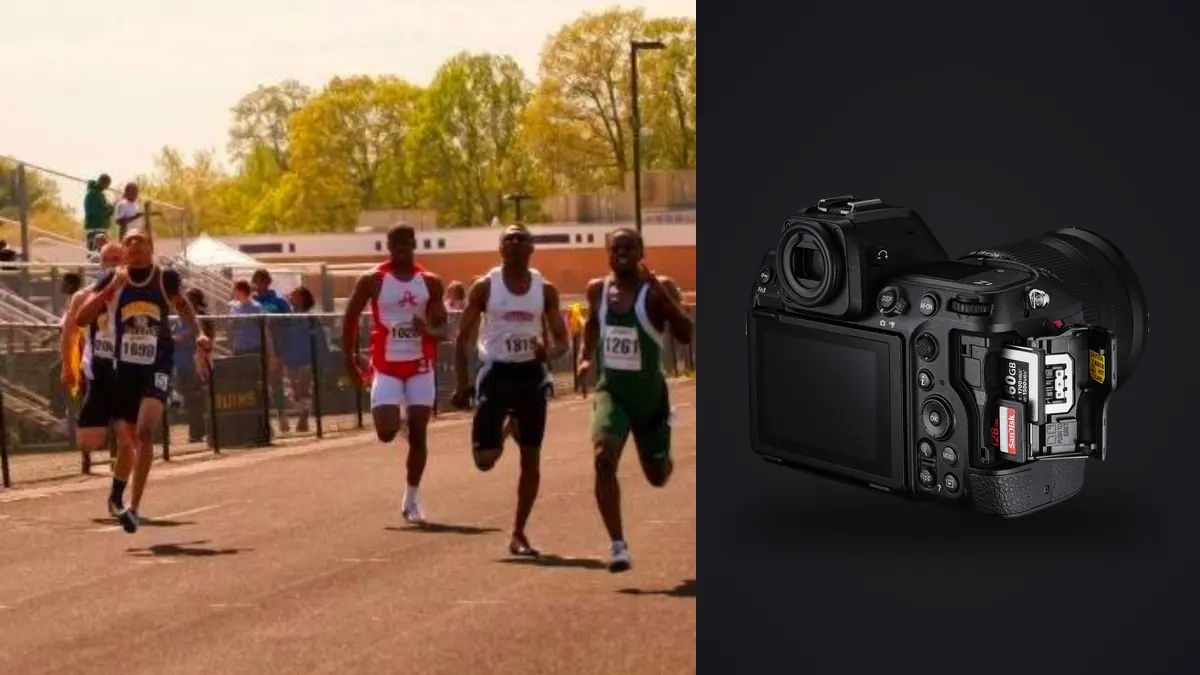
The first time I brought the Z8 to a track meet, I still had my old habits from years of shooting with a DSLR that hunted every time a runner crossed a shadow on the infield. I was bracing for the same fight. It never came. What I got instead was a different problem entirely, which is that the camera captures so cleanly and so fast that I ended a four-hour meet with close to 9,000 frames and a laptop fan that didn't stop whining until midnight. That trade, more keepers for more sorting, is basically the whole story of shooting track with this body.
This isn't a spec sheet regurgitation. I've shot maybe a dozen meets with the Z8 now, from a chilly regional qualifier where I was the only photographer with a long lens, to a conference championship where I was elbow to elbow with three other shooters on the same 10-meter mark. What follows is what actually worked, what didn't, and where I had to change my process because the gear got so much faster than my old workflow could handle.
Why a stacked sensor matters more on a track than almost anywhere else
Track and field is a strange sport to photograph because it's really six or seven different sports happening on the same afternoon. A 100m final is over in under 10 seconds and everything happens in a straight line. A long jump runway gives you a diagonal approach and then a single explosive moment in the pit. Discus and shot put are slow, deliberate, rotational, until they're not. Pole vault is the hardest of all of it, a vertical event where the peak of the action happens 15+ feet in the air and you have maybe a quarter second to nail focus before the vaulter is coming back down.
The Z8's sensor is fully electronic, no mechanical shutter at all, which sounds like a liability until you actually use it under stadium lights. Older electronic shutters on rolling-shutter sensors would skew a sprinter's legs into a slight lean, especially with a fast pan. The stacked sensor reads out fast enough that I genuinely can't see that skew in my sprint sequences, even panning hard on a 200m curve. That's the one spec that quietly makes every other feature on this camera usable for fast lateral motion, and it's the reason I stopped missing the Z9 body I used to borrow for meets like this.
The burst modes I actually reach for
Nikon buries a lot of options in the shooting menu, and most of them are useless for track. Here's what I actually cycle between during a meet, and why.
| Burst mode | File type | Rated speed | What I use it for |
|---|---|---|---|
| Continuous High Extended | 14-bit lossless compressed RAW | 20 fps | My default for anything from the 100m through the 400m hurdles |
| Continuous High | RAW | 10 fps | Long field-event sequences where I'd rather not generate 400 frames of a shot putter adjusting their grip |
| High-Speed Frame Capture + | 11MP JPEG | up to 120 fps | Isolating the exact instant a vaulter clears the bar, nothing else |
| Pre-Release Capture | buffered RAW/JPEG | 20/30 fps | Starting-gun reactions, so I'm not guessing when to press the shutter |
Pre-release capture is the one that changed my start-line photography the most. It buffers a rolling window of frames before you fully press the shutter, so as long as you've half-pressed and you're tracking the blocks, you catch the actual gun and the first explosive step out of it instead of the frame half a second after, which is what always used to happen to me on a manual reaction. I missed exactly one clean start in the last six meets I've shot, and that was because I had the camera in the wrong mode, not because the tech let me down.
I stay away from 120fps for anything other than pole vault peaks and the very top of a high jump arc. Eleven megapixels is fine for web and even a decent print, but it's not what I want for a magazine-quality shot of a sprinter crossing the line, and burning through that many frames for routine action just multiplies your culling problem for no real gain.
Autofocus behavior, event by event
Sprints and hurdles
3D-tracking with the widest AF-area box I can get away with is what I use once the gun goes off. The Z8's people-detection is genuinely good at recognizing a human torso even when a runner is leaning at an angle over a hurdle, which used to be exactly where my old body would jump focus to the hurdle itself. I do turn off eye-detection priority for this specific event, because at 60+ meters out a runner's face is a handful of pixels and I'd rather the camera lock onto the whole body than hunt for an eye it can barely resolve.
Jumps
Long jump and triple jump are actually more forgiving than sprints because the runway gives you a predictable line to pre-focus on. I set a single wide AF point on the board itself, let the runner come to me, and only switch to tracking once they've taken off. Pole vault is the opposite problem: the runway is predictable but the payoff happens above the bar, off to one side, with the pole itself sometimes crossing right through your AF point. I've had the best luck with 3D-tracking started low on the vaulter's hips during the plant, so the camera has something solid to hold onto as they rotate upside down.
Throws
Shot put, discus, javelin, hammer. These are slower events until the release, and I actually drop back to single-point AF-C here rather than wide tracking, because a crowded infield with officials and other athletes standing around gives the tracking algorithm too many things to grab onto. A tight single point on the thrower's shoulder, recomposed as they rotate through the circle, has been far more reliable for me than letting the camera decide what the subject is.
Glass that actually earns its keep trackside
A 70-200mm f/2.8 covers close infield work and most jumps if you're allowed on the runway apron, but it runs out of reach fast for anything on the far straight or a throw circle across the field. My go-to has become a 100-400mm zoom for the flexibility of reframing mid-race without changing position, paired with a shorter prime for when I'm shooting from close to the track barrier and need the wider aperture in low evening light.
For meets under stadium lights, aperture matters more than reach. I'd rather have f/2.8 or f/4 at 300mm than f/6.3 at 500mm, because a lot of high school and club-level tracks are lit poorly enough that ISO 6400 becomes routine after sunset, and every stop of aperture you can claw back saves you noise you'll be fighting in post. If your venue has good sun access for day meets, that calculus flips and reach becomes the priority instead.
The part nobody warns you about: what 9,000 frames does to your evening
This is the real cost of a camera this fast. At 20fps, a single clean sprint sequence from blocks to finish can run 150 to 200 frames on its own, and multiply that across heats, semis, and finals in six or seven events and you're looking at a card full of near-duplicates by the time you pack up the tripod. Most of those frames are 90% identical to the one next to them, a stride cycle repeating five or six times with only tiny differences in leg position and expression.
I run everything through imagic before I open a single file in an editor. It scores sharpness and focus locally on the images themselves, so it's not guessing off the camera's AF confirmation flag, which on a fast burst can lie to you more than you'd think. It also clusters the burst sequences and near-duplicate frames from a single sprint or jump into groups instead of leaving me to click through two hundred nearly-identical images one at a time. For a track meet specifically, that clustering step is what turns a three-hour cull into something closer to forty minutes, because I'm choosing between five real candidates from each sequence instead of scrolling through the whole burst manually.
It also matters that this runs entirely on my laptop with no upload step. Most of the venues I shoot at have unreliable wifi at best, and I am not waiting on a cloud queue to process a card while I'm trying to pack up and get to the next event. If you want more detail on how sharpness scoring actually distinguishes a genuinely sharp frame from one that just looks acceptable at thumbnail size, I wrote a longer breakdown at how AI photo culling works that goes into the mechanics.
Settings I dial in before the first gun
- Shutter speed floor of 1/2000s for sprints and hurdles, dropping to 1/1250s for throws where I want a touch of natural motion in the arm.
- Auto-ISO capped around 6400 for evening meets, because past that the noise reduction I have to apply starts eating into the fine detail on faces that matters for a usable action shot.
- Back-button focus, always, so a half-press for metering doesn't accidentally kick tracking off a runner mid-stride.
- Custom bank C1 set to my sprint configuration (wide 3D-tracking, 20fps extended) and C2 set to my throws configuration (single-point AF-C, 10fps), so I'm one dial-turn away from switching event types instead of digging through menus between heats.
- Auto Capture, added in a firmware update, set up as a backup on a second body angled at the pole vault bar itself, triggered by motion crossing a defined zone. I don't rely on it as my primary shot, but it's caught a couple of clearances I would have missed while my eye was on the vaulter's approach instead of the bar.
Editing after the meet
Once the cull is done, the bigger time sink used to be matching color and exposure across shots taken in three different lighting conditions in one afternoon: harsh midday sun for the morning heats, flat overcast for the field events, then sodium-vapor stadium lights for the evening finals. I built a preset in imagic using apply_my_style, trained on a set of my own previously edited meet photos, so new frames from a similar lighting setup land close to my usual look before I ever touch a slider. It's not magic and it doesn't replace judgment on individual frames, especially the mixed-lighting ones under the stadium lights where warm sodium vapor bleeds into cooler shadow, but it cuts a huge amount of the repetitive baseline adjustment that used to eat my Sunday evenings. If you're building out a faster meet-day workflow generally, this rundown on speeding up a photo workflow covers a lot of the same ground from a different angle.
Frequently Asked Questions
Do I actually need the Z9 instead, or is the Z8 enough for a serious track meet?
For track specifically, I don't think the Z9 buys you much. The sensor, autofocus system, and burst speeds are close enough between the two bodies that the Z8's real disadvantage is battery life and grip comfort over a full-day meet, not image-capturing capability. If you're shooting from a fixed position with a monopod and don't need the integrated vertical grip, the Z8 covers the sport just as well at a lower price and lighter weight to carry between events.
Does the fully electronic shutter cause any distortion on fast-moving sprinters?
I was worried about this going in, coming from a camera with a noticeably slower sensor readout. In practice, panning hard on a 100m sprinter or a 400m runner on the curve, I haven't been able to spot the skewing that plagues slower electronic shutters. It shows up more on very fast rotational subjects like a spinning propeller, which isn't something you'll encounter trackside.
What's the single most useful autofocus setting for pole vault specifically?
Starting 3D-tracking low on the vaulter's hips during the plant phase, rather than trying to lock onto their face or the pole itself. The camera has more consistent contrast to hold onto there, and it carries that lock up through the rotation over the bar far better than it does if you initiate tracking once they're already airborne.
How many frames should I expect from a typical burst sequence, and does that change how I should shoot?
A clean 100m final at 20fps from the blocks to the tape runs somewhere around 180 to 220 frames per athlete if you hold the shutter the whole way, more if you're shooting multiple lanes in frame. I've found it's actually better discipline to shoot in shorter, more deliberate bursts (start, mid-race form, the lean at the line) rather than holding the trigger the entire race, both for card space and for cutting down the cull later.