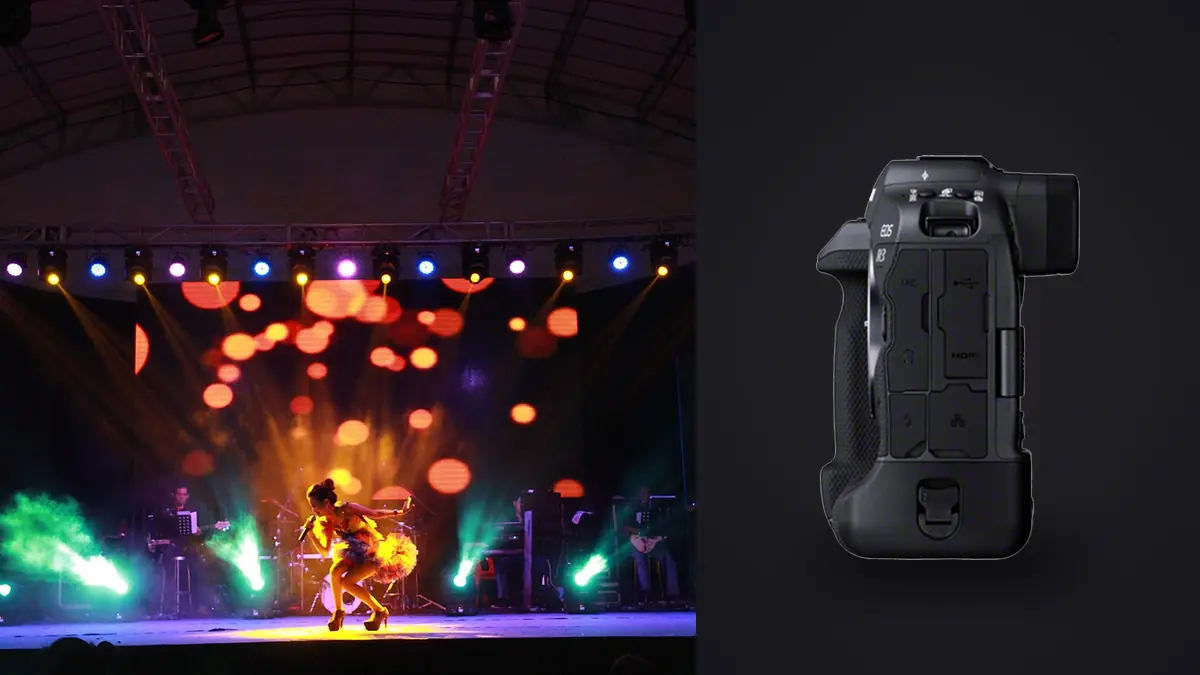
The Canon EOS R3 fits concert photography best when reliability, responsive control, and fast subject tracking matter more than a small bag or maximum cropping resolution. Its integrated vertical grip, full-frame stacked sensor, and professional control layout suit demanding pits and long events. Those same traits make it a large body for cramped clubs, and its resolution leaves less freedom for severe crops than higher-resolution alternatives.
A buying decision should follow the venues, access rules, output, and existing lenses rather than the most dramatic specification. The R3 can be an excellent tool for live music, but it is not a universal upgrade. This assessment separates the assignments where its design pays off from the situations where a smaller, higher-resolution, or less specialized body is a better fit.
Start with the venue rather than the camera
A small club, theater, arena, and outdoor festival impose different constraints. In a small room, the photographer may stand near the stage with little space to lift a large lens. In a theater, the position can be fixed far from the performers. A festival may involve weather, long walking distances, and rapid movement between stages. The R3's strengths are most valuable when the assignment includes difficult motion, extended handling, and little opportunity to correct missed operation.
Access rules also determine value. A three-song pit limit rewards fast controls and dependable subject acquisition. A seated soundboard position rewards resolution and long-lens support. A venue that allows no interchangeable-lens bag inside may favor a smaller two-body setup. Before buying, list typical shooting distance, allowed time, flash policy, bag restrictions, weather exposure, and delivery size.
If most work happens in controlled, well-lit theaters with measured movement, the R3 may offer more speed than the job needs. If it happens under erratic lighting with performers crossing one another, the responsive sensor and autofocus system become more relevant. Fit is about how often those hard conditions occur, not whether the camera can handle an easy show.
Where the R3 body design earns its place
The integrated grip gives the camera the same control orientation in horizontal and vertical framing. That matters when switching quickly between a full-stage landscape frame and a vertical portrait of a singer. The larger body also balances substantial RF telephoto zooms without adding a separate grip, and the battery format supports extended operation.
Dedicated buttons and dials can be assigned to exposure, AF area, subject tracking, or image review so changes can happen without opening a menu. Weather-oriented construction is useful at outdoor stages, though no camera should be treated as waterproof. A rain cover, dry card handling, and sheltered lens changes remain necessary.
The cost of that design is volume and weight. The R3 is conspicuous in an intimate venue, takes more bag space, and can become tiring when held above a crowd. A photographer who primarily uses compact primes in quiet rooms may gain little from the integrated grip. Handle the body with the intended lens before deciding; a specification sheet cannot reveal whether the combination fits a particular hand or carrying method.
Autofocus is strong, but stage clutter still matters
Face and eye detection can follow a performer through many changes in pose, while customizable AF areas help when several people overlap. The camera does not know which musician the assignment prioritizes. Microphone stands, drum hardware, raised hands, smoke, and bright video screens can interrupt or redirect tracking.
A useful setup combines subject detection with a starting area placed on the intended performer. Assign a button that recalls a smaller AF area for a face partly hidden by a microphone, and another method for wider movement across the stage. Back-button focus can separate tracking from exposure, but only if it feels natural under time pressure.
Eye Control AF can be valuable for choosing among several subjects in the viewfinder, yet it depends on calibration and the individual user. Glasses, viewing angle, and venue conditions can affect comfort or consistency. Treat it as an optional selection method, not the sole reason to buy. Test it in conditions close to a real show before making it central to the workflow.
The stacked sensor helps action more than it fixes light
The R3's stacked sensor reads quickly, which reduces the skew associated with electronic shutters when performers or cameras move. It supports a fluid view during fast shooting and makes electronic operation practical for many action moments. It cannot make dim light clean, restore clipped spotlights, or prevent every interaction with a pulsing fixture.
Modern LEDs can vary in brightness and color faster than the eye notices. Anti-flicker or high-frequency flicker tools may help in supported conditions, but they need setup time and cannot guarantee every complex stage rig. Mechanical shutter remains a useful fallback when electronic capture shows bands or inconsistent frames. Test during support acts or soundcheck when access permits.
Silent shooting also has an ethical and operational limit. The lack of shutter sound can lead to unnecessarily long bursts, and performers may still hear lens or body operation in a very quiet set. Use short, timed sequences. A responsive sensor creates choice; it does not remove the need to anticipate expression, jump, gesture, or lighting peak.
Resolution is sufficient until the crop becomes the lens
The R3 records roughly twenty-four megapixels, which is ample for many editorial, web, and standard print deliveries. It offers manageable files and does not demand the same storage as a high-resolution body. The limitation appears when the photographer is fixed far away and expects to turn a loose frame into a tight portrait afterward.
Cropping cannot replace focal length indefinitely. At a distant soundboard position, a high-resolution body or longer lens may preserve more subject detail. At the barrier with a suitable zoom, the R3 resolution is rarely the main constraint. Evaluate the worst common shooting distance and the largest actual delivery, not a hypothetical crop viewed only at extreme screen magnification.
Lower resolution can be an operational benefit when event folders are large, but it should not be framed as automatically better in low light. Noise performance depends on exposure, processing, display size, and sensor behavior. A well-exposed high-resolution file can be reduced effectively, while a badly underexposed file from any camera remains difficult.
Lens ownership can decide the purchase
A body is only one part of the concert system. From a close pit, a standard fast zoom covers full-stage context and single performers. From farther back, a telephoto zoom is often essential. Fast primes help in very dark clubs but reduce framing flexibility when movement is restricted. The R3 balances larger lenses well, though the combined weight should be considered over a full festival day.
Existing EF lenses can be used through Canon's mount adapter, but each lens should be tested for autofocus behavior, balance, and flare under point lights. An adapter preserves an investment; it does not make every older lens equivalent to a current native design. Budget and bag space should include the glass actually needed at typical venues.
If changing systems would require replacing several dependable lenses, the body advantage needs to be substantial and repeated. If the photographer already owns suitable RF or adapted EF glass, the R3 becomes easier to justify. A rental with the exact concert lens is more informative than handling a body with a small showroom prime.
Storage, cards, and post-production are part of fit
The dual-slot design supports CFexpress Type B and SD media. Choose a recording arrangement based on whether the assignment needs duplicate RAW files, separated RAW and JPEG, or overflow. The two card types do not have identical performance, so confirm that both can sustain the selected burst and format. Carry enough verified media that formatting during the show is unnecessary.
Fast capture produces clusters of nearly identical frames. A workable post process compares eye focus, hand position, microphone obstruction, and stage light within each burst, then builds variety across performers and songs. Local culling in imagic can group bursts and assess sharpness, exposure, closed eyes, and composition without uploading the files, while the photographer retains the final editorial choice.
For a broader view of equipment tradeoffs, browse the camera hardware guides. If private, offline review matters for unreleased tours or artist agreements, the desktop application overview explains the supported local workflow. Do not assume any tool replaces the venue's credential or image-use rules.
Limitations to accept before buying
- Large body: the integrated grip is stable with heavy lenses but less discreet and less compact.
- Moderate resolution: normal delivery is well covered, while severe distant crops have less margin.
- Complex setup: extensive customization helps only after controls are practiced and documented.
- LED uncertainty: fast readout reduces some artifacts but does not make every pulsing light source consistent.
- System commitment: suitable lenses, cards, batteries, and carrying support matter to total fit.
- Specialization: photographers who rarely need speed may prefer a smaller or higher-resolution alternative.
A decision framework for the R3
The R3 is a strong fit when concerts are frequent, performer motion is unpredictable, vertical and horizontal handling must be immediate, substantial lenses are normal, and the final output does not depend on extreme cropping. It also makes sense when an existing Canon lens system is already proven and the photographer values physical control over compactness.
It is a weaker fit when most venues are tiny and quiet, the camera must stay discreet, access positions are consistently distant, or the work is mainly static promotional portraiture. In those cases, a smaller Canon body, a higher-resolution body, or investment in a more suitable lens may change the photographs more.
Make the final decision after one realistic rental. Photograph a venue from the normal position, carry the combination for the expected duration, process the RAW files in the existing software, and export at the actual delivery size. The resulting friction or ease is more useful than a generic recommendation.
Also repeat the exercise with the camera already owned. If the existing body misses only because the lens is too short, the shooting position is poor, or the control layout has never been customized, an R3 purchase will not remove the underlying constraint. A direct comparison should identify a recurring failure that the new body actually addresses.
Frequently asked questions
Is the Canon EOS R3 resolution enough for concert photography?
Yes for many editorial, web, and normal print uses when framing is reasonably close. Photographers who work from distant fixed positions and crop heavily should compare it with a higher-resolution body using their actual output size.
Does the stacked sensor eliminate LED banding?
No. Its fast readout reduces several electronic-shutter artifacts, but pulsing stage lights can still produce brightness or color variation. Test shutter modes and anti-flicker options under the venue's rig.
Who should choose a different camera?
A photographer prioritizing a small discreet body, maximum crop latitude, or mostly static work may be better served elsewhere. The R3 makes the clearest case when handling and action reliability are repeated needs.