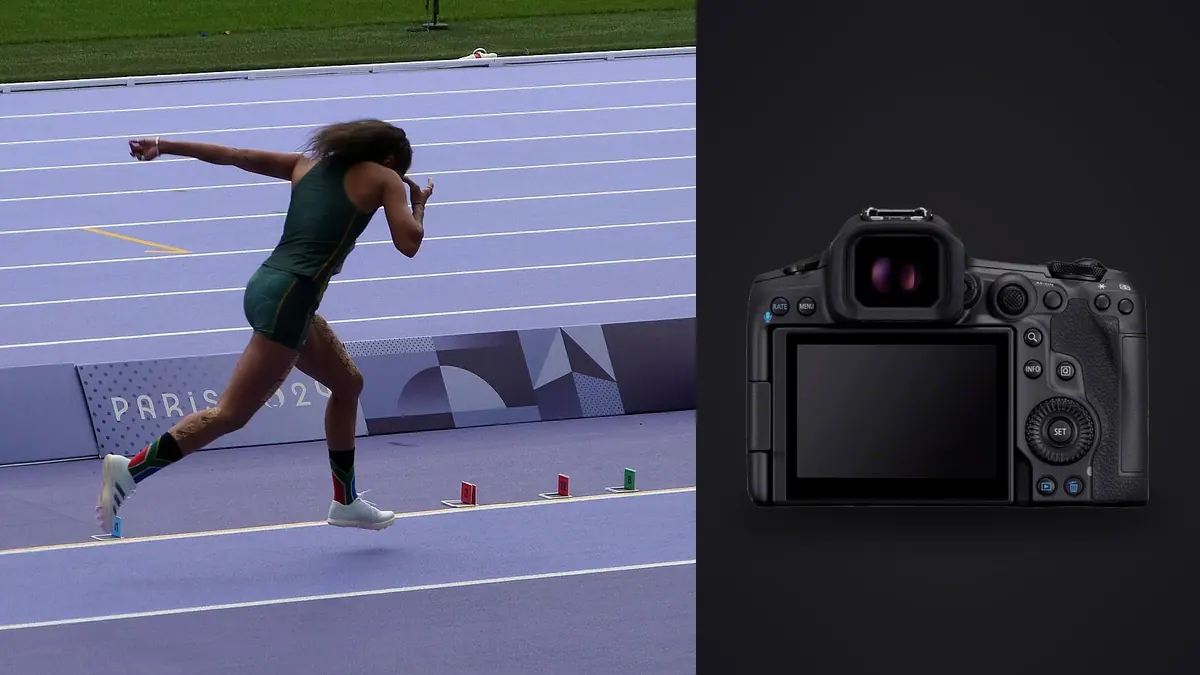
I shot my first meet with the EOS R5 Mark II at a regional qualifier in April, mostly to see whether the buffer complaints I'd read about the original R5 had actually been fixed. Track is a brutal test for a camera. You get maybe ten seconds of usable action per sprint final, the light changes every time a cloud crosses the stadium, and half the interesting moments (a baton exchange, a block start, a photo-finish lean) happen in a window measured in frames, not seconds. By the end of that meet I'd filled two CFexpress cards and come away with a much clearer opinion of where this body earns its keep and where it doesn't.
The stacked sensor is the real story, not the megapixels
Canon's marketing leaned hard on the 45-megapixel figure, but for track shooting the number that actually matters is readout speed. The R5 Mark II uses a stacked, back-illuminated sensor, the first in the R5 line, paired with the Digic Accelerator co-processor working alongside the main Digic X chip. Practically, that means the electronic shutter reads the sensor fast enough that rolling shutter skew on a panned 100m sprinter is dramatically reduced compared to the original R5. I ran the same panning shot, a 400m runner coming off the final bend at roughly 1/125s, on both bodies back to back. The original R5's electronic shutter frame showed visible lean in the lane markings behind the runner. The Mark II's frame was clean enough that I couldn't tell it apart from a mechanical shutter capture at a glance.
That readout speed is also what unlocks 30fps electronic shooting without the sensor becoming a liability. On the original R5, nobody serious about action recommended running electronic shutter at speed because of the distortion risk. On the Mark II, I used electronic 30fps for the 100m heats and mechanical 12fps for slower events like triple jump, where a mistimed mechanical shutter frame here and there doesn't cost you the shot.
What the buffer actually does at a meet
Canon rates the buffer at over 1000 raw frames with a fast CFexpress Type B card at full 30fps. I didn't burn through a buffer-limiting wall once during four separate finals, including a 4x100m relay where I held the shutter down for nearly the entire race waiting for a clean exchange. With a UHS-II SD card in the second slot instead, the buffer depth dropped noticeably, enough that I switched to CFexpress-only for anything with sustained bursts and relegated the SD card to backup recording. If you're buying this body specifically for track or field, don't cheap out on the card; a slow SD card in your primary slot will bottleneck a sensor this fast.
Autofocus in a lane-by-lane environment
Track presents a specific AF problem: you often have six to nine athletes moving in parallel lanes, sometimes wearing near-identical kit, and you need the camera locked onto one specific person, not whichever subject is nearest or largest in frame. The R5 Mark II's subject detection handles this reasonably well once you register the athlete's position early, but it will happily jump to a competitor in an adjacent lane if your framing drifts and two runners cross paths in the viewfinder.
Eye Control AF, carried over and refined from the EOS R3, is the feature I went in skeptical about and came out liking more than expected, with caveats. For finish-line work where I'm tracking one lane and holding the frame relatively still, glancing at where I want focus and having the camera snap there faster than I could drag a joystick point was genuinely useful. It calibrates per shooting position though, and if you shift from a low finish-line angle to a standing infield position mid-meet, expect to recalibrate or accept some drift. Sunglasses and some prescription lens coatings interfere with it too, which matters if you're shooting outdoor day meets in bright sun, which is most of them.
For field events I mostly ignored Eye Control and relied on Servo AF with the "vehicles" detection mode turned off and people/animal priority on. Pole vault and long jump both involve a subject moving toward the camera on a predictable line, and standard zone tracking with a single expanded AF point handled takeoff and the peak of the jump without hunting.
Settings by event: what actually changes
The table below is built from a season of shooting a mix of school and regional meets with the R5 Mark II, not a spec sheet. Shutter speeds assume mid-morning to early-afternoon outdoor light around ISO 400-800.
| Event | Shutter speed | Drive mode | AF approach |
|---|---|---|---|
| 100m / 200m sprint | 1/2000s or faster | Electronic, 30fps | Servo, people priority, single expanded point on the block/lane |
| 400m / 800m | 1/1600s | Electronic, 20fps | Servo, zone AF, registered subject on the back straight |
| Baton relay exchange | 1/2500s | Electronic, 30fps | Servo, wide zone to catch whichever runner enters the exchange zone first |
| Long jump / triple jump takeoff | 1/2000s | Mechanical, 12fps | Servo, single point held on the board |
| Pole vault | 1/1600s | Electronic, 20fps | Servo, single expanded point tracking the pole tip |
| Discus / shot put / hammer | 1/1000s | Mechanical, 12fps | Servo, wide zone, back button focus recompose |
| Panned motion shot (any sprint) | 1/60s to 1/125s | Mechanical, single shot burst | One-shot on the athlete, manual pan |
The panning row is deliberately on mechanical shutter, not electronic. Even with the improved readout speed, a slow shutter pan holds the sensor open long enough that I'd rather not introduce any rolling shutter risk at all when the whole point of the shot is a clean, sharp subject against blurred lanes.
Lens pairings for different vantage points
Where you're allowed to stand changes everything about lens choice, and track meets are stricter about this than most sports. Credentialed infield access gets you close enough to use shorter glass; general admission or a fenced-off press area pushes you toward longer lenses whether you like it or not.
From an infield position at the curve or near the exchange zones, I used the RF 100-500mm F4.5-7.1 for most of the meet. It's not a fast lens wide open at the long end, but at f/7.1 and 1/2000s or faster in daylight I never found myself ISO-limited, and the reach to compress a field event from thirty or forty meters away is hard to replace without carrying something much heavier. For the finish line, where I could get close and low, a 70-200mm f/2.8 did more work, letting me open up in flatter light late in the day and keep shutter speeds high without pushing ISO into territory I'd need to worry about.
If you're shooting from the stands with no infield credential, which is the reality for a lot of school-level meets, a 400mm or longer prime becomes close to mandatory for anything beyond wide establishing shots. I borrowed a 400mm f/2.8 for one meet specifically to test it with the R5 Mark II's AF system and the combination tracked a 200m runner through a full lane change without a single dropped focus point, which the 100-500mm at its long end occasionally did in flatter light.
Weather sealing and battery across a full day
Track meets run long, often six to eight hours from the first heat to the final relay, frequently outdoors with no guaranteed shelter. The body's weather sealing held up through a genuinely miserable drizzly meet in May without issue, though I kept a rain cover on regardless because sealing on a body doesn't help much if the lens mount or card door gets left open between events. The new LP-E6P battery got me through a full day of mixed 12fps and 30fps shooting with one spare in reserve, which is a real improvement over how anxious I used to get about battery level during the original R5's longer video-heavy days. If you're shooting stills only, one spare battery is probably enough for most single-day meets; I'd still carry two for anything with finals running into the evening under stadium lights, since AF hunts a little more in mixed artificial lighting and burns through charge faster.
The part nobody puts in the spec sheet: sorting the take
Here's the number that actually changes your evening after a meet. A single 4x100m relay held at 30fps for eight seconds is around 240 frames. Multiply that across heats, semis, and finals for sprints, relays, and field events across a full meet day and you're routinely looking at four to six thousand frames, sometimes more. Almost none of it is usable. Most of a sprint burst is the runner mid-stride with nothing distinctive happening, and bursts of near-identical frames a hundredth of a second apart are exactly the kind of thing that eats an evening if you're clicking through them one by one in a standard browser.
This is the point where I stopped trying to cull manually and started running the day's cards through imagic before touching Lightroom at all. It's a local desktop tool, everything processes on the machine with no upload step, which matters when you're offloading a full day of sport at a hotel with mediocre wifi and want to start sorting immediately rather than waiting on a cloud queue. It scores sharpness and focus accuracy per frame and groups near-duplicate bursts together, so instead of scrolling through 240 nearly identical relay frames I get the three or four that are actually sharp on the runner's face and hands, with the rest folded into the group rather than cluttering the grid. For a deeper look at how that scoring actually works under the hood, there's a rundown at /blog/how-ai-photo-culling-works.
The other piece I've leaned on more than expected is the "apply_my_style" preset, which trains on your own past edits rather than a generic filter pack. Track photos have a specific problem: stadium lighting swings between harsh midday sun, overcast, and sodium-vapor floodlights for evening finals, sometimes within the same meet. Having a starting grade that's already learned how I tend to handle skin tones and grass color under those conditions saves real time compared to building a look from scratch on every batch. It's not a substitute for finishing an edit by eye, but it gets the baseline much closer before I open anything manually. If your workflow is generally slow between the card and a finished gallery, the broader tips at /blog/10-tips-faster-photo-workflow cover more of that ground than I have space for here.
Where it still falls short
None of this makes the R5 Mark II a perfect track camera. It's still a 45-megapixel body, which means file sizes at 30fps add up fast, and a relay final alone can produce several gigabytes of raw data before you've shot a second event. If you're not disciplined about culling before you start stacking up storage, a season of meets will bury an external drive quickly. The electronic shutter, while much improved, still isn't completely immune to banding under certain LED stadium lighting at faster shutter speeds, something I ran into during one indoor meet under older fluorescent-style fixtures where a handful of frames showed faint horizontal banding that mechanical shutter avoided entirely. And Eye Control AF, for all the praise above, is genuinely inconsistent enough between shooting positions that I wouldn't rely on it as a sole focus method for anything you can't reshoot.
None of these are dealbreakers for the sport. They're the kind of thing you learn to work around after a few meets, and once you know where the edges are, the body handles the actual demands of track, fast subjects in tight time windows, better than anything else I've used at this price point.
Frequently Asked Questions
Is 30fps electronic shutter safe to use for sprint finals on the R5 Mark II?
Yes, for straight-line running it's the setting I default to. The stacked sensor's fast readout keeps rolling shutter distortion low enough that I haven't had a frame ruined by skew during a straight sprint. Where I'd hold back is on hard panning shots at slow shutter speeds, where I still switch to mechanical shutter to remove any risk entirely.
Does Eye Control AF actually help for tracking a single lane at the finish line?
It helped more than I expected once calibrated for that specific shooting position and angle. The catch is that calibration doesn't transfer cleanly if you move positions mid-meet, and sunglasses or certain lens coatings will degrade it. Treat it as a fast way to shift focus within a locked-down finish-line setup, not a universal tracking solution across the whole meet.
What lens should I bring if I only get general admission, not infield access?
Something in the 400mm-plus range, ideally with at least f/4 for evening finals under stadium lights. The RF 100-500mm covers a lot of ground and is what I use most often, but at its long end in flat light it occasionally lags a longer prime for continuous AF tracking, so if you're shooting from the stands and budget allows, a 400mm f/2.8 or 300mm f/2.8 with extender is the more capable option.
How do you avoid spending the whole evening sorting thousands of burst frames?
Cull before you edit, not during. Running the day's cards through imagic locally to score sharpness and group burst duplicates before opening Lightroom cuts the pile down to a manageable shortlist within minutes rather than hours, and because it runs offline there's no upload wait between the meet and starting to work.