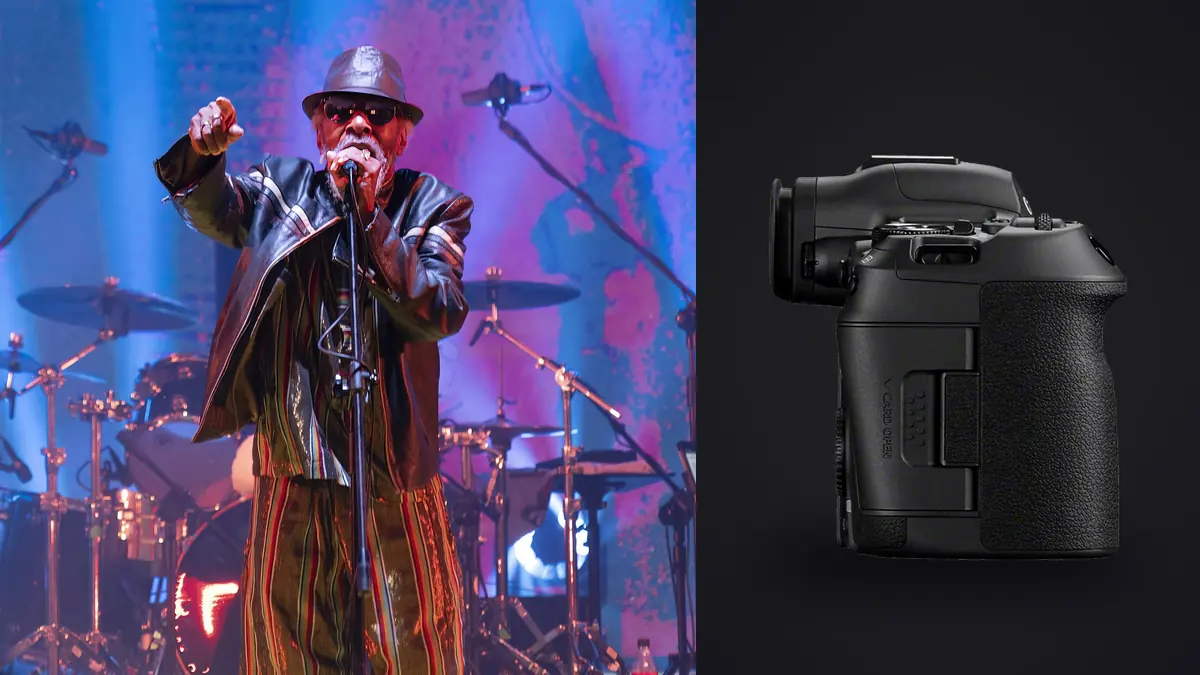
I picked up the R5 Mark II halfway through last year's festival run, mostly because a rental house had one sitting unclaimed and I was tired of babysitting rolling shutter on my old R5 under LED wall backdrops. Concert photography is a strange test for a camera. You get maybe three songs, no flash, lighting that swings from pitch black to blinding strobe in the space of a chorus, and a singer who will not stand still long enough for you to recompose. Most cameras are designed around a general idea of "fast" or "good in low light." Very few are stress-tested against a mosh pit. This is what changed for me, and what didn't, once I started bringing the Mark II into actual venues instead of reading about it on a spec sheet.
What Actually Changed From the Original R5
The headline spec is the new stacked sensor, and for concert work it matters more than the megapixel count ever will. The original R5 had a fast sensor for its time but it still rolled under certain LED video walls, which meant diagonal banding or a slight skew on anything moving fast under panel lighting. That's the kind of thing you don't notice on the back screen at the venue and then discover at 100% crop three days later, right as you're trying to deliver a gallery. The Mark II's readout is quick enough that I stopped thinking about it as a variable. I still test a venue's lighting rig with a few frames before the set starts, out of habit more than necessity now.
The other real change is how the camera handles a performer who won't hold still. Eye Control AF, borrowed and reworked from the R3, lets you glance at where you want focus to land and the camera shifts its point there without you touching a joystick. It sounds like a gimmick until you're three feet from a stage monitor trying to swap focus from the guitarist to the singer mid-strum, and moving your eye is genuinely faster than moving your thumb. It needs a calibration pass per shooter (and reportedly behaves worse for some people who wear glasses, myself included on nights when I'm too lazy to swap to contacts), but when it's dialed in it changes how I frame a shot. I stopped pre-planning compositions as much and started reacting.
Autofocus When the Singer Won't Stand Still
Canon's subject detection in this body was tuned with sports and action in mind, and a band under moving lights borrows a lot from that same problem: unpredictable direction changes, partial occlusion from mic stands and other musicians, backlighting that would confuse older contrast-based systems. I run people detection with eye priority as a default and only switch to a wider tracking zone when a whole band is jumping together, like during a final chorus, where I want the camera picking whichever face is cleanest rather than locking onto one person who might turn away.
Low light autofocus acquisition is the part that actually saved shots for me. Small venues run house lighting so dim between songs that older bodies would hunt visibly, and hunting means missing the first note of the next song while the AF motor searches. The Mark II locks noticeably faster in that in-between darkness, which matters because that's exactly when a band will kick off their most energetic song of the set without warning.
Reading the Stage Lighting Before You Press Anything
Concert lighting is adversarial by design. A lighting designer wants drama, not an evenly exposed frame, so you're dealing with spotlights blowing out against a black background, colored gels shifting white balance every few seconds, and strobes that can wreck a shutter speed choice if you're not paying attention. I shoot RAW exclusively for this reason and set a flat, neutral picture profile just so the EVF preview doesn't lie to me about color.
The sensor's dynamic range gives me more room to pull back a blown spotlight highlight than the original R5 did, which matters because you often can't re-expose for it. You get one pass at a strobe-lit chorus. I meter for the performer's skin tone and let backgrounds do whatever they're going to do, then rely on RAW headroom afterward rather than chasing a perfect in-camera exposure that doesn't exist under a moving light rig.
Settings I actually dial in by venue size
| Venue type | Typical ISO range | Shutter speed | Drive mode | AF area |
|---|---|---|---|---|
| Small bar / club stage | 3200 to 12800 | 1/200 to 1/320 | Mechanical, 8-10 fps | Spot AF, eye priority |
| Mid-size venue, mixed rig | 1600 to 6400 | 1/320 to 1/500 | Electronic, 20 fps | Zone AF, people detect |
| Arena with moving lights / pyro | 800 to 4000 | 1/500 to 1/1000 | Electronic, 30 fps burst for peak moments only | Whole-area tracking |
That's not gospel, obviously, every rig and every song tempo shifts these numbers, but it's roughly where I start before adjusting on the fly. The main thing I'd tell someone new to pit work is to stop chasing a "correct" exposure and start protecting the highlight on the performer's face, because that's the only part of the frame anyone will actually look at later.
Frame Rate and Buffer: Not Missing the Jump
Thirty frames per second sounds excessive until you're trying to catch the exact peak of a jump shot where the guitarist's hair, the mic cable, and the light hit all line up for maybe two frames out of a burst. I don't shoot at 30fps constantly, that would fill a CFexpress card in a single song and turn culling into a nightmare, but I'll drop into it for two or three seconds around a moment I can see building, like a drummer winding up for a big fill. Mechanical shutter still has its place. Under certain LED walls, especially older cheaper rigs some smaller venues still run, electronic shutter can introduce banding that mechanical avoids entirely. I test this in the first song and pick a lane for the rest of the set rather than switching mid-song and second-guessing myself.
Buffer depth is where the CFexpress card actually earns its cost over a UHS-II SD card. Shooting RAW at the higher burst rates, I can hold a sustained burst for a noticeably longer stretch on CFexpress before the buffer chokes and the fps drops off. For a three-song set that's the difference between capturing the entire encore jump and getting the first half of it before the camera stutters.
Lenses I Actually Bring to a Show
The RF 70-200mm f/2.8 lives on the body for most of a set, it covers tight face shots from the barrier without forcing me to physically climb onstage, which most pits won't allow anyway. I keep an RF 24-70mm f/2.8 in the bag for wider stage shots and crowd context, and if I know a band leans into moody, backlit staging I'll bring a fast prime, an RF 50mm f/1.2 or 85mm f/1.2, purely for how it renders haze and stage smoke as soft falloff rather than a hard, distracting background. None of that is specific to this camera body, but the R5 Mark II's in-body stabilization means I can hand-hold the heavier 70-200 through a full set without the fatigue I remember from earlier bodies, which matters when you're doing this for four bands back to back at a festival.
How It Stacks Up for This Specific Job
None of these numbers are the manufacturer's marketing figures, they're what I'd actually flag for someone deciding between bodies for pit work specifically.
| Camera | Rolling shutter risk under LED walls | Max silent (electronic) burst | Low-light AF acquisition | RAW buffer at max burst |
|---|---|---|---|---|
| Canon EOS R5 Mark II | Low, stacked sensor | 30 fps | Fast, rarely hunts below stage-dim light | Deep on CFexpress, holds through most bursts |
| Canon EOS R5 (original) | Noticeable on fast panel content | 20 fps | Good but visibly slower in near-dark | Fills faster, especially on SD UHS-II |
| Nikon Z8 | Low, stacked sensor | 20 fps (RAW), higher in JPEG modes | Strong, comparable low-light claims | Deep, similar class to the R5 II |
| Sony A9 III | Essentially none, global shutter | 120 fps | Excellent | Very deep, built for sustained action |
If pure burst speed and zero rolling shutter risk were the only criteria, the A9 III wins outright, its global shutter design makes strobe-heavy shows almost trivial. But it trades resolution for that speed, and most clients want large, croppable files for posters and merch, not just web-sized action shots. The R5 Mark II is the better all-around trade for someone who needs both.
Getting Through a Few Thousand Frames the Same Night
Here's the part nobody warns you about before you start shooting bands: a busy festival day at 20-30fps in bursts leaves you with four or five thousand frames by the time the headliner walks off. Editors want a turnaround measured in hours, not days, and most venues have unreliable or nonexistent wifi backstage, so cloud-based culling tools are a dead end before you even open your laptop. I run everything through imagic once I'm back at the hotel or in the car. It scores sharpness and focus locally on the machine, which matters a lot after a burst-heavy set because half of any 30fps sequence is going to be soft transitional frames between the ones that actually landed. The duplicate and burst clustering groups those near-identical frames together automatically instead of making me scroll through forty nearly-identical jump shots one at a time looking for the sharpest. Because it processes everything offline, I can start culling the moment I'm off the truck, no upload wait, no venue wifi required.
The other piece that's saved real time is the apply_my_style preset feature. I trained it on a folder of my own previously graded concert edits, the moody, slightly desaturated look I use for most club shows, and now a fresh set gets a first pass in that style automatically instead of manually grading a few hundred keepers from scratch after every show. It's not magic, I still tweak individual frames, but starting from a preset built on my own actual edits gets me to a shareable gallery a lot faster than starting from a flat RAW. If you're new to this kind of AI-assisted sorting, our breakdown of how AI photo culling works covers the mechanics in more depth, and our tips for a faster photo workflow has more on structuring a night like this end to end.
Frequently Asked Questions
Is the R5 Mark II actually worth upgrading from the original R5 for band photography?
If you're shooting venues with LED video wall backdrops regularly, yes, the rolling shutter improvement alone is worth it because it removes a failure mode you can't fix after the fact. If you mostly shoot smaller rooms with traditional stage lighting and rarely push past 12fps, the gap matters less and your money is better spent on a second fast lens.
Do I need the RF 70-200mm f/2.8, or can I get by with a slower zoom?
In a small club you can get away with an f/4 zoom because you're often close enough to the stage that light falloff isn't brutal. In anything mid-size or larger, where you're shooting from a barrier fifteen or twenty feet back, the extra stop matters both for shutter speed and for how cleanly the camera's autofocus can lock in dim rooms. It's the one lens I wouldn't skip.
Does Eye Control AF actually work reliably while wearing glasses or in-ear monitors?
In my experience it's inconsistent with glasses on, the calibration seems to drift more than it does with contacts, and I've had to recalibrate mid-shoot more than once. In-ear monitors haven't caused any issue since they don't interfere with the eye tracking sensor near the viewfinder. If you wear glasses regularly, budget extra calibration time before a show rather than assuming it'll just work.
How many usable RAW frames should I expect from a typical three-song pit set?
Shooting a mix of mechanical for steadier moments and short electronic bursts for peak action, I usually come away with somewhere between 400 and 900 frames for a standard three-song set, depending on how much the band moves. Culling that down to a delivered gallery of 30 to 60 images is where most of the actual post-show time goes, which is exactly why fast local sorting matters more than raw shooting speed once you're back at your laptop.