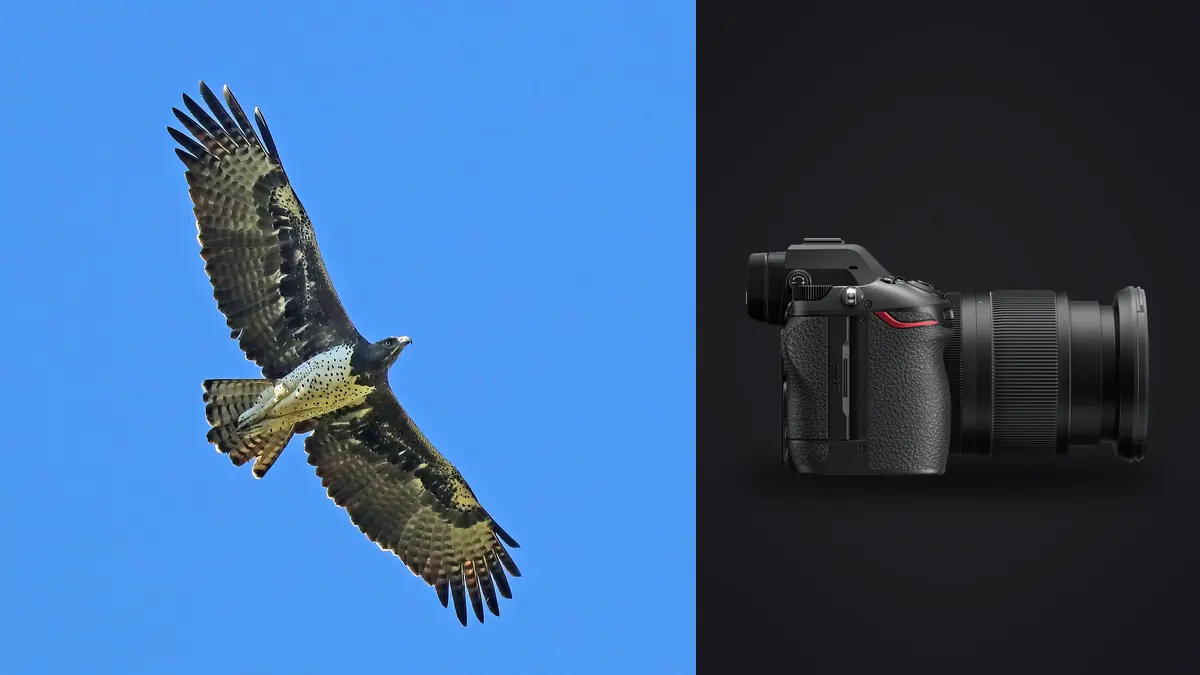
I spent most of last winter on a stretch of estuary mudflat waiting for godwits and curlews to lift off in loose panic when a marsh harrier drifted over, and that's about as hard a test as birds-in-flight photography gets: erratic group launches, low light, birds crossing at odd angles against a bright water background. The Z6 III was the camera that finally made those mornings feel less like gambling. Not because it's flawless, but because the parts that actually matter for flight work (the AF system, the buffer, the way it handles subject detection when a bird banks hard) are genuinely different from the Z6 II I retired.
The AF system, and why EXPEED 7 matters more than the spec sheet suggests
Nikon carried the EXPEED 7 processor down from the Z9 and Z8 into the Z6 III, and that's the single biggest reason this camera holds a bird through erratic flight paths better than its predecessor. The 3D tracking box doesn't just sit on a blob and hope; it re-evaluates the subject at a rate that lets it stay glued through a wingbeat that briefly obscures the head, or through a bird crossing in front of a cluttered reed bed. Bird detection, one of the animal-detection modes, will pick out an eye at a distance that surprised me the first few times I used it, particularly against open sky where there's nothing else in the frame to distract it.
Where it gets harder, and where I still see missed frames, is dense cover. A bird flying between branches or reeds will occasionally cause the tracking box to jump to a twig with similar contrast, and it takes a fraction of a second longer to recover than it does on the flagship bodies. That's a real limitation, not a knock against the camera in general terms. It's simply the kind of gap you'd expect from a camera at this price point sitting one rung below the sports-and-wildlife flagships.
Frame rate math you actually need to understand
The Z6 III gives you more shooting modes than you'll ever use in one session, and picking the wrong one for the situation is an easy way to waste card space or, worse, miss the shot because the buffer clogged mid-sequence. Mechanical shutter tops out at 14fps with full AE/AF, which is honestly plenty for most flight sequences of anything larger than a swift or a swallow. Push to the electronic shutter and you get full-resolution 20fps raw, still with full AF tracking, though you're now trusting the sensor's readout speed against rolling shutter on fast lateral passes.
Then there's the pair that catches people off guard: C30 and C60. These use a DX-area crop and, more importantly, C60 is JPEG-only. That crop isn't a huge cost with most super-telephotos since you're usually cropping into distant subjects anyway, but it's worth knowing before you dial up C60 for a raptor stoop and realize afterward you've got compressed JPEGs to work with instead of raw files. Pre-release capture, which buffers frames before you fully press the shutter, is the feature I'd actually call underrated. On a launch sequence where the bird commits half a second before you react, it's saved me shots that would otherwise have been the back half of the wingbeat instead of the moment the feet left the perch.
| Mode | Max fps | File type | Crop | Best use case |
|---|---|---|---|---|
| Mechanical (S/CH) | 14fps | Raw + JPEG | None | General flight, larger birds, herons and raptors |
| Electronic H+ | 20fps | Raw + JPEG | None | Fast small birds, terns, swallows, tight action |
| C30 (pre-capture eligible) | 30fps | Raw + JPEG | DX crop | Launch and landing sequences where reach matters more than full-frame width |
| C60 | 60fps | JPEG only | DX crop | Wingbeat-critical peak-action moments where you'll accept JPEG for the frame rate |
With a fast CFexpress card the buffer on raw+JPEG at 14fps runs deep enough that I rarely hit the wall on a single flight pass. Drop to a UHS-II SD card in the second slot and shooting from that slot instead will choke the buffer noticeably faster, something I learned the hard way on a day I'd forgotten to swap cards after a studio session.
Glass that actually pairs well with this body
The Z6 III's 24.5 megapixel sensor is a deliberate trade against the higher-resolution bodies, and for flight work I think it's the right trade. Fewer megapixels means faster readout, smaller file sizes at high frame rates, and less punishing crop penalties when you're not perfectly framed (which, chasing a tern into the wind, you rarely are). It does mean you have less room to crop after the fact compared to a 45-megapixel body, so getting close in-camera matters more.
The Z 100-400mm f/4.5-5.6 has been my most-used lens on this body for general flight work; it's light enough to track a fast crossing bird handheld for an entire sequence without your shoulder giving out by frame twenty. For serious reach, the Z 180-600mm gives you more working distance on skittish shorebirds without the weight or price of the primes, though autofocus speed drops a touch at the long end in low light. If budget allows the Z 400mm f/4.5 or the 800mm f/6.3 PF, both focus faster and hold contrast better in flat overcast conditions, which in the UK is most mornings. I've used a 1.4x teleconverter on the 400mm for distant raptors and the AF hit rate stays usable; stack a 2x on and you'll start losing tracking speed on anything moving quickly.
Settings I actually run, by scenario
I stopped trying to find one universal AF setting years ago because flight conditions change too much within a single outing. What I run now depends heavily on background:
- Bird against open sky: Wide-area AF (Animal), Bird detection on, focus tracking with lock-on set toward the responsive end so the box picks up a new bird fast if the first one is lost.
- Bird over water: Same detection settings, but I bump AF-C priority slightly toward release over focus, because water glare occasionally causes a half-second focus wobble I'd rather shoot through than wait out.
- Bird in canopy or reeds: I drop to 3D tracking without subject detection here. Detection modes get confused by branch clutter more than plain 3D tracking does, in my experience, even though that sounds backward.
- Close, fast flybys (raptors, gulls near a boat): Single-point or small dynamic-area AF, manually placed, because a wide detection box at close range will sometimes lock onto a wingtip instead of the eye.
What a good morning does to your card, and your evening
Here's the part nobody mentions when they're selling you on 20fps: a single decent flight sequence at high frame rate can produce sixty or eighty near-identical frames, and multiply that by a dozen good passes in a morning and you're looking at a genuinely unpleasant culling session by the time you get home. This is the actual cost of the Z6 III's speed, not the megapixels or the price tag. It's your evening.
I run the day's card through imagic before I do anything else now. Its burst clustering groups that sixty-frame godwit sequence into one stack instead of leaving me to page through every near-duplicate individually, and the local sharpness scoring will flag the two or three frames in that stack where the eye is actually locked, rather than the ones where the AF system was still catching up mid-wingbeat. It runs entirely on the laptop, no upload step, which matters more than I expected the first time I was culling from a car in a spot with no signal at all. For a deeper look at how that kind of automated sorting actually works under the hood, this piece on how AI photo culling works covers the mechanics better than I can in a paragraph here.
Once the culling pass is done, I lean on the apply_my_style preset trained on my own past edits to get a fast first pass on exposure and white balance across the keepers, which on a morning with fifteen keeper sequences is the difference between an hour of editing and half a day. If your bottleneck right now is less about the camera and more about how long the sorting and editing takes afterward, this rundown on speeding up the photo workflow is worth a look too.
Where the Z6 III still shows its limits
I want to be honest about where this camera falls short of the flagships, because a lot of marketing copy glosses over it. Buffer clearing, while good, isn't Z9-good; on a long 20fps burst you'll occasionally see the frame counter stall for a beat while it catches up writing to card. Viewfinder blackout at the highest frame rates is minimal but not zero, which matters when you're tracking a bird making a sudden direction change. And subject detection, while strong, still occasionally locks onto the wrong bird in a mixed flock, something the higher-end bodies handle a touch more reliably. None of these are dealbreakers for the price. They're just the honest tradeoffs of a camera that costs meaningfully less than the sports flagships while inheriting most of their autofocus intelligence.
Frequently Asked Questions
Do I need 20fps electronic shutter for birds in flight, or is 14fps mechanical enough?
For most subjects, 14fps mechanical is plenty and gives you full-resolution files without any rolling shutter risk. I reach for 20fps electronic specifically for small, fast fliers like terns and swallows where wingbeat frequency is high enough that the extra frames genuinely change which moment you land on.
Is the autofocus actually good enough for small, erratic birds like swifts or swallows?
Better than I expected, but not perfect. In open sky it tracks small fast birds well. Against cluttered backgrounds, or when a bird makes a sudden vertical dive, you'll lose the box more often than you would on a flagship body. Practice with lock-on sensitivity settings helps more than any single magic setting does.
Does the DX crop in C30 and C60 hurt image quality for cropping in post?
The crop itself doesn't degrade quality, since you're still reading real pixels off the sensor rather than a digital zoom. The tradeoff is simply that you've already used up some of your framing headroom in-camera, so if the bird is closer than expected you have less room to recompose afterward. C60's JPEG-only limitation is the bigger practical cost for most serious work.
What's a reasonable starting lens if the 800mm PF isn't in budget yet?
The Z 100-400mm f/4.5-5.6 is the lens I'd point most people toward first. It's light enough to hand-hold through a full flight sequence, focuses quickly enough to keep up with the body's AF system, and a 1.4x teleconverter extends its reach for distant subjects without a major autofocus penalty. The 180-600mm is the next step up if reach becomes the limiting factor.